

A flash report is a short, high-frequency management snapshot, usually produced weekly and sometimes daily, that tracks cash, revenue, and key operating drivers before the formal month-end close. In a modern FP&A process, it may also be a preliminary estimate prepared within one to three working days after month-end, often with about 80% to 95% accuracy.
It's the 15th of the month. A piece of equipment is available now, or a strong candidate is ready to sign, but your accounting team won't finish the formal financial statements for another two weeks. Your bank balance looks healthy, yet receivables are aging, payroll is approaching, and a major customer payment may slip.
That's the situation a flash report is built to solve. It gives you a directional view while you still have time to act. It isn't a replacement for reconciled financial statements. It's a management control that helps you decide whether to hire, buy, delay, collect, renegotiate, or conserve cash.
Table of Contents
- The Mid-Month Decision Dilemma for Founders
- Core Components and Cadence of a Flash Report
- Why Owner-Led Businesses Need Early Warning Systems
- Essential Metrics for Your Weekly Financial Snapshot
- Elevating Visibility with AmbitionCFO
- Take Control of Your Cash Flow Today
The Mid-Month Decision Dilemma for Founders
The founder of a growing contractor doesn't make decisions at month-end. The equipment supplier wants an answer today. The project manager needs approval to add labor this week. A prospective customer wants a contract signed before the next billing milestone.
Yet the accounting process is still looking backward.
The latest formal income statement may describe a period that ended weeks ago. The bank balance may show cash that belongs to a subcontractor, a tax payment, or a vendor already waiting for release. A strong sales pipeline may look reassuring while collections are slowing and gross margin on current jobs is deteriorating.
That's how capable owners end up making capital decisions with incomplete visibility. They're not careless. They're operating with information that arrives too late.
The cost of waiting for perfect information
A formal month-end close has an important role. It supports reliable accounting, reporting, tax work, lender conversations, and long-term analysis. But it isn't designed to answer every urgent operating question in the middle of the month.
A flash report serves a different purpose. It's a concise early warning system that gives management a usable view of cash, sales, expenses, receivables, collections, and the operating activity that drives the next financial result. Farseer's explanation of the weekly flash report describes this shift from backward-looking accounting toward near-real-time decision support.
Practical rule: Don't confuse unfinished data with unusable data. Label the estimate, state the confidence level, and use it to decide what deserves attention now.
Suppose the equipment purchase would increase capacity but also create a near-term cash strain. You don't need a perfect annual forecast to ask the right questions. You need to know what cash is available, what collections are expected, which payments are committed, whether the related work is sold, and how the purchase changes the next operating cycle.
A flash report puts those questions in front of you before the opportunity disappears.
What changes for the owner
Without a flash report, a founder often checks the bank account, asks a salesperson for an update, and relies on instinct. With one, the leadership conversation becomes more disciplined:
- Cash position: What can the business safely commit?
- Collections: Which customers must be contacted now?
- Performance: Is current revenue converting into acceptable margin?
- Capacity: Can the team deliver the work already sold?
- Decision trigger: What fact would make us proceed, pause, or renegotiate?
That isn't academic accounting. It's operating control.
If your current cash view only shows what happened after the books are closed, strengthen it with a cash flow forecasting framework that connects expected receipts and payments to actual decisions. The flash report should become the short-cycle view that keeps that forecast grounded in what is happening this week.
Core Components and Cadence of a Flash Report
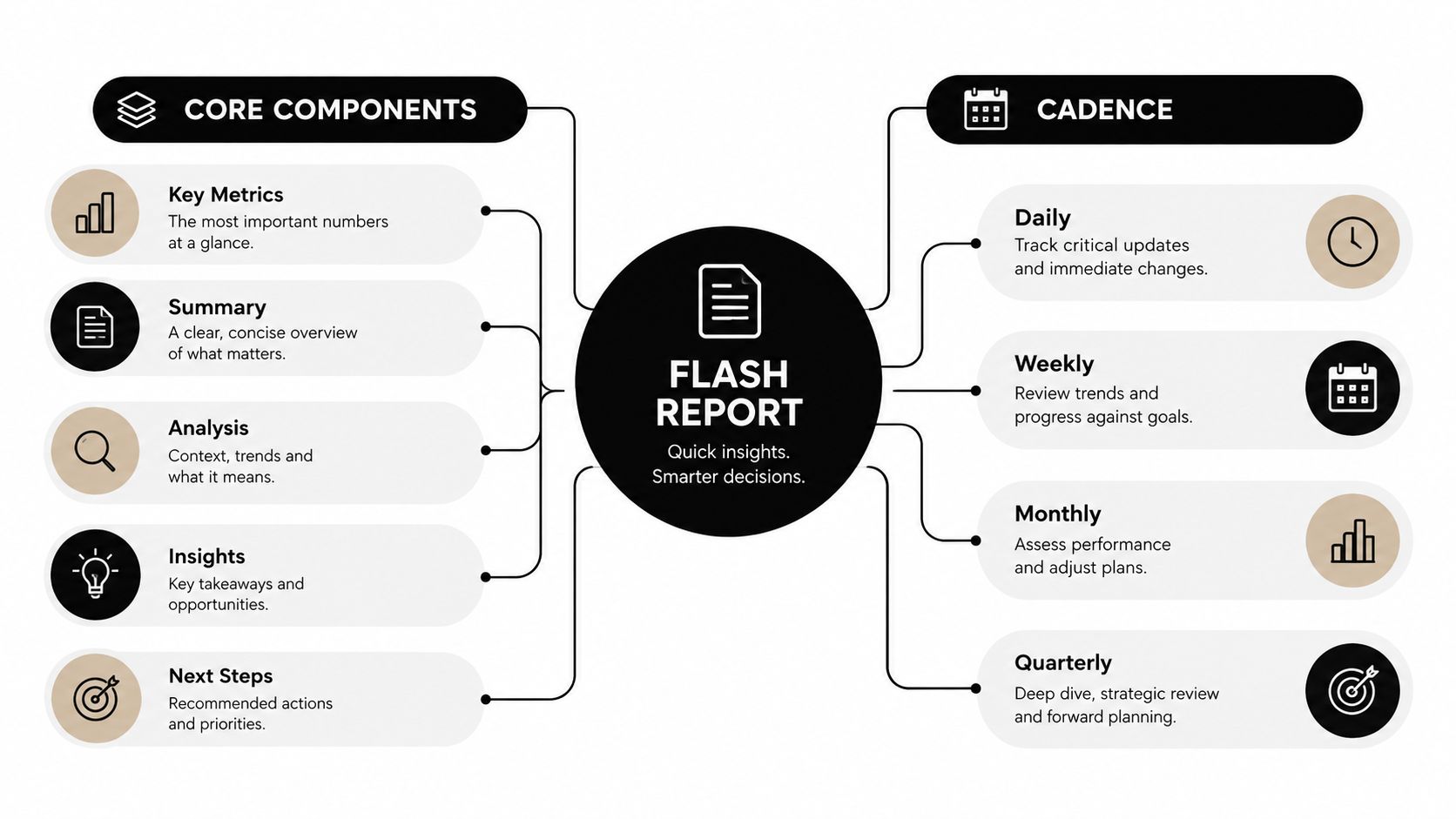
A flash report should be short enough for an owner to read before a leadership meeting and focused enough to trigger a decision. It isn't a smaller version of a lengthy management pack. It's a deliberately edited view of the few metrics that can change the next action.
Most flash reports fit on one or two pages, according to Orbit Analytics' overview of flash reports. The format can vary, but the discipline doesn't. If every department adds its favorite metric, the report becomes a dashboard catalogue instead of a control tool.
What belongs on the page
A practical report usually combines three layers:
- Financial condition: Cash, receivables, collections, payables, payroll, revenue, and major cost movements.
- Commercial activity: Bookings, backlog, open proposals, renewals, signed contracts, or customer commitments.
- Operating drivers: Shipments, billable hours, utilization, headcount, project progress, inventory movement, or equipment use.
The right metrics depend on the business model. A distributor may need inventory and shipment visibility. A professional services firm may need utilization and unbilled work. A contractor may need job progress, committed costs, and billing milestones.
The cadence should match the speed of the decisions. Weekly reporting is a strong default for most owner-led companies. A daily view can make sense when cash, orders, shipments, or labor activity moves rapidly. The objective isn't to produce more reports. It's to shorten the time between a change in the business and a management response.
Speed versus precision
The modern flash report has two common forms. One is a weekly or daily operating snapshot prepared before the books are fully closed. The other is a preliminary post-month-end estimate, often produced within one to three working days, with about 80% to 95% accuracy depending on the data and process maturity. Grove Financial's definition of a flash report describes this version as a fast view of revenue, major costs, EBITDA, and cash, followed by a fuller management pack within about 5 to 10 working days.
That estimate is useful only when the report shows its limitations. Mark preliminary figures clearly. Identify missing transactions. Separate actuals from estimates. Add a short confidence note beside any number that could materially change the decision.
A directional view delivered while management can still act is more valuable than a perfectly reconciled view delivered after the hiring, purchase, collection opportunity, or contract decision has passed.
For teams still compiling reports manually, automation of financial reporting can reduce repetitive extraction and consolidation work. Automation won't fix poor definitions or unreliable source data, but it can make a consistent reporting rhythm easier to maintain.
Use a KPI dashboard design approach that gives every metric a clear owner, source, update frequency, and decision threshold. A metric without a decision attached is usually decoration.
Here's a short visual explanation of how the report supports management decisions:
Why Owner-Led Businesses Need Early Warning Systems
Owner-led companies feel financial changes before the accounting system fully records them. A construction company sees labor overruns before they appear cleanly in reported margin. A distributor sees inventory tied up before the balance sheet explains the working-capital pressure. A professional services firm sees utilization soften before the income statement confirms that revenue quality has weakened.
That delay creates exposure. Long project cycles, heavy inventory requirements, milestone billing, and uneven collections can all make a healthy-looking month misleading. Revenue may be recognized while cash remains uncollected. A profitable contract may still consume cash before the next billing event. A full sales pipeline may hide a capacity problem.
A flash report gives the owner an earlier read on those conditions.
Different industries, different warning signals
For construction, the report should connect cash to project execution. Track billing progress, collections, committed costs, labor activity, and margin movement by job. If a project is behind schedule or costs are rising, the leadership team needs to know before the accounting close turns the problem into a historical fact.
For distribution, the emphasis shifts toward inventory, purchasing, shipments, receivables, and supplier commitments. Cash can become trapped in stock that sells more slowly than planned. A weekly view helps management decide whether to accelerate collections, adjust purchasing, or protect liquidity.
Professional services companies need a close relationship between bookings, staffing, billable activity, utilization, and collections. A new contract may look attractive but require hiring ahead of cash receipts. The flash report should make that timing visible before the owner commits to permanent overhead.
The gap between compliance and control
A CPA or bookkeeper may provide essential historical reporting and compliance support. That work tells you what happened and helps keep the records sound. It doesn't automatically provide a weekly decision system for capital allocation, hiring, pricing, or collections.
A fractional CFO adds interpretation and accountability to the information flow. The question isn't just whether revenue increased. It's whether cash conversion, margin, capacity, and risk support the decision in front of the owner.
Owner's test: Every line on the flash report should answer one question, “What decision could change because I know this today?”
Cloud-based reporting can help connect finance, operations, sales, and workforce data, provided the underlying definitions are consistent. For teams evaluating that technology layer, this guide to cloud intelligence from F1Group offers useful context on how cloud systems support business intelligence.
The report should also lead to a focused liquidity analysis process. Cash on hand is only the starting point. You need to understand when money arrives, when it leaves, which receipts are dependable, and which commitments can be delayed without damaging delivery or relationships.
That's why early warning matters. It preserves choices. Once liquidity has deteriorated or margin has disappeared, management has fewer levers available.
Essential Metrics for Your Weekly Financial Snapshot
A useful flash report doesn't try to describe the entire company. It highlights the indicators that reveal whether cash, performance, and operating capacity are moving in the right direction.
Start with a blank page and divide it into three areas. Then choose the smallest practical set of measures for your business. I recommend beginning with five leading indicators, not because every business has the same needs, but because a short list forces management to decide what really matters.
Liquidity
Cash and working capital deserve the most prominent position because profit doesn't pay a vendor on its own.
Track cash on hand, expected collections, receivables aging, upcoming payroll, and significant payables. Don't report only totals. Show the items that require action, such as a large overdue invoice, a payment commitment that can be rescheduled, or a customer receipt that has become uncertain.
Performance
Weekly revenue, bookings, backlog, and gross margin provide the commercial context. Revenue tells you what has been billed or earned under your reporting method. Bookings show new commitments. Backlog indicates work still to be delivered. Margin helps determine whether growth is creating economic value or just increasing activity.
The report should explain movement, not just display it. A short note such as “new bookings increased, but delivery capacity is constrained” is more useful than another chart with no interpretation.
Operational drivers
Operating metrics should explain what will happen next. Depending on the company, that may include utilization, shipments, headcount, inventory movement, project completion, open orders, or billable hours.
Use a practical test for every candidate KPI: if the number moves unfavorably, can management take a specific action this week? If the answer is no, move the metric to a deeper report.
Here's a simple blueprint you can hand to a controller or bookkeeper:
| Traditional Monthly Metric | Weekly Flash Report Equivalent | Decision Value |
|---|---|---|
| Period revenue | Revenue billed or earned during the current week | Shows whether current activity is converting into reported performance |
| Accounts receivable balance | Collections received, overdue accounts, and expected receipts | Identifies customers and invoices that need immediate follow-up |
| Monthly gross margin | Margin trend by job, client, service line, or product group | Flags pricing or delivery pressure before the close |
| Month-end cash balance | Current cash, committed payments, and expected near-term receipts | Supports hiring, purchasing, and payment timing decisions |
| Annual sales forecast | New bookings, open pipeline, and backlog movement | Shows whether future workload is strengthening or weakening |
| Monthly headcount expense | Current headcount, planned hires, and capacity or utilization | Tests whether labor commitments match demand |
| Inventory balance | Shipments, purchases, slow-moving stock, and supplier commitments | Helps protect cash from unnecessary inventory accumulation |
Build the first version quickly
Pull the data from the systems your team already uses. Don't wait for a perfect dashboard. A spreadsheet can work for the first version if each line has a source, owner, date, and explanation.
Then add three controls:
- Definition: Write down exactly what each metric includes.
- Confidence: Mark whether the number is actual, estimated, or incomplete.
- Action: Record the owner and next step when a threshold is missed.
The financial metrics every business owner should track can help you expand the list later. Start narrow. A report that leadership reads and acts on beats an intricate dashboard nobody trusts.
Elevating Visibility with AmbitionCFO
A flash report becomes valuable when someone interprets it. A bookkeeper can compile cash receipts, invoices, payroll, and expense activity. A fractional CFO connects those facts to decisions about pricing, hiring, capital expenditure, working capital, profitability, and exit readiness.
John Myklusch and the AmbitionCFO team embed with owners and leadership teams to turn raw financial and operating data into management insight. The weekly snapshot can serve as the foundation for a broader FP&A rhythm, including a 13-week cash flow model, margin analysis by job or client, budgeting, forecasting, and KPI reporting.
The sequence matters. First, establish a dependable short-cycle view. Then use it to improve the forecast. Next, analyze which customers, jobs, services, or products create or consume cash. Finally, connect those findings to the owner's strategic horizon.
From snapshot to financial strategy
A flash report might show that cash collections are weakening. The next question is why. Is the issue slow customer approvals, milestone disputes, inaccurate invoices, poor payment terms, or a sales mix that requires too much delivery investment before billing?
A margin view by job or client may reveal that revenue growth is coming from work with weak economics. A cash model may show that a planned hire is manageable only if a specific receipt arrives on time. A long-term forecast may demonstrate that an equipment purchase supports the owner's transition plan, or that it creates unnecessary fixed-cost risk.
Those are not bookkeeping questions. They're senior-level financial strategy questions.
Companies preparing for a merger, acquisition, expansion, or ownership transition need more than historical statements. They need evidence that management understands cash generation, customer concentration, margin quality, working capital, and the operating drivers behind the forecast.
That preparation is especially important for founders planning a transition within a 3-to-10-year horizon. The flash report won't replace an exit plan, but it can create the operating discipline that makes financial performance easier to understand and improve over time.
Technology can support the process, from spreadsheet models to ERP reporting and AI-enabled tools. A practical review of available AI business tools from Truespeak may help teams identify where automation can assist with data preparation or analysis. Keep the priority clear, though. A faster system with inconsistent definitions only produces confusion sooner.
The right advisor asks what the numbers mean, what decision follows, and who owns the action. That's how a short report becomes a management system rather than another monthly deliverable.
Take Control of Your Cash Flow Today
Waiting for month-end statements feels responsible because the numbers are more complete. For operating decisions, that instinct can be expensive. By the time the report confirms a collection problem, margin erosion, excess inventory, or an overextended hiring plan, the easiest corrective action may already be gone.
A flash report changes the rhythm. It gives the leadership team a regular moment to ask what changed, why it changed, and what needs to happen next. It replaces vague concern with a short list of decisions.
Start with a one-page draft. Don't build a reporting project that takes months to launch.
Your first reporting cycle
Use this sequence:
- Choose five leading indicators. Select the measures that best reveal cash pressure, commercial momentum, and operating capacity.
- Assign a source and owner. Name the system and person responsible for each number.
- Separate actuals from estimates. Don't hide uncertainty. Make it visible and explain what could change.
- Add an action column. Record the decision, owner, and due date for every material issue.
- Set a weekly meeting. Keep the discussion focused on movement, causes, and actions rather than reading the page aloud.
Ask your finance team to produce the first one-page draft by next Friday. It won't be perfect, and it shouldn't be. The first version will show where definitions conflict, where data is missing, and which metrics don't help anyone decide.
Then improve it in the next cycle.
A report earns its place when it changes what the owner does before the close.
The flash report should also connect to a 13-week cash flow model. The weekly snapshot tells you what is changing now. The cash model shows how those changes may affect upcoming receipts, payments, payroll, debt service, and operating commitments.
You don't need to choose between speed and control. You need a process that uses preliminary information responsibly, documents confidence, and updates the full financial picture as better data becomes available.
Founders build companies by acting before every variable is known. The goal isn't to eliminate uncertainty. It's to make uncertainty visible early enough to manage.
If your business has outgrown basic bookkeeping but isn't ready for a full-time CFO, AmbitionCFO can review your current financial visibility, cash-flow process, KPI reporting, and forecasting rhythm. Contact the team to schedule a diagnostic review and turn your next flash report into a practical management tool.