

You're probably asking a practical question, not an academic one: will a fractional CFO create more value than the fee costs? The answer depends less on revenue and more on how often you make financially significant decisions, how much cash or margin leaks from those decisions, and whether your current finance team can give you reliable forward-looking answers.
A founder-led company can be profitable, growing, and still operate with weak financial control. If you're reviewing vendor invoices, chasing collections, checking payroll cash, and making hiring or expansion decisions from instinct, you may already be performing the CFO function without the systems or perspective that make it effective.
Table of Contents
- The Moment Every Growing Owner Recognizes
- What a Fractional CFO Actually Does
- Cost and ROI Math Behind the Decision
- Triggers That Signal a Fractional CFO Is Worth It
- A Simple Decision Framework You Can Use Today
- Short Case Studies From Owner-Led Businesses
- How AmbitionCFO Delivers Fractional CFO Value
- The Question to Ask Before You Sign Anything
The Moment Every Growing Owner Recognizes
By Friday afternoon, a founder may be deciding whether to hire, approve a purchase, extend customer terms, or delay a payment. Each choice affects cash, margin, or capacity, yet the financial answer often sits across disconnected spreadsheets, accounting records, and inboxes.
The business can have a capable bookkeeper and a responsive CPA. The books may be accurate. The gap appears when nobody converts those records into a forward view of cash, profitability, financing needs, and the cost of the next decision.
For founder-led companies in the $10M to $100M revenue range, the defining issue is decision frequency, not company size. If high-value financial decisions happen occasionally, existing support may be enough. If they happen every week, informal judgment creates value leakage. It can show up in a delayed hire, an underpriced contract, excess inventory, an avoidable borrowing decision, or a customer that consumes more working capital than expected.
NowCFO's comparison of outsourced and in-house CFOs describes outsourced CFO support as an option for companies that need forecasting, cash control, and strategic finance without immediately hiring a full-time executive.
Practical rule: If you are the only person who can explain where cash will be six weeks from now, the company has a finance leadership gap.
AmbitionCFO turns this decision-frequency test into measurable management outcomes for $10M to $100M founder-led firms. The work should show which decisions are consuming cash, where margin is leaking, how working capital is changing, and whether each major action produced the expected result. That gives the owner a finance partner tied to operating performance, not another layer of historical reporting.
The guidance on when to hire a CFO helps identify when recurring decisions and rising financial exposure justify that level of support. At that point, the question is simple: will better decisions recover more value than the fractional CFO costs?
What a Fractional CFO Actually Does
A fractional CFO is a senior finance leader who works with your company part time. The role turns accounting information into decisions about cash, pricing, hiring, financing, profitability, and growth. A bookkeeper maintains transactions and reconciliations. A CPA handles tax, compliance, and accounting advice. A controller protects the close, reporting process, and financial controls. The fractional CFO connects that foundation to the choices that determine operating performance.
A full-time CFO performs a similar strategic function as a permanent executive dedicated to one company. The difference is the commitment. A fractional CFO provides senior judgment for the decisions that require it, without requiring a permanent executive seat.
A typical engagement may include:
- Monthly close review: Convert monthly results into operating actions and investigate unusual movements.
- 13-week cash forecast: Track expected collections, payments, payroll, debt service, and cash risk over a rolling period.
- KPI dashboard: Monitor the operating measures that explain revenue quality, margin, working capital, and capacity.
- Unit economics: Measure profitability by customer, job, location, service line, or product.
- Capital communication: Prepare lender, investor, or board-style reporting when the business needs a credible financial narrative.
- Decision projects: Model pricing changes, equipment purchases, hiring plans, acquisitions, expansion, or exit preparation.
The work should follow the decisions in front of the owner. For a $10M to $100M founder-led firm, AmbitionCFO can turn those decisions into measurable management outputs: a forecast tied to actual cash movements, margin analysis by customer or offering, working-capital tracking, and post-decision reviews that show whether an initiative produced the expected result. Its explanation of what a fractional CFO does further distinguishes executive finance work from bookkeeping and tax services.
Scope and pricing vary with company stage and complexity. Many outsourced CFO retainers fall around $3,000 to $15,000 per month, according to Tipalti's fractional CFO pricing guide. Some market guidance places many retainers in the $5,000 to $7,500 monthly range for 20 to 40 hours of senior support, as described by NowCFO. Use those figures as planning ranges, then judge the engagement by the value of decisions improved and cash leakage prevented.
| Role | Typical Focus | Engagement | Best Fit |
|---|---|---|---|
| Bookkeeper | Transaction processing, reconciliations, payables, and receivables administration | Internal or outsourced ongoing support | A business that needs accurate records and routine financial administration |
| CPA | Tax, compliance, accounting interpretation, and year-end requirements | External recurring or project support | A company that needs tax and accounting expertise |
| Controller | Close quality, reporting process, controls, and accounting team management | Internal or outsourced ongoing support | A business with increasing reporting volume and operational complexity |
| Fractional CFO | Forecasting, cash strategy, margins, KPIs, capital decisions, and planning | Part-time retainer or defined project | An owner-led company that needs executive finance judgment without a permanent hire |
| Full-time CFO | Dedicated executive finance leadership across strategy and operations | Permanent employee | A company with sustained, full-time finance leadership demand |
A fractional CFO does not replace bookkeeping or tax work. The role sits above that foundation and creates a repeatable process for deciding what to fund, change, delay, or stop.
Cost and ROI Math Behind the Decision
A fractional CFO earns their fee by improving decisions, preventing value leakage, and releasing cash. A monthly retainer in the $4,000 to $6,000 range equals $48,000 to $72,000 annually, based on the cost range described in the required comparison brief and NowCFO's outsourced CFO guidance. A full-time CFO can cost around $438,118 in annual salary alone, before benefits, bonuses, payroll taxes, and recruiting costs, according to the same source.
That comparison establishes the commitment, not the answer. A lower fixed cost only matters when the CFO improves decisions that occur often enough, or carry enough financial weight, to repay the fee.
For AmbitionCFO's $10M to $100M founder-led firms, the useful question is how frequently financial decisions occur and how much value leaks from weak execution. Test the engagement across four levers:
- Margin improvement: Better pricing, customer profitability analysis, job costing, or contractor mix can improve EBITDA.
- Working-capital release: Faster collections, better payment terms, and tighter inventory control can put cash back into the business.
- Financing decisions: A clearer forecast may help you avoid emergency borrowing or negotiate from a stronger position.
- Decision protection: A model can expose the cost of a bad hire, underpriced contract, equipment purchase, or expansion plan before you commit.
One published benchmark places the potential EBITDA improvement from well-run fractional CFO engagements at 200 to 500 basis points, with payback potentially occurring within about 90 days (John Galt Finance's fractional CFO guidance). Treat that as a testable benchmark, not a promise. Establish your own baseline and connect the CFO's work to operating changes.
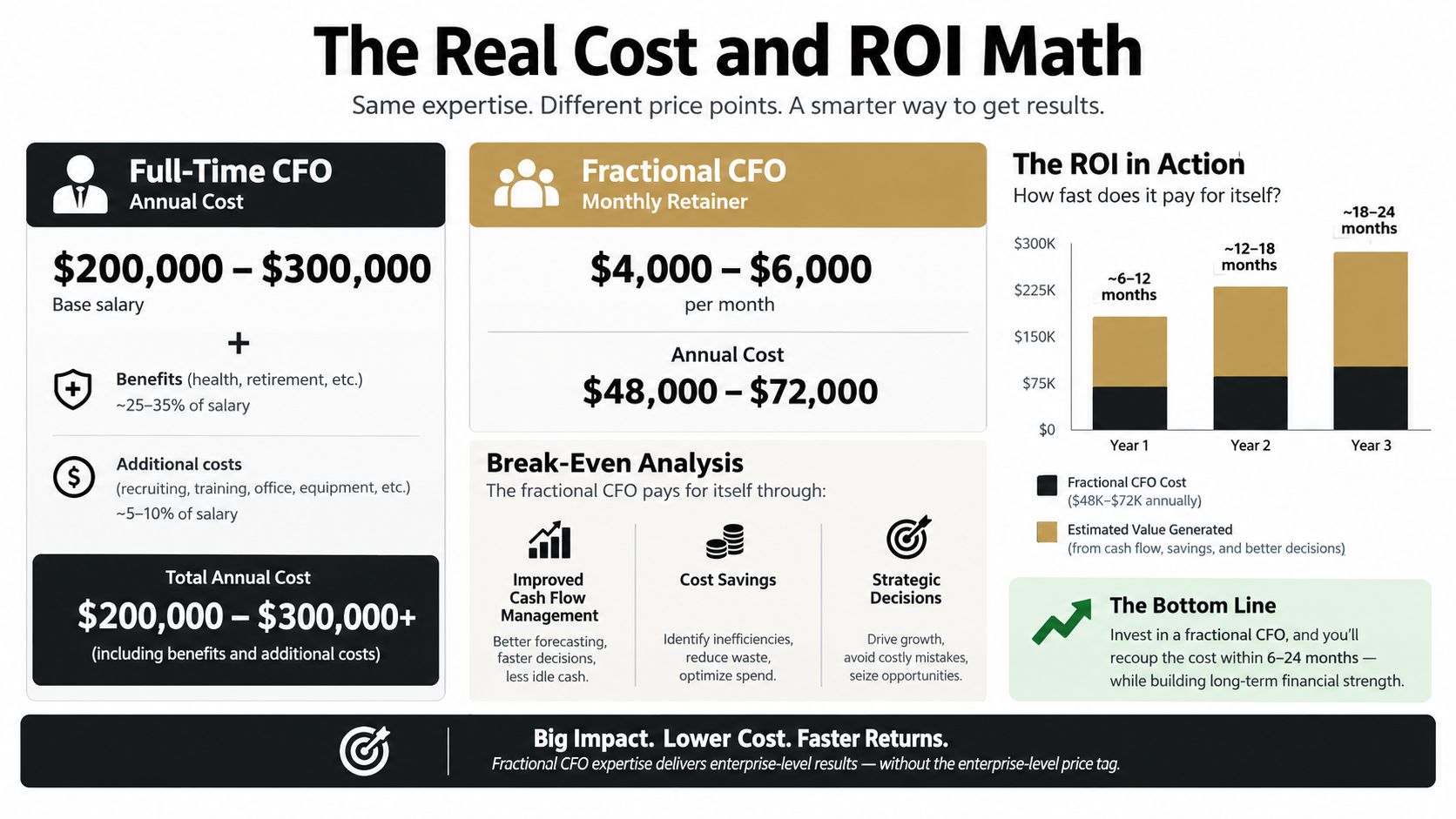
An annual fee of $60,000 could be justified if the CFO releases $1M in working capital or creates a sustainable margin improvement that materially increases operating profit. The engagement reaches breakeven through repeated, measurable improvements, not through a dramatic company-wide transformation.
Build a simple ROI worksheet. Record the fee, then list each financial lever, its baseline, the required action, and the resulting dollar value. Use resources such as this guide to measuring subscription ROI to compare recurring spend with measurable outcomes.
The CFO should begin with pricing, collections cadence, inventory turns, and forecast accuracy. Published advisory benchmarks claim forecast accuracy can move from roughly ±30% to ±10% within 90 days, while close cycles can compress from 20 or more days to 7 to 10 days within six months when rolling cash models and KPI discipline are implemented (John Galt Finance). Those outcomes require clean data, disciplined execution, and an owner prepared to act when the numbers challenge instinct. The fractional CFO ROI framework provides a practical structure for connecting the engagement to specific financial outcomes.
Triggers That Signal a Fractional CFO Is Worth It
The strongest hiring signals are not vanity measures such as headcount or office size. They're signs that financial decisions are becoming frequent, interconnected, and expensive to get wrong.
A fractional CFO is usually worth serious consideration when:
- Cash timing is unpredictable: You can show profit but can't confidently explain when cash will arrive or leave.
- Margins are slipping: Gross margin varies by customer, job, SKU, or service line, and nobody owns the analysis.
- Capital is involved: You're preparing for a raise, refinancing, acquisition, major equipment purchase, or expansion.
- The owner is the finance bottleneck: You're spending substantial working time reviewing reports, chasing collections, or approving financial decisions without a reliable model.
- Stakeholder reporting is rising: Lenders, investors, a board, or potential buyers expect consistent forecasts and performance reporting.
- An exit is becoming real: You're planning a transition and need stronger reporting, profitability, and risk controls before approaching buyers.
The opposite signals matter just as much. A company with revenue below $5M, stable margins, one entity, one bookkeeper, and no financing or transition event may be better served by improving its accounting foundation first. That threshold is a screening point, not a universal rule, and it comes from the market guidance summarized by Black Peak CFO.
| Signal Category | Worth It Trigger | Premature Situation |
|---|---|---|
| Cash | Cash movement requires active weekly management | Cash is predictable and the existing team explains it clearly |
| Profitability | Margin differs materially by customer, job, or product | The business has simple, stable economics |
| Strategic change | Financing, acquisition, expansion, or exit planning is active | No major capital or ownership decision is approaching |
| Owner capacity | The owner is repeatedly pulled into finance work | The owner can review a simple report without becoming a bottleneck |
| Reporting | Lenders, investors, or a board need forward-looking information | Internal reporting is sufficient for current decisions |
| Root problem | The business needs better financial judgment and execution | The primary constraint is sales pipeline, delivery, or staffing |
The guide to when to hire a fractional CFO captures the central test: your business should have a decision problem, not merely a finance title problem. If better bookkeeping would solve the issue, hire or improve bookkeeping. If the issue is choosing between competing uses of cash, pricing work correctly, or understanding which customers create value, senior finance support becomes more defensible.
A Simple Decision Framework You Can Use Today
Score your business in four areas from 1 to 5, then multiply each score by its weight. The weighted total gives you a fast screening tool.
- Financial complexity, 30%: Score higher when you have multiple entities, complicated revenue recognition, inventory layers, project accounting, or funding needs.
- Decision frequency, 25%: Score higher when financial decisions about hiring, pricing, purchasing, contracts, or cash happen repeatedly.
- Growth or transition pressure, 25%: Score higher when you're preparing for a raise, acquisition, expansion, recapitalization, succession, or sale.
- Capability gap, 20%: Score higher when your bookkeeper and CPA provide accurate historical information but no rolling forecast, KPI discipline, margin analysis, or decision model.
Calculate each weighted score by multiplying the 1-to-5 rating by the percentage weight. A total above 15 supports a fractional CFO conversation. A result from 10 to 15 suggests targeted project work may be appropriate. A score below 10 indicates that your current finance stack may be sufficient.
A $22M services firm might score 4 for complexity, 4 for decision frequency, 3 for transition pressure, and 4 for capability gap. Its weighted score is 3.8, which is not 17 on a weighted 1-to-5 scale. If you prefer a simple unweighted score, the same business totals 15, signaling a need for focused diagnostic work before committing to a broad retainer.
A $9M retailer might score 3, 3, 2, and 3, producing an unweighted total of 11. That profile points toward a defined cash, inventory, or forecasting project rather than an expansive ongoing engagement.
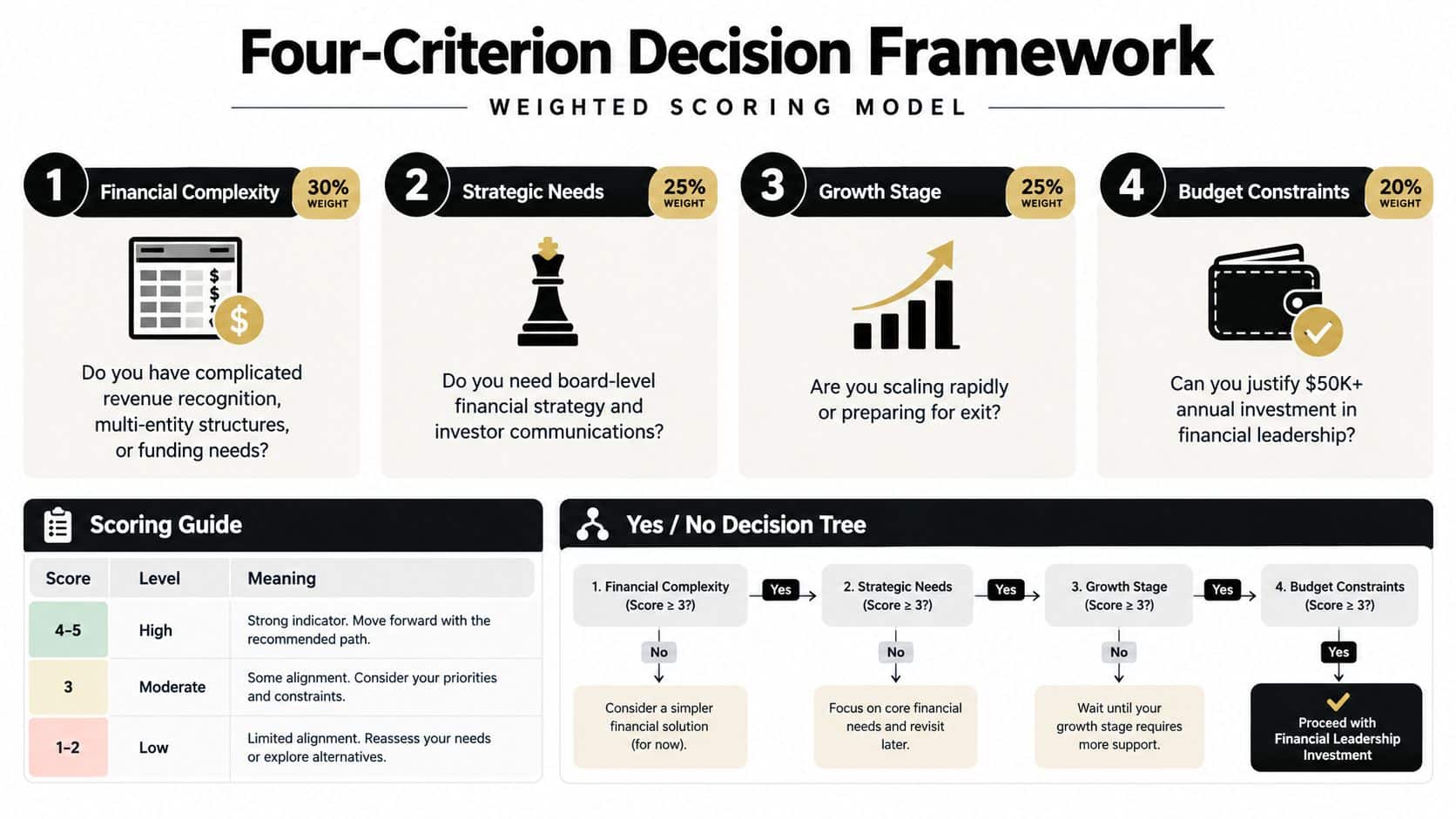
Because the requested score thresholds and percentages are decision aids rather than verified market facts, use them as an internal worksheet, not an industry benchmark. You can adapt the categories to your business and record the result on a one-page CFO advisory service worksheet.
Short Case Studies From Owner-Led Businesses
A fractional CFO earns its keep when recurring decisions allow value to leak from the business. The issue is not company size alone. It is how often the owner must choose what to buy, when to hire, which work to accept, or whether the business can support a transaction without reliable financial answers. The following are illustrative models, not invented client results.
Consider a specialty distributor with cash tied up in inventory while collections lag. A fractional CFO would establish a rolling cash forecast, review inventory aging, examine supplier terms and purchase commitments, and set a collections cadence. The measurable outcome is cash released, fewer emergency payments, and clearer decisions about which inventory to sell, return, discount, or stop purchasing.
A professional services firm preparing for recapitalization faces a different pattern of leakage. Its finance leader would build a three-statement model, test pricing and contractor mix, separate recurring from nonrecurring earnings, and organize the lender or buyer data room. The value shows up in recovered margin, faster diligence, fewer surprises, and a financing process that does not stall because the numbers cannot be explained.
For a founder-led firm in the $10M–$100M range, these examples show how AmbitionCFO can translate frequent decisions into measurable finance work. The engagement should begin with the decisions that recur, then identify the financial evidence needed to improve them.
| Metric | Distributor Case | Services Firm Case |
|---|---|---|
| Primary problem | Inventory and collections absorb cash | Profitability and transaction readiness lack structure |
| First intervention | 13-week cash model, inventory review, supplier terms, collections process | Three-statement model, pricing analysis, contractor mix, reporting package |
| Value to measure | Working capital released and payment risk reduced | Margin recovered and diligence time reduced |
| Owner decision improved | What to buy, when to pay, and which accounts to pursue | Which services to price differently and how to present earnings |
| Evidence required | Aging reports, purchase commitments, payment history, gross margin by product | Revenue by service line, labor and contractor cost, adjusted earnings, lender requirements |
Require baseline measurements before calling the work successful. Working-capital discipline, margin analysis, and forecast accuracy are practical mechanisms for creating value (John Galt Finance's growth and clarity guidance). If a provider cannot define the baseline, the action, the owner, and the expected financial result, the engagement risks becoming advisory theater.
How AmbitionCFO Delivers Fractional CFO Value
A founder calls because the books are current, but the decisions are still expensive. Cash gets tight before anyone sees it coming, margins are unclear by job or client, and the owner is still guessing on hiring, pricing, debt, and expansion. AmbitionCFO is built for that moment.
The work starts with the decision calendar. The first question is not company size. It is how often high-value decisions are being made and where value is leaking because those decisions are being made without a reliable finance cadence. A business with uneven collections needs a weekly cash view. A project business needs margin detail by job. A services firm heading toward transition needs normalized profitability and exit planning.
AmbitionCFO works as an advisory partner, not a bookkeeping or tax shop. It stays focused on finance leadership, clear reporting, and owner decisions. Typical deliverables include:
- A 13-week cash-flow model that shows expected receipts, payments, payroll, and liquidity pressure.
- Monthly KPI reporting that ties financial results to operating performance.
- Budgeting and forecasting that supports hiring, capital, contract, and expansion decisions.
- Margin analysis by job or client for businesses where revenue alone hides weak economics.
- Quarterly board-style reviews that force clear choices and accountability.
- Exit-planning support for owners preparing a transition within a multi-year horizon.
| Engagement Element | What AmbitionCFO Delivers |
|---|---|
| Owner relationship | Direct work with the owner and leadership team |
| Existing finance team | Works alongside bookkeepers and CPAs rather than replacing them |
| Cash visibility | Rolling 13-week cash-flow modeling |
| Profitability | Margin analysis by job, customer, service line, or operating segment |
| Reporting cadence | Weekly cash visibility, monthly KPI packs, and quarterly strategic reviews |
| Strategic work | Forecasting, budgeting, capital decisions, and exit planning |
| Industry context | Construction, distribution, and professional services experience |
| Scope | Finance leadership matched to decision frequency and value leakage |
Pricing should reflect complexity, hours, and the decisions being supported, not a generic promise of unlimited access. Market context often puts fractional CFO retainers in the low thousands to mid five figures per month, with hourly rates that can land in the low hundreds and above. The right scope is the one that gives the owner timely answers and forces action on them.
The Question to Ask Before You Sign Anything
Don't ask only, “Is a fractional CFO worth it?” Ask this instead:
Which dollar decisions am I making alone, how often do they occur, and what does one bad decision cost?
Write down the decisions from the last several months that involved hiring, pricing, inventory, equipment, customer terms, borrowing, expansion, or an ownership transition. For each one, record the cash committed, the expected return, the information available at the time, and what you wish you'd known earlier.
If the list contains recurring six- and seven-figure choices, a fractional CFO may be economically justified even when the company isn't ready for a full-time CFO. If the list mostly contains missing reconciliations, late invoices, uncategorized transactions, or tax questions, you need stronger accounting execution first. A fractional CFO can't turn unreliable books into reliable judgment, a limitation emphasized in Taxstra's comparison of fractional and full-time CFO support.
Bring three things to an initial diagnostic conversation:
- Your latest income statement and balance sheet.
- A current cash position, debt schedule, and accounts receivable aging.
- A short list of the decisions you expect to make over the next planning period.
The advisor should respond with a clear view of the finance gap, the first deliverables, the cadence, and the measures that will determine whether the work is paying for itself. Don't accept broad promises about insight. Ask which cash, margin, forecast, or decision metric will change and who will act on it.
For a business in the $10M to $100M range, the right answer is often neither “hire a full-time CFO immediately” nor “keep managing finance informally.” It's to install the level of financial leadership your decision load now requires, then review the economics against measurable results.
AmbitionCFO provides fractional CFO advisory support for founder-led businesses that need stronger cash forecasting, profitability visibility, KPI reporting, and exit planning without a full-time CFO commitment. Bring your financial statements, cash concerns, and upcoming decisions to AmbitionCFO for a diagnostic conversation about the finance leadership your business needs.