

A CFO advisory service gives owner-led businesses senior-level financial strategy, including cash flow forecasting, margin analysis, budgeting, and exit planning, without the $250,000–$500,000+ cost base of a full-time CFO. The right advisor turns clean accounting data into a weekly operating cadence that helps you decide whether to hire, buy equipment, accept a contract, or preserve cash.
Your books close on time. Your CPA handles tax compliance. Your bank balance is visible.
Yet you still can't answer the questions that carry the most risk. Can the company afford the new equipment? Will hiring the next team member improve capacity or create a cash squeeze? Is the large contract profitable after labor overruns, financing costs, and delayed collections?
That gap isn't an accounting problem. It's a financial leadership problem.
Table of Contents
- Why Business Owners Hire CFO Advisory Services
- What a CFO Advisory Service Actually Does
- Core CFO Advisory Offerings That Drive Decisions
- How CFO Advisory Differs From a Full-Time CFO, Bookkeeper, and CPA
- Pricing and Engagement Models for CFO Advisory
- Industry Use Cases for CFO Advisory
- Choosing the Right CFO Advisory Partner
Why Business Owners Hire CFO Advisory Services
A $20 million owner-led business can have accurate financial statements and still operate without a reliable decision system. The owner sees revenue, expenses, and net income after the month closes, but the equipment purchase has to happen now. The contract has to be accepted before the next reporting cycle. The hiring decision affects payroll before the new employee produces revenue.
The bookkeeper records what happened. The CPA reviews, reports, and advises on tax and compliance matters. Neither role automatically owns the forward-looking conversation about liquidity, capacity, margin, and capital allocation.
Clean books don't create clarity
The problem becomes sharper as a company enters the $10 million–$100 million revenue range. At that point, the business may have multiple teams, locations, projects, customers, lenders, or legal entities. Small changes in payment timing, labor cost, pricing, or inventory can affect decisions across the company.
A 2026 market report estimates the U.S. fractional CFO market at $3.2 billion, with a projection to reach $6.4 billion by 2028 at a 12.4% CAGR. The same report identifies the $10 million–$100 million revenue range as the strongest demand segment, because these companies need strategic financial management without carrying the cost of a full-time CFO. (Perea AI's fractional CFO market report)
The owner in this situation doesn't need another report that explains last month's results. They need someone to connect the accounting data to the next decision and stay involved long enough to see whether the decision worked.
The weekly questions matter most
A useful advisory relationship answers questions such as:
- Liquidity: Which receipts are likely to arrive, and which payments must be protected?
- Profitability: Which jobs, clients, products, or services are producing acceptable margins?
- Capacity: Can the company support another hire, shift, vehicle, warehouse commitment, or project?
- Risk: What happens if collections slow, labor costs rise, or a customer delays approval?
- Ownership: What must improve before a sale, succession, recapitalization, or leadership transition?
A 2026 market report also notes that demand is strongest where businesses need strategic finance but don't want the expense of a full-time executive. That makes advisory a practical bridge between transactional accounting and permanent executive hiring.
Owners often start looking for help after a near miss, such as a payroll squeeze, an unexpectedly weak project, or a financing conversation where the numbers weren't ready. A better approach is to install the decision cadence before the next crisis. If you're unsure whether your current structure has reached that point, use this guide to when to hire a CFO as a practical evaluation.
What a CFO Advisory Service Actually Does
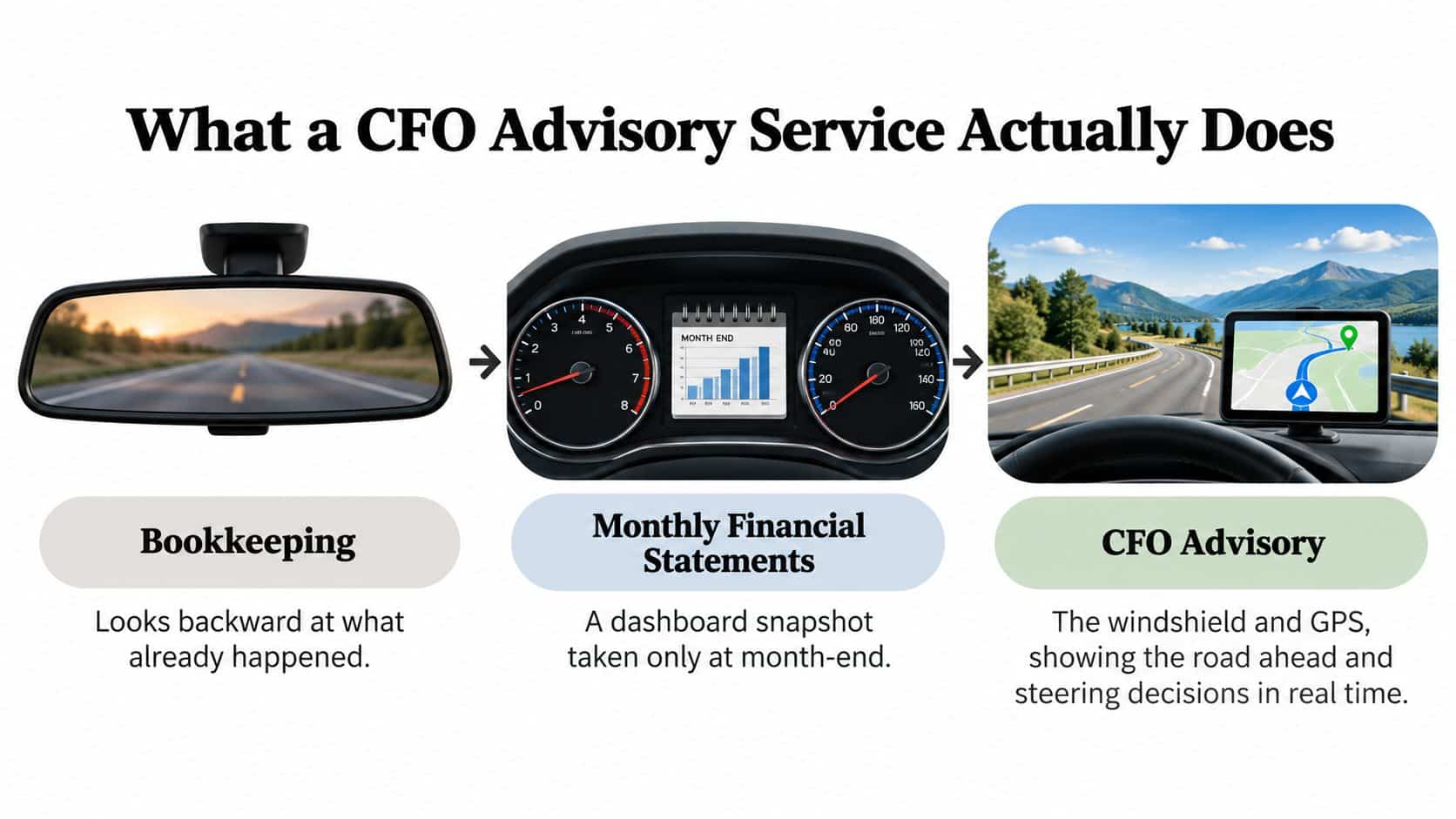
Bookkeeping is the rearview mirror. It shows what already happened.
Monthly financial statements are a dashboard photograph. They give you a useful snapshot at the end of the month, but they don't show how the business is changing between reporting dates.
CFO advisory is the live cockpit. It combines current cash information, operational drivers, forecasts, margins, and leadership decisions so you can see the road ahead and adjust while there is still time.
The difference is translation
A CFO advisor doesn't replace the accounting record. The advisor translates it.
That translation turns receivables into a collection plan, gross margin into pricing or staffing decisions, debt service into a liquidity constraint, and customer concentration into a risk discussion. It also connects ownership goals to operating behavior, whether the goal is expansion, acquisition, succession, or an eventual sale.
Core work often includes:
- Cash flow visibility: Forecast expected receipts and required disbursements by week.
- Profitability analysis: Separate revenue growth from profitable growth by job, customer, product, or service.
- Rolling forecasts: Refresh expectations as sales, hiring, vendor terms, and debt obligations change.
- KPI management: Choose a small set of indicators that leadership reviews consistently.
- Ownership transition planning: Build the financial discipline and reporting quality needed for a future transition.
The tools matter, but the meeting around the tools matters more. A forecast sitting in a shared folder won't change behavior. A weekly review that assigns collection actions, approves spending, updates hiring assumptions, and records decisions will.
Core principle: Advisory is an operating system for decisions, not another report.
One survey-based report found that 46% of fractional CFO consultants said lack of time or expertise was their clients' biggest barrier to better planning. The same report identified cash flow stability, a slowing sales pipeline, and rising labor costs as common concerns in late 2025. (CFO Voices report)
That finding describes why many founders feel stuck despite having accounting data. They don't need more information in isolation. They need a repeatable routine for interpreting it and acting on it. A practical explanation of the role is available in this guide to what a fractional CFO does.
Core CFO Advisory Offerings That Drive Decisions
A CFO advisory service earns its place when each model answers a business question. The following tools are not valuable because they look refined. They are valuable because they reduce uncertainty around a decision.
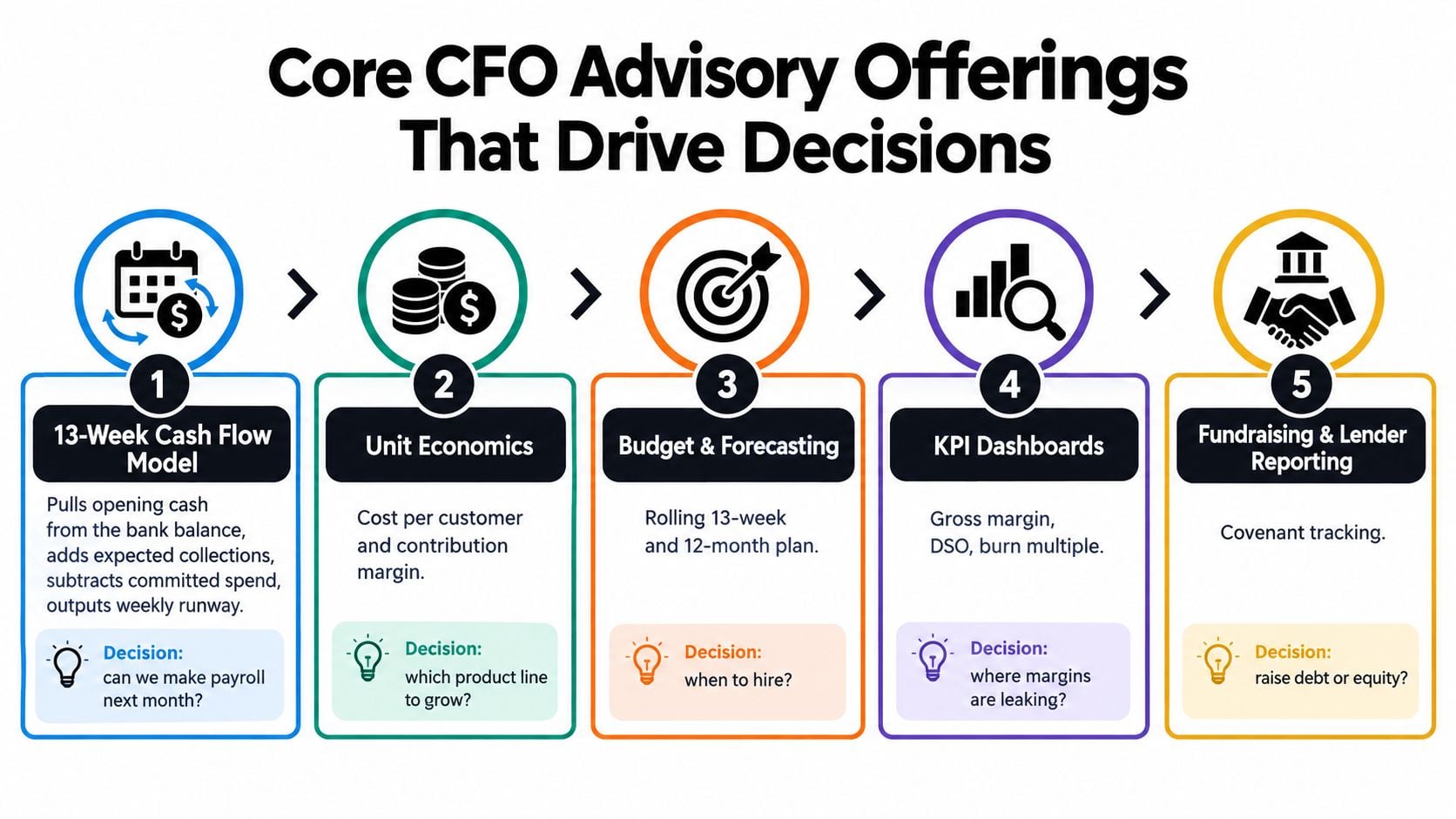
13-week cash flow modeling
A 13-week cash flow model is a weekly, direct-cash forecast. It tracks actual receipts and disbursements over a 13-week horizon, making timing differences in receivables and payables visible before they become a liquidity crisis. (CBH explanation of the 13-week cash flow model)
Build it by pulling opening cash from the bank, mapping expected accounts receivable collections, scheduling accounts payable payments, and adding payroll, debt service, taxes, and capital spending by week. Refresh it every week. The oldest week drops off and a new week enters, keeping the horizon constant.
Decision enabled: Can the company meet upcoming obligations, and which collection or payment action should happen first?
Business outcome: You gain time to collect, renegotiate, defer, or finance before a cash shortage becomes an emergency.
Margin analysis by job or client
Company-wide gross margin can hide the problem. A contractor may have profitable projects masking one job with labor overruns. A professional services firm may have strong revenue from a client whose work consumes too much senior staff time.
Analyze revenue, direct labor, materials, subcontractors, delivery costs, and other directly attributable expenses by job or client. Compare the original expectation with current performance, then isolate the operational driver behind the difference.
Decision enabled: Which work should you price differently, renegotiate, resource differently, or stop accepting?
Business outcome: You protect contribution margin instead of celebrating revenue that consumes capacity without producing enough profit.
Driver-based rolling forecasts
A static annual budget becomes stale when hiring changes, sales timing moves, vendor terms shift, or debt service changes. A driver-based rolling forecast updates projections as new operational data arrives, allowing leadership to test scenarios around revenue timing, staffing, supplier commitments, and liquidity.
A practical forecast might link labor hours to project volume, headcount to service capacity, inventory purchases to expected demand, and collections to customer payment behavior. The purpose isn't to predict the future perfectly. It's to make assumptions visible before they create expensive surprises.
Decision enabled: When can the business hire, invest, borrow, or slow spending?
Business outcome: You allocate capital using current operating assumptions rather than last month's plan. See this guide to financial forecasting models for a deeper framework.
KPI dashboards
A useful dashboard doesn't display every available metric. It highlights the numbers that explain whether the company is converting activity into cash and profit.
Small-business dashboards often include gross profit margin, operating cash flow, and days sales outstanding, or DSO. DSO helps owners see whether customers are paying within expected terms. Pairing DSO with weekly cash forecasting can expose collection delays before they affect payroll or vendor payments. (Small-business KPI dashboard guidance)
Decision enabled: Where is performance leaking, and who owns the corrective action?
Business outcome: Leadership spends less time debating reports and more time resolving the operational cause behind a weak metric.
Exit planning
Exit planning isn't a document you create at the end. It is a financial and operational improvement process that prepares the owner, management team, and business for a future transition. A Certified Exit Planning Advisor, or CEPA, can help connect owner objectives with profitability, reporting quality, management depth, risk reduction, and deal readiness.
For an owner considering a transition within 3–10 years, the advisory work should begin with the factors a buyer, successor, or lender will examine. That includes dependable earnings, understandable financial reporting, customer and supplier risk, and a business that can operate without every decision flowing through the founder.
Decision enabled: What must change now to create more transferable value later?
Business outcome: You build a company that is easier to finance, manage, transition, or sell.
How CFO Advisory Differs From a Full-Time CFO, Bookkeeper, and CPA
The roles overlap, but they solve different problems. Confusing them creates expensive gaps. A bookkeeper can keep records current without explaining why job margins are slipping. A CPA can protect tax and reporting compliance without running the weekly decisions that determine cash, pricing, or hiring.
| Role | Primary Job | Key Deliverables | Typical Cost |
|---|---|---|---|
| Bookkeeper | Record and organize financial activity | Transaction records, reconciliations, payables, receivables, routine reports | Lower ongoing cost, usually tied to transaction volume and scope |
| CPA | Handle tax, accounting, compliance, and assurance needs | Tax filings, accounting guidance, financial statement work, audit or review support | Project-based or recurring cost, depending on tax and assurance requirements |
| Fractional CFO advisor | Turn financial information into decisions | Cash forecasting, margin analysis, budgets, scenarios, KPIs, lender and ownership planning | Retainer or project fee, based on complexity and engagement cadence |
| Full-time CFO | Own the finance function and executive financial strategy | Finance leadership, capital allocation, team management, enterprise planning, executive decisions | Salary, benefits, and executive compensation |
What each role should own
Your bookkeeper should make the records dependable. Your CPA should protect compliance, tax efficiency, and accounting integrity. A CFO advisor should interpret the numbers, build forward-looking models, and bring financial judgment into the weekly leadership meeting.
That weekly cadence is the practical dividing line. A construction company may review committed costs and job margins. A distributor may focus on inventory, supplier terms, and cash tied up in the supply chain. A professional services firm may track client profitability, utilization, and scope changes. The advisor turns those operating measures into decisions, owners, and deadlines. A bookkeeper or CPA may supply the underlying data, but the advisor sets the decision rhythm.
A CFO advisory firm typically does not provide bookkeeping, tax preparation, audit, business valuation, or fundraising support. It sits above those functions and uses their output to build a decision framework. Ask whether a proposal adds strategic leadership or merely repackages accounting work.
A full-time CFO makes sense when the business needs one person accountable for the entire finance function every day, including finance staff, capital strategy, executive communication, and organizational leadership. The provided market data places the cost base of a full-time CFO well above an advisory retainer, before the broader employment package is considered. (Fractional executive cost data)
The question owners hesitate to ask
Have you outgrown your bookkeeper and CPA, or do you need more from them?
If records are inaccurate or consistently late, fix the accounting foundation first. If tax exposure, filings, or assurance requirements are the issue, strengthen the CPA relationship. If the data is reasonably solid but decisions still stall, the missing layer is CFO advisory.
Use a fractional advisor when you need senior judgment for defined priorities and a recurring leadership cadence, but do not yet need a permanently embedded executive. Choose a full-time CFO when finance has become a daily management discipline requiring constant internal ownership. This CFO versus controller comparison clarifies another common role boundary.
Pricing and Engagement Models for CFO Advisory
CFO advisory fees should track the decisions the engagement improves, not the number of spreadsheets delivered. A polished report has little value if the founder still cannot decide whether to hire, delay a purchase, renegotiate terms, or preserve cash. Pay for a recurring decision process when the advisor joins weekly leadership meetings, maintains live models, and assigns clear actions from the numbers.
Three common engagement structures
Monthly retainers suit an ongoing operating cadence. The advisor can attend leadership meetings, maintain a 13-week cash forecast, review KPIs, update scenarios, and prepare monthly reporting. This structure fits a company that needs regular judgment and follow-through rather than a single financial deliverable.
Project-based engagements suit a defined initiative. Examples include building a cash model, preparing for an ownership transition, redesigning management reporting, or analyzing the financial effect of a major expansion. The agreement should specify what the advisor will build, which data the client must provide, the decision the work should support, and who will maintain the output afterward.
Interim arrangements suit a transition. A company may need temporary senior guidance while it restructures the finance function, replaces an executive, completes a major transaction, or prepares for a permanent hire. Set an end date and handoff requirements at the start so temporary support does not become an undefined retainer.
Fractional executive work has become more common as companies seek senior financial judgment without carrying a permanently embedded executive salary and benefits package. That shift supports advisory models for founders who need a weekly finance operating rhythm before hiring a full-time CFO.
What drives the fee
The fee should reflect revenue complexity, the number of entities, reporting quality, industry volatility, transaction volume, and leadership involvement. A construction company needs job-cost and backlog analysis, a distributor needs inventory and purchasing visibility, and a professional services firm needs client-margin and capacity analysis. The tools should match the operating model, not come from a generic dashboard template.
Clarify whether the fee covers time, defined deliverables, or agreed outcomes. This discussion of outcome based pricing real life shows how outcome-linked arrangements can work in practice. Define responsibilities in writing because an advisor can improve decisions and controls, but cannot control every business result.
Before signing, ask:
- People: Who performs the work, and who attends leadership meetings?
- Cadence: How often will the team review cash, margins, KPIs, and decisions?
- Tools: Does the scope include a 13-week cash model, rolling forecast, dashboard, and scenario analysis?
- Ownership: Who updates assumptions, follows up on actions, and validates the data?
- Success: Which visible decisions or operating improvements will show that the engagement is working?
Compare proposals with this guide to how much a fractional CFO costs. Choose the proposal that gives you a reliable cadence, named accountability, and faster decisions, not the one with the longest deliverables list.
Industry Use Cases for CFO Advisory
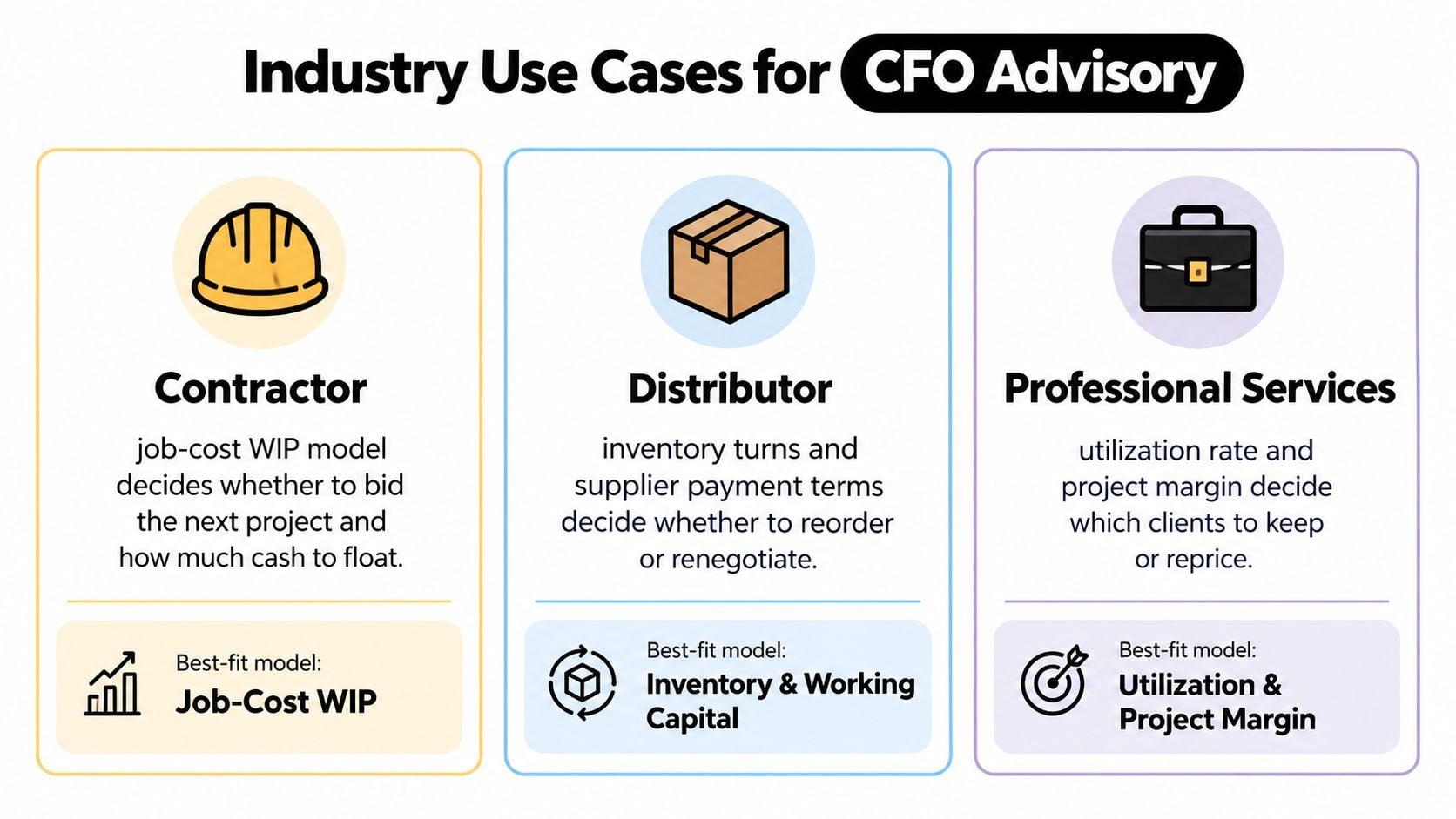
Generic CFO advice fails when the operating model changes the meaning of the numbers. A contractor, distributor, and professional services firm can all report revenue and gross margin, but they need different models to decide whether to hire, buy equipment, reorder inventory, or accept a new contract.
Construction
Construction advisory starts with job-level economics and cash timing. A company-wide income statement can show a profitable business while one large project absorbs labor, materials, and management attention without producing the expected return.
A contractor weighing a bond-backed project should review current job cost, committed costs, expected labor requirements, billing milestones, retainage, subcontractor payments, and the cash required to carry the work. The model should show whether the project strengthens the company or stretches liquidity beyond its practical capacity.
Labor volatility, job mix, supply-chain disruption, and project timing can distort reported margin. These pressures make disciplined capital allocation especially important for construction and other capital-intensive businesses. (Forvis Mazars CFO adaptability coverage)
Best-fit model: Job-cost and work-in-progress analysis connected to the 13-week cash forecast.
Distribution
Distribution businesses often grow by buying inventory before they collect from customers. The critical model therefore links inventory commitments, supplier payment terms, customer collections, freight, pricing changes, and borrowing capacity.
Suppose a distributor faces supplier price volatility and a possible tariff exposure. The CFO advisor should model reorder timing, landed cost, available cash, customer pricing, and the effect of delaying or accelerating purchases. The decision is not just whether to buy more inventory. It's whether the expected margin and service benefit justify the working-capital commitment.
Best-fit model: Inventory and working-capital planning connected to supplier terms and cash availability.
Owners dealing with benefit costs and workforce planning may also find this group benefits guidance for CFOs useful when evaluating the broader cost of their employment strategy.
Professional services
Professional services firms need client-level profitability and capacity economics. Revenue alone won't tell you whether a client is worth retaining if the account consumes senior people, creates rework, or requires constant scope management.
A firm considering a partner hire should model expected capacity, compensation, ramp time, current utilization, project margin, and the volume of profitable work needed to support the addition. The same analysis can identify clients that need repricing, tighter scope controls, or a different delivery team.
Best-fit model: Client profitability and utilization analysis linked to a hiring and capacity forecast.
The principle is consistent across all three industries. The advisor doesn't impose one universal dashboard. The advisor identifies the operational driver that changes the decision, then builds the model around that driver.
Choosing the Right CFO Advisory Partner
Choose a CFO advisory partner based on operating behavior, not presentation quality. A polished dashboard won't help if nobody updates it, reviews it, or assigns action from it.
Look for four things:
- Embedded cadence: The advisor meets with the owner and leadership team regularly, not only at month-end or when a crisis appears.
- Industry fluency: The advisor understands job margins, inventory commitments, client profitability, or the other economics that shape your business.
- Defined toolkit: The engagement includes practical tools such as a 13-week cash flow model, margin analysis, rolling forecasts, and KPI dashboards.
- Relevant credentials: CPA experience matters for accounting fluency, while CEPA credentials can matter when ownership transition is part of the plan.
Ask for a sample meeting agenda, a sample deliverable, and a clear description of what happens after the report is issued. The advisor should be able to explain how a weak DSO number leads to a collection action, how a margin variance leads to an operating decision, and how a cash constraint changes the hiring or capital plan.
AmbitionCFO is one example of this model. Led by John Myklusch, CPA, CEPA, the fractional CFO advisory firm serves founder-led businesses in construction, distribution, and professional services, with services including 13-week cash flow modeling, profitability analysis, forecasting, KPI dashboards, and exit planning. The firm doesn't provide bookkeeping, tax preparation, audits, valuations, or fundraising support.
Start this week by listing your next three decisions that involve cash, capacity, or risk. A good advisor will ask what data supports each decision, which assumptions could change, and what weekly action will keep the decision on track.
AmbitionCFO provides embedded fractional CFO advisory for founder-led businesses that need clearer cash flow, profitability, forecasting, and exit planning without adding a full-time CFO. Visit AmbitionCFO to schedule a conversation or begin building a 13-week cash flow model around the decisions your leadership team faces now.