

Poor cash management is linked to 82% of small business failures, even when a company is profitable. A cash flow forecast is the critical difference between using growth to build a stronger business and letting growth create the liquidity crisis that brings it down.
Founders usually ask one practical question: Can we afford the next major decision without putting payroll, suppliers, or operations at risk? Profit and cash flow statements alone can't answer it. A forecast shows when money will arrive, when it will leave, and which weeks could force you to delay hiring, capital spending, expansion, or debt repayment.
This matters at every stage of growth. A company can win new work, report strong margins, and still run short of cash because customers pay after payroll, inventory, or subcontractor bills come due. The forecast turns that timing problem into an operating decision you can address early.
Table of Contents
- The Profit Trap Most Founders Fall Into
- How a 13-Week Cash Flow Model Actually Works
- Why Forecasting Is a Strategic Competitive Edge
- Key Metrics and KPIs Every Owner Must Monitor
- Turning Cash Flow Insights Into Business Growth
- Building Your Roadmap to Cash Flow Confidence
The Profit Trap Most Founders Fall Into
A construction company lands several large contracts and reports an excellent month. The owner approves new hires, orders materials, and starts work on another project. The income statement looks healthy because revenue has been earned. The bank account tells a different story because customer deposits arrive later, payroll runs weekly, and suppliers expect payment sooner.
By the time the owner sees the problem, the business isn't asking whether growth is profitable. It's asking which obligation can wait.

Net income records economic activity. Cash flow records financial timing. Those are different realities. A quick sale may improve reported revenue while the related receivable remains unpaid. Aggressive hiring may support future capacity while creating an immediate payroll obligation. Inventory may support a profitable contract while absorbing cash before the customer pays.
Founder's rule: Never approve a major commitment because the profit and loss statement looks good. Approve it because the cash forecast shows the business can carry it.
A widely cited U.S. Bank study reports that 82% of small business failures are due to cash flow problems rather than lack of profit, while a Global Treasurer study of more than 100 large companies found that only about 20% could forecast mid-term cash requirements within 5% of actual figures. The underlying cash flow forecasting discussion puts the risk in plain terms: even a profitable company can miss payroll, delay supplier payments, or mis-time capital spending when it can't see cash needs ahead.
Start by converting your accrual-based reports into a cash view. This guide to converting accrual to cash helps clarify which reported sales, expenses, receivables, and payables will affect the bank balance, and when.
How a 13-Week Cash Flow Model Actually Works
A 13-week cash flow forecast is a rolling, weekly model of expected receipts and disbursements. It isn't a budget that sits untouched for a year. Each week, you replace the earliest forecast period with actual results, shift the remaining weeks forward, and add a new future week.
The model answers a more useful question than “Are we profitable?” It answers, “How much cash will we have at the end of each week, and what decision must we make before the balance gets uncomfortable?”
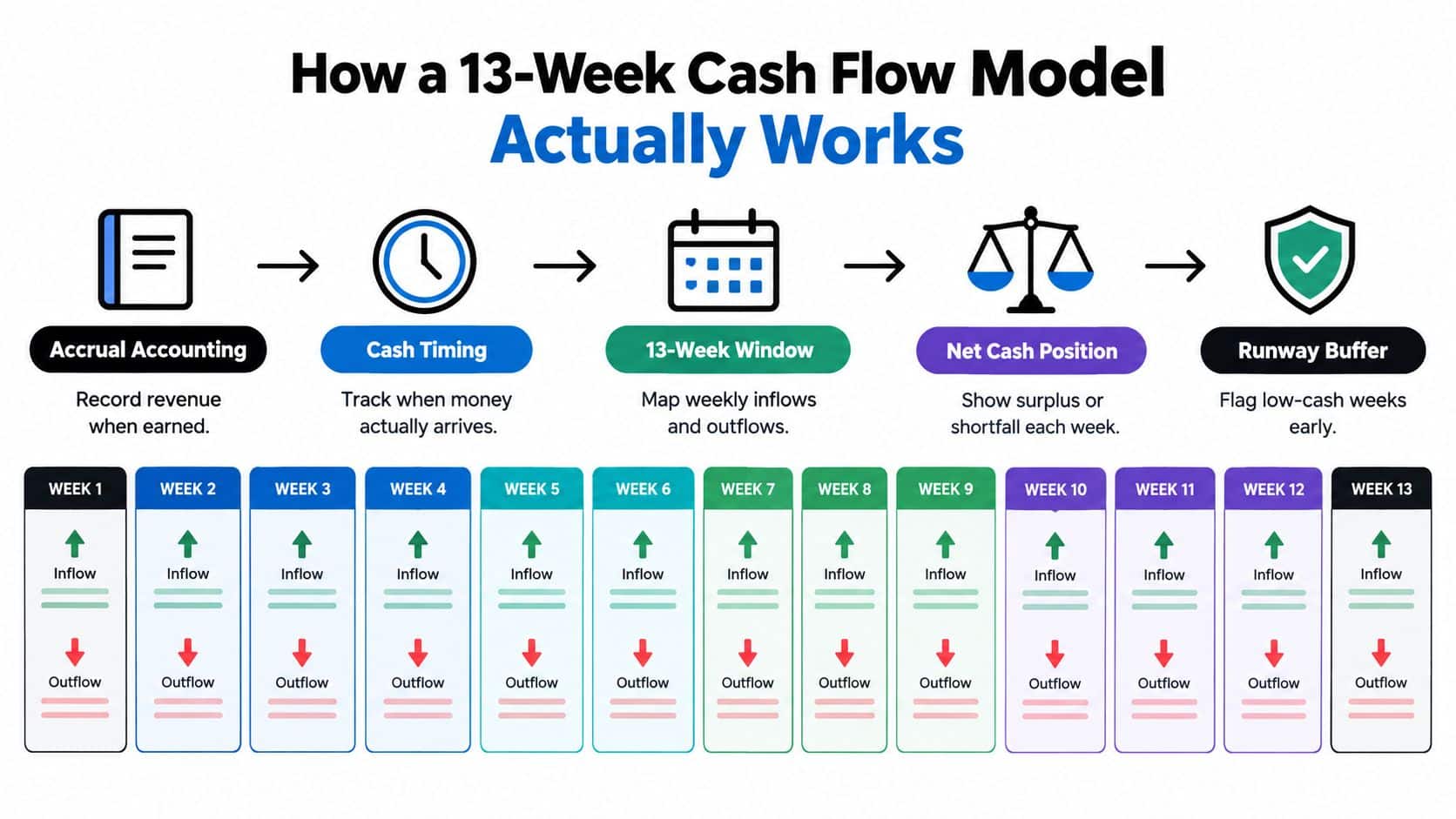
Standard accrual accounting records revenue when earned and expenses when incurred. A direct cash forecast tracks the later event, the customer payment or the supplier disbursement. That distinction matters when a sale booked today won't become cash for 30, 60, or 90 days. This explanation of the 13-week forecast describes the model as a real-cash timing system that lets management adjust collections, payroll, vendor payments, or borrowing before a liquidity gap appears.
Build the model in five layers:
- Opening cash: Reconcile the current bank balance across operating and other accounts.
- Expected receipts: Map customer collections from open invoices, committed work, deposits, and other known sources.
- Expected disbursements: Schedule payroll, vendors, rent, taxes, debt service, capital purchases, and other payments on their actual expected dates.
- Weekly ending cash: Add receipts, subtract disbursements, and carry each week's ending balance into the next week.
- Decision triggers: Flag any week below the company's minimum cash floor and assign an action before the shortfall arrives.
The model becomes valuable when you compare forecast to actual every week. If collections repeatedly arrive later than expected, change the collection assumption. If subcontractor costs run ahead of the job schedule, update the payment pattern. The forecast improves because it learns from timing variances instead of hiding them in a monthly close.
For a practical structure, use this 13-week cash flow forecasting framework as a starting point.
Why Forecasting Is a Strategic Competitive Edge
Forecasting is not merely a defensive finance task. It gives an owner the confidence to act while competitors hesitate and the discipline to reject growth that the business can't yet finance.
Suppose two distributors receive the same expansion opportunity. One has a weekly view of collections, inventory purchases, payroll, debt payments, and minimum cash requirements. The other relies on current bank balance and a monthly income statement. The first owner can decide whether to accept the contract, negotiate supplier terms, arrange financing, or phase inventory. The second owner is guessing.
That difference affects capital allocation, which means deciding where available cash should go and when. Reliable forecasting shows the timing and size of surpluses and deficits, so finance leaders can separate fixed costs from discretionary spending, identify the precise weeks of stress, and arrange financing only when needed. Grant Thornton's guidance on cash flow forecasting and working capital also frames forecasting as a governance tool because boards and auditors increasingly expect confidence in financial performance and cash-position forecasts.
Use the forecast to approve decisions
Ask the same questions before every significant commitment:
- Hiring: Does the projected cash position support the added payroll through the weakest collection period?
- Equipment: Can the business pay the deposit and later installments without crossing its minimum cash floor?
- Expansion: Does the new location or service line require cash before it produces receipts?
- Debt: Will repayment timing reduce flexibility during a predictable working-capital squeeze?
- Contract bids: Do billing milestones finance delivery, or does the company fund the customer's project first?
This process changes the founder's role. Instead of reacting to a cash shortage, you can set an approval threshold for new commitments, define the cash buffer required, and make decisions based on timing rather than optimism.
Cash visibility gives you options. Without it, every late payment becomes an emergency and every growth opportunity becomes a gamble.
Forecasting also improves credibility with lenders, investors, directors, and potential buyers. A leadership team that can explain its assumptions, track variances, and show how it responds to downside conditions demonstrates control. Strategic financial planning guidance can help connect the weekly liquidity model to longer-term hiring, investment, and ownership goals.
Key Metrics and KPIs Every Owner Must Monitor
A forecast is only as useful as the operating signals behind it. Don't build a beautiful spreadsheet that merely repeats old accounting data. Track the few measures that explain why cash arrives late, leaves early, or becomes trapped in working capital.
Start with the cash position
Build the forecast from the current bank balance, then separate operating cash flow, financing cash flow, and investing cash flow. Operating cash covers normal trading activity. Financing includes borrowing and repayments. Investing includes equipment and other capital purchases.
Use real operating inputs, not broad guesses. A sound model incorporates accounts-receivable aging, accounts-payable aging, payroll calendars, and debt schedules, as described in this 13-week cash flow model guide.
Track the drivers behind the balance
Days Sales Outstanding, or DSO, measures how long customers take to pay. A rising DSO warns that reported sales may not convert to cash on the expected schedule. Review it by customer and contract, not just as a company-wide average.
Operating cash flow ratio compares cash generated by operations with current operating obligations. It helps you judge whether normal trading activity is funding the business or whether debt and owner capital are carrying it.
Minimum cash threshold is the lowest balance you're willing to tolerate while still protecting payroll, essential suppliers, debt obligations, and operating continuity. Set it before a crisis, then trigger a defined response when the model approaches it.
| Weekly check | What to compare | Action when variance appears |
|---|---|---|
| Collections | Expected receipts against actual deposits | Contact overdue customers and revise dates |
| Supplier payments | Scheduled disbursements against approved invoices | Confirm terms and postpone nonessential payments |
| Payroll | Forecast payroll against the staffing plan | Revisit hiring timing and overtime |
| Cash floor | Ending balance against the minimum threshold | Freeze discretionary spend or arrange funding |
Review these metrics at the same weekly meeting. This guide to financial metrics for business owners can expand the dashboard, but the principle is simple: every KPI should lead to a decision.
Turning Cash Flow Insights Into Business Growth
A mature forecast gives you more than warning. It tells you when to move, how quickly to move, and which risks must be priced into the decision.
Consider a large contract bid. The revenue may look attractive, but the key question is whether billing milestones match labor, materials, inventory, and subcontractor payments. If the forecast shows that the company funds delivery long before it collects, you can revise the payment schedule, request a deposit, negotiate supplier terms, or decline the work if it would weaken liquidity.
The same logic applies to a capital purchase. Don't ask only whether the equipment improves capacity or margin. Map the deposit, financing payments, maintenance costs, utilization ramp, and expected customer receipts into the weekly model. A profitable purchase can still be badly timed.

Cash flow forecasting helps leaders make operating decisions before bills come due, including inventory, staffing, procurement, expansion, and capital spending. The same source notes that nearly 80% of Australian SMBs reported impacts to cash flow, reinforcing that cash visibility is a practical risk-management tool, not just a reporting exercise.
Protect optionality before an exit
Owners preparing for a sale or succession need predictable financial control. Buyers and lenders care about sustainable earnings, but they also examine working capital, customer collections, supplier obligations, capital needs, and the reliability of management reporting. A business that repeatedly enters avoidable cash stress can lose negotiating advantage even when its underlying operations are sound.
Use the forecast to run downside scenarios:
- What happens if a major customer pays later than planned?
- Which supplier or debt payments can be renegotiated early?
- How much inventory can be delayed without disrupting delivery?
- Which discretionary commitments can be paused?
- Can the company fund diligence, integration, or transition costs without destabilizing operations?
Here is where working capital optimization becomes strategic. Better timing preserves cash, protects supplier relationships, and keeps the owner free to pursue a contract, acquisition, expansion, or sale from a position of choice.
AmbitionCFO offers rolling 13-week cash flow modeling alongside reporting, KPI dashboards, budgeting, forecasting, and exit-planning support for founder-led businesses. Use the model as the operating rhythm, not as a document prepared only when a lender or buyer asks for it.
Building Your Roadmap to Cash Flow Confidence
Start this week with the current bank balance and a clean list of expected receipts and disbursements. Build the next 13 weeks by customer collection date, payroll date, supplier payment date, debt schedule, and planned capital spending.
Then establish a weekly routine:
- Replace the oldest forecast week with actual results.
- Shift the remaining weeks forward and add a new future week.
- Explain every material variance.
- Update collection and payment assumptions.
- Review decisions triggered by the minimum cash threshold.
Use the short-term model for liquidity control and connect it to a broader plan for hiring, contracts, equipment, expansion, and ownership transition. The founder who sees cash timing clearly can invest with purpose, negotiate earlier, and protect the company when conditions change.
Don't wait for a shortage to prove the forecast's value. Build the model before the next major commitment, review it with your leadership team, and make every significant decision pass through the cash test.
AmbitionCFO provides fractional CFO support for founder-led businesses, including rolling 13-week cash flow models, KPI dashboards, profitability analysis, forecasting, and exit planning. Visit AmbitionCFO to start a practical conversation about turning cash visibility into better growth and ownership decisions.