

The question most founders are trying to answer isn't “What was last month's profit?” It's “Can I fund the next decision without putting the business or my personal balance sheet at risk?”
You may have solid revenue, a healthy-looking income statement, and customers who pay reliably most of the time. Yet payroll arrives before several large receivables, inventory absorbs cash faster than expected, and your lender wants updated projections before the next covenant review. The accounting may be accurate. The problem is that the cash, margin, and operational consequences of your decisions aren't visible far enough ahead.
That's the gap strategic financial planning fills. It creates a repeatable operating rhythm that surfaces decisions before they become emergencies, connects sales and operations to finance, and turns the founder from a firefighter into a capital allocator.
Table of Contents
- The Moment Every Founder Eventually Faces
- What Strategic Financial Planning Actually Means
- The Five Core Components That Make It Work
- How to Build a 13-Week Cash Flow Model
- Two Founder Stories and the Numbers Behind Them
- Five Pitfalls That Quietly Undermine Every Plan
- Exit Readiness as a Financial Planning Problem
- How a Fractional CFO Embeds the System
The Moment Every Founder Eventually Faces
A founder of a growing commercial services company can have profitable financial statements and still lack dependable access to cash. In one such case, the controller was tied up in reconciliations, the owner was personally supporting a line of credit, and the bank wanted updated projections before its next review.
The books were not obviously wrong. Revenue was recorded, expenses were classified, and the income statement showed profit. The operating reality was harder: customer collections varied, payroll commitments arrived on schedule, project spending came in waves, and debt payments continued regardless of the accounting close.
Practical rule: Profit shows whether the business model worked over a period. Cash planning shows whether the business can meet its obligations when they fall due.
Bookkeeping records transactions. Accounting organizes and reports them. Strategic financial planning connects those records to choices, including whether to hire, accept a large contract with demanding payment terms, buy equipment, increase inventory, or preserve borrowing capacity.
That connection requires an operating cadence, not another spreadsheet prepared for a quarterly meeting. Management needs a current view of expected receipts, upcoming commitments, decision deadlines, and the assumptions behind each forecast. A fractional CFO can install that cadence, assign ownership, and run the review process without the cost of a full-time hire.
The answer is not automatically a larger bank balance. Excess cash can conceal weak collections, poor pricing, or unprofitable work. A clearer planning system shows whether cash is available because the business is performing well or because a temporary financing cushion is masking a problem.
Owners assessing whether their current financial support matches the company's needs can use this practical guide on when to hire a CFO. The timing is less about title than accountability. Once financial information must shape hiring, pricing, delivery, and capital decisions, someone needs responsibility for turning that information into an operating routine.
The founder eventually faces a choice: keep reacting to cash surprises, or make planning part of how the company runs. A fractional CFO helps build the second approach, with defined inputs, recurring reviews, and decisions tied to measurable financial consequences.
What Strategic Financial Planning Actually Means
Strategic financial planning is the disciplined process of converting business goals into cash, margin, and capital decisions across a rolling 12-to-36-month horizon. It answers a practical question: given what we expect to earn and spend, what should we do next?
That makes it different from the finance activities many companies already perform.
- Bookkeeping records what happened. It captures invoices, bills, receipts, payroll, and payments.
- Accounting explains and reports what happened. It classifies transactions, closes the books, and produces financial statements.
- Planning decides what happens next. It tests assumptions, assigns responsibility, and links operational choices to financial consequences.
The process needs three connected horizons.
The operating horizon
The operating horizon covers the next 90 days. It focuses on weekly cash receipts, supplier payments, payroll, taxes, debt service, and other obligations. A rolling cash model gives management time to act before a shortfall forces an expensive decision.
The tactical horizon
The tactical horizon covers the next 12 months. Management compares actual performance with the forecast, identifies variances, and adjusts hiring, pricing, spending, and sales expectations. A tactical forecast should change when the business changes. It shouldn't become a ceremonial budget that nobody trusts by the middle of the year.
The strategic horizon
The strategic horizon extends across one to three years. It frames capital structure, major equipment purchases, market expansion, acquisitions, leadership development, and potential ownership transition. The model doesn't need false precision. It needs clear assumptions and enough visibility to compare alternatives.
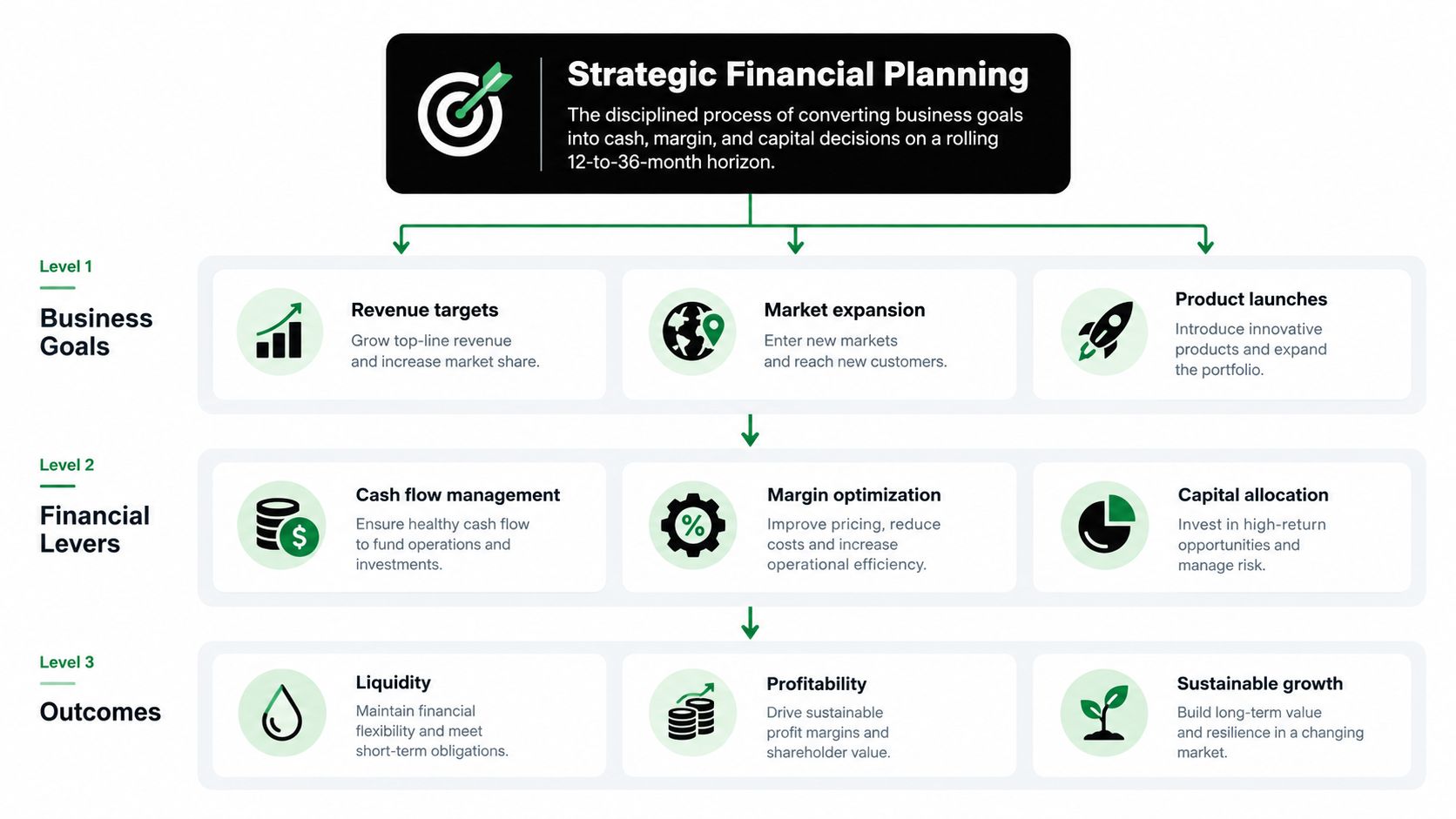
The spreadsheet is only the container. The discipline lives in the cadence: weekly cash review, monthly forecast review, quarterly strategic review, and an annual operating plan that leadership uses.
The Five Core Components That Make It Work
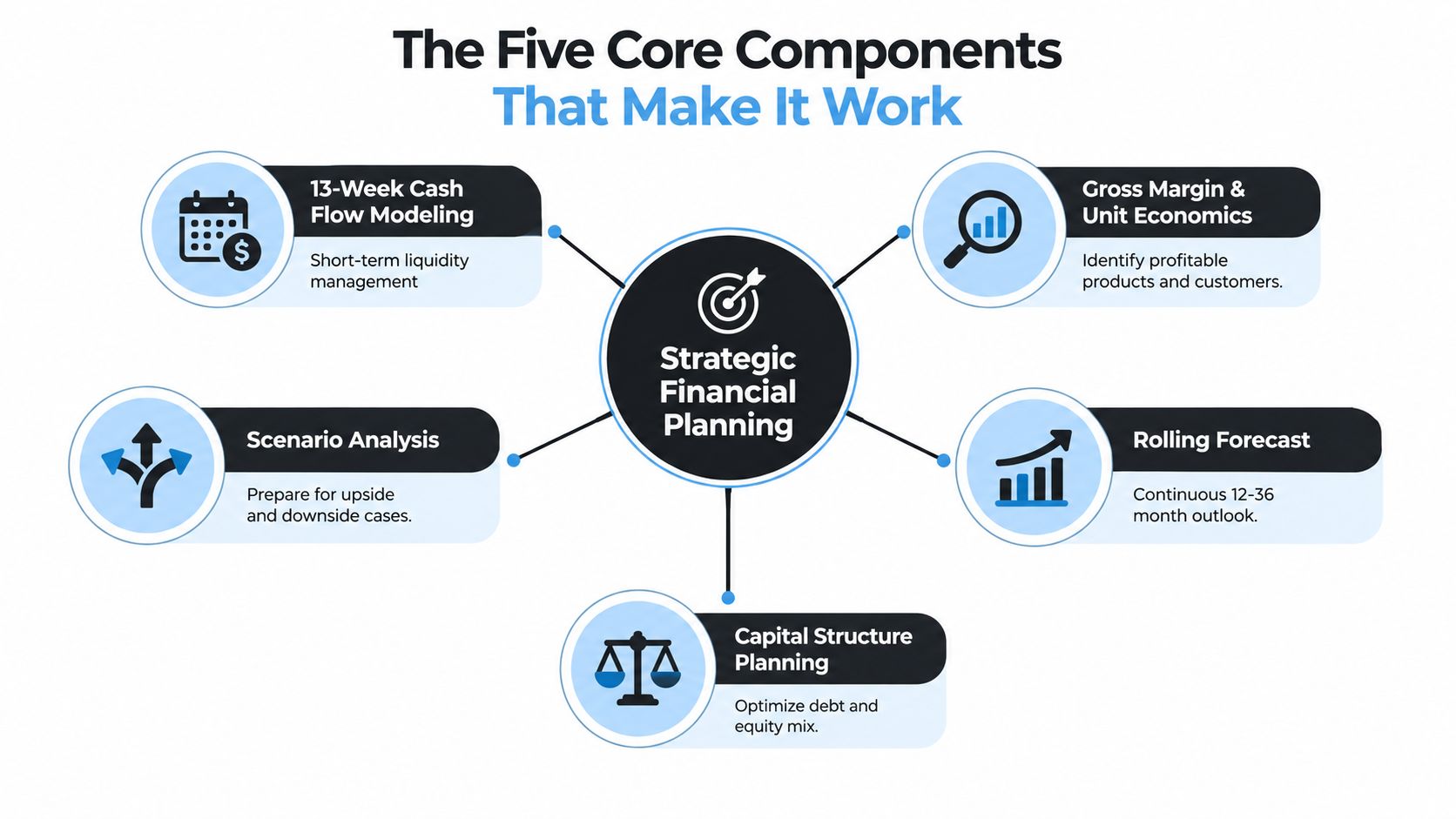
A founder-led company gets better decisions when finance runs as one operating system. Cash visibility sets the constraint, margin explains performance, KPIs expose operating signals, forecasts update expectations, and scenarios turn uncertainty into defined actions.
1. 13-week cash flow modeling
A 13-week cash flow model is a short-term rolling forecast that maps expected inflows and outflows by week. It usually uses the direct method, tracking actual cash receipts and disbursements rather than accounting profit. (Definition of a 13-week cash flow model)
The practical question is straightforward: can the company fund payroll, suppliers, taxes, debt service, and planned investments without relying on assumptions buried in the income statement?
2. Gross margin and unit economics
Revenue growth can hide deteriorating economics. Break gross margin down by job, service line, customer, product, or channel, based on how the business sells and incurs costs.
A construction company may need labor-efficiency and change-order visibility. A distributor may need product-level contribution after freight and handling. A professional services firm may need realization, utilization, and delivery cost by client. The right view is the one that changes pricing, staffing, scope control, or customer selection.
3. KPI dashboards
A useful dashboard pairs leading indicators, including pipeline, bookings, backlog, utilization, and days sales outstanding, with lagging measures from the profit and loss statement. Each metric needs an owner, a target, and a defined management response. Otherwise, the dashboard becomes another report to review and ignore.
The KPI dashboard design guide offers a practical framework for separating decision-useful measures from attractive but irrelevant charts.
4. Rolling forecasting
A rolling forecast keeps assumptions current as results change. Each month, management compares actual performance with the prior forecast, identifies meaningful variances, and updates the drivers behind future periods.
A forecast earns its place in the operating rhythm only when it affects hiring, pricing, purchasing, sales capacity, or capital allocation. If those decisions never change, the process is reporting theater.
5. Scenario analysis
Scenario planning gives management an action plan for different conditions. Build a base case, an upside case, and a downside case, then specify the trigger that moves the company from one response to another. Assign an owner to each action, such as reducing discretionary spend, slowing hiring, changing payment terms, or arranging financing.
Scenario work often fails because assumptions sit with finance while operating leaders remain uninvolved. Keep the cases simple enough to update and specific enough to use in a leadership meeting.
Tax decisions belong in capital planning as well. Owners evaluating entity choices to lower taxes should coordinate with their tax adviser and CFO so the tax result does not obscure cash requirements, financing constraints, or the longer-term ownership plan.
How to Build a 13-Week Cash Flow Model
Monthly cash reporting is too slow for a business with uneven receivables or concentrated payment dates. A weekly view gives the owner a chance to call a customer, delay a discretionary purchase, reschedule a project cost, or discuss financing before the problem reaches payroll.
Start with the opening cash balance. Pull it from the bank accounts, not from an old spreadsheet. Then build the model using auditable source data.
- Map customer receipts. Use the accounts receivable aging report, customer payment history, contractual milestones, and known collection commitments. Place expected receipts in the week management reasonably expects the cash to arrive.
- Map supplier payments. Pull scheduled payments from the accounts payable listing and vendor terms. Separate committed obligations from discretionary spending.
- Add payroll. Source payroll runs, commissions, benefits, and contractor payments from the payroll system or approved payroll schedule.
- Add taxes and debt service. Include scheduled tax deposits, loan payments, leases, and other fixed cash commitments.
- Capture unusual items. Add equipment purchases, insurance renewals, owner distributions, legal bills, and other one-off payments that can distort a normal week.
The mechanics are simple:
Opening balance + cash inflows – cash outflows = closing balance.
Keep all 13 weeks visible. Each Monday, replace the prior week's forecast with actual receipts and disbursements, roll the model forward by adding a new Week 13, and compare forecast against actual. (Weekly update method)
Make the variance review useful
Tag each variance as either timing or permanent. A customer payment that arrives later than expected is a timing issue. A customer that disputes an invoice, reduces an order, or changes terms may require a permanent adjustment to future assumptions.
The practical process begins with live cash data, maps collections and payments week by week, calculates net cash and closing balances, and flags weeks below the company's minimum cash threshold. (Implementation guidance)
Add decision triggers
A downside case should change behavior, not just produce a different line on a chart. Test a receivables delay, the loss of a key customer, or an unexpected capital expenditure. One published checklist recommends modeling 15% lower collections and defining when to activate a credit line. (Scenario checklist)
Set your own threshold based on obligations and financing agreements. If projected cash falls below it, document the response: accelerate collections, pause discretionary hiring, defer nonessential capital spending, renegotiate payment timing, or contact the lender.
For a model structure and additional implementation context, review this cash flow forecasting model guide.
Two Founder Stories and the Numbers Behind Them
A $22M commercial services company in the Midwest looked profitable but left its founder unable to draw cash consistently. The team installed a KPI dashboard covering gross margin by service line, utilization, and DSO. That view exposed a low-margin product line consuming 35% of working capital.
Management repriced the line, reduced its role in the mix, and freed $1.4M in cash within two quarters. The result didn't come from a new reporting package. It came from connecting margin analysis to working capital and giving the owner a clear decision.
A $45M specialty distribution business had an owner who made inventory purchases largely by instinct. Management tied demand-driven forecasting to a 13-week cash model, cut inventory days from 91 to 64, freed $2.1M, and avoided a planned $1.5M line of credit increase.
Those examples illustrate the operating value of strategic financial planning. A dashboard creates visibility, but the cash appears only when someone changes pricing, purchasing, collections, staffing, or investment behavior.
| Metric | Commercial Services, Before | Commercial Services, After | Distribution, Before | Distribution, After |
|---|---|---|---|---|
| Cash visibility | Profitability visible, owner draws inconsistent | Service-line margin linked to cash decisions | Inventory purchases driven by judgment | Purchasing tied to demand and cash |
| Primary diagnostic | Gross margin, utilization, and DSO added to dashboard | Low-margin line consuming 35% of working capital identified | Inventory days tracked through forecast discipline | Inventory days moved from 91 to 64 |
| Cash outcome | Cash constrained despite reported profit | $1.4M freed within two quarters | Planned $1.5M credit increase under consideration | $2.1M freed and increase avoided |
The lesson is uncomfortable for owners who want a better report: reports don't produce cash by themselves. Decisions based on the report do.
Five Pitfalls That Quietly Undermine Every Plan
Most planning failures don't begin with a broken formula. They begin with a management habit that rewards comfort over visibility.
Vanity metrics
Revenue growth feels reassuring, but it can conceal margin erosion, slow collections, and cash trapped in working capital. Pair revenue with gross margin, DSO, utilization, backlog quality, and operating cash flow.
Static budgets
An annual budget locked in January becomes fiction when pricing, demand, staffing, or supplier terms change. Keep the budget as a reference point, but use a rolling forecast to re-baseline expectations as new information arrives.
Single-scenario forecasting
One optimistic path leaves the team improvising during a bad week. Maintain base, downside, and upside cases, and attach each case to a specific management response.
Founder dependency
When every pricing exception, hire, purchase, and customer escalation routes through the owner, the founder becomes the company's bottleneck. Document decision rights and give managers responsibility for the portions of the P&L they control.
Ignoring exit readiness
Owners often treat exit preparation as a legal event that starts shortly before a transaction. That approach creates avoidable cleanup around customer contracts, financial statements, add-backs, management reporting, and operational documentation.
A practical overview of how Capital Express helps avoid pitfalls can complement internal planning, especially when an owner wants to identify financing and cash-management vulnerabilities before they become urgent.
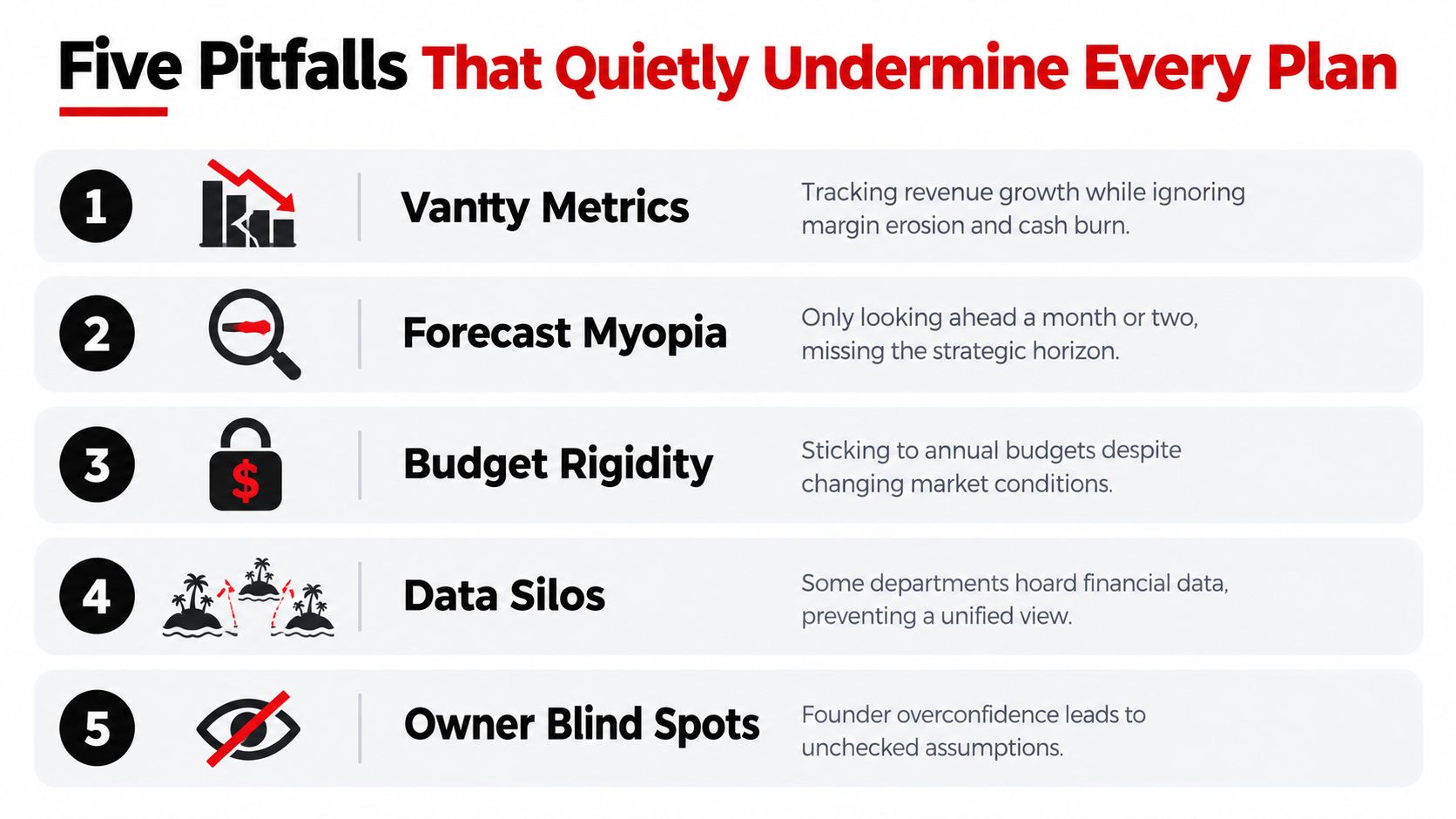
The better habit across all five is the same: assign an owner, define the review cadence, and connect each metric to a decision. A plan that nobody acts on is only a document.
Exit Readiness as a Financial Planning Problem
A buyer does not pay for a compelling valuation story alone. The price depends on clean reporting, durable cash generation, transferable operations, and evidence that the company can perform without the founder managing every important relationship.
Independent survey data from 2025 found that only about half of small-business owners had a specific, detailed succession plan. Another 23% had only a plan in mind, while 27% had no plan at all. A U.S. Bank survey reported that 85% of owners started their business to build something to pass on, but only 54% had a formal succession plan, and 62% found the process overwhelming. (Succession planning data)
The practical test is simple: can a buyer verify the quality of earnings, understand the cash conversion cycle, and keep the business performing after the founder leaves?
The operating evidence buyers examine
Buyers examine normalized cash flow, the working capital cycle, recurring and one-time revenue, customer concentration, leadership depth, and the reliability of financial statements. They also review contracts, pricing discipline, reporting consistency, and management's ability to explain variances without the owner translating every number.
Use each quarterly review as a mock diligence exercise. Keep support for adjustments, customer terms, contracts, key processes, and management responsibilities current, while the facts remain easy to verify.
| Criterion | What Buyers Look For | Typical Threshold | Why It Matters |
|---|---|---|---|
| Cash flow quality | Normalized EBITDA, owner add-backs, working capital cycle, recurring revenue | Consistent and supportable | Indicates whether reported earnings convert into usable cash |
| Customer concentration | Revenue spread across customers | No single client above 10% to 15% of revenue | Reduces dependence on one relationship |
| Management depth | Leaders who can operate without the founder in every meeting | Defined accountability across core functions | Makes the business transferable |
| Recurring revenue mix | Repeatable contracts or repeat purchasing patterns | A durable, documented mix | Supports predictability after transition |
| Financial reporting | Clean statements with reliable support | Audited or reviewed within 12 months | Reduces diligence friction and credibility concerns |
A 2025 survey found that 75.8% of middle-market CEOs had started exit planning, while businesses with 1 to 100 employees were least prepared, with 57.5% having exit plans in place. That gap matters because smaller companies often rely more heavily on the founder and have less formal reporting infrastructure.
Owners who want to maximize company value before exit should treat transferability and financial quality as operating work, not transaction paperwork. A practical explanation of what exit planning means can help define the work: establish dependable reporting, reduce owner dependence, document the operating model, and address weaknesses before a buyer finds them.
How a Fractional CFO Embeds the System
A fractional CFO makes strategic financial planning operational by owning the rhythm, not by delivering a binder that sits on a shelf. The role connects financial analysis to the meetings where the owner and leadership team decide what to sell, hire, buy, defer, finance, or change.
A typical first 90-day engagement can follow a practical sequence:
- Weeks 1 to 2: Diagnose the reporting, cash position, working capital, margins, and decision bottlenecks. Establish a cash flow baseline.
- Weeks 3 to 6: Build the KPI dashboard, launch the 13-week cash model, and assign data ownership.
- Weeks 7 to 10: Introduce a monthly board-style reporting pack and a scenario framework for material decisions.
- Weeks 11 to 12: Set the planning calendar and establish an exit-readiness baseline.
The ongoing artifacts matter more than the initial presentation. Leadership should have weekly cash meetings, monthly forecast variance reviews, quarterly board reporting, and an annual operating plan refresh. Each meeting needs a defined owner, a short decision agenda, and follow-through captured in writing.
A full-time CFO hire can exceed $200K in annual cost, while a fractional engagement allocates senior financial leadership to the company's actual needs without requiring a full-time executive structure. The right hours per month depend on complexity, revenue band, transaction activity, and the maturity of the internal finance team.
The practical distinction is captured in what a fractional CFO does: the work isn't bookkeeping, tax preparation, audit, valuation, or fundraising support. It's financial leadership, forecasting, cash management, profitability analysis, reporting, and planning. Once the team can run the cadence independently, the fractional CFO can step back toward a quarterly role without abandoning the system.
AmbitionCFO works with founder-led businesses in the $10M to $100M revenue range to install 13-week cash flow models, margin reporting, KPI dashboards, rolling forecasts, scenario planning, and exit-readiness processes. Visit AmbitionCFO to discuss the next financial decision your leadership team needs to make with better visibility.