

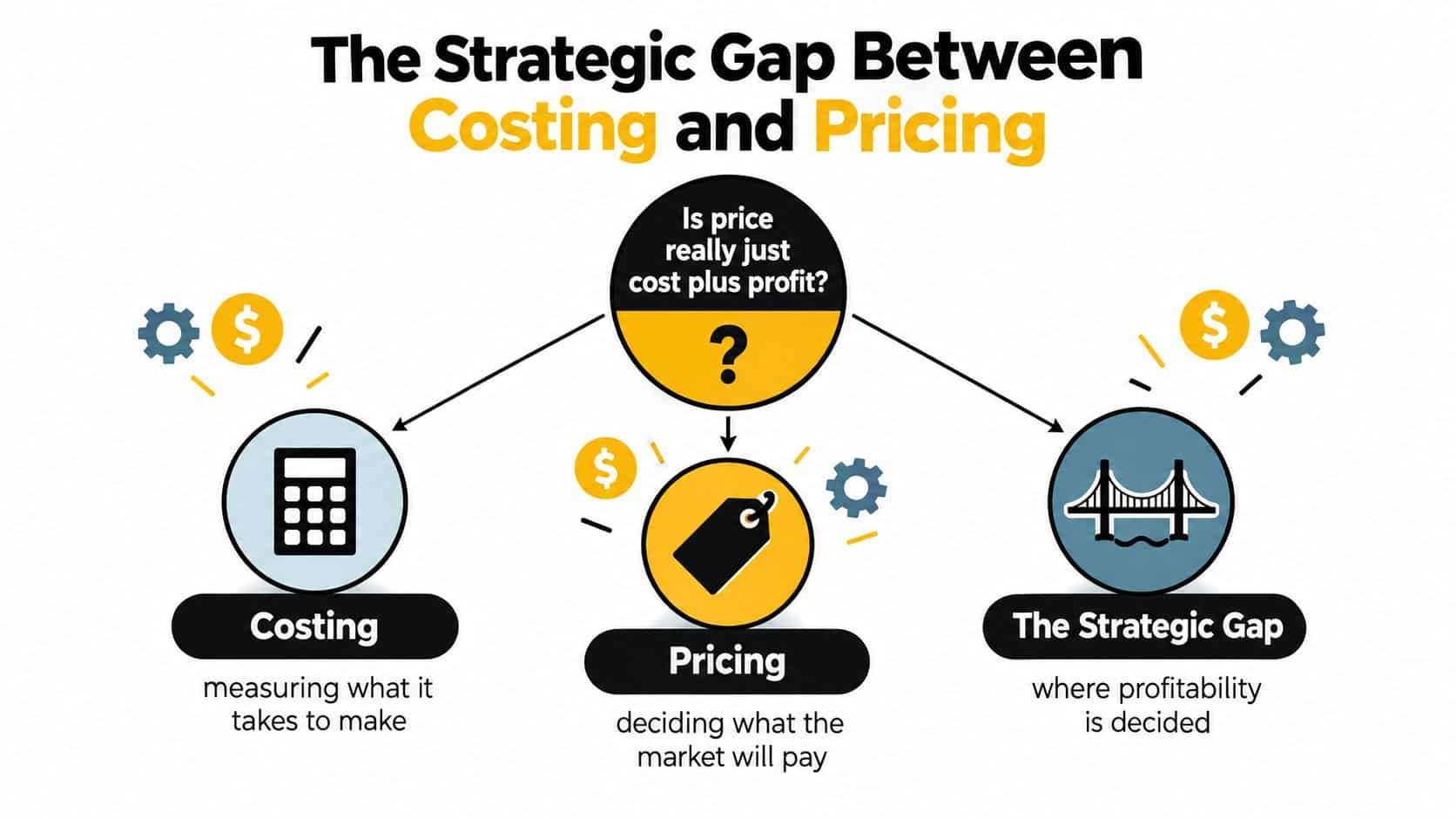
Costing measures the internal resources consumed to produce and deliver a product or service, while pricing decides what the market will bear. If a product costs $10 and sells for $15, the markup is 50% of cost, but the gross margin is only 33% of selling price.
Are you still treating price as cost plus a standard profit percentage? That shortcut may have worked when the business was smaller, the owner knew every job personally, and overhead was easy to estimate. It becomes dangerous once you add employees, multiple customers, complex delivery costs, discounts, subcontractors, or several service lines.
The difference between costing and pricing is strategic, not semantic. Costing establishes your economic floor. Pricing determines your market position above that floor. When those two decisions blur together, owners often win revenue while losing contribution margin.
Table of Contents
- The Strategic Gap Between Costing and Pricing
- Costing vs Pricing Mechanics and Purpose
- Understanding Markup Versus Margin
- Industry Applications in Construction and Services
- The Cost-Plus Pricing Trap
- Repricing Strategies for Margin Protection
The Strategic Gap Between Costing and Pricing
Your cost isn't your price, and your desired profit isn't enough to make a customer buy. Costing answers an internal question, what does this product, project, or client consume? Pricing answers an external question, what will a buyer pay under the current market conditions?
That distinction has deep roots. Cost accounting can be traced as far back as the 14th century, but industrialization and professional accounting formalized internal cost control from the 19th century through the mid-20th century. By the early 20th century, businesses increasingly separated the measurement of unit costs from the market-facing decision of setting prices. A historical review of that development is available in this review of cost accounting and price making.
Costing is your internal measurement system. It supports inventory valuation, job control, resource planning, and profit analysis. It should account for the resources your business consumes, whether those resources appear as direct materials, production labor, supervision, storage, delivery, or support.
Pricing is the commercial decision that turns cost knowledge into revenue. It includes list prices, negotiated prices, wholesale tiers, discounts, contract terms, and the value a customer assigns to the outcome.
Why growth exposes the gap
A small company can survive poor costing because the owner compensates through personal knowledge, long hours, or unusually close customer relationships. Growth removes that protection. More people make purchasing decisions, quote work, approve discounts, schedule labor, and promise delivery dates.
The result is often structural margin erosion. Salespeople quote from outdated assumptions. Operations absorbs extra work that wasn't included in the estimate. Finance reports a companywide gross margin that hides the loss on particular jobs or customers.
Practical rule: Never approve a price from a cost number alone. Approve it by comparing a reliable cost model with customer value, competitive context, capacity, and the required contribution to overhead.
Treat costing and pricing as linked decisions, not one automatic formula. If you need a more detailed way to identify the resources consumed by individual projects, use a disciplined approach to boost profits with job costing. The point isn't to make every quote complicated. It's to stop profitable-looking work from subsidizing work that consumes more labor, overhead, or support than expected.
| Business question | Costing answers | Pricing answers |
|---|---|---|
| Primary purpose | What resources did we consume? | What should we charge? |
| Main perspective | Internal and operational | External and commercial |
| Typical inputs | Materials, labor, overhead, logistics, support | Demand, competition, customer value, terms |
| Main risk | Understating the true cost | Charging too little or pricing yourself out |
| Owner's decision | Improve resource economics | Select a profitable market position |
The owner who understands this gap stops asking, “What markup should we use?” and starts asking, “What price supports the business model this customer and this work require?”
Costing vs Pricing Mechanics and Purpose
Costing is calculated from the inside out. Pricing is selected from the outside in. That is the cleanest mental model for separating the two.
A complete costing model includes materials, labor, overhead, storage, marketing, distribution, and support where those resources contribute to producing and delivering the offering. The exact allocation depends on the business. A distributor may need to assign warehousing and delivery costs. A contractor may need job-specific labor and equipment costs. A professional services firm may need billable labor, nonbillable supervision, software, and client support.
Pricing then layers a commercial decision over that cost base. A business may use a list price for standard work, a wholesale price for volume buyers, negotiated terms for strategic accounts, or discounts for defined commercial reasons. Those prices can differ even when the underlying cost is identical.
| Dimension | Costing | Pricing |
|---|---|---|
| Core question | What does the offering consume? | What will the market pay? |
| Direction | Internal measurement | External decision |
| Decision owner | Operations, finance, project leaders | Owner, sales leadership, commercial team |
| Main variables | Direct costs, fixed costs, volume, lifecycle resources | Demand, competition, value, urgency, terms |
| Output | Unit cost, job cost, service cost, contribution data | List price, quote, discount, contract price |
| Timing | Before, during, and after delivery | Before and during the sale |
| Success test | Cost data reflects economic reality | Price produces acceptable contribution and wins appropriate work |
The boundary matters because a cost number can be accurate and still produce a bad price. If competitors charge less for a comparable commodity, your accurate cost may reveal that your operating model is too expensive. If buyers value speed, reliability, compliance, or reduced risk, a cost-only price may fail to capture the economic value of the outcome.
Costing establishes the floor
Your cost model should tell you what must be recovered before the job contributes to shared overhead and profit. That doesn't mean every price must sit directly above a single fully allocated cost number. It means you should know which costs are unavoidable, which are incremental, and which are absorbed by existing capacity.
For a practical view of how cost of goods sold should be organized and scheduled, review this guide to the schedule for cost of goods sold. Your financial statements won't give you useful pricing insight if the underlying cost categories are incomplete or inconsistent.
Modern cost-based pricing developed as companies discovered that scale, overhead, and industrial complexity made simple markup rules unreliable. Precise unit economics became necessary because a price that looked competitive could still fail to recover the resources required to deliver it. A review of the development of cost accounting explains that rising competition pushed businesses toward more precise unit-cost calculations as they worked to preserve market share and set competitive prices. You can read that historical perspective in this analysis of cost accounting development.
Pricing selects the position
Pricing decides whether you compete on accessibility, speed, specialization, reliability, convenience, or a premium result. Two customers can receive similar deliverables but face different prices because their urgency, risk, buying process, or required service level differs.
That doesn't justify arbitrary pricing. It requires a documented logic. Before approving a quote, identify the cost floor, the customer's economic benefit, the alternatives available to the buyer, the capacity required, and the concessions included in the terms. Tools such as fabrication pricing plans can help organize quote assumptions, but the financial owner still needs to validate whether those assumptions support the business's target economics.
Understanding Markup Versus Margin
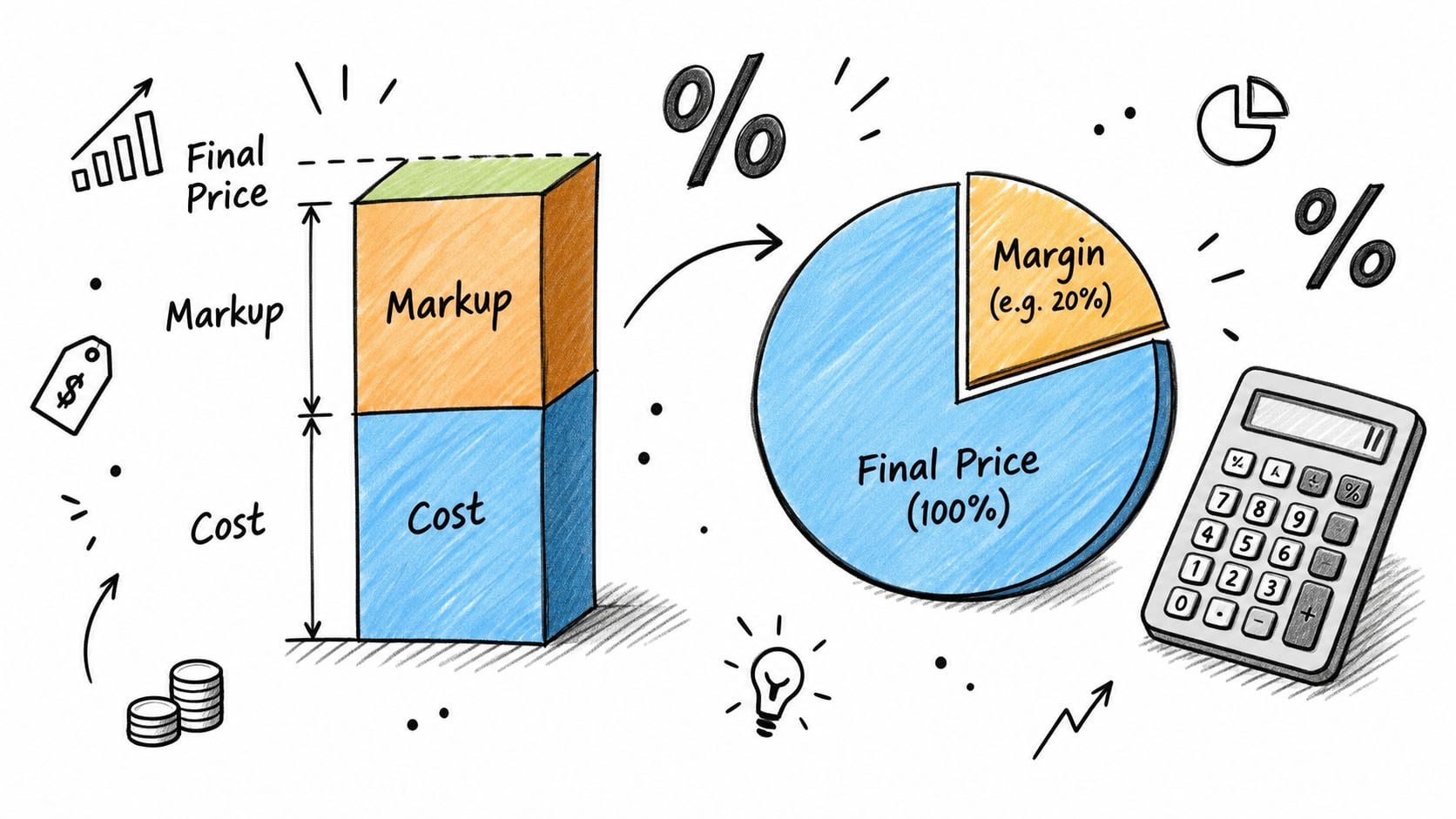
Markup tells you how much you added to cost. Margin tells you how much of the selling price remains after cost. Those are different denominators, and confusing them is one of the fastest ways to overestimate profitability.
Take the simple example. A product costs $10 and sells for $15. The markup is calculated as:
($15 – $10) ÷ $10 = 50%
The gross margin is calculated as:
($15 – $10) ÷ $15 = 33%
The distinction and example are explained in this pricing terminology guide. The business earns $5 before other costs in either calculation, but the percentage tells a different story depending on what you divide by.
Use the right measure for the decision
Markup can be useful for building a starting price. It isn't the right measure for assessing whether the business has enough money left to cover overhead, customer support, selling costs, financing, and profit.
Margin is more useful for comparing customers, jobs, products, and service lines because it expresses the remaining contribution as a share of revenue. A business can apply the same markup across several offerings and still produce different margins when labor intensity, logistics, returns, discounts, or support requirements differ.
Costing must therefore capture variable and fixed cost behavior, volume effects, and lifecycle costs before the price is approved. Pricing analysis must then translate those costs into contribution. For a deeper calculation framework, use this guide to the segment margin formula.
Build a quote that exposes the economics
A useful quote review should show more than revenue and a markup percentage. It should show:
- Direct resource cost: Materials, subcontractors, delivery, and labor directly tied to the work.
- Allocated operating cost: The portion of supervision, equipment, facilities, software, or support required to deliver it.
- Discount impact: The reduction from the standard price and the reason for granting it.
- Contribution margin: The amount left after relevant costs to support shared overhead and profit.
- Commercial conditions: Payment timing, warranty obligations, change-order exposure, and service commitments.
Suppose a salesperson says, “We added our usual markup.” That statement doesn't tell you whether the quote covers a difficult installation, a demanding customer, expedited delivery, or extended support. A margin review forces the team to price the actual work rather than the label attached to it.
Financial test: If you can't explain why a job has the margin it has, you haven't finished costing it.
Owners should also separate historical margin from quoted margin. Historical margin shows what happened. Quoted margin shows what you expect to happen. Comparing the two exposes estimating drift and reveals where operational performance is invalidating the pricing model.
Industry Applications in Construction and Services
The difference between costing and pricing becomes operational when a business delivers different work to different customers. The same discipline applies across industries, but the cost drivers and pricing decisions change materially.
Construction
Construction costing must follow the job, not just the companywide income statement. Track project-specific labor, materials, subcontractors, equipment, permits, rework, and committed costs. Then compare the original estimate with actual consumption while the project is still active.
Pricing has a separate job. It must reflect the customer's willingness to pay, the scope definition, schedule pressure, risk allocation, warranty expectations, and the competitive field. A contractor that prices only from historical cost may win work that overloads the team or carries unacceptable change-order risk.
Use a job-costing workflow that distinguishes estimated cost, committed cost, actual cost, and forecast cost to complete. The construction job costing guide provides a useful foundation for organizing that analysis.
Distribution
A distributor's product cost rarely stops at the supplier invoice. Freight, receiving, storage, picking, delivery, sales support, returns, and inventory handling can all affect the economic cost of serving an account.
Pricing also varies by channel. Wholesale customers may receive volume terms, while retail buyers may pay a list price. The correct question isn't whether every customer receives the same price. It's whether each price reflects the service burden, order pattern, delivery requirements, and contribution expected from that account.
Review margin by customer, product family, order type, and delivery pattern. A large account with frequent small orders may consume more operational resources than its revenue suggests. A smaller account with predictable orders and efficient delivery may produce stronger contribution.
Professional services
Professional services firms commonly undercost work because they count billable labor and overlook management time, revisions, coordination, technology, recruiting, and client communication. A senior employee can spend substantial time supporting a project without that time appearing in the original estimate.
Price each engagement from a realistic effort model. Identify the people involved, expected hours, review layers, scope risk, payment terms, and post-delivery obligations. Then compare the price with the client's business outcome and the firm's capacity constraints.
Target costing
Traditional cost-plus logic starts with cost and adds a return. Target costing reverses the sequence. The market price becomes a constraint, the required return is subtracted, and the resulting target cost tells engineering, sourcing, or operations what the offering must cost.
A management accounting presentation describes this logic as using market price less target return to derive a target cost, followed by design or sourcing changes to close the gap. That approach is valuable when customers have strong alternatives and the business can't pass every internal inefficiency into the price. It makes cost improvement a design requirement rather than an after-the-fact finance exercise.
The Cost-Plus Pricing Trap
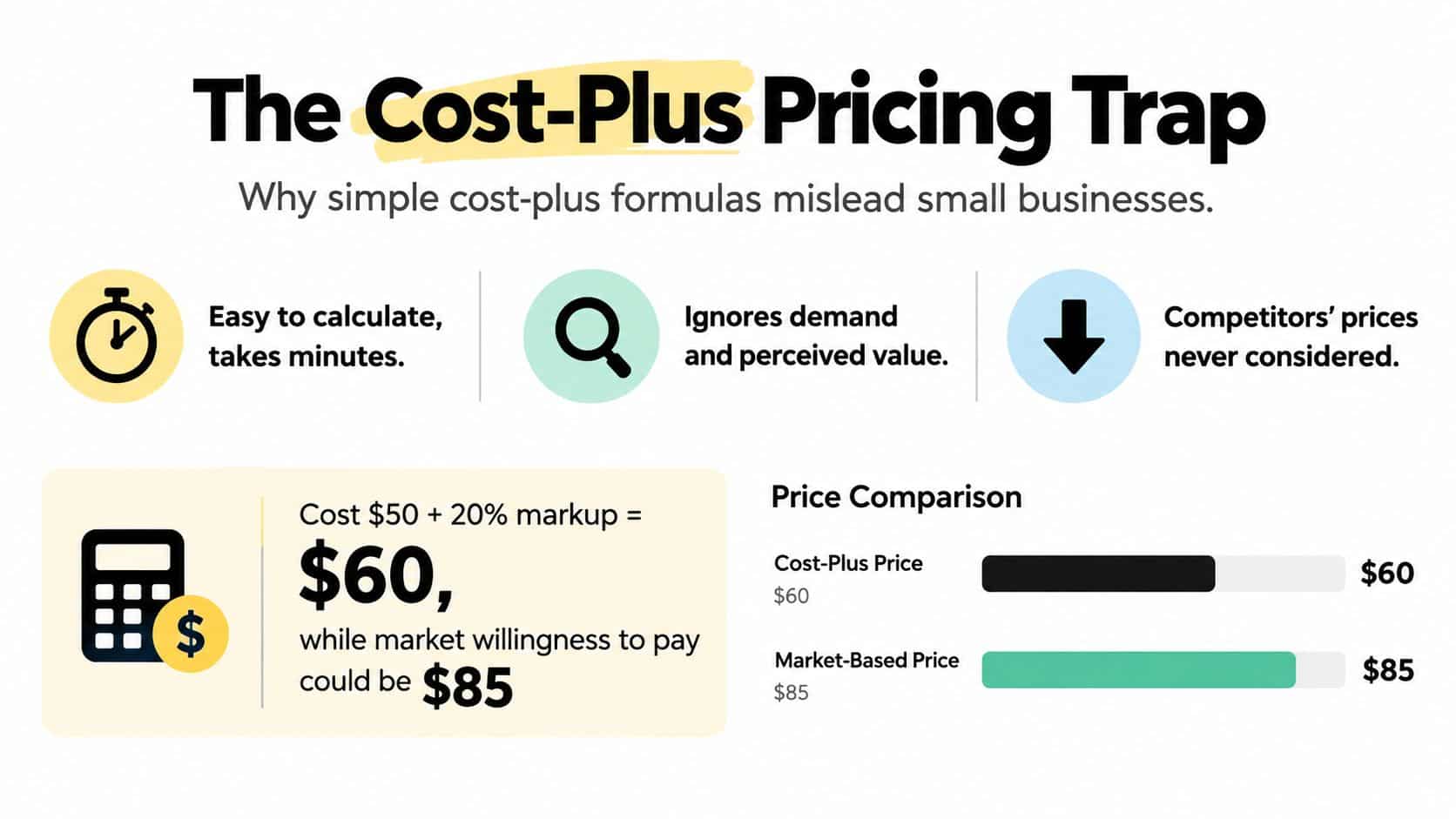
Cost-plus pricing feels safe because it's simple. Calculate cost, add a percentage, send the quote. The problem is that simplicity can hide a bad commercial decision.
A cost-plus formula ignores demand, competitor prices, customer willingness to pay, urgency, differentiation, and the cost of losing capacity to a low-quality engagement. It can underprice a specialized service in a market where buyers value speed or risk reduction. It can also overprice a standardized product when buyers can switch easily.
Why the formula fails
The formula assumes your cost base is complete, your markup is economically appropriate, and the market will accept the result. Growth-stage companies often have trouble with all three assumptions.
A company may omit owner time, account management, delivery complexity, warranty risk, or idle capacity from its cost. It may apply the same markup to a routine order and a custom job. It may use an old price list even though labor, materials, or support requirements have changed.
That creates two opposite problems:
- Underpricing: The market would accept a higher price, but the company leaves contribution on the table.
- Overpricing: The formula produces a price above practical alternatives, so the company loses volume or fills capacity with less suitable work.
- Misallocation: Managers accept work with attractive revenue but poor contribution because the quote doesn't reflect the resources required.
A pricing guide for small businesses highlights the importance of pricing decisions, noting that a 10% price change can lift profit 25% to 50%, depending on the business economics and starting position. The same guidance explains why pricing can be more powerful than making an equivalent change to cost or volume. See the small business pricing strategy discussion for that analysis.
Replace one formula with scenarios
Don't ask only, “What price does our markup produce?” Build several scenarios and test the consequences.
| Scenario | Question to answer |
|---|---|
| Cost floor | What price covers the relevant economic resources? |
| Competitive position | How does the quote compare with available alternatives? |
| Value position | What financial or operational result does the customer receive? |
| Capacity position | What work will this engagement displace? |
| Risk position | What happens if delivery takes longer or scope expands? |
The objective isn't to guess the perfect price. It's to understand the tradeoff before the customer does. A quote that wins only because the company underestimates its own cost isn't a win.
For businesses that need to understand profitability at the project level, review what job costing is. Cost-plus can remain a starting reference, but it should never be the entire pricing strategy.
Use the following video as a practical supplement to the financial logic:
Owner's decision: Keep cost-plus as a floor-setting tool if it helps your team move quickly. Add market, value, capacity, and risk analysis before treating the resulting number as a price.
Repricing Strategies for Margin Protection
Rising costs don't justify a blind price increase, and customer resistance doesn't justify absorbing every increase. Repricing requires a new economic model for the affected product, job, or client.
A flat pass-through can still compress margin. If the business raises price by the same absolute amount as the cost increase but ignores discounts, labor mix, delivery changes, or customer-specific concessions, the expected margin may not survive.
The repricing playbook
First, isolate the change. Identify which material, labor category, subcontractor, freight charge, software expense, or service requirement changed. Don't spread an account-level problem across every customer without evidence.
Next, rebuild the cost. Calculate the new cost for each product, line item, job type, or service package. Include the resources that changed and the related operating burden. A companywide average can conceal the fact that one customer or job is absorbing the largest increase.
Then, set the required price. Work backward from the target contribution margin rather than adding a casual percentage to the old price. The market may require a different response by customer, product, or contract.
Test the commercial scenarios. Model a full increase, a partial increase, a scope adjustment, a service-tier change, and a negotiated concession. Each scenario should show revenue, relevant cost, contribution margin, customer impact, and capacity implications.
Finally, monitor actual results. Compare quoted margin with realized margin after delivery. If the gap is widening, correct the estimating assumptions or change the offer. Repricing isn't complete when the new rate enters the system. It's complete when the economics hold in practice.
A margin protection playbook recommends modeling the new price from the new cost and target margin, then testing contribution by line item or job instead of relying on companywide averages. The margin compression and cash flow playbook provides useful context for that approach.
Manage pushback without surrendering economics
Customer conversations should focus on the commercial structure, not an apology for having costs. Explain what changed, preserve the value of the outcome, and offer choices where appropriate.
You might reduce scope, alter delivery timing, change service frequency, revise payment terms, or move the customer to a different package. A concession should buy something in return, such as a longer commitment, a larger order, reduced customization, or faster payment.
Review your most important customers and jobs using four fields:
- Current price: What the customer pays today.
- Current cost: What the work consumes.
- Required contribution: What the engagement must contribute to overhead and profit.
- Available response: Price change, scope change, term change, or exit.
For a broader framework on strengthening profitability, use this guide to improve gross profit margin. The essential discipline is to make repricing decisions at the level where the economics occur, not at the level where the accounting is easiest.
Audit your current price list, open quotes, customer discounts, and active jobs now. Any business that has outgrown basic bookkeeping should be able to explain the cost floor, pricing logic, and realized contribution for its major revenue streams.
AmbitionCFO helps founder-led businesses analyze margin by job or client, build cash flow models, and connect costing data to pricing and profitability decisions. Visit AmbitionCFO to discuss an immediate review of your pricing model and the financial reporting needed to protect margin.