

Exit planning is the structured process of closing the gap between your company's current value and the value you need at exit. It's typically a 3-to-10-year operating program, not a last-minute sale exercise.
You may be running a profitable company, paying yourself well, and still have no clear answer to the question, “What happens when I'm ready to leave?” The books may be accurate enough for tax filing but not clean enough for diligence. Your biggest customers may still call your mobile phone. Key pricing, hiring, and capital decisions may still wait for you.
That's the problem exit planning solves. It turns a future ownership change into a present operating discipline, one that improves cash flow, margins, management depth, and transferability before a buyer, successor, or employee ownership structure ever enters the room.
Table of Contents
- What Exit Planning Actually Means for a Founder
- The Value Gap and Why Most Owners Undershoot
- The 3-to-10 Year Exit Timeline and What to Do Each Year
- Comparing the Four Main Exit Paths for Founder-Led Businesses
- Readiness Metrics, EBITDA Multiples, and the Buyer-Ready KPI Dashboard
- Common Mistakes That Quietly Destroy Exit Value
- When to Bring in a CEPA or Fractional CFO
- Your First 30 Days and the Next Step with AmbitionCFO
What Exit Planning Actually Means for a Founder
A founder can build a $40M services business and still walk away with only 40% of expected proceeds after taxes if planning starts too late. The revenue is real, but revenue alone doesn't determine what the owner keeps. Business value, deal structure, taxes, owner dependence, and personal financial needs all shape the final result.
So, what is exit planning? It's the structured process of measuring the gap between your company's current enterprise value and the amount you need from the transition, then closing that gap through operational, financial, leadership, and ownership improvements. Practical guidance on owner exit timing describes exit planning as a multi-year process, with owners commonly advised to begin 3 to 10 years before leaving.
The work rests on three connected pillars:
- Value creation: Improve sustainable earnings, customer quality, management depth, and operational consistency.
- Value capture: Convert business value into usable personal wealth through deal structure, tax coordination, and proceeds planning.
- Ownership transition: Decide who will own and run the company, how ownership will transfer, and when control will change.
A sale isn't the only path. An owner may choose a third-party acquisition, family succession, management buyout, employee ownership, or another structured transfer. Resources such as California business succession planning help clarify the legal and ownership questions that sit alongside financial preparation.
For founder-led companies in the $10M to $100M range, the practical planning window is long enough to improve the business but short enough that delay creates real risk. Exit planning should influence today's hiring plan, pricing model, capital expenditures, reporting cadence, and leadership development. If those decisions only make sense when you're preparing to sell, you've started too late.
The Value Gap and Why Most Owners Undershoot
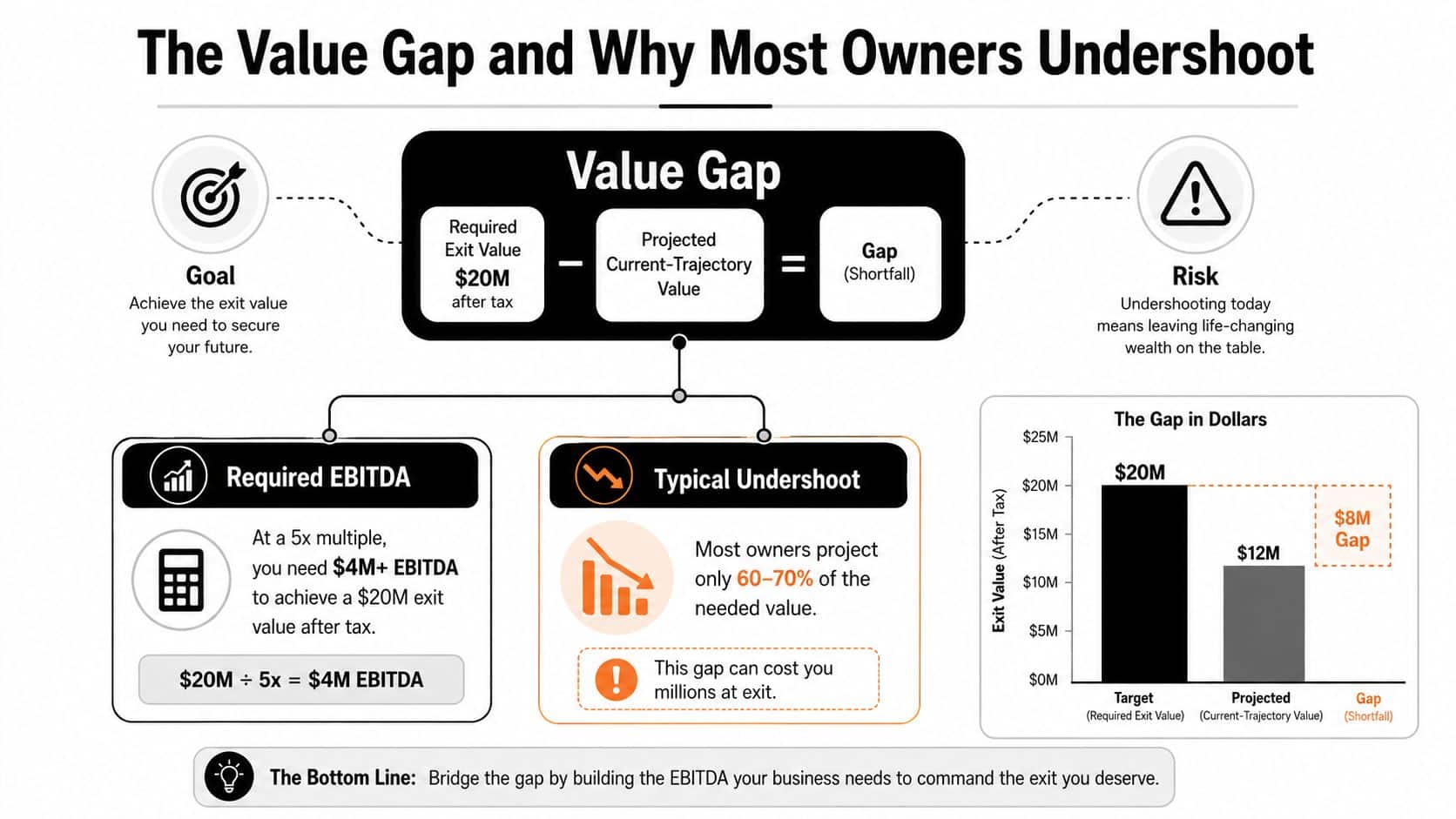
The value-gap calculation is simple:
Required exit value minus projected current-trajectory value equals the value gap.
Suppose you need $20M after tax and assume a 5x EBITDA multiple. You'd need at least $4M in EBITDA to reach that gross value target before considering taxes, fees, debt, and transaction structure. If your current plan produces only $2.1M in EBITDA at the same multiple, projected value is $10.5M, leaving a $9.5M gap.
Those figures are an illustration of the framework, not a market forecast. The important point is that owners can identify the shortfall before a buyer does. Valuation methods commonly used in exit planning include EBITDA multiples, discounted cash flow, and comparable transaction analysis, with one valuation guide describing a mid-market range of roughly three to eight times EBITDA, depending on sector and risk. Review this guide to the value of a private company to understand how earnings quality and risk affect the valuation conversation.
Why owners miscalculate
Owners routinely confuse gross revenue with transferable value. Buyers care about durable earnings, customer quality, management independence, and the risks that could interrupt cash flow. Common causes of an undershoot include:
- Concentrated customers: A large account can make revenue look strong while making future earnings fragile.
- Weak recurring-revenue documentation: Revenue that renews but isn't contractually or operationally documented may receive less credit.
- Owner-heavy compensation and expenses: Personal or discretionary expenses can obscure normalized earnings, while poor records make adjustments difficult to defend.
- Organic growth assumptions: A plan based only on historical growth may not produce the EBITDA needed for the owner's personal target.
A written three-statement roadmap should connect the income statement, balance sheet, and cash flow statement. It should rank the available levers, such as margin improvement, multiple expansion, growth quality, and tax structure, then assign an accountable owner and an annual checkpoint to each one.
Practical rule: Never accept a valuation estimate without writing down the exit amount you need, the earnings required to support it, and the operating changes that will produce those earnings.
The 3-to-10 Year Exit Timeline and What to Do Each Year
Exit planning works best when the work is staged. Neutral industry guidance recommends beginning 3 to 10 years before an exit, with operational cleanup often taking 2 to 5 years, advisor assembly beginning 1 to 3 years out, and a prepared third-party sale often closing in about 6 to 12 months once marketed. The timeline varies by path. Family succession can require 5 to 10 years to develop a successor. See this 2026 mergers and acquisitions checklist for transaction-preparation detail.
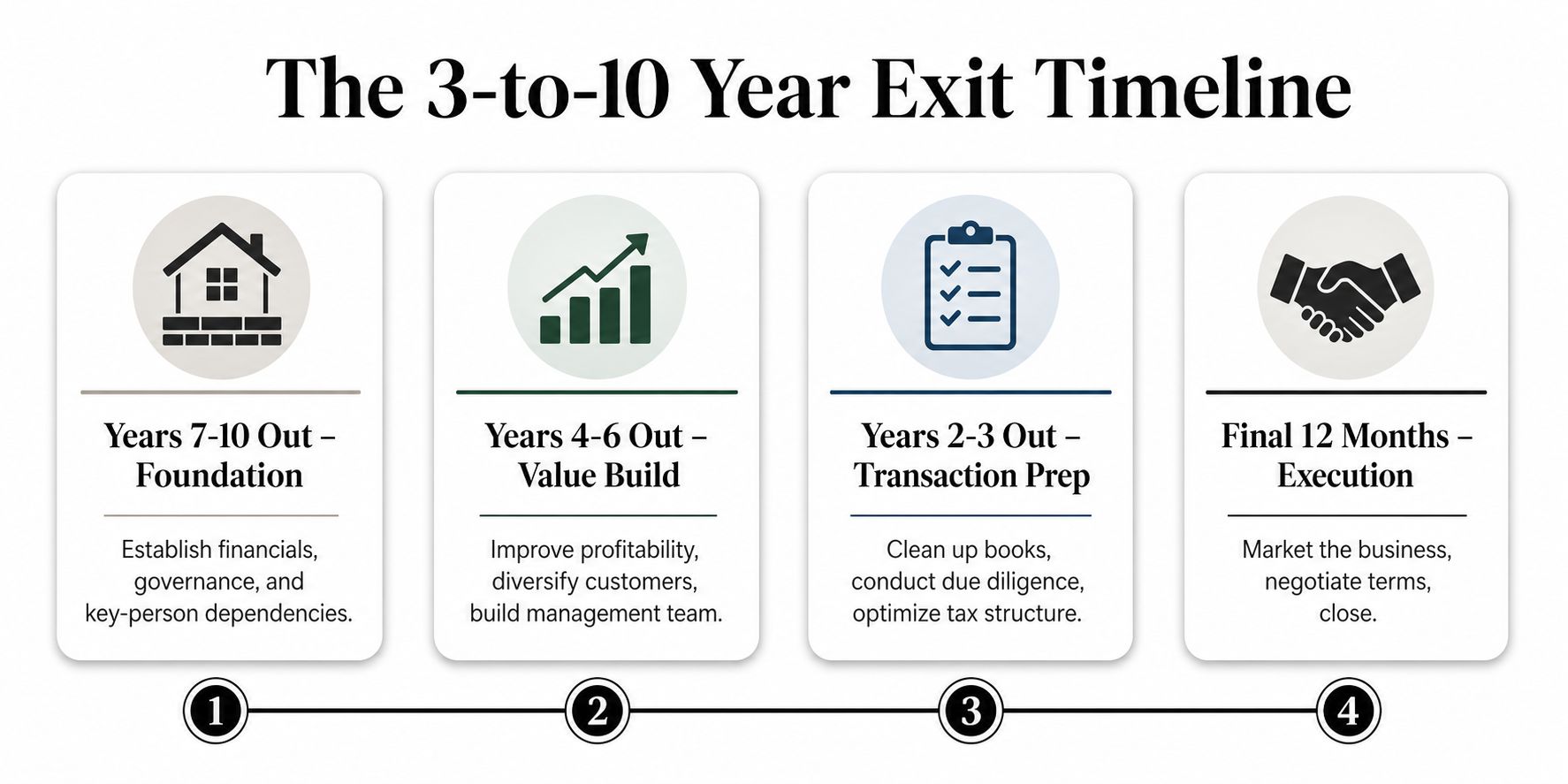
Years 7 to 10 out, foundation
Build the company you'd want to buy if you were an outsider.
- Clean up the chart of accounts and establish consistent monthly reporting.
- Document standard operating procedures for critical workflows.
- Remove yourself from routine approvals and customer escalation.
- Create a baseline KPI dashboard that leadership reviews every month.
The first 90 days should produce an operating baseline, not a vague intention to “get organized.”
Years 4 to 6 out, value build
The business earns a stronger future valuation.
- Improve gross margin by job, client, product, or service line.
- Reduce customer concentration and strengthen commercial contracts.
- Build management depth so decisions don't return to the founder.
- Establish recurring revenue where the business model supports it.
Margin expansion without better management creates a fragile result. Management depth without financial discipline creates expensive overhead. You need both.
Years 2 to 3 out, transaction preparation
Prepare the company to withstand scrutiny.
- Produce quality-of-earnings-ready financial statements.
- Draft the confidential information memorandum.
- Map likely strategic, private equity, family, and management buyers.
- Review tax and legal structures with the appropriate advisors.
Final 12 months, execution
The final year is for controlled execution, not reinvention.
- Build the buyer data room.
- Prepare management presentations.
- Coordinate diligence responses.
- Negotiate the letter of intent and final purchase agreement.
A compressed process forces decisions into the worst possible window. Start the first 90 days of your current planning phase now, regardless of whether your exit is years away.
Comparing the Four Main Exit Paths for Founder-Led Businesses
There isn't one universally correct exit. The right path depends on your desired liquidity, role after closing, family goals, tax position, successor readiness, and tolerance for complexity.
| Exit Path | Best Fit | Typical Timeline | Tax Structure | Management Depth Required | Owner Outcome |
|---|---|---|---|---|---|
| Third-party sale, strategic or private equity | Owners seeking liquidity and a competitive process | Often about 6 to 12 months once marketed, with preparation earlier | Depends on asset or equity structure and tax advice | High | Cash, possible retained equity, limited or continuing involvement |
| Internal transfer, family or management buyout | Owners prioritizing continuity and known leadership | Family succession commonly requires 5 to 10 years to develop a successor | Gift, sale, staged withdrawal, trust, or transfer at death may apply | Very high | Legacy, staged liquidity, and possible ongoing role |
| ESOP | Owners who want employee ownership and continuity | Requires careful planning and transaction execution | Can involve seller financing and specialized tax structuring | High | Legacy, employee ownership, and structured liquidity |
| IPO | Businesses with scale, governance, reporting infrastructure, and public-market suitability | Multi-year preparation may be necessary | Complex public-company and shareholder tax considerations | Exceptional | Liquidity, retained ownership, and public-company obligations |
A strategic sale can produce the strongest near-term cash outcome when the business has durable earnings, credible management, and strategic value. It also gives the buyer the most control over diligence, integration, and post-close decisions. An internal transfer may preserve relationships and legacy but often requires more patience and creative financing.
An ESOP can preserve employee ownership, though it brings fiduciary, valuation, governance, and financing requirements. An IPO is rarely realistic for smaller founder-led companies because public reporting and governance demands can overwhelm an otherwise healthy operating business.
Screen yourself with three questions:
- Do you want a clean break or ongoing involvement?
- Is next-generation leadership ready to run the company without you?
- What after-tax amount would materially change your life?
Don't select a path because it sounds prestigious. Select it because it matches the life and liquidity outcome you want.
Readiness Metrics, EBITDA Multiples, and the Buyer-Ready KPI Dashboard
A buyer-ready company makes its economics easy to understand. That starts with EBITDA, or earnings before interest, taxes, depreciation, and amortization, but EBITDA isn't enough by itself. Buyers examine how repeatable those earnings are, who produces them, and what could cause them to disappear.
One source describes common exit-planning valuation methods as EBITDA multiples, discounted cash flow, and comparable transactions, with a mid-market range of roughly three to eight times EBITDA depending on sector and risk. The multiple rises or falls based on the quality of the earnings and the risk attached to them.
Build the dashboard buyers can trust
Your monthly dashboard should include:
- Revenue growth by customer, service line, and channel.
- Gross margin by job, client, or product.
- EBITDA margin and reconciliation to reported earnings.
- Net retention where recurring revenue applies.
- Working-capital days and cash conversion.
- Free-cash-flow conversion.
- Customer concentration and contract status.
- Forecast versus actual performance.
The dashboard isn't a vanity report. It should tie to the general ledger, balance sheet, cash flow statement, and tax returns. A buyer should be able to trace a KPI to source records without a manual explanation from the founder.
Use this financial due diligence resource to structure the reporting work before a buyer asks for it.
Readiness tests
Treat these as operating standards rather than decorations in a presentation:
- Revenue retention: Aim for 90% or higher where retention is relevant to your business model.
- Reporting ownership: Put controller-level accountability behind the monthly close.
- Model integrity: Maintain a three-statement model that ties to tax returns.
- Risk coverage: Document standard operating procedures for the top three operating risks.
- Management independence: Make sure the company can make routine decisions without your involvement.
The strongest dashboard is produced monthly, reviewed by leadership, and used to change decisions. If it only appears when diligence begins, it isn't a management system.
Common Mistakes That Quietly Destroy Exit Value
Most failed exits don't fail because the owner lacks ambition. They fail because the company has avoidable risks that become visible at exactly the moment the owner needs strategic advantage.
Waiting until a buyer appears
Starting preparation after a buyer is engaged leaves little time to improve earnings quality, document processes, or fix customer risk. The operational fix is a standing monthly readiness review, supported by clean financial reporting and a written improvement backlog.
Optimizing for taxes instead of transferable earnings
Minimizing taxable income can make sense in a narrow annual-tax context, but buyers pay for sustainable, defensible earnings. Excessive discretionary expenses, inconsistent adjustments, and weak documentation make normalized EBITDA harder to defend.
The fix is to separate tax reporting from management reporting. Maintain a clear reconciliation that shows legitimate add-backs and recurring operating costs without pretending ordinary expenses are nonrecurring.
Leaving customer relationships undocumented
A business dependent on two or three customers without strong contracts carries renewal and transition risk. The fix is written customer agreements, a documented sales playbook, account ownership outside the founder, and regular concentration reporting.
Keeping every important decision with the founder
Founder dependency shows up in client relationships, vendor approvals, hiring, pricing, and exceptions. Buyers discount businesses when key relationships and institutional knowledge leave with the owner. A delegated authority matrix, role-based approvals, and documented account plans reduce that risk.
Underinvesting in systems and management
A data room can't repair a weak monthly close or an inexperienced leadership team. The fix is a close calendar completed within 10 business days, consistent financial definitions, documented procedures, and leadership accountability for operating KPIs.
Buyers don't pay extra for a founder who remains indispensable. They pay for a company that can perform after the founder leaves.
When to Bring in a CEPA or Fractional CFO
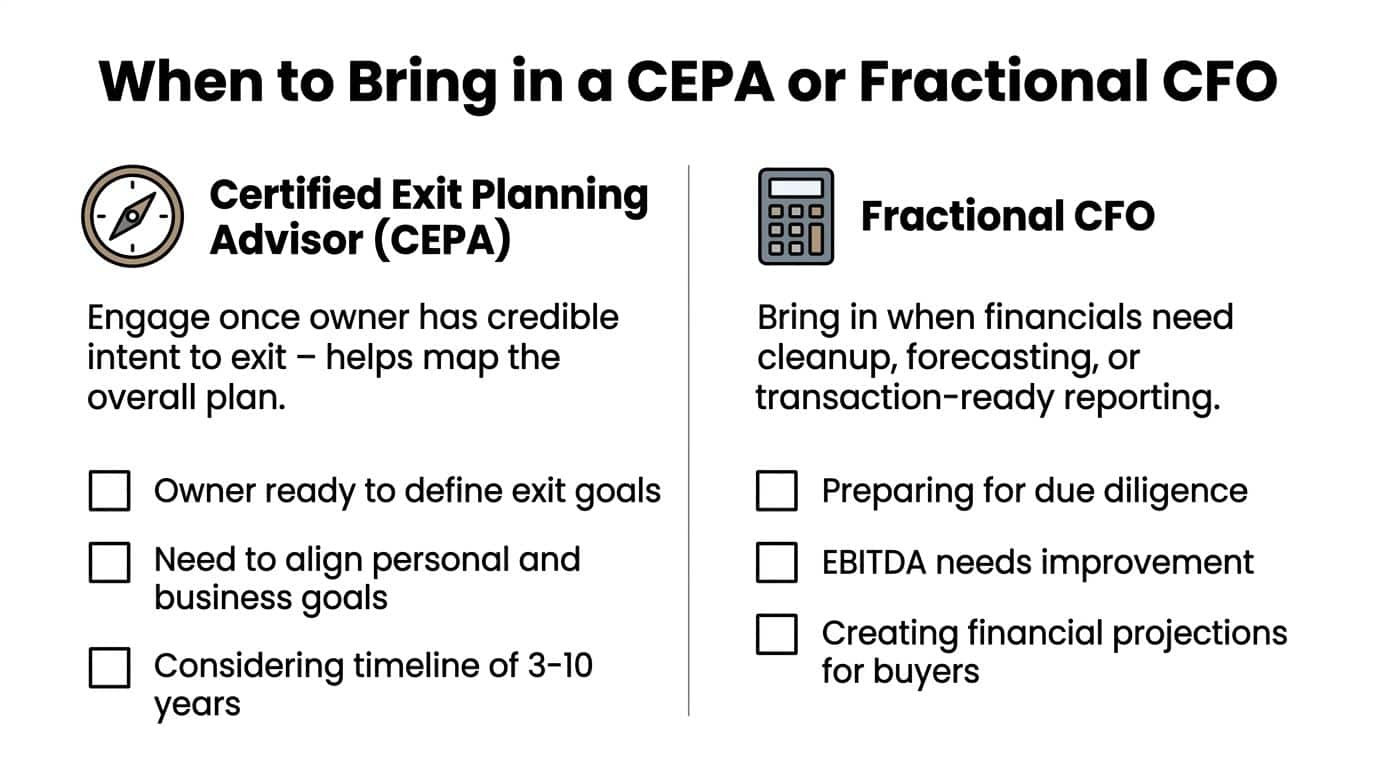
A Certified Exit Planning Advisor and a fractional CFO solve different problems. A CEPA helps coordinate the full transition plan around personal goals, business value, ownership structure, estate planning, tax strategy, and the advisory team. A fractional CFO improves the financial and operating system that makes the plan achievable.
Engage a CEPA when you have a credible intent to exit within 3 to 10 years and need to pressure-test the path. That advisor can help coordinate an investment banker, attorney, wealth manager, valuation professional, and tax advisor around one owner outcome rather than a collection of disconnected recommendations. A CEPA should help answer who will own the company, who will run it, how control transfers, and when the transition occurs.
A fractional CFO earns value earlier, often when revenue reaches $5M and the founder's decisions about customer concentration, recurring revenue, margins, and management depth begin to affect valuation directly. The role isn't bookkeeping, tax preparation, audit, valuation, or fundraising. It's senior-level financial leadership focused on forecasting, cash flow, profitability, reporting, and decision support.
Three clear CFO trigger points
Bring in financial leadership when:
- EBITDA falls below 15% of revenue: You need margin analysis and an operating plan, not just a year-end report.
- The founder owns client relationships: Build account coverage, a sales playbook, and management accountability.
- Rolling 13-week cash flow is missing: Replace gut feel with a forward-looking liquidity model.
A practical cadence pairs a value-gap analysis with the CEPA roadmap, a 90-day cash flow model with weekly decisions, and KPI dashboards with quarterly readiness reviews. AmbitionCFO provides these financial planning and reporting services for founder-led businesses as one possible fractional CFO resource. Owners considering the broader advisory relationship can also review CEPA exit-planning support before choosing their advisor mix.
Your First 30 Days and the Next Step with AmbitionCFO
You don't need a transaction mandate to start. You need a fact base.
Week one, establish the financial baseline
Pull the trailing 24 months of profit and loss statements. Calculate owner-discretionary earnings, separate recurring from unusual items, and write down the amount you need at exit in today's dollars.
Don't begin with a valuation multiple. Begin with your personal requirement and the earnings your company would need to support it.
Week two, map relationship risk
List your top ten customer relationships. For each one, record the revenue contribution, contract status, renewal timing, gross margin, primary relationship owner, and the percentage of revenue that might leave if you stopped selling or servicing the account.
If the founder is the only relationship owner, mark it as a transition risk. A useful sales and positioning resource, including SaaS founder content ideas, can help teams think more deliberately about founder-independent market communication, even when the business isn't a SaaS company.
Week three, test management depth
Ask a blunt question for every critical role: Could this position remain vacant for 90 days without affecting revenue? If the answer is no, document the risk, identify a backup, and assign a development plan.
Week four, convert findings into action
Book a free diagnostic call with AmbitionCFO and turn the inputs into a one-page readiness scorecard. The next deliverable should be a sequenced 90-day plan covering a cash flow model, margin analysis, and KPI dashboard build-out. Owners preparing for a sale can also review transaction advisory services to understand how financial preparation supports the deal process.
Treat the engagement as a time-boxed diagnostic, not an automatic multi-year commitment. The immediate objective is to identify the highest-value operating changes, assign owners, and start measuring progress.
AmbitionCFO helps founder-led businesses build cash-flow visibility, margin discipline, financial forecasts, KPI dashboards, and exit-readiness systems before a transition is urgent. Visit AmbitionCFO to schedule a diagnostic conversation and turn your next 30 days of information into a focused 90-day operating plan.