

The phases of company growth are startup, survival, growth, scaling, and maturity or exit, and only 34.7% of private-sector establishments born in March 2013 were still operating in March 2023. That survival pattern tells you the task isn't chasing revenue at every size. It's recognizing which phase you're in, then changing how you manage cash, people, and decisions before the old playbook breaks the business you built.
Table of Contents
- Why the Phases of Company Growth Matter
- The Five Phases of Company Growth Explained
- Financial Priorities and Pitfalls by Growth Phase
- Spotting the Inflection Points Between Phases
- How Growth Phases Play Out in Real Businesses
- Choosing the Right Financial Leadership for Your Phase
- Your Next Move in the Growth Journey
Why the Phases of Company Growth Matter
Most owners ask the wrong first question. They ask how fast they can grow when they should ask which phase they're in and what that phase demands financially. A founder who built a company on instinct, personal relationships, and watching the bank balance can reach a size where those same habits hide margin leaks, slow collections, and bad hiring decisions. The company looks bigger. Control feels thinner.
The ten-year picture is sobering. U.S. Bureau of Labor Statistics data on establishments born in 2013 show that only 34.7% were still operating in March 2023, with the sharpest contraction, a 20.4 percentage-point drop, occurring in the first year. Construction fell even harder, down 24.0 points in year one. Those numbers matter for established owners too, because every later transition repeats the same test in a new form. Can you fund what you're trying to build?
Consider a founder weighing a larger contract, a second location, or a senior hire. Revenue says yes. The forecast, if one exists, is a spreadsheet built on hope. Without knowing your phase, you can't tell whether that move needs cash preservation, working capital discipline, delegated management, or a slower pace to protect future sale value.
What Phase Awareness Gives You
- Clearer priorities: You stop applying startup frugality to a scaling problem, or scaling spending to a survival problem.
- Earlier warnings: You watch the metric that breaks first in your phase, instead of waiting for the bank account to deliver the news.
- Better capital decisions: You match each investment to the cash it will consume and the return it must produce.
Growth isn't a smooth line upward. It's a sequence of financial regimes, each with its own cash behavior, KPI focus, and failure mode. Learn to read yours and you've taken the first step toward growth that's funded, not fatal.
The Five Phases of Company Growth Explained
Treat each phase as a different financial job. The signs below help you locate yourself by how cash behaves, how decisions get made, and what breaks when you push harder. Revenue alone won't tell you.
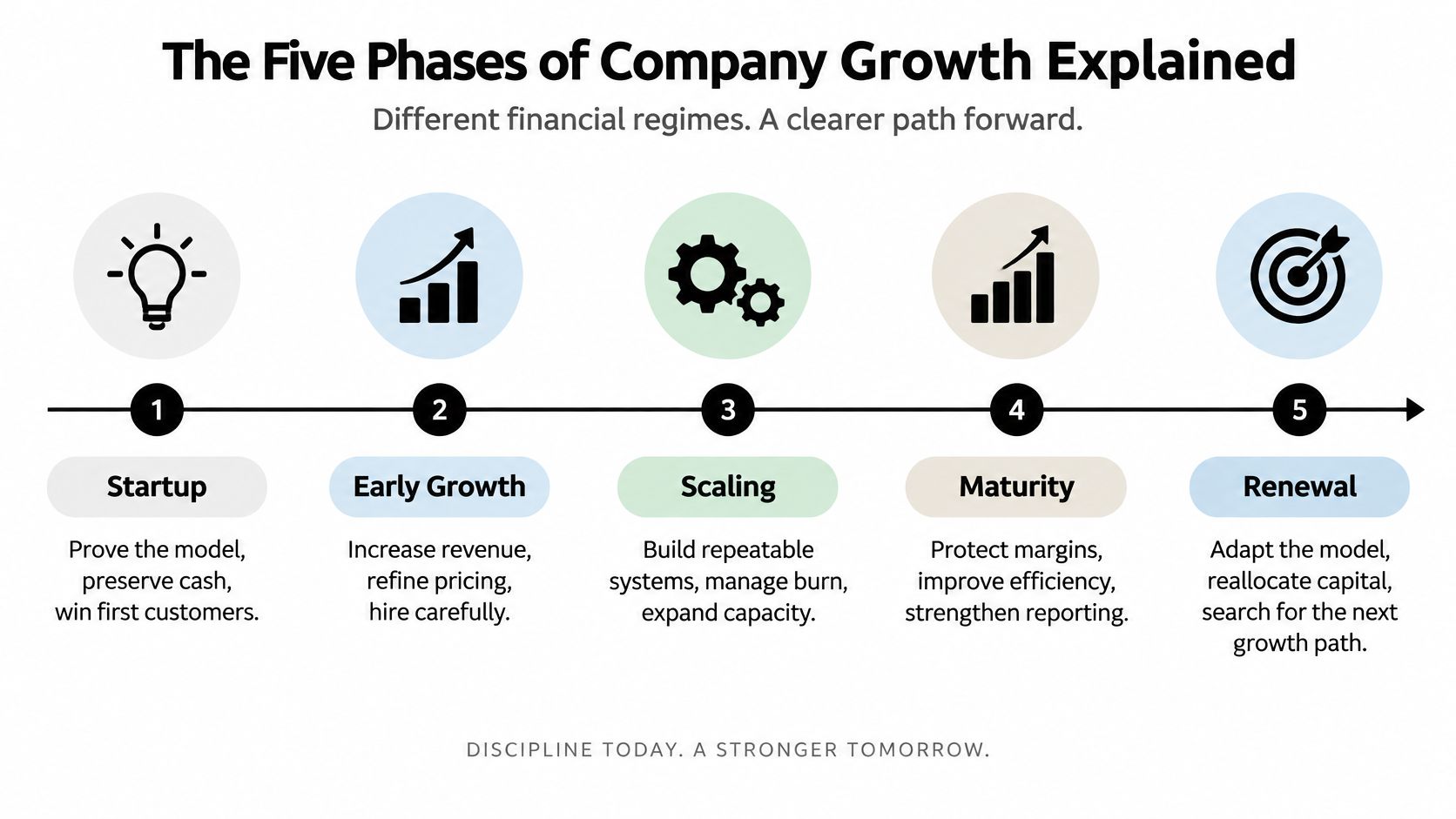
Startup Phase
Your job is to prove someone will pay, repeatedly, at a price that can work. Cash preservation beats polish. The founder sells, delivers, collects, and often does the books. Signs include irregular revenue, few customers, and decisions made the same day they're raised. Your headline metric is cash runway, meaning how long current cash covers operations if sales stall. The question to ask is simple. Do we have a repeatable offer, or just a few good months?
Survival Phase
Revenue becomes more regular, but cash stays fragile. You have customers and payroll, yet one late payer or one underpriced job can wipe out the month. The founder still approves most spending because there's no real system to replace that oversight. Watch gross margin by job, customer, or contract. If you can't see which work makes money, you're guessing at pricing. Owners at this point often benefit when they compare automated business solutions for invoicing and reporting, because manual tracking breaks before revenue does. Your core question changes. Can we deliver profitably without heroic effort every week?
Growth Phase
Demand is proven and you're reinvesting to serve it. You hire ahead of revenue, buy equipment, add inventory, or open capacity. Operating results improve, but cash often feels worse, not better, because growth consumes it first. Signs include a busier pipeline, pressure on your credit line, and arguments about whether you can afford the next hire. Your headline metric is cash conversion, the speed at which reported profit becomes collected cash. Ask whether each new dollar of revenue funds itself or drains the dollars already earned.
Scaling Phase
Founder intuition stops being a management system. You need managers who own results, standardized reporting, and decision rights that don't route through you. The shift is structural. BLS analysis of establishment age and employment found first-year establishments employed about four people on average, while establishments 29 years and older employed about 35, nearly nine times as many. That gap isn't just headcount. It represents layers, procedures, and controls. Watch forecast accuracy and capacity utilization. Your question becomes whether the organization can grow without you personally catching every problem.
Maturity or Exit Phase
Growth slows or stabilizes, and the owner's horizon changes. You may reinvest for renewal, enter new markets, defend margins, or prepare for ownership transition. Signs include established processes, a management bench, and strategic choices about where capital earns the best return. Your headline metric is earnings quality, meaning profit that's repeatable, documented, and not dependent on you. Ask whether the business would keep performing if you stepped back for a quarter. If the answer is no, transferability work is your growth work now.
Financial Priorities and Pitfalls by Growth Phase
Profit and cash part ways as you grow, and that split confuses good operators. Research on growth-phase cash flow patterns shows operating cash flow typically turns positive while investment cash flow remains negative, so external financing may still be required. A company can report increasing revenue and improving EBITDA while facing liquidity stress if receivables and inventory grow faster than payables. Construction and distribution owners know this pattern through retainage, milestone billing, and extended payment terms.
Operating cash flow is cash generated by day-to-day operations. Investment cash flow is cash spent on capacity, equipment, and expansion. When the second grows faster than the first, growth needs funding even in a profitable year. That's not failure. It's a timing problem you must manage deliberately.
Financial Priorities by Growth Phase
| Growth Phase | Cash-Flow Reality | Primary KPI Focus | Biggest Pitfall |
|---|---|---|---|
| Startup | Cash out before reliable cash in | Cash runway | Spending before proof of demand |
| Survival | Revenue arrives, collections wobble | Gross margin by job or customer | Underpriced work that fills capacity |
| Growth | Operating cash positive, investment cash negative | Cash conversion cycle | Receivables and inventory outpacing payables |
| Scaling | Larger inflows, larger fixed commitments | Forecast accuracy and return on invested capital | Founder bottleneck and uncontrolled overhead |
| Maturity or exit | Cash steadier, reinvestment choices matter | Earnings quality and customer concentration | Stagnation or growth that harms transferability |
In startup and survival, protect cash and price fairly. Bill fast, collect faster, and know your margin before you discount to win work. Many owners hire for the company they hope to become and then carry payroll the current company can't support. Discipline here looks boring. It keeps you alive.
In growth, run a 13-week cash-flow model. That's a week-by-week forecast of receipts and disbursements for the next quarter, updated on a rolling basis. Pair it with investment-approval thresholds, so equipment, hires, and inventory builds above a set amount need a cash case, not just enthusiasm. Reading why working capital discipline matters as you scale helps owners see that receivables, inventory, and payables are funding decisions, not back-office details.
Practical rule: Never approve a growth investment on projected profit alone. Approve it on when the cash comes back and what happens to liquidity in between.
In scaling, shift to capital allocation and covenant management. Your lender cares about forecasted cash conversion, not your pipeline. In maturity, protect earnings quality. Recurring or contracted revenue, documented processes, and a team that doesn't depend on you are worth more than one aggressive year that leaves margins volatile.
Spotting the Inflection Points Between Phases
A company changes phases when the decisions that once worked start consuming cash, margin, or management capacity faster than the business can replace them. Revenue milestones matter less than control. The owner usually feels the strain first: sales are up, the calendar is full, and the numbers are harder to trust.
That pattern is common. McKinsey's analysis of companies that fail to scale reports that 78% of companies that achieve product-market fit fail to scale, because practices that worked early become constraints later. Treat the finding as a warning about institutionalization. Founder effort can cover weak processes for a while, but it cannot make the business transferable.
Run the Owner Approval Test
List every decision that still needs your approval this month. Sort each one into strategic, financial, operational, or routine. I look for one telling question: can managers explain what they are allowed to spend, discount, or schedule without checking with you?
If routine items dominate your list, the company has outgrown founder-led control. Set decision rights, spending limits, pricing authority, and weekly reporting that managers use. Keep your approval for capital commitments, major pricing changes, and decisions that can materially affect liquidity.
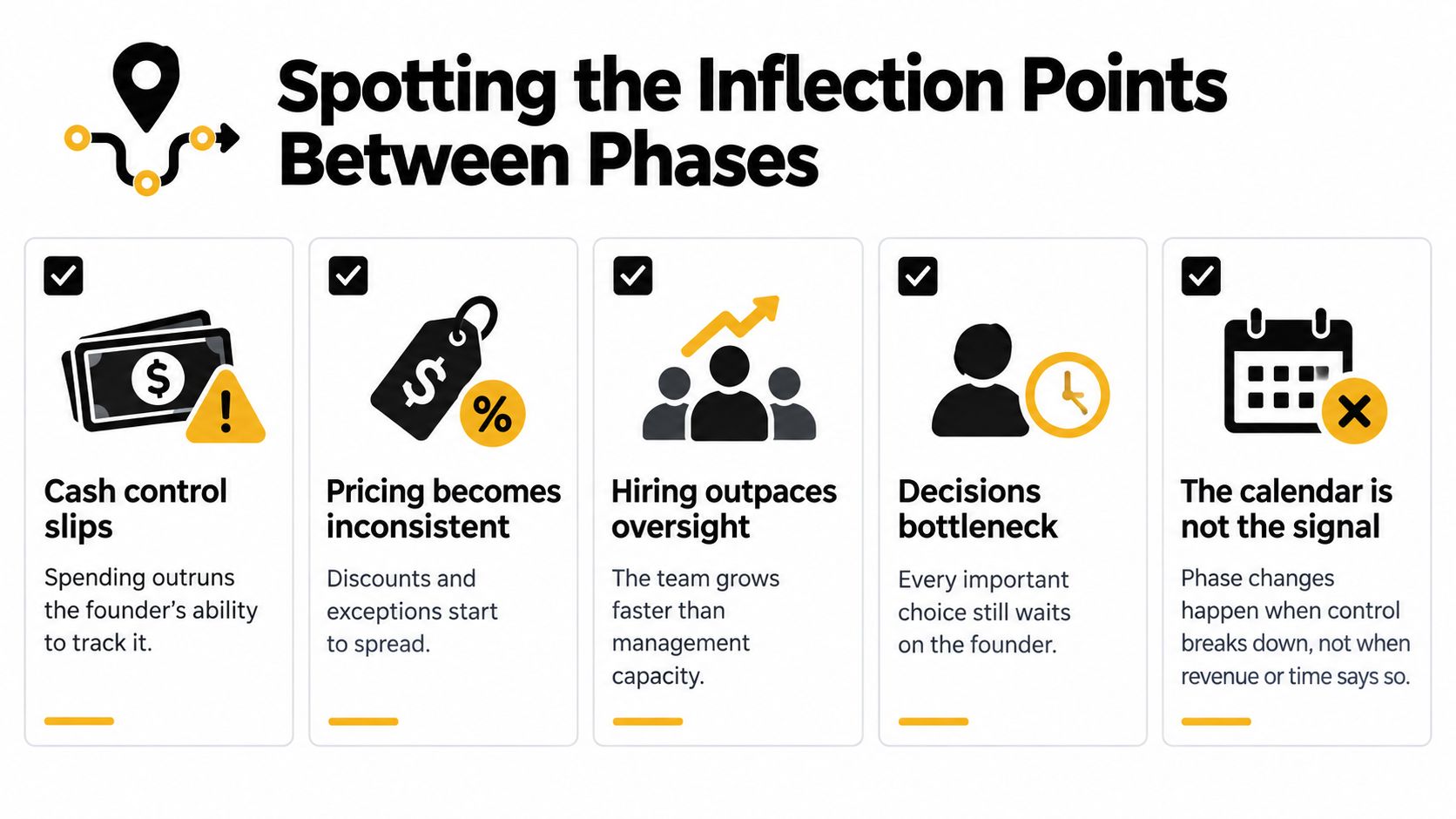
Warning Signs Your Playbook Has Expired
- Cash surprises repeat: Payroll feels uncertain even during strong revenue months.
- Pricing authority blurs: Discounts and exceptions spread because no one owns margin consistently.
- Hiring outruns management: New employees arrive faster than managers can train and measure them.
- Reports arrive too late: A bad job, rising cost, or slow payer becomes visible after the cash is gone.
- Forecasting stays informal: Major commitments are made from the bank balance and owner judgment.
Each sign points to the same operating gap. The company still depends on your memory and intuition where repeatable controls should be doing the work. Replace static budgets with rolling forecasts, informal measures with standard KPIs, and one-off commitments with tested capital decisions.
Learning how to use scenario planning for cash-flow decisions lets you test slower collections, margin compression, or a delayed project before committing money. That discipline also supports exit value. A buyer can underwrite repeatable cash generation more easily than earnings that depend on the founder catching every problem personally.
How Growth Phases Play Out in Real Businesses
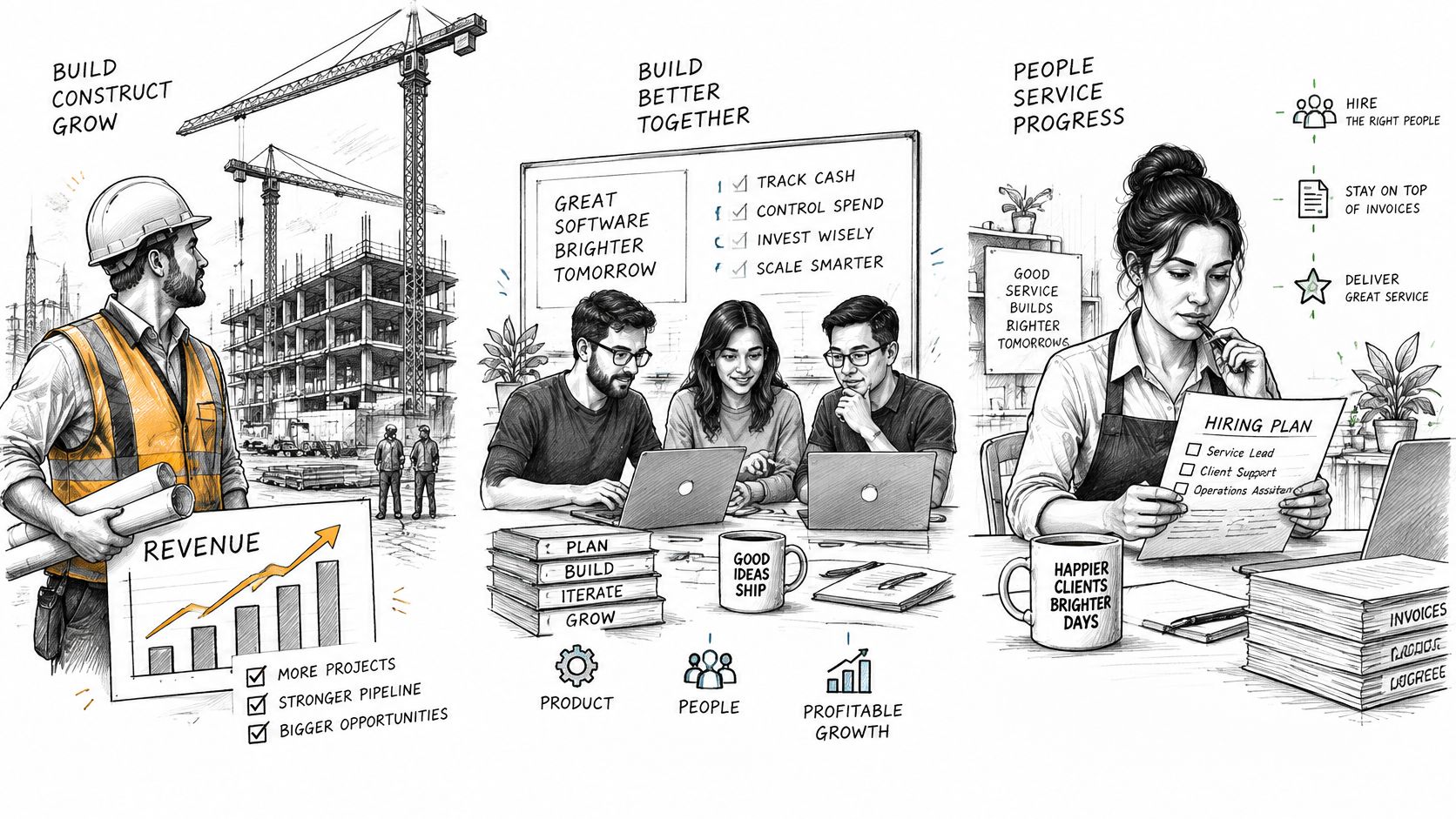
The framework becomes useful when you can see your own week inside it. The three situations below are composite patterns from construction, distribution, and professional services. Each owner was growing. Each had a different cash problem hiding under the same word, growth.
The illustration below reflects how differently growth pressure shows up across operating models.
Construction Revenue Up and Liquidity Down
A contractor doubles revenue by winning larger projects, then discovers retainage and milestone billing keep earned cash locked up for months. Crews and materials get paid now. Collections arrive later. That's a growth phase cash conversion problem, and job-level cash reporting would have surfaced it early. The CFO move is a project-by-project cash forecast tied to billing milestones, plus tighter change-order approval before work proceeds.
Owners looking for outside perspective on scaling discipline sometimes review growth strategies from Dealmaker Wealth Society alongside their own numbers. Outside ideas help only when your forecast can tell you which ones you can fund.
Distribution Growth Financed by Inventory
A distributor builds inventory ahead of a major contract and watches the credit line shrink faster than collections arrive. Sales projections look strong. The cash is sitting on warehouse shelves. Inventory days, meaning how long stock sits before it sells and collects, was the metric that mattered. The fix is phased purchasing tied to confirmed demand and a borrowing-base forecast. Understanding the hidden costs of rapid growth and forecasting prevents a good contract from creating a liquidity crisis.
The short video below walks through how forecasting discipline changes growth decisions like these.
Professional Services and the Founder Bottleneck
An owner nearing 60 runs a healthy firm, but every pricing call, key hire, and client escalation still runs through them. Revenue is fine. Transferability isn't. The metric that exposes it is management succession coverage, whether each critical role has a capable backup. The move is documented pricing authority, a leadership bench, and client relationships spread across the team. Same framework, three industries, three different first fixes. Your billing model decides where growth bites first.
Choosing the Right Financial Leadership for Your Phase
Your phase determines the financial help you need. Buying more help than the phase requires wastes money. Buying less costs you visibility at exactly the moment decisions get expensive.
Three Realistic Options
- Bookkeeper plus CPA: This pairing handles compliance, closes the books, and files taxes. It works in startup and early survival. It won't build forecasts, price work, or warn you about a cash gap two months out, because that's not its job.
- Full-time CFO: The right answer at sufficient scale, when complexity fills a senior executive's week. The trade-off is a major fixed salary commitment before some growth-phase companies have the volume to justify it. Reading when to hire a CFO for your company helps you test whether your decision load has reached that point.
- Fractional CFO: Senior financial leadership embedded part-time with your team. This fits the growth and scaling phases well, when you need forecasting and capital discipline but not a full-time executive.
A fractional engagement typically covers 13-week cash flow modeling, margin analysis by job or client, KPI dashboards, budgeting, rolling forecasts, and lender-ready reporting. AmbitionCFO works in that fractional model with founder-led companies in construction, distribution, and professional services, matching services like cash flow modeling and exit planning to the phase the owner is navigating. The point isn't more reports. It's fewer surprises.
If your financial help only tells you what happened last month, you've hired for your last phase, not your next one.
The exit timeline deserves honesty here. A 2025 survey of small-business owners and succession readiness reported more than half of owners were age 55 or older, yet only 54% had a formal succession plan. In that same survey, 53% said they lacked resources or guidance to plan, and 56% worried they wouldn't receive a fair price. Transferability takes years to build. If an exit sits anywhere in your next decade, late growth is when that work starts, while you still have time to fix customer concentration and founder dependence.
Your Next Move in the Growth Journey
You now have a working map. Five phases, each with its own cash behavior, headline KPI, and characteristic mistake. Startup proves the model, survival makes it repeatable, growth funds expansion, scaling replaces founder control with systems, and maturity or exit turns performance into lasting value. The phases of company growth reward owners who change their financial habits before circumstances force the change.
Locate Yourself in Three Steps
- Name your phase: Match your cash behavior and decision patterns to the signs above, not to your revenue.
- Check for an inflection: Run the owner approval test and consider whether routine decisions still wait on you.
- Pick one priority: Choose the single financial focus your phase demands, whether that's billing discipline, a 13-week cash flow model, or succession coverage.
Before you chase the next opportunity, decide how you'll grow. Comparing organic growth versus inorganic growth paths clarifies whether expansion should come from your current engine or from acquisition, and what each path demands from your cash. Then build or commission your 13-week cash flow model this quarter. It's the one tool that serves every phase, and it's where funded growth starts.
If you've located your phase and the next move involves cash you can't yet forecast with confidence, a fractional CFO engagement can build the 13-week model, KPI visibility, and capital discipline your stage demands without a full-time hire. Visit AmbitionCFO to start a conversation about matching senior financial leadership to where your company stands.