

What must be ready before you invite buyers in? The central question is not just, “What is my business worth?” It's whether a buyer can understand the business quickly, trust the numbers, see how it operates without you, and defend the purchase to a lender, investment committee, or board.
A strong checklist for selling a business reduces buyer risk before marketing begins. It connects financial cleanup, cash conversion, customer and job profitability, contract transferability, management depth, diligence records, owner readiness, and the post-close handoff. The sequence below is designed to turn preparation into an action tracker with named owners across finance, legal, operations, and leadership.
You'll see normalized EBITDA, which means earnings before interest, taxes, depreciation, and amortization adjusted for unusual, personal, or non-recurring items. Working capital is the operating liquidity tied up in receivables, inventory, and payables. Key-person risk exists when critical decisions or relationships depend on one owner or employee. A data room is the secure, organized collection of documents buyers review during diligence.
AmbitionCFO can support 13-week cash-flow modeling, profitability analysis, KPI packaging, forecasting, and CEPA-based exit planning. Legal, tax, valuation, audit, and transaction work still belongs with the appropriate specialists.
Table of Contents
- 1. Establish Your Current Financial Baseline and Valuation Range
- 2. Optimize Cash Flow and Working Capital Before Marketing
- 3. Audit and Optimize Your Pricing Strategy and Margins
- 4. Clean Up Your Customer and Revenue Concentration
- 5. Prepare Comprehensive Due Diligence Documentation
- 6. Resolve Legal, Compliance, and Contractual Issues
- 7. Strengthen and Document Your Management Team
- 8. Package the KPIs Buyers Use to Test Business Quality
- 9. Build a CEPA-Aligned Owner Transition Plan and Timeline
- 10. Build and Present a Compelling Financial Narrative and Business Story
- 11. Select the Right Broker, Advisor, and Process Structure
- 12. Create a Detailed Transition and Integration Plan
- 12-Point Business-Sale Readiness Comparison
- Turn the Checklist Into Your Next 30-Day Action Plan
1. Establish Your Current Financial Baseline and Valuation Range
Can a buyer reproduce your reported earnings without asking you to explain every line? Build that answer before marketing begins. Collect historical income statements, balance sheets, cash-flow reports, tax filings, debt schedules, revenue by customer or product, and recurring-revenue detail. Use a three-year lookback for bank statements, debt agreements, customer revenue, billings, revenue-recognition support, sales pipeline, win rates, and churn analysis.
Define normalized EBITDA, earnings before interest, taxes, depreciation, and amortization adjusted for unusual, owner-specific, or non-recurring items. Record every adjustment with its amount, business reason, and supporting evidence. A defensible add-back can improve the valuation case. An unsupported one creates a buyer question and may reduce confidence in the entire forecast.
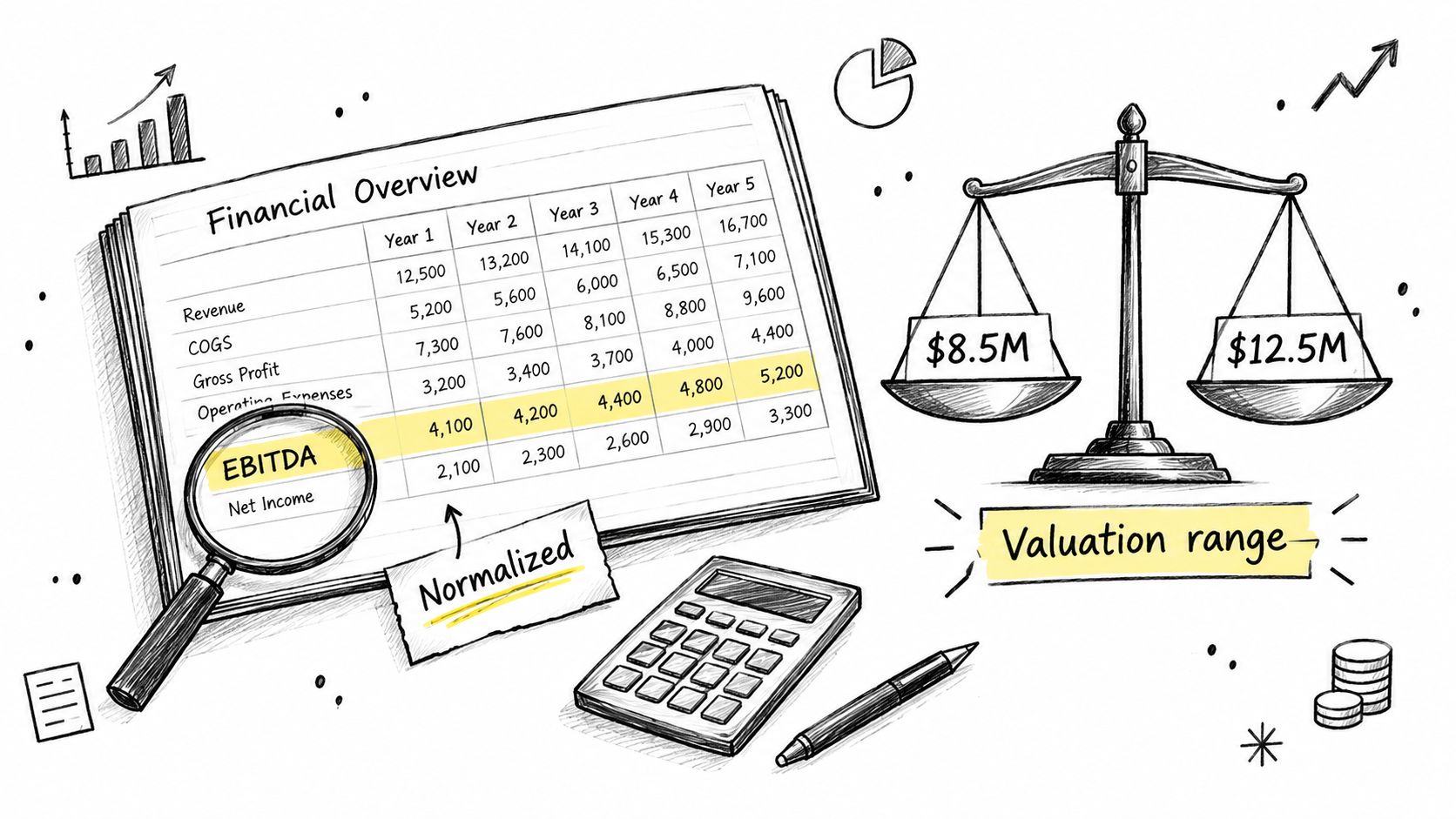
Build a baseline worksheet
Create five working tabs:
- Historical statements: Organize financial statements and tax records.
- Adjustment register: List each normalization, amount, reason, and evidence.
- Revenue schedule: Separate recurring, contracted, repeat, and one-time revenue.
- Concentration view: Show customer, product, geography, and channel exposure.
- Valuation assumptions: Record the method, multiple range, risks, and sensitivities.
Treat the valuation range as a planning tool, not a promised sale price. Use it to rank improvements, test downside cases, and discuss assumptions with a CPA, valuation professional, or exit-experienced fractional CFO. For a practical valuation framework, see this guide to valuing a small business for sale.
2. Optimize Cash Flow and Working Capital Before Marketing
Profit doesn't automatically become cash. A profitable company can still alarm buyers if receivables are slow, inventory is excessive, or growth consumes liquidity faster than customers pay.
Build a rolling 13-week cash-flow model by week. Start with beginning cash, then forecast customer collections, payroll, vendor payments, taxes, debt service, capital spending, and other committed outflows. End each week with projected cash, compare the forecast with actual results, and explain every material variance. This model gives you a forward view that a year-end income statement can't provide.
Track the operating drivers behind the forecast:
- Receivables: Review days sales outstanding by customer, not just as a company average.
- Inventory: Identify obsolete, slow-moving, seasonal, and strategically necessary stock.
- Payables: Preserve supplier trust while using agreed payment terms consistently.
- Work in progress: Confirm that unbilled work is recoverable and supported by documentation.
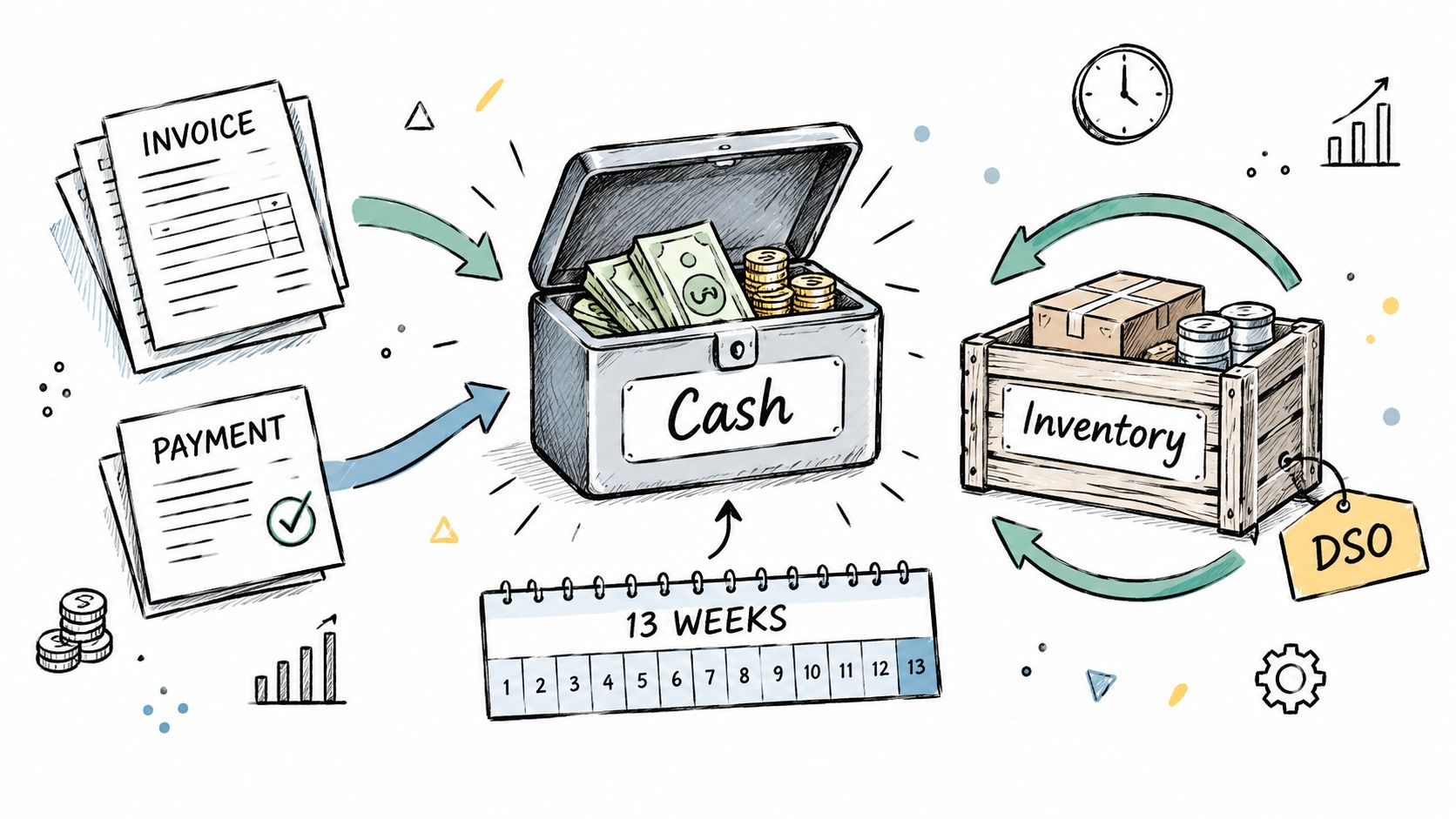
Working capital also affects the post-close true-up. Buyers and sellers usually negotiate a working-capital target, often called a peg, and the final purchase price can change if delivered working capital differs from that target. Working-capital optimization guidance can help you structure the model, while cash flow planning for Dubai businesses offers a separate perspective on forward liquidity planning.
3. Audit and Optimize Your Pricing Strategy and Margins
A buyer won't rely on company-wide gross margin alone. They'll want to understand which customers, jobs, products, and services create cash and which ones consume management attention without adequate return.
Build a profitability worksheet with revenue, direct labor, materials, freight or delivery, subcontractors, allocated overhead, and contribution margin. Use consistent allocation rules, then test whether those rules reflect how the business operates. A low-margin customer may still be strategically valuable, but you should be able to explain why and identify the path to improvement.
The analysis should match the industry:
- Construction: Review original bids, approved and unapproved change orders, scope creep, job close-out, WIP, and final gross margin.
- Distribution: Examine SKU margin after handling, freight, storage, rebates, returns, and purchasing costs.
- Professional services: Analyze client, project, utilization, realization, WIP, staffing mix, and write-offs.
A useful approach is to rank accounts or jobs by contribution, then investigate the bottom group. Some can be repriced. Some need tighter scope controls. Others should be declined or redesigned.
Practical rule: Don't hide low-margin work from buyers. Explain what caused it, what you changed, and whether the improvement is already visible in the reporting.
For example, a contractor may discover that profitable projects are being diluted by underpriced change orders. A distributor may find that a product line appears attractive before delivery and handling costs, but loses money after them. A professional-services firm may learn that revenue growth is masking poor realization. Buyers respond better to a documented management response than to unexplained margin volatility.
4. Clean Up Your Customer and Revenue Concentration
Customer concentration is a risk question, not merely a sales-reporting issue. A buyer needs to know whether revenue will remain after ownership changes, whether contracts can transfer, and whether the owner personally holds the relationship.
Create a concentration dashboard showing the top five and top ten customers, revenue by customer and segment, retention, contract length, renewal terms, recurring versus one-time revenue, gross margin, payment behavior, and relationship owner. Add a risk rating and an action for each major account.
Diversification doesn't mean chasing every possible market. It means reducing dependence on a narrow group without sacrificing profitable relationships. A construction company may develop relationships with additional general contractors. A distributor may balance a heavily concentrated channel with carefully selected wholesalers. A professional-services firm may move client relationships from the founder to a broader account team.
Test the quality of revenue
Review each major relationship against four questions:
- Transferability: Can the contract move to a buyer, or is consent required?
- Durability: Is revenue recurring, repeat, project-based, or dependent on a personal relationship?
- Profitability: Does the account generate acceptable contribution after service costs?
- Continuity: Will the customer remain comfortable after the announcement?
Customer diversification often takes longer than financial cleanup because trust must be earned. Start before the sale process, assign responsibility to specific leaders, and record the progress in your quarterly readiness scorecard.
Be honest with your advisors about concentration. They can help distinguish a manageable exposure from a deal-threatening dependency and shape the buyer narrative without making unsupported promises.
5. Prepare Comprehensive Due Diligence Documentation
Due diligence is the buyer's investigation into the financial, legal, commercial, operational, people, and compliance condition of the business. One independent diligence guide describes a complete process involving about 98 documents across nine workstreams, including financial, legal, sales and marketing, human resources, contracts, intellectual property, corporate standing, and real estate records. Use this diligence document guide to test whether your current files are complete.
Create a secure data room with an index covering:
- Financial and tax: Statements, tax filings, bank records, debt, budgets, and forecasts.
- Corporate and legal: Formation records, minutes, ownership, litigation, and good-standing certificates.
- Commercial: Customer contracts, vendor agreements, pricing schedules, pipeline, and marketing materials.
- People: Organization charts, employment agreements, benefits, handbooks, and retention arrangements.
- Operations and assets: SOPs, equipment, leases, inventory, systems, and maintenance records.
- Insurance, compliance, and IP: Policies, permits, claims, regulatory records, trademarks, software, and proprietary materials.
Use a naming convention, document owner, date, version number, permissions policy, and exceptions log. Redact sensitive personal information where appropriate, but don't use redaction to conceal a material business issue. Resolve obvious gaps before buyers find them.
A financial review should reconcile the data room to the general ledger, tax returns, and cash-flow model. Financial due diligence support can help identify inconsistencies before a buyer turns them into a negotiation point.
6. Resolve Legal, Compliance, and Contractual Issues
Legal transferability can determine whether a transaction closes. Review customer and vendor contracts for assignment restrictions, change-of-control clauses, termination rights, renewal terms, exclusivity, insurance requirements, and consent procedures. Confirm that licenses, permits, leases, intellectual property, and employment obligations can move to the buyer or be replaced without disrupting operations.
Create a legal risk register with these fields:
- Issue: What is the problem or uncertainty?
- Owner: Who is responsible for resolving it?
- Severity: How could it affect price, timing, or closing?
- Remediation date: When will the business address it?
- Evidence: Which document proves resolution?
- Disclosure decision: What must the buyer know, and when?
Common problems include undocumented side agreements, expired permits, tax liabilities, unpaid filings, employee disputes, environmental exposure, and active litigation. Buyers may tolerate a known issue with a defined remedy. They react far worse to an issue discovered after management represented that no such problem existed.
An M&A attorney should lead the contract and litigation review. A tax professional should assess tax exposure and transaction structure. A virtual legal assistant can help with document collection and tracking through virtual legal assistant services, but administrative support doesn't replace legal advice.
Review the sale sequence with counsel: confidentiality agreement, letter of intent, diligence, purchase agreement and disclosure schedules, ancillary agreements, closing, and post-closing adjustments or indemnification. That sequence tells you when each disclosure and approval must be ready.
7. Strengthen and Document Your Management Team
A buyer discounts a business that depends on the owner's memory, relationships, approvals, or personal energy. Key-person risk appears when one person controls estimating, purchasing, client retention, hiring, pricing, cash decisions, or institutional knowledge.
Start with an owner-dependency map. List every decision, relationship, approval, report, and operational task that currently depends on you. For each item, assign a successor, create or update the SOP, set an authority limit, and test whether the process works when you step away.
The right test is not whether a manager has a good title. It's whether that manager has already made decisions under normal operating pressure and produced reliable outcomes.
- Construction: Transfer estimating, project reviews, subcontractor relationships, field escalation, and change-order approval to accountable leaders.
- Distribution: Document purchasing authority, inventory decisions, supplier negotiations, pricing exceptions, and warehouse controls.
- Professional services: Move client leadership, staffing, scope management, billing, and renewal conversations beyond the founder.
Promote or prepare a COO or operations leader well before marketing. Give that person measurable responsibility and let buyers see evidence of continuity. A management summary should explain roles, tenure, accomplishments, decision rights, incentives, and succession coverage.
Retention bonuses or earnouts may help keep key managers through the transition, but counsel should structure them carefully. They can support continuity, yet poorly designed incentives may create confusion about authority or distract leaders from operating performance.
8. Package the KPIs Buyers Use to Test Business Quality
Buyers shouldn't have to rebuild your reporting system to understand performance. Create a monthly KPI pack that reconciles to the financial statements and explains why revenue, margin, cash conversion, customer health, delivery, and staffing changed.
Each KPI needs a definition, formula, data source, owner, reporting period, target, trend, and management response. Separate leading indicators, such as backlog, pipeline, utilization, and renewal activity, from lagging indicators, such as revenue, EBITDA, cash flow, and realized margin.
Your industry determines the useful measures:
- Construction: Backlog, backlog conversion, project gross margin, change-order performance, WIP, and cash receipts.
- Distribution: Fill rate, inventory turns, DSO, SKU margin, customer margin, supplier concentration, and returns.
- Professional services: Utilization, realization, recurring revenue, client retention, WIP, staffing mix, and revenue per employee where already tracked.
Start with a one-page dashboard. Add metrics only when management can act on them. A long report full of unexplained charts signals weak control rather than sophistication.
Use the same definitions in management reports, the data room, the financial narrative, and buyer presentations. Add a short monthly variance narrative that answers three questions: what changed, why it changed, and what management is doing next.
For example, a construction KPI pack can connect backlog and project margin to forecasted revenue and cash receipts. A distribution pack can connect turns, DSO, fill rate, and SKU economics to working capital. A professional-services pack can connect utilization, realization, retention, and WIP to predictable delivery and collections.
9. Build a CEPA-Aligned Owner Transition Plan and Timeline
Exit readiness includes the owner's personal objectives, not just the company's financial performance. A CEPA-aligned plan connects desired future, personal financial needs, value drivers, successor options, transferability, risk, and the intended transition date. It doesn't replace legal, tax, valuation, or transaction advice.
Work backward from the target transition. A practical timeline includes checkpoints at 24, 18, 12, nine, six, and three months before marketing or closing:
- Long lead: Define personal goals, improve management depth, reduce owner dependency, and identify value gaps.
- Preparation phase: Establish the financial baseline, launch the cash-flow model, repair margins, and organize the data room.
- Process phase: Complete legal and tax reviews, select advisors, package KPIs, and prepare buyer materials.
- Handoff phase: Confirm customer communications, employee retention, decision rights, training, and post-close responsibilities.
Choose the intended owner role early. You might exit immediately, remain under an earnout, or serve as a limited advisor. Each option changes customer handoffs, employee communications, authority, compensation, and risk.
Assign one accountable person to every milestone and save evidence of completion. Review a quarterly scorecard covering value, transferability, risk, management readiness, and personal preparedness. CEPA-aligned exit planning can help coordinate the financial work with your legal, tax, and transaction advisors.
10. Build and Present a Compelling Financial Narrative and Business Story
A spreadsheet shows what happened. A buyer also needs to understand why the results are repeatable and what the business could become under new ownership.
Prepare a one-page executive summary and a longer investment narrative using verified information from the KPI pack, normalized financials, customer analysis, management plan, and operational records. Explain:
- What the business does and who it serves.
- Why customers choose it and continue buying.
- How revenue, margin, and cash conversion have developed.
- Which processes reduce execution risk.
- What the buyer can improve, expand, or integrate.
Avoid unsupported market-size claims or inflated adjectives. A stronger narrative uses evidence such as recurring contract structure, customer retention records, documented process improvements, management depth, geographic reach, backlog quality, or product-level profitability.
A construction company might position its strength around repeatable project delivery, disciplined change-order management, and a capable operations team. A distributor might emphasize supplier relationships, customer breadth, inventory control, and an established platform for adjacent products. A professional-services firm might focus on recurring engagements, transferable client relationships, documented delivery, and leadership beyond the founder.
The story must agree with the numbers. Don't describe predictable revenue if contracts are short-term and at-will. Don't claim pricing power if margins are falling. Don't present a management team as independent if every major decision still returns to the owner.
Buyers don't pay for a slogan. They pay for a credible explanation of future cash flow, supported by evidence they can verify.
11. Select the Right Broker, Advisor, and Process Structure
Your advisor affects confidentiality, buyer access, diligence discipline, negotiation, and process design. Start by deciding what support you need. A broker may be appropriate for a straightforward owner-operated sale. A transaction advisor may provide more strategic coordination. An investment banker may fit a complex process requiring broader buyer outreach and detailed transaction execution.
Interview several candidates and compare them on:
- Relevant experience: Have they worked with businesses like yours?
- Buyer access: Can they identify qualified strategic and financial buyers?
- Process design: How will they manage confidentiality, diligence, offers, and timing?
- Communication: Who will handle buyer questions and internal coordination?
- Conflicts: Do they represent potential buyers or competing sellers?
- Fees: What is the retainer, success fee, expense policy, and termination provision?
- References: Can recent clients explain the actual process, not just the result?
Don't choose solely on the highest valuation opinion. An aggressive estimate may create a failed launch, while a grounded process can preserve credibility. Ask how the advisor will respond if customer concentration, owner dependency, contract restrictions, or working-capital disputes appear during diligence.
AmbitionCFO can support financial readiness and exit planning, but it doesn't provide brokerage, business valuation, tax preparation, audit, legal, or fundraising services. Transaction advisory support should be evaluated separately from the financial operating work required before a sale.
12. Create a Detailed Transition and Integration Plan
Closing transfers ownership, but it doesn't transfer trust, knowledge, or operating rhythm automatically. Buyers worry about customer departures, key employee losses, disrupted delivery, outdated systems, and unclear authority after the transaction.
Build a 90-day post-close calendar with named owners and milestones. Include customer communications, employee communications, system access, reporting handoff, supplier introductions, process training, and the date when the owner's responsibilities change.
Your plan should answer:
- Who contacts each important customer, and in what sequence?
- Which managers remain, under what reporting structure?
- What systems and documents transfer at closing?
- What decisions can the seller make after closing?
- What happens if a key customer or manager leaves?
- How will earnouts, retention incentives, or consulting obligations be measured?
A founder might introduce the buyer to major clients while the COO takes over day-to-day account leadership. A construction owner might transfer project escalation and subcontractor relationships to the operations team. A distribution owner might remain available for supplier introductions while purchasing authority moves to the new leadership structure.
Don't leave the seller's role vague. “Available as needed” can create conflict if nobody defines decision rights, response times, compensation, or the end date. Have counsel review retention terms, earnouts, consulting arrangements, indemnities, and post-close restrictions.
12-Point Business-Sale Readiness Comparison
| Item | Implementation complexity | Resource requirements | Expected outcomes | Ideal use cases | Key advantages |
|---|---|---|---|---|---|
| Establish Your Current Financial Baseline and Valuation Range | Moderate, financial review and normalization work | CPA or fractional CFO, 3–5 years financials, adjustment register | Preliminary valuation range, clearer negotiation walk-away number | Pre-sale owners needing realistic valuation and cleanup | Identifies value drivers, prevents surprises, can increase multiple via normalization |
| Optimize Cash Flow and Working Capital Before Marketing | Moderate–High, process and operational changes | Finance team, 13-week cash model, AR/AP tools, inventory controls | More cash on balance sheet, improved liquidity and enterprise value | Businesses with weak cash conversion or high working capital | Frees cash, demonstrates discipline, reduces buyer concern |
| Audit and Optimize Your Pricing Strategy and Margins | High, requires analysis and pricing actions | Finance/ops, margin worksheets, benchmarking data | Higher EBITDA via pricing/mix changes and cost allocation fixes | Low- or declining-margin firms; project- or SKU-based businesses | EBITDA uplift without revenue growth; reveals profitable segments |
| Clean Up Your Customer and Revenue Concentration | High, strategic sales & diversification effort | Sales/marketing resources, CRM, diversion plan, targeted campaigns | Reduced concentration risk, higher valuation multiple, broader buyer interest | Businesses with large single-customer exposure (>20–30%) | Lowers acquirer risk, attracts more bidders, can add 1–2x multiple |
| Prepare Comprehensive Due Diligence Documentation | High, extensive document compilation and organization | Due-diligence coordinator, legal/accounting input, virtual data room | Faster diligence, fewer surprises, smoother negotiation | Firms about to launch formal sale process | Accelerates closing, reduces negotiation friction, shows transparency |
| Resolve Legal, Compliance, and Contractual Issues | High, legal remediation and negotiation | M&A attorney, tax professionals, possible settlements | Lower deal risk, fewer holdbacks and price reductions | Businesses with regulatory, tax, or contract vulnerabilities | Eliminates buyer leverage, prevents deal-killing surprises |
| Strengthen and Document Your Management Team | High, org change, documentation, retention | HR, training, SOPs, retention/earnout packages | Reduced key-person risk, higher valuation multiple | Founder-dependent companies or small leadership teams | Increases buyer confidence; can add 10–20% to valuation |
| Package the KPIs Buyers Use to Test Business Quality | Moderate, reporting standardization and reconciliation | Finance/reporting systems, KPI pack reconciled to GL | Clear performance story buyers can test quickly | Companies with inconsistent reporting or complex operations | Builds trust, links ops to financials, simplifies buyer review |
| Build a CEPA-Aligned Owner Transition Plan and Timeline | Moderate, strategic planning and coordination | CEPA advisor, CPA, attorney, M&A advisor coordination | Aligned personal/business exit plan, staged readiness milestones | Owners needing personal and business succession alignment | Aligns goals, creates accountability, reduces transition risk |
| Build and Present a Compelling Financial Narrative and Business Story | Moderate, narrative + evidence preparation | Broker/M&A advisor, KPI and financial data, marketing materials | Stronger buyer interest, competitive bids, potential premium | Sellers targeting strategic buyers or auctions | Differentiates business, justifies higher multiples |
| Select the Right Broker, Advisor, and Process Structure | Moderate, advisor selection and alignment | Advisor interviews, references, advisor fees (4–6%), engagement docs | Broader buyer access, structured process, better negotiated outcomes | Any seller seeking market execution; mid-market sellers | Sources more buyers, manages process, often increases sale price |
| Create a Detailed Transition and Integration Plan | Moderate, operational and HR planning | Management team, HR, counsel for retention/earnout terms | Smoother integration, reduced buyer anxiety, possible premium | Deals with customer/employee dependency or earnouts | Reduces transition risk, improves retention and earnout success |
Turn the Checklist Into Your Next 30-Day Action Plan
A checklist only creates value when it changes what the owner does next. Group the work by urgency, then assign an accountable person, a deadline, and evidence of completion.
The next 30 days
Start with the financial baseline. Gather historical statements, tax records, debt schedules, customer revenue, and current management reports. Create the adjustment register for normalized EBITDA, but have a CPA or qualified financial advisor review every proposed add-back.
Launch the rolling 13-week cash-flow model. Include beginning cash, collections, payroll, vendors, taxes, debt service, capital spending, and ending cash for every week. Review actual versus forecast weekly, and use the variances to identify collection, purchasing, inventory, or spending problems.
Begin job-, client-, or SKU-level margin analysis. Construction owners should review bids, change orders, WIP, and close-out results. Distribution owners should analyze SKU economics after freight, handling, rebates, and returns. Professional-services owners should review utilization, realization, WIP, project margin, and client profitability.
Assign a diligence owner. Build the data-room index, identify missing documents, and start a risk register for legal, tax, compliance, contract, insurance, people, and intellectual-property issues. Don't wait for a buyer to identify the first gap.
Schedule conversations with the appropriate CPA, M&A attorney, transaction advisor, and CEPA-certified exit planner. Each specialist has a different role, and early coordination reduces contradictory assumptions.
The near-term work
Use quarterly checkpoints to improve management delegation, KPI reporting, customer diversification, legal remediation, working-capital performance, and contract transferability. Review whether the business can operate while the owner is absent, not merely whether someone has been assigned a new title.
Maintain one version of the truth across the general ledger, KPI pack, cash-flow model, data room, and buyer narrative. Inconsistent definitions create avoidable questions and weaken confidence.
The long-lead work
Transition planning, customer diversification, management depth, and owner readiness need time. JPMorgan reported that 76% of business owners planned to transition within 10 years, representing about 4.5 million businesses and more than $10 trillion in value. The same report found that 49% had done no succession, financial, or estate planning, while 66% weren't familiar with their exit alternatives. Read the JPMorgan succession-planning report.
The Exit Planning Institute's 2023 National State of Owner Readiness Report found that 49% of surveyed owners planned to transition within five years and 75% within 10 years. It also identifies core elements of a written transition plan, including written goals, an action plan, market attractiveness, business readiness, risk assessment, recast financial statements, valuation, and value-gap analysis. Review the owner-readiness report.
The broader transaction process also takes preparation. One industry summary reports that roughly 80% of privately held businesses listed for sale fail to transact, while a brokered small-business market summary reported that about half of listed businesses closed, with an average sale period of six to ten months and about 90 days spent in diligence after an offer or letter of intent. Review the transaction-readiness discussion.
Finally, model what you will receive. Escrow can hold 10% to 25% of the purchase price for 12 to 24 months, depending on the negotiated representations, warranties, and survival period. Review the escrow and earnout mechanics. Working-capital true-ups, escrow, indemnification, taxes, debt, and earnouts can make net proceeds materially different from the headline price. The purchase agreement should define the working-capital peg, calculation method, permitted adjustments, and dispute process. Tax counsel should also determine whether the transaction is structured as an asset sale or stock sale. IRS Publication 544 explains how business assets are classified and how applicable sales reporting is handled.
Download or complete a selling-business checklist worksheet, then score each area as ready, incomplete, or high risk. Use the result to decide what belongs in the next 30 days, what needs quarterly investment, and what requires specialist advice before buyers receive access.
AmbitionCFO helps founder-led businesses build 13-week cash-flow models, improve profitability by job, client, or SKU, develop forecasts, package KPI dashboards, and coordinate CEPA-aligned exit planning. Visit AmbitionCFO to discuss financial readiness for a sale, while engaging separate specialists for transaction, tax, legal, valuation, audit, bookkeeping, and fundraising services.