

You're staring at a strong P&L, yet the bank account feels empty. Customers owe you money, payroll is approaching, suppliers want payment, and the next growth opportunity requires cash you can't confidently see. The question isn't whether your business is profitable. It's whether you can make the next major decision without guessing.
That's where outsource CFO services earn their place. An outsourced CFO gives a founder senior financial leadership without adding a permanent executive role, focusing on cash timing, forecasting, margins, reporting, and decisions that affect the next quarter and the next stage of the company.
Table of Contents
- The Cash Flow Reality Check for Growing Businesses
- Outsourced CFO vs Full-Time Executive and Traditional CPA
- Pricing Models and the True ROI of Fractional Finance
- Managing Cash Volatility in Construction and Distribution
- Delegation and Governance in Founder-Led Companies
- Evaluating Providers and the AmbitionCFO Difference
- Your First 30 Days with an Outsourced Finance Partner
The Cash Flow Reality Check for Growing Businesses
A profitable income statement can hide a liquidity problem. Revenue may be recorded when work is billed, while cash arrives later. Payroll, rent, loan payments, inventory purchases, and subcontractor bills still leave the bank account on their scheduled dates.
Consider a growing contractor that wins several attractive projects. The P&L shows rising revenue and healthy projected profit. But progress billing is delayed, retainage remains outstanding, equipment must be purchased before mobilization, and payroll continues every week. The founder sees growth. The bank sees timing pressure.
A bookkeeper can record those transactions accurately. A CPA can prepare compliance filings and explain historical results. An outsourced CFO operates at the point where those facts become decisions. The CFO asks whether the company can fund the new work, which customers deserve tighter collection attention, whether supplier terms need renegotiation, and what minimum cash balance management must protect.
What an outsourced CFO actually does
Outsource CFO services typically combine forward-looking financial planning with management discipline. The work can include:
- Cash flow management: Connect expected collections and payments to the actual bank balance.
- Forecasting and budgeting: Build operating scenarios that show what happens if hiring, pricing, demand, or collections change.
- Management reporting: Turn accounting data into a concise package covering performance, liquidity, margins, and exceptions.
- KPI design: Identify the few operating measures that help the leadership team act before financial problems become visible in year-end reports.
- Capital decisions: Evaluate equipment, expansion, debt, and major contracts through a liquidity and return lens.
A useful starting point is a cash flow forecasting model for growing businesses. The model shouldn't exist as a spreadsheet exercise. It should support a weekly conversation about what management can approve, delay, renegotiate, or reject.
Practical rule: If your financial reports explain last month but don't clarify the next payment cycle, you need more than bookkeeping. You need a forward-looking operating rhythm.
The model becomes especially valuable when the company is expanding, entering a new market, investing in equipment, or preparing for a financing or ownership transition. The point isn't to predict the future perfectly. It's to expose the consequences of today's decisions early enough to change them.
Finance leaders are increasingly using external partners for strategic work, not just transaction processing. A 2025 CFO survey found that 96% of finance leaders worked with an outsourced finance and accounting partner, compared with 79% in 2024. The most commonly outsourced functions included FP&A reporting at 62%, budgeting and forecasting at 56%, and cash management at 54%, according to the 2025 outsourced CFO industry report. That pattern fits founder-led companies particularly well. They often need senior judgment before they need a full-time executive infrastructure.
Outsourced CFO vs Full-Time Executive and Traditional CPA
The wrong comparison is “external CFO versus no finance support.” Most growing businesses already have someone handling the books, tax, or controller work. The question is which layer of financial responsibility is missing.
A traditional CPA primarily protects compliance and explains historical results. A controller strengthens accounting operations, close processes, controls, and reporting accuracy. A CFO connects financial information to decisions about price, capacity, cash, capital, and risk.
Financial Leadership Comparison
| Role | Primary Focus | Typical Cost | Strategic Value |
|---|---|---|---|
| Bookkeeper | Transaction recording, reconciliations, account maintenance | Varies by scope and provider | Keeps financial records organized |
| Traditional CPA | Tax, compliance, historical financial interpretation | Varies by filing and advisory scope | Reduces compliance risk and supports tax reporting |
| Outsourced CFO | Cash flow, FP&A, margins, scenarios, management decisions | Commonly structured as a monthly retainer | Adds senior financial judgment without a permanent executive hire |
| Full-time CFO | Permanent executive leadership across finance and strategy | A fully loaded annual cost can be roughly $250,000 to $500,000 or more, according to 2026 fractional CFO market guidance | Provides continuous executive ownership when complexity justifies it |
The threshold for a fractional CFO isn't a particular revenue figure. It's decision complexity. You may need one when the owner is approving large commitments without a reliable cash model, when margins vary sharply by job or client, when monthly reports arrive too late to guide action, or when growth creates financing and capacity questions your existing team can't answer.
A full-time CFO becomes more sensible when finance requires constant executive presence, the company has sustained complexity across multiple operating units, or the owner needs a permanent member of the leadership team. Until then, hiring a senior executive can create fixed cost before the business has enough recurring decision demand to use that capacity.
Keep the roles clear
Don't ask the CFO to replace your CPA, and don't ask the CPA to become your operating strategist by default. Use the CFO versus controller comparison to clarify where accounting operations stop and financial leadership begins.
For an independent starting point, a vetted fractional CFO specialist can help you evaluate credentials, experience, and engagement fit before you sign a proposal. The right arrangement gives each professional a defined lane and creates one shared reporting calendar.
Pricing Models and the True ROI of Fractional Finance
Most outsourced CFO engagements use a fixed monthly retainer, not an open-ended timesheet. That structure is appropriate because the value comes from decisions, preparation, and continuity, not from counting isolated hours.
Published market guidance places common monthly pricing around $3,000 to $10,000 or more, while broader fractional CFO benchmarks show an $8,000 to $18,000 monthly retainer band and approximately $150 to $250 per hour for the middle 50% of the market. These figures and the factors behind them are outlined in current outsourced CFO budgeting and forecasting guidance. Treat them as market reference points, not a substitute for a scope-based proposal.
Match the fee to decision-criticality
Service intensity usually determines price more than company size alone. Light advisory may cover a periodic review and targeted questions. Ongoing oversight may add management reporting, forecast maintenance, and leadership meetings. Growth-stage work can require scenario planning, board materials, capital planning, or transaction support.
One 2026 pricing framework describes tiers of $1,500 to $4,000 per month for light advisory, $3,000 to $7,000 for ongoing oversight, $7,000 to $15,000 for growth-stage support, and $15,000 to $25,000 or more for intensive transaction work, as summarized in fractional CFO engagement model guidance.
Evaluate a proposal against the financial decisions it will improve:
- Liquidity: Will you know early enough to delay spending, accelerate collections, or renegotiate terms?
- Margin: Will job, client, product, or service profitability become visible?
- Capacity: Can you test a hiring or equipment decision before committing cash?
- Governance: Will owners and leaders receive consistent reporting and escalation?
- Readiness: Will the company maintain cleaner financial evidence for lenders, buyers, or investors?
A virtual CFO may cost around $5,000 to $12,000 per month, compared with roughly $180,000 to $300,000 in annual in-house finance costs, according to outsourced finance ROI guidance. The economic case is strongest when the engagement prevents a poor hire, improves collections, strengthens supplier terms, or stops the company from accepting revenue that creates a liquidity trap.
Use fractional CFO cost guidance to prepare your budget, then ask every provider to connect its fee to deliverables, meeting cadence, decision ownership, and reporting outcomes.
Managing Cash Volatility in Construction and Distribution
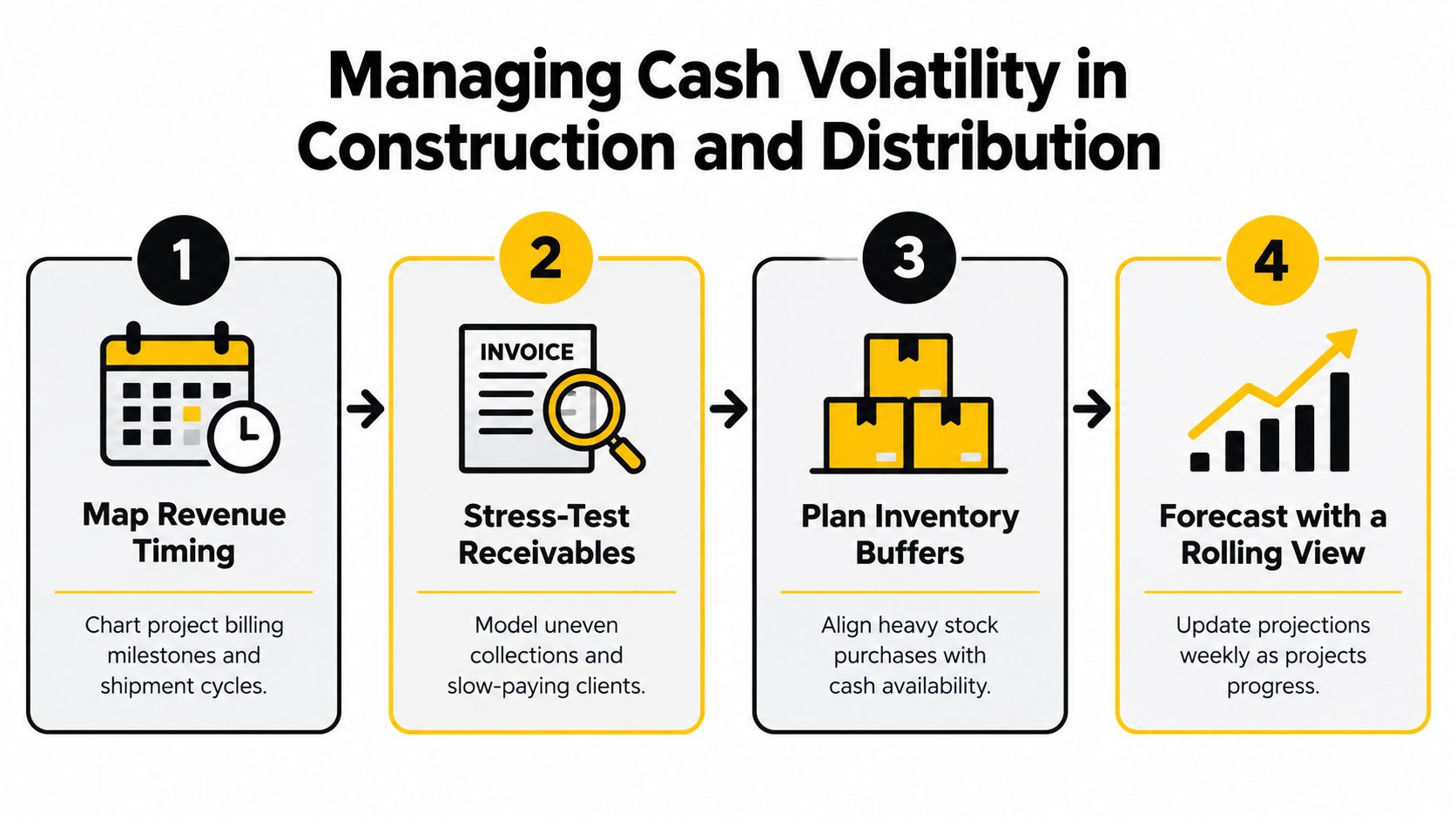
A generic monthly forecast fails when cash follows job progress, shipment timing, inventory purchases, or uneven customer collections. Construction and distribution businesses need a model that mirrors how cash moves.
A rolling 13-week cash flow forecast maps weekly inflows and outflows to the actual bank balance. It helps management test whether payroll, vendor payments, debt service, equipment purchases, and other near-term obligations can be covered before liquidity breaks. The method is described in 13-week cash flow management guidance for outsourced CFO work.
Build the forecast around operating reality
Construction: Start with contract billing milestones, approved change orders, retainage, subcontractor payment schedules, payroll, equipment needs, and expected job completion. Don't treat the entire contract value as available cash. Separate signed work, work in progress, billed amounts, and collections with reasonable certainty.
Distribution: Map expected shipments, customer payment behavior, inventory replenishment, supplier terms, freight, storage, debt service, and planned stock purchases. A profitable order can still damage liquidity if inventory must be paid for well before the customer pays.
Professional services: Tie receipts to project milestones, timesheet approval, invoice timing, client payment history, payroll, and contractor commitments. A full pipeline isn't cash until the work is delivered, billed, and collected.
Use this weekly process:
- Start with the actual bank balance. Reconcile the opening figure before adding assumptions.
- Classify inflows by certainty. Separate contracted collections from probable and speculative receipts.
- List outflows by timing. Include payroll, taxes, vendors, debt, inventory, equipment, and owner distributions.
- Compare the projected balance with a minimum cash threshold. The threshold should protect critical obligations and reflect the company's risk tolerance.
- Review actual versus forecast weekly. Record why collections, purchases, or payments differed, then improve the next forecast.
A new contract is not automatically a good contract. It's good only if the company can finance delivery while protecting its minimum cash position.
Before hiring a crew, buying equipment, or accepting a large order, run the decision through the model. If the forecast falls below the threshold, management has choices: negotiate billing milestones, request deposits, adjust supplier terms, delay discretionary spending, stage the purchase, or decline the work.
The operating detail behind construction-specific forecasting is covered in construction cash flow management guidance. The model should change as job progress, collections, and commitments change. A static annual budget can't do that job.
This video provides another practical visual for thinking about cash timing and financial decisions:
Delegation and Governance in Founder-Led Companies
Outsourcing finance doesn't mean handing over the keys. It means assigning authority deliberately so the CFO can move quickly without allowing an external advisor to make decisions that belong to the owner.
The founder should retain authority over ownership distributions, acquisitions, debt that changes the company's risk profile, executive compensation, major strategic commitments, and decisions that alter the company's purpose or control. The CFO should own the preparation, analysis, recommendation, monitoring, and escalation around those decisions.
Write the authority rules before the first crisis
Create a one-page delegation charter with four columns:
| Decision | CFO authority | Founder approval | Escalation trigger |
|---|---|---|---|
| Routine forecast updates | Prepare and maintain | Review during the leadership cadence | Material variance from plan |
| Vendor terms | Analyze and recommend | Approve strategic changes | Liquidity risk or operational dependency |
| Hiring | Model financial impact | Approve leadership and capacity commitments | Forecast falls below minimum cash |
| Capital spending | Prepare return and liquidity analysis | Approve major purchases | Purchase affects cash protection |
| Owner distributions | Monitor capacity | Retain final approval | Distribution would weaken liquidity |
The founder shouldn't approve every spreadsheet adjustment. That creates a bottleneck and turns the CFO into a reporting clerk. The CFO also shouldn't approve a major commitment just because the model shows an accounting profit.
Set a weekly cash review, a monthly management review, and a quarterly strategic review. The weekly meeting addresses near-term liquidity and exceptions. The monthly meeting covers margins, KPIs, forecast variance, and accountability. The quarterly meeting addresses capacity, capital allocation, expansion, succession, or exit preparation.
Governance rule: Delegate analysis and execution within agreed limits. Retain decisions that change ownership, risk, or strategic direction.
Scope drift creates another governance problem. A CFO may gradually absorb controller work, bookkeeping cleanup, tax coordination, or operational administration until strategic priorities receive less attention. Define deliverables, exclusions, response expectations, and change approval in writing. Guidance on how to resolve scope drift in delivery can help keep the engagement accountable without making collaboration rigid.
The governance model should evolve. Survival mode may require tight cash approvals and frequent escalation. Expansion requires faster decision rights around hiring, pricing, capacity, and contracts. Exit preparation demands cleaner reporting, stronger controls, and evidence that the business can operate without the founder making every financial decision.
Evaluating Providers and the AmbitionCFO Difference
Choose a strategic finance partner, not a glorified bookkeeper with a CFO title. Ask what the provider will decide, what it will measure, what it will deliver each month, and which work it explicitly excludes.
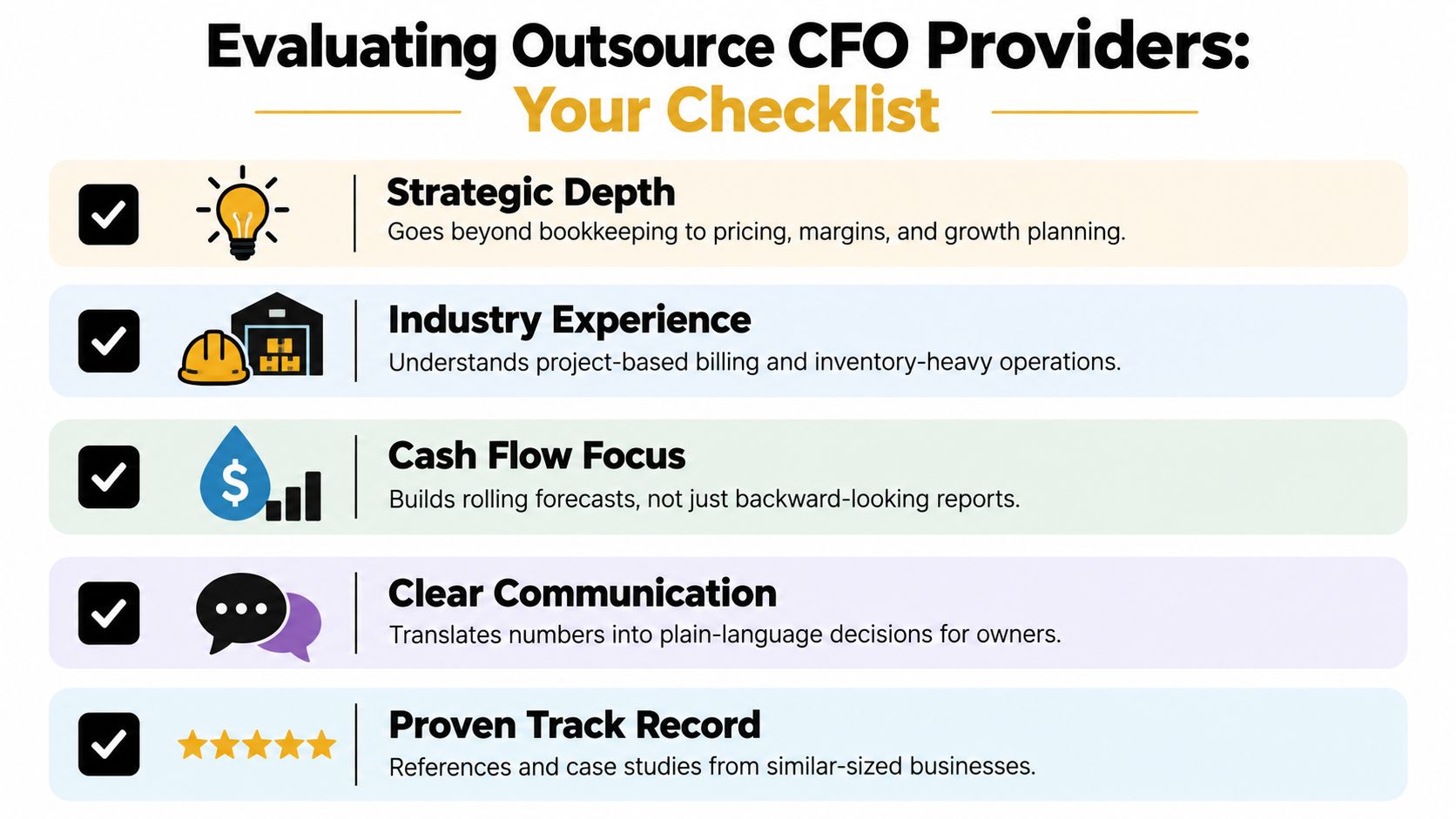
A serious evaluation should test five areas:
- Strategic depth: Can the advisor analyze pricing, margins, capacity, and growth choices, not just produce reports?
- Industry experience: Has the team worked with project billing, inventory cycles, supplier terms, retainage, or uneven collections?
- Cash flow discipline: Will the provider maintain a rolling forecast and compare actual performance with prior expectations?
- Communication: Can the advisor explain financial consequences in plain language to an owner and operating team?
- Transition expertise: If an owner expects a sale or succession event, can the provider improve reporting and decision discipline ahead of it?
Separate strategic finance from conflicting services
A provider that also sells bookkeeping, tax preparation, audit work, and other services may be useful, but the arrangement can blur accountability. Ask who owns the numbers, who challenges assumptions, and whether the CFO can give an independent view of margin, cash, and operating performance.
AmbitionCFO works with founder-led businesses in construction, distribution, and professional services. Its stated scope includes 13-week cash flow modeling, margin analysis by job or client, financial reporting, budgeting and forecasting, KPI dashboards, and Certified Exit Planning Advisor support for owners planning a transition within 3 to 10 years. It doesn't provide bookkeeping, tax preparation, audit services, business valuation, or fundraising support.
That boundary can be valuable when the owner wants strategic financial leadership rather than another vendor handling every finance task. Review the firm's fractional CFO ROI perspective and ask for a sample management package, a sample forecast, references from comparable businesses, and a clear escalation process before signing.
Your First 30 Days with an Outsourced Finance Partner
The first month should create visibility, not produce a polished presentation that nobody uses. Your CFO needs access to the underlying data, direct conversations with the people who run the business, and permission to challenge assumptions.
Days one through five
Set up a controlled data room with bank statements, accounting exports, debt schedules, customer and vendor aging, payroll commitments, open contracts, inventory information, equipment plans, and prior management reports. Give the CFO a written list of current concerns, including cash pressure, margin uncertainty, planned hiring, major purchases, and contracts under consideration.
Confirm responsibilities with your bookkeeper and CPA. The CFO should know who closes the books, who approves payments, who handles tax matters, and who owns each source system.
Days six through fifteen
Clean up the basic information needed for decisions. That may include separating direct and indirect costs, organizing customers or jobs, reviewing receivables aging, matching debt obligations to payment dates, and identifying reporting gaps.
Then establish the initial KPI set. Keep it tied to operating decisions. A contractor may need job margin, approved change orders, billing progress, collections, and backlog quality. A distributor may need inventory movement, gross margin by product or customer, supplier exposure, and collection timing. A professional services firm may need utilization, realization, project margin, and payroll capacity.
Days sixteen through thirty
Deliver the first management package and initial rolling 13-week cash flow forecast. Don't wait for perfection. Label assumptions, identify confidence levels, and list the decisions that require owner attention.
End the month with a leadership meeting that answers five questions:
- What cash is expected to enter and leave each week?
- Which assumptions create the most risk?
- Which jobs, customers, products, or services produce acceptable margins?
- What decisions must the owner make now?
- What will the team measure before the next meeting?
Require a written action log with an owner and due date for every decision. The engagement is working when financial information changes operating behavior, not when the spreadsheet becomes more elaborate.
AmbitionCFO provides fractional CFO support for founder-led businesses that need cash flow visibility, margin analysis, forecasting, KPI reporting, and exit planning without a full-time CFO. Visit AmbitionCFO to discuss your current cash pressures, decision rights, and the financial operating rhythm your business needs next.