

A debt covenant is a contractual restriction in a loan or bond agreement that protects the lender by limiting borrower actions, such as caps on financial risk, minimum interest coverage, and limits on additional debt. In U.S. corporate bond and loan markets, restrictions on additional debt rose from 18% of bonds in 1993 to 81% in a later sample period, showing how central these provisions have become to business financing.
Your company may be having its strongest sales quarter yet when the bank calls about covenant compliance. Revenue looks healthy, customer demand is strong, and the team is preparing to hire, purchase equipment, or acquire a competitor. Then a ratio on a lender report suddenly determines whether you can move forward.
For owners of $10M to $100M businesses, that moment usually isn't caused by a bad business decision. It comes from treating the covenant as legal fine print instead of an operating signal. A working capital swing, delayed customer payment, acquisition, or rise in debt can reduce your headroom before the company runs out of cash.
This guide translates covenant language into owner decisions. You'll learn how affirmative, negative, and financial covenants work, how to calculate common tests, what happens after a breach, and how to monitor headroom before your lender does. You'll also see why private credit and syndicated loans can give borrowers very different flexibility around hiring, capital expenditure, acquisitions, and an eventual exit.
Table of Contents
- Introduction What Every Owner Should Know Before Signing
- Understanding Debt Covenants and Why Lenders Require Them
- The Three Types of Debt Covenants Explained
- How Financial Covenants Work With Real Examples and Calculations
- What Happens When You Breach a Debt Covenant
- How to Monitor Negotiate and Stay Compliant With Confidence
- Take Control of Covenant Risk With AmbitionCFO
Introduction What Every Owner Should Know Before Signing
A founder-led distribution company closes a major contract. A construction business adds crews for a large project. A professional services firm hires senior talent ahead of expected demand. Each decision may support growth, but each can also affect liquidity, interest coverage, or restrictions on additional debt.
The lender isn't only asking whether the business can repay principal and interest. The lender is asking whether the business will continue operating inside the risk boundaries agreed in the loan documents. That's why a covenant acts like a guardrail. It doesn't drive the vehicle, but it defines how far the driver can move before someone intervenes.
Debt covenants commonly address balance sheet ratios, interest coverage, dividends, asset sales, insurance, reporting, and additional borrowing. They turn broad lending risk into specific promises that the owner and finance team can track.
Owner's rule: If a covenant can affect hiring, capex, acquisitions, or distributions, it belongs in the operating forecast, not only in the legal file.
The right financing choice starts before the agreement arrives. Owners comparing debt with equity should consider control, repayment pressure, flexibility, and dilution together. AmbitionCFO's discussion of equity versus debt financing provides useful context for that decision, while this guide focuses on what happens after debt enters the capital structure.
Before signing, it also helps to understand the broader loan market and the terms lenders may use. A practical resource on smart loan choices with Visbanking can help owners evaluate loan structures more carefully.
Your immediate task is simple. Put every covenant into a monthly schedule, model the effect of the next hiring plan or equipment purchase, and identify the point at which the business would need lender consent. That process turns a surprise bank call into a manageable planning conversation.
Understanding Debt Covenants and Why Lenders Require Them
A debt covenant is a condition attached to borrowed money. The borrower agrees to take certain actions, avoid others, and maintain specified financial conditions for as long as the loan remains outstanding. The agreement gives the lender a way to monitor risk between scheduled principal and interest payments.
Think of a mountain road with guardrails. The road is the business plan, and the loan provides fuel for the journey. The guardrails don't prevent progress, but they reduce the chance that a sudden turn, weak cash collection, or excessive borrowing leaves the lender with less protection.
The two behavioral categories
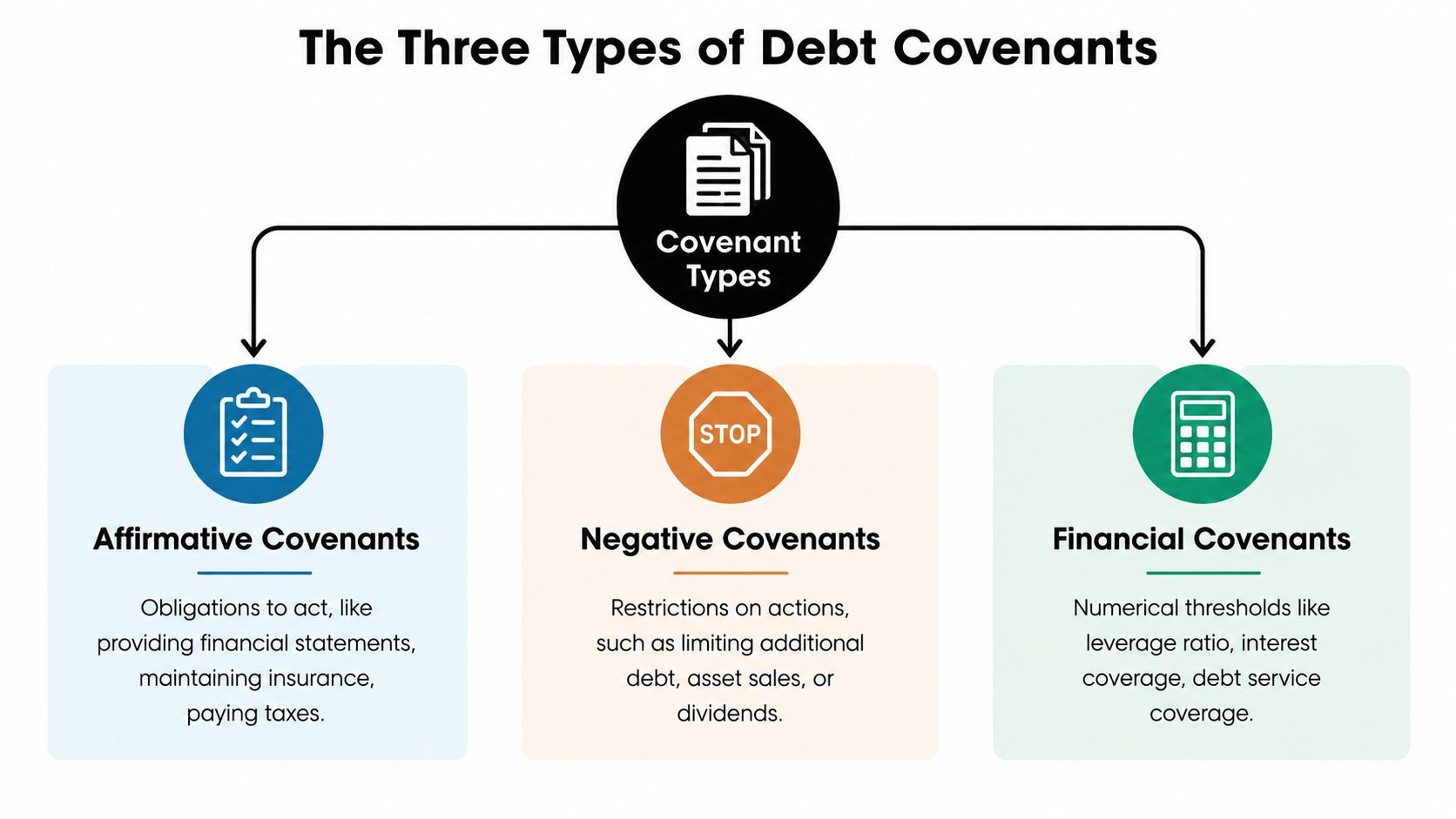
Affirmative covenants require the borrower to do something. Common obligations include delivering periodic financial statements, maintaining insurance, paying taxes, and keeping the business in legal good standing. These requirements give the lender visibility and help preserve the assets supporting repayment.
Negative covenants restrict actions that could weaken creditor recovery. They may limit additional debt, asset sales, dividends, distributions, or the creation of extra liens. A company might still be able to take those actions, but only after meeting conditions or obtaining lender consent.
Financial covenants form the numerical side of the structure. They may require the borrower to stay within limits for interest coverage, liquidity, debt service coverage, or net worth. The precise formula often comes from the loan agreement, so the accounting team's normal income statement or balance sheet may not be enough.
Why lenders use them
Covenants let lenders intervene before a repayment problem becomes a crisis. If customer collections slow, inventory rises, or a project takes longer to complete, liquidity can deteriorate while the company still pays its bills. A covenant can surface that deterioration early.
For the owner, the trade-off is flexibility. The loan may provide growth capital, but the covenants define which decisions require permission. Read the definitions, reporting deadlines, permitted exceptions, and calculation rules as carefully as the interest rate. Owners who want more context on the legal side can browse loan agreement posts before reviewing their own documents.
A useful internal reference is a written financial risk management plan that assigns responsibility for each test. One person should calculate the metric, another should review the result, and leadership should see the forecasted headroom before making a major commitment.
The Three Types of Debt Covenants Explained
The easiest way to remember covenant categories is to ask three questions:
- What must the company do?
- What must the company avoid?
- What numbers must stay within limits?
Affirmative covenants answer the first question. Negative covenants answer the second. Financial covenants answer the third. A single loan can contain all three.
A practical comparison
| Covenant Type | Purpose | Common Example | Owner Action |
|---|---|---|---|
| Affirmative | Preserve transparency and operating discipline | Provide financial statements and maintain insurance | Assign reporting owners and calendar deadlines |
| Negative | Prevent value leakage or weaker creditor recovery | Limit additional debt, asset sales, or dividends | Obtain consent before restricted actions |
| Financial | Keep business performance inside agreed risk boundaries | Maintain leverage or interest coverage | Forecast the ratio and track headroom |
Affirmative covenants are often underestimated because they don't always involve a ratio. Missing a reporting deadline, failing to maintain required insurance, or neglecting notice obligations can still create a compliance issue. Build these obligations into the same calendar used for payroll, tax filings, board reporting, and customer concentration reviews.
Negative covenants shape strategic freedom. A restriction on additional debt can affect an equipment purchase. A limit on dividends can change owner distributions. An asset-sale restriction can complicate the disposal of underused equipment or a business unit. The important question isn't only, “Is this action prohibited?” It's also, “What exceptions, baskets, approvals, or thresholds apply?”
Financial covenants translate performance into a test. A covenant may compare total debt with EBITDA. An interest coverage covenant compares operating earnings with interest expense. A current-ratio test compares current assets with current liabilities. These tests can move because of timing, classification, or loan-defined adjustments, not just because the business changed permanently.
The categories overlap in practice. A financial test may determine whether the company can take an action restricted by a negative covenant. An affirmative reporting covenant may require the borrower to certify that financial tests were met. Review the agreement as a connected system rather than a collection of unrelated clauses.
Practical rule: For every covenant, write down the trigger, the calculation, the reporting date, the responsible person, and the business decision it could restrict.
How Financial Covenants Work With Real Examples and Calculations
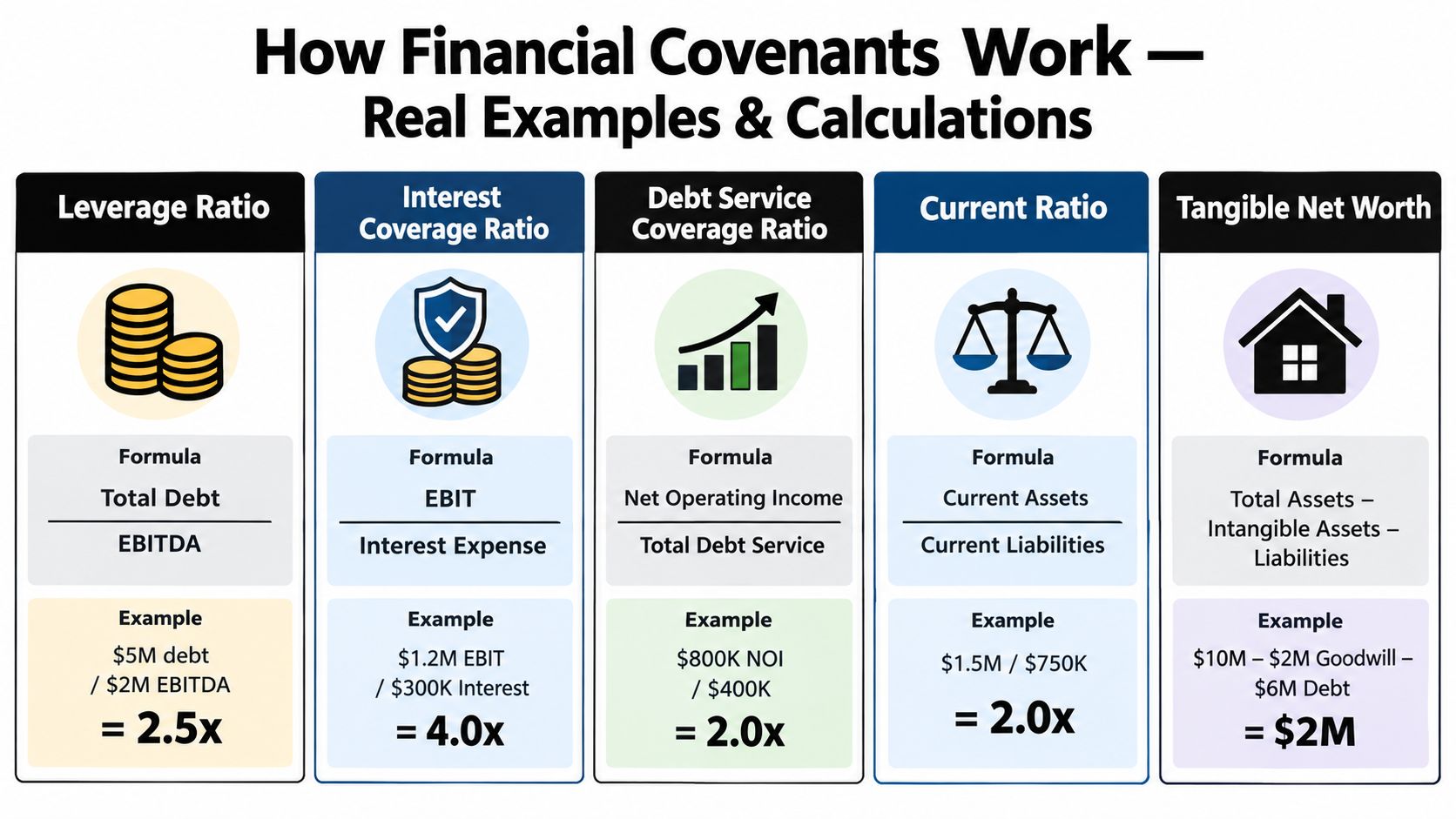
Financial covenants are easiest to understand when you connect each formula to an operating decision. The exact definitions and thresholds come from the agreement, but market references commonly describe debt-based covenants around 5.0x to 6.5x debt-to-EBITDA, depending on industry and credit quality, while a typical fixed-charge coverage structure may require at least 2.0x coverage. These reference points come from financial covenant mechanics, not a substitute for your own loan document.
Leverage and coverage
Ratio is commonly calculated as:
Total Debt ÷ EBITDA
If debt is $5M and EBITDA is $2M, the ratio is 2.5x. If EBITDA falls while debt stays unchanged, the ratio rises. That's why owners should forecast the denominator, not check the current balance sheet.
Interest coverage ratio is commonly calculated as:
EBIT ÷ Interest Expense
If EBIT is $1.2M and interest expense is $300K, coverage is 4.0x. A lower result means less operating earnings are available to absorb interest. A fixed-charge coverage test may include other required charges and, in one typical structure, require at least 2.0x.
Debt service coverage ratio compares operating income with total debt service:
Net Operating Income ÷ Total Debt Service
If net operating income is $800K and total debt service is $400K, the result is 2.0x. The business has a cushion above its scheduled debt service in that example, but the agreement determines which income and service items count.
Liquidity and net worth
A current ratio uses:
Current Assets ÷ Current Liabilities
A 1.20 to 1.00 covenant means current assets must remain at least 1.20 times current liabilities, according to Cohen & Company's explanation of debt covenant calculations. A company can appear profitable and still approach trouble if receivables collect slowly or current obligations rise.
A debt-to-tangible-net-worth covenant may require debt to remain at or below 1.00 to 1.00. Tangible net worth excludes intangible assets such as goodwill and trademarks, so a balance sheet with strong book equity can still produce a weaker covenant result. The Minnesota loan documentation guide also identifies debt service coverage, debt-to-equity, and current ratio as common financial measures.
Maintenance versus incurrence tests
A maintenance covenant is tested at recurring intervals, often quarterly. The borrower must remain inside the threshold whether or not it is taking a new action.
An incurrence covenant is tested only when the borrower wants to take a restricted action, such as adding debt, making a distribution, or completing an acquisition. This structure can provide more day-to-day flexibility, but it still requires accurate forecasting before a transaction.
Covenant headroom is a forward-looking liquidity buffer. If a ratio is close to its limit, a small EBITDA decline or debt increase can force an amendment before cash reaches zero. Build these tests into a cash flow forecasting model and run scenarios before approving hires, equipment, or acquisitions.
The latest calculations should also be visible through the embedded video below.
What Happens When You Breach a Debt Covenant
A covenant breach doesn't automatically mean the lender will demand immediate repayment, but it does create a contractual problem that requires prompt action. The outcome depends on the agreement, the nature of the breach, the lender's rights, and the quality of the relationship.
A typical sequence looks like this:
- The test fails. The finance team identifies that a ratio, reporting obligation, or restricted action falls outside the agreed terms.
- The lender receives notice. The borrower reports the issue or the lender identifies it during review.
- The parties negotiate. The lender may provide a waiver, amend the covenant, request additional reporting, or ask for stronger protections.
- The borrower pays for flexibility. A waiver or amendment may involve fees, a higher interest rate, tighter reporting, additional collateral, or other concessions.
- Unresolved default escalates. Depending on the agreement, the lender may exercise remedies, including acceleration of the loan.
The distinction between a waiver and an amendment matters. A waiver generally addresses a specific existing violation. An amendment changes the agreement for future periods or changes the covenant itself. Get the lender's decision documented in writing, with the affected period and any new conditions clearly stated.
Why covenant design changes lender leverage
Covenant design affects how quickly a lender can intervene. A Federal Reserve study of private-equity-sponsored loans reported an average annual violation rate of 18.0% for all covenants and 21.9% for performance-based covenants, while another study found the average annual violation rate fell to about 6% per year after the financial crisis, roughly half the lowest pre-2005 annual rate. The Reserve Bank of Australia's debt covenant research explains why structure and tightness influence renegotiation power and default timing.
Don't wait until the formal reporting date if your forecast shows a likely miss. Prepare a bridge from the current result to the expected result, explain the cause, and present a correction plan. Owners evaluating the legal response can also review options when a startup partner breaches, then involve counsel familiar with the specific loan documents.
Financial diligence matters during a breach because the lender will want reliable numbers, not optimistic explanations. A structured financial due diligence process can help separate a temporary timing issue from a deeper operating problem.
How to Monitor Negotiate and Stay Compliant With Confidence
Covenant compliance works best as a recurring management process. The bank's quarterly test should be the final checkpoint, not the first time leadership sees the numbers.
Start with a covenant register. Record the exact formula, threshold, test date, reporting requirement, permitted adjustments, cure rights, and approval requirements. Keep the agreement's definitions beside the calculation because “EBITDA,” “debt,” “cash,” and “tangible net worth” may not match the figures in standard management reporting.
Run the monthly operating routine
Use a monthly close package that includes:
- Ratio calculation: Update debt usage, coverage, liquidity, and net worth tests using the loan-defined formula.
- Headroom view: Show the distance between the current result and the covenant limit.
- Forward forecast: Project the next test date under the base plan and a downside case.
- Cash visibility: Maintain a rolling 13-week cash forecast that shows collections, payroll, taxes, debt service, capex, and major commitments.
- Decision flags: Identify whether a planned hire, equipment purchase, acquisition, dividend, or new borrowing requires consent.
A dashboard should show both actual compliance and forecasted compliance. A business can pass today and fail after a large inventory purchase or delayed customer payment. Monthly visibility gives the owner time to adjust timing, preserve liquidity, or approach the lender from a position of preparation.
Negotiate for usable flexibility
Before signing, focus on more than the presence of a covenant. Review the amount of headroom, how EBITDA is defined, whether one-time items receive agreed treatment, and whether the agreement includes cure rights. Ask how the lender treats acquisitions, capex, additional debt, distributions, and future refinancing.
Market segment matters. In 1Q25, covenant protection remained relatively stable in private corporate credit while continuing to deteriorate in broadly syndicated loans, and lender protections such as J.Crew, Serta, Chewy, and Envision blockers appeared more often in private credit than syndicated deals, according to the Loan Syndications and Trading Association's 1Q25 market update. Those terms can affect whether value can move outside the borrower group and how much negotiating power lenders retain.
Covenant-lite requires a different discipline. By 1H 2025, the share of new private credit loans with only covenants fell from 74.2% in 2022 to 40.9%, while roughly 90% of large-cap leveraged loans carried no maintenance covenants through Q3 2025. Nearly 98% of lower-middle-market loans still had at least one maintenance test, as summarized by Allvue's private credit monitoring analysis.
Covenant-lite doesn't mean risk-free. It means the lender has fewer formal tripwires, so management must create its own early-warning system.
Track cash conversion, accounts receivable aging, customer concentration, gross margin, backlog, working capital, debt balances, and committed capex. Use a liquidity management framework to connect those indicators to hiring and investment decisions.
Take Control of Covenant Risk With AmbitionCFO
A debt covenant is more than a lender rule. It's a boundary around your company's financial flexibility.
Affirmative covenants keep reporting and operating obligations visible. Negative covenants protect the lender from value leakage. Financial covenants turn coverage, liquidity, and net worth into early-warning indicators. When you forecast headroom rather than merely record compliance, you can make growth decisions with clearer trade-offs.
That visibility matters for a $10M to $100M owner. A planned hire may improve capacity but reduce near-term coverage. Equipment may increase revenue potential while adding debt. An acquisition may strengthen the business strategically but consume liquidity and trigger consent requirements. The same analysis supports exit planning because buyers and lenders will examine the quality of cash flow, debt structure, reporting discipline, and future obligations.
A fractional CFO can connect the covenant schedule to the budget, 13-week cash flow forecast, KPI dashboard, board package, and capital plan. AmbitionCFO works with leadership teams on those planning and reporting processes, including debt covenant headroom and scenario analysis, without requiring the cost of a full-time CFO.
Start today by locating the loan agreement, listing every covenant and test date, and calculating current headroom under the lender's definitions. Then model your next major hiring, capex, or acquisition decision before you commit.
AmbitionCFO helps founder-led businesses build covenant tracking into cash flow forecasts, KPI reporting, and growth planning so owners can see risk before a lender does. Visit AmbitionCFO to discuss a practical covenant monitoring process or request support with headroom modeling and exit-ready financial visibility.