

A founder-led business lands a major contract, but the opportunity arrives with a cash-flow problem. Revenue is strong, the pipeline looks healthy, and the customer is credible. Yet fulfilling the work requires more working capital than the business has available today. The bank offers a loan. An investor offers cash in exchange for part of the company.
That's the equity vs debt decision. You're not choosing between two abstract finance terms. You're deciding who controls future value, whether monthly cash flow can absorb fixed payments, and how much flexibility your business will have when the next slow quarter arrives.
Table of Contents
- The Financing Decision Every Founder Eventually Faces
- How Equity and Debt Actually Work for SMBs
- Comparing Equity and Debt Across Five Decision Criteria
- The Real Cost of Each Option Over Three Years
- When Industry and Exit Plans Change the Answer
- Your Step-by-Step Financing Decision Framework
- Your Next Move Starts with a Conversation
The Financing Decision Every Founder Eventually Faces
Take a construction company with $15 million in revenue and a new contract requiring $2 million in working capital before collections begin. The bank proposes a term loan. A growth equity firm proposes 20% of the company for the same capital.
The founder's first reaction is predictable: “I don't want to give up 20% of what I built.” That concern is valid. But the loan creates a different risk. If customer payments arrive late, payroll, materials, subcontractors, and loan payments still have to be funded on schedule.
The choice affects more than ownership. It can determine whether the founder hires aggressively, accepts lower-margin work, takes distributions, or delays an expansion. It can also change the company's eventual exit value. A financing decision that looks inexpensive on a term sheet can become expensive through missed opportunities, covenant pressure, or forced refinancing.
The practical question: Can this business convert its expected profit into cash quickly and consistently enough to support debt service?
A founder should evaluate the decision through four lenses:
- Cash conversion: How long does money remain tied up in receivables, inventory, retainage, or unbilled work?
- Operating volatility: Do revenue and gross margins remain stable, or do they swing with projects, customers, or staffing?
- Ownership priorities: Is retaining control more important than reducing fixed obligations?
- Exit timing: Will the capital be outstanding when a buyer performs due diligence?
A useful liquidity management approach starts with the cash calendar, not the income statement. Map when cash leaves the business, when customers pay, and how much of the financing remains available after the contract begins.
The right answer depends on the business's stage, industry, working-capital cycle, and strategic plan. This article gives you a method for making that call without being distracted by a headline interest rate or an attractive valuation.
How Equity and Debt Actually Work for SMBs
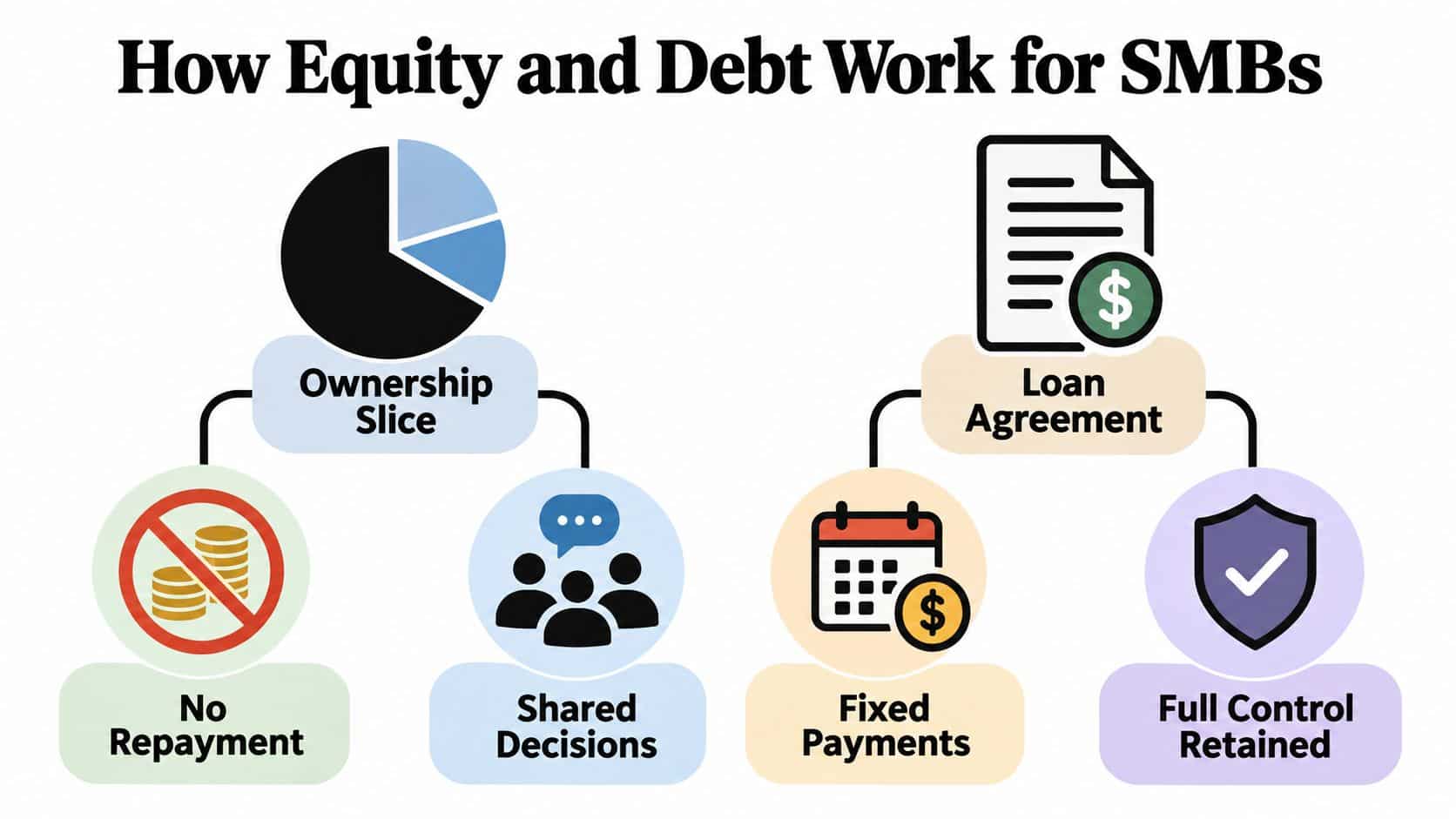
Equity financing means selling an ownership interest in exchange for capital. The investor becomes an owner, usually through common equity or preferred equity, and generally doesn't receive scheduled principal and interest payments. The founder gives up part of the future upside and may share certain decisions, but the company avoids a mandatory loan payment.
Debt financing means borrowing capital under a loan agreement. The business promises to repay principal and interest according to a schedule. The lender doesn't own part of the company, so issuing debt doesn't dilute ownership, but the lender may require collateral, reporting, financial covenants, or restrictions on additional borrowing.
The vocabulary that changes the negotiation
Dilution is the reduction in an existing owner's percentage ownership after new shares are issued. If a founder owns the entire company and sells new shares representing 20% of the business, the founder no longer owns 100% of the company. The founder may still control the company, but a meaningful portion of future proceeds belongs to the new investor.
Covenants are contractual requirements in a debt agreement. A lender might require minimum cash balances, limits on additional debt, or financial performance tests. Breaching a covenant can trigger a waiver process, higher costs, restrictions, or a default, depending on the agreement.
Interest coverage measures the company's ability to pay interest from operating earnings. It's useful, but it can hide working-capital stress. A company may report adequate earnings while waiting months to collect invoices.
Preferred equity sits ahead of common equity in the distribution waterfall. That can give the investor priority for certain distributions or return of capital, while common equity typically carries the residual upside and voting rights defined in the governing documents.
Consider a distribution company taking a $500,000 equipment loan. It retains ownership, makes scheduled payments, and uses the equipment to support fulfillment capacity. A professional services firm may instead bring in a minority investor who funds hiring and market expansion. The services firm avoids loan payments, but the investor may expect information rights, approval rights, or a path to liquidity.
For an accounting view of how financing flows through the statements, review these CFF examples and journal entries. Financing decisions also influence how founders think about shareholder value maximization, because ownership percentage alone doesn't determine value. The quality and durability of the cash flow supporting that ownership matter just as much.
Comparing Equity and Debt Across Five Decision Criteria
A founder-friendly comparison should focus on the operating consequences, not just the funding source.
| Decision Criteria | Equity Financing | Debt Financing |
|---|---|---|
| Ownership control | Dilutes existing ownership and may share decisions | Preserves ownership, subject to lender restrictions |
| Cash-flow impact | No scheduled principal and interest payments | Requires scheduled payments |
| Cost of capital | Future upside given to investors | Interest and financing fees |
| Risk profile | No repayment default risk, but permanent sharing of value | Repayment and covenant risk |
| Exit impact | Investor rights and liquidity expectations affect the sale | Debt is generally repaid or refinanced at closing |
Ownership control
Debt is the cleaner choice if the founder's priority is retaining ownership. Creditors receive repayment rights, not an ownership stake. The trade-off is that lenders can still influence behavior through covenants and collateral requirements.
Equity reduces the founder's percentage ownership. That cost becomes larger if the company grows substantially after the raise. Selling a minority stake may feel painless when the business is small, but the investor's share applies to the future value created with the new capital.
Equity removes scheduled repayment, but it doesn't remove the economic cost of capital. It transfers part of the upside to the investor.
Cash-flow impact
Debt creates a fixed obligation. That can work well for a company with recurring collections and predictable margins. It becomes dangerous when receivables are lumpy, inventory turns slowly, or a project requires cash long before the customer pays.
Equity provides more breathing room during weak periods because the company isn't required to make loan payments to the investor. That flexibility has a price, the founder shares future profits and sale proceeds.
Cost of capital
Debt's visible cost is interest. Equity's cost is the portion of future value the founder gives away. A loan may look more expensive on a monthly basis, while equity may become far more expensive if the company grows quickly.
Debt also receives a U.S. tax advantage. Interest paid or accrued on a debt instrument is generally deductible by the issuer, while equity distributions aren't deductible. That deduction can reduce the after-tax cost of borrowing, although it doesn't eliminate the cash payment.
Risk profile
Equity absorbs more downside from an operating perspective because investors don't receive scheduled principal and interest like lenders do. Debt leaves the founder with control, but missed payments and covenant breaches can force difficult decisions at the worst possible time.
Use a broader financial risk management strategy that tests delayed collections, margin compression, hiring increases, and customer concentration. A financing structure should survive a bad quarter, not only match the base-case forecast.
Exit implications
Debt usually reduces the cash proceeds available to owners because the balance must be paid off or refinanced at exit. Equity investors may have approval rights, preferred economics, or their own timeline for liquidity.
The decision rule is straightforward: choose debt when cash flow is resilient and ownership value is the priority; choose equity when preserving cash flexibility matters more than retaining every percentage point of ownership.
The Real Cost of Each Option Over Three Years
A back-of-the-envelope model clarifies the trade-off. Consider a construction company raising $2 million.
The debt illustration uses a 7% interest rate and a five-year term, with annual payments shown as $400,000 in each of the first three years. Over 36 months, the stated payments total $1.2 million. That figure is a cash outflow during the period, not the full economic cost of the loan, because the business is also paying down principal and still has a remaining balance after the third year.
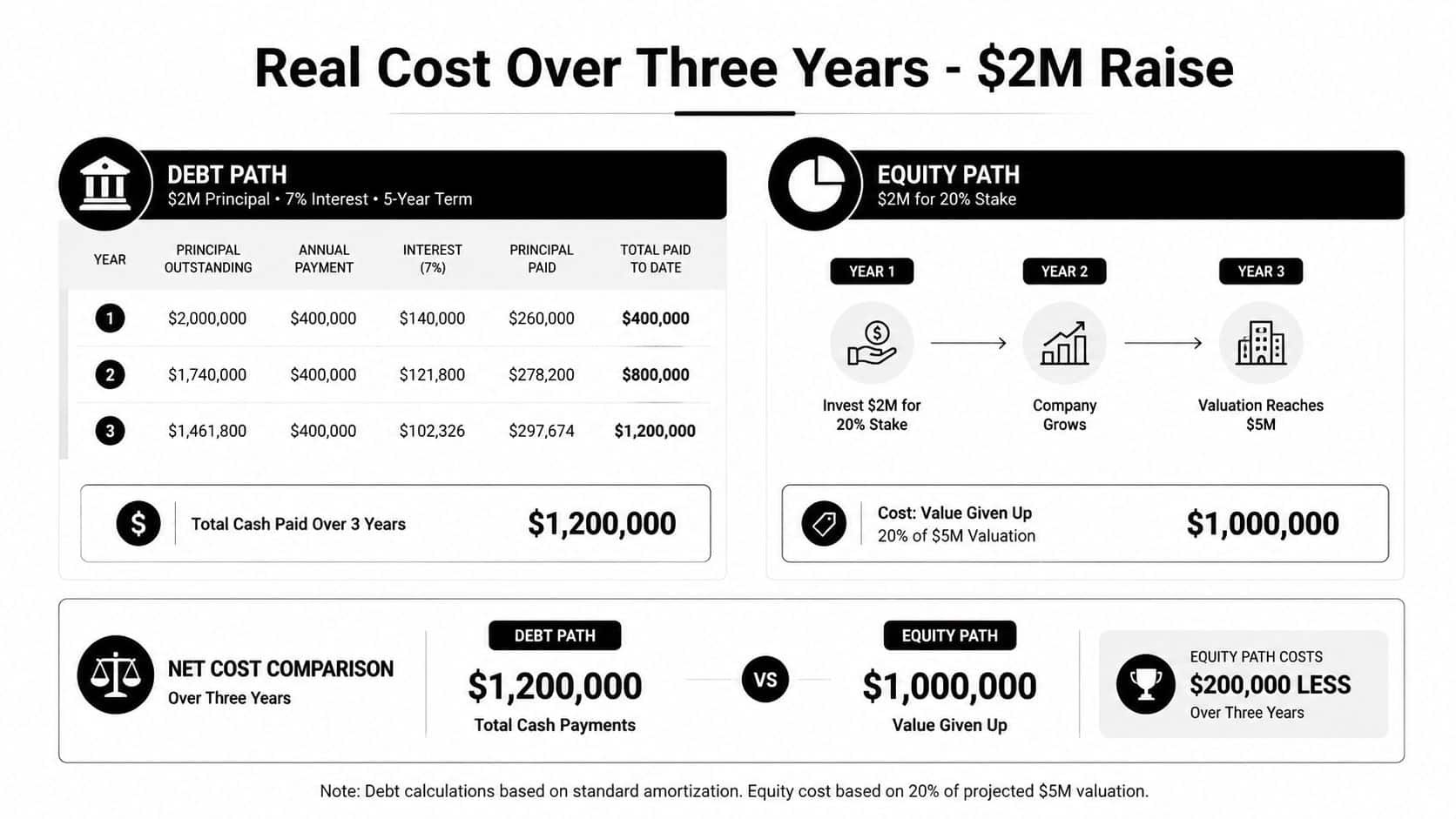
The equity illustration gives an investor 20% for $2 million, implying a $10 million post-money valuation if the full amount represents newly issued ownership. If the company later grows to a $5 million valuation, 20% represents $1 million of value. The founder avoids scheduled loan payments, but the investor owns that portion of the company's value under the agreed terms.
Those figures shouldn't be treated as a universal answer. The debt case needs an amortization schedule, fees, collateral terms, and the actual payment structure. The equity case needs the full capitalization table, liquidation preferences, voting rights, dividends, and exit provisions.
Taxes change the comparison
Interest deductibility can make debt cheaper after tax. The company pays interest in cash, then may reduce taxable income by the deductible amount. That benefit depends on taxable income, entity structure, and applicable limitations.
Business interest deductions aren't unlimited. Under the tax guidance covering Section 163(j), business interest expense can be capped at 30% of adjusted taxable income under current rules discussed in tax guidance. A company with high debt levels may therefore receive less tax benefit than its initial model assumes.
C corporations face another equity-related issue. Corporate profits are taxed at the business level, and dividends can be taxed again when distributed to shareholders, creating a second layer of tax as described in tax guidance on debt and equity. The tax answer depends on the entity and transaction, so have your tax adviser model the actual structure.
Build your own three-year worksheet
Use these columns:
- Capital received, including fees and closing costs.
- Monthly cash payment, split between principal and interest.
- Minimum cash balance, after payroll, vendors, taxes, and distributions.
- Interest deduction, subject to applicable limits.
- Ownership transferred, including investor rights and preferences.
- Estimated value surrendered, based on several exit values.
For debt, calculate both total cash paid and the remaining principal. For equity, calculate the investor's proceeds at each plausible exit value. A discounted payback period formula can add a time-value perspective, but don't let a tidy return calculation override a cash shortfall that could damage operations.
When Industry and Exit Plans Change the Answer
A construction company, distributor, and professional services firm can each use the same financing instrument and experience completely different risk.
Construction revenue often arrives through project milestones, retainage, change orders, and collections that don't line up neatly with payroll or materials. Debt can fund mobilization and equipment, but a delayed draw or disputed invoice can leave the company servicing the loan before the project produces cash.
Distribution has a different pressure point. Inventory and equipment consume cash before the customer pays. Debt may fit a purchase-order or equipment need when turns and collections are dependable. It becomes less attractive when one large customer can stretch payment timing or when inventory becomes obsolete.
Professional services firms may have lower capital intensity, but hiring ahead of contracted revenue still creates exposure. A firm with recurring retainers can often forecast collections more confidently than a project-based consultancy. An equity partner may make sense when the goal is a large hiring push, geographic expansion, or a new service line that won't produce dependable cash immediately.
Working capital decides whether debt stays affordable
The headline interest rate doesn't capture the cost of timing. If payroll is due weekly and customers pay after work is accepted, the company needs enough liquidity to bridge the gap. A loan with a reasonable rate can still become expensive if the founder has to draw additional emergency capital, delay vendor payments, or accept poor-margin work to keep cash moving.
Cash-flow test: Model the financing against delayed collections, not only the revenue forecast.
Exit plans add another layer. A founder planning a sale within three to five years should understand how outstanding debt affects buyer diligence, refinancing, and closing proceeds. A buyer may accept the debt, require repayment, or adjust the purchase price through the transaction structure. An equity investor may also expect a liquidity event within a negotiated period, which can reduce the founder's flexibility.
Use exit planning guidance to align today's capital decision with the intended transition. If the founder wants maximum control through a long-term ownership period, debt may be attractive when cash flow supports it. If the company needs to invest ahead of uncertain growth, equity may protect the operating plan even though it reduces the founder's eventual share.
Your Step-by-Step Financing Decision Framework
Use this sequence before signing a term sheet or accepting an equity proposal.
1. Build the cash map
Create a 13-week cash flow model showing opening cash, expected collections, payroll, vendors, taxes, capital spending, distributions, and proposed financing payments. The question is simple: What is the lowest cash balance under realistic timing?
Use actual collection patterns, not invoice due dates. If the model breaks under delayed receipts, debt shouldn't be your default.
2. Test debt service capacity
Calculate expected debt service against operating cash flow. Then stress the model with lower gross margin, slower collections, and an unexpected project delay. The decision rule is practical: if the company can only make payments in the optimistic case, the loan is too large.
3. Set a dilution ceiling
Decide how much ownership you're willing to sell before you negotiate. Model the investor's share under conservative, base, and strong exit values. Include preferred returns, liquidation preferences, voting rights, and any future funding provisions.
A founder who hasn't set a ceiling may focus on the percentage and miss the rights attached to it.
4. Review covenant exposure
Compare every proposed covenant with the company's normal volatility. A minimum profitability test that looks easy in an annual budget may become restrictive during a slow quarter. Ask what happens after a breach, how quickly a waiver is required, and whether the lender can block distributions or additional investment.
5. Match the structure to the strategic plan
Write down what the capital must accomplish over the next three to ten years. Equipment, working capital, and a predictable expansion may fit debt. A new market, management buildout, or uncertain product investment may justify equity.
A fractional CFO can build the cash model, margin analysis, forecast, and KPI dashboard needed to make each checkpoint operational. AmbitionCFO provides those financial strategy services for founder-led businesses, including cash flow modeling, profitability analysis, forecasting, and Certified Exit Planning.
Your Next Move Starts with a Conversation
The right financing choice isn't determined by the lowest stated rate or the smallest ownership percentage. It comes from matching the capital structure to collection timing, margin stability, covenant risk, tax treatment, and the founder's exit plan.
Owners of $10 million to $100 million businesses don't need to make that decision from a spreadsheet prepared after the fact. A senior finance partner can work with the owner and leadership team on 13-week cash flow modeling, margin analysis, forecasting, KPI reporting, and Certified Exit Planning, so the financing decision supports the operating plan instead of constraining it.
Schedule a strategy conversation before you accept the money. Bring the term sheet, equity proposal, current balance sheet, and cash forecast, then test both options against the next slow quarter and the intended exit.
AmbitionCFO helps founder-led businesses evaluate financing through cash-flow modeling, margin analysis, forecasting, KPI dashboards, and Certified Exit Planning. Visit AmbitionCFO to start a focused conversation about the debt or equity decision in front of your business.