
Most advice on organic growth vs inorganic growth starts with the same assumption: acquisitions are faster, so ambitious owners should buy their way into scale. That's incomplete advice. For a founder-led company, the more important question is whether the business can fund and survive the integration period without starving its core operations.
A deal can increase revenue and EBITDA on paper while cash leaves the business through working-capital swings, integration costs, debt service, earn-outs, and delayed collections. The right decision for a $10M–$100M construction, distribution, or professional services company isn't “Which path grows faster?” It's Which path strengthens the company without creating a liquidity crisis?
Table of Contents
- Why the Speed Narrative About Growth Is Misleading
- Defining Organic and Inorganic Growth for Business Owners
- KPIs and Financial Outcomes That Separate the Two Paths
- Real-World Growth Scenarios by Industry
- The Hidden Cash-Flow Mechanics of Acquisitions
- A Decision Framework for Founder-Led Companies
- How a Fractional CFO Supports Your Chosen Growth Path
Why the Speed Narrative About Growth Is Misleading
Inorganic growth can create an immediate increase in customers, locations, capabilities, or market access. That speed is real. U.S. M&A data records more than 325,000 announced transactions since 1985, with a known value of almost USD 34.9 trillion. In 2017, the market reached a record 15,100 deals, up 12.2% from 2016, demonstrating how quickly companies can build scale through transactions (U.S. M&A statistics from IMAA).
But revenue velocity isn't the same as financial progress. The acquired company may bring receivables that collect later than expected, inventory that needs replenishment, employees who need retention packages, and systems that require immediate replacement. Your lenders still expect scheduled payments while your leadership team spends time integrating the new operation.
The first 90 to 180 days matter most
The first 90 to 180 days can expose the difference between accounting accretion and cash reality. Management may report that the transaction adds revenue immediately, yet the combined business can still experience a liquidity squeeze before the expected benefits arrive.
Construction companies face particular pressure when retainage and contract billing delay cash collection. Distributors may need to rebuild inventory levels to protect customer service. Professional services firms can incur overlapping payroll and technology costs while teams learn new processes.
That's why owners should distinguish between internally funded growth and balance-sheet-stressed growth. Organic growth uses the existing sales engine, customer base, operating capacity, and retained earnings to expand. Inorganic growth often requires external capital, transaction fees, acquisition financing, and a cash reserve for execution risk.
Practical rule: A deal isn't financially attractive because it closes quickly. It's attractive when the combined business can meet obligations, protect the core operation, and produce the promised cash flow after integration.
Before approving a transaction, build a rolling cash forecast that shows the base business separately from the target. AmbitionCFO's discussion of the hidden costs of rapid growth and financial forecasting is useful because growth can create forecasting complexity before it creates usable cash.
The recommendation is direct. If your core business has unstable margins, weak collections, shallow management depth, or limited cash visibility, fix those issues before pursuing an acquisition. If the core is strong and the deal fills a specific strategic gap, inorganic growth may be justified. Speed should be the result of readiness, not a substitute for it.
Defining Organic and Inorganic Growth for Business Owners
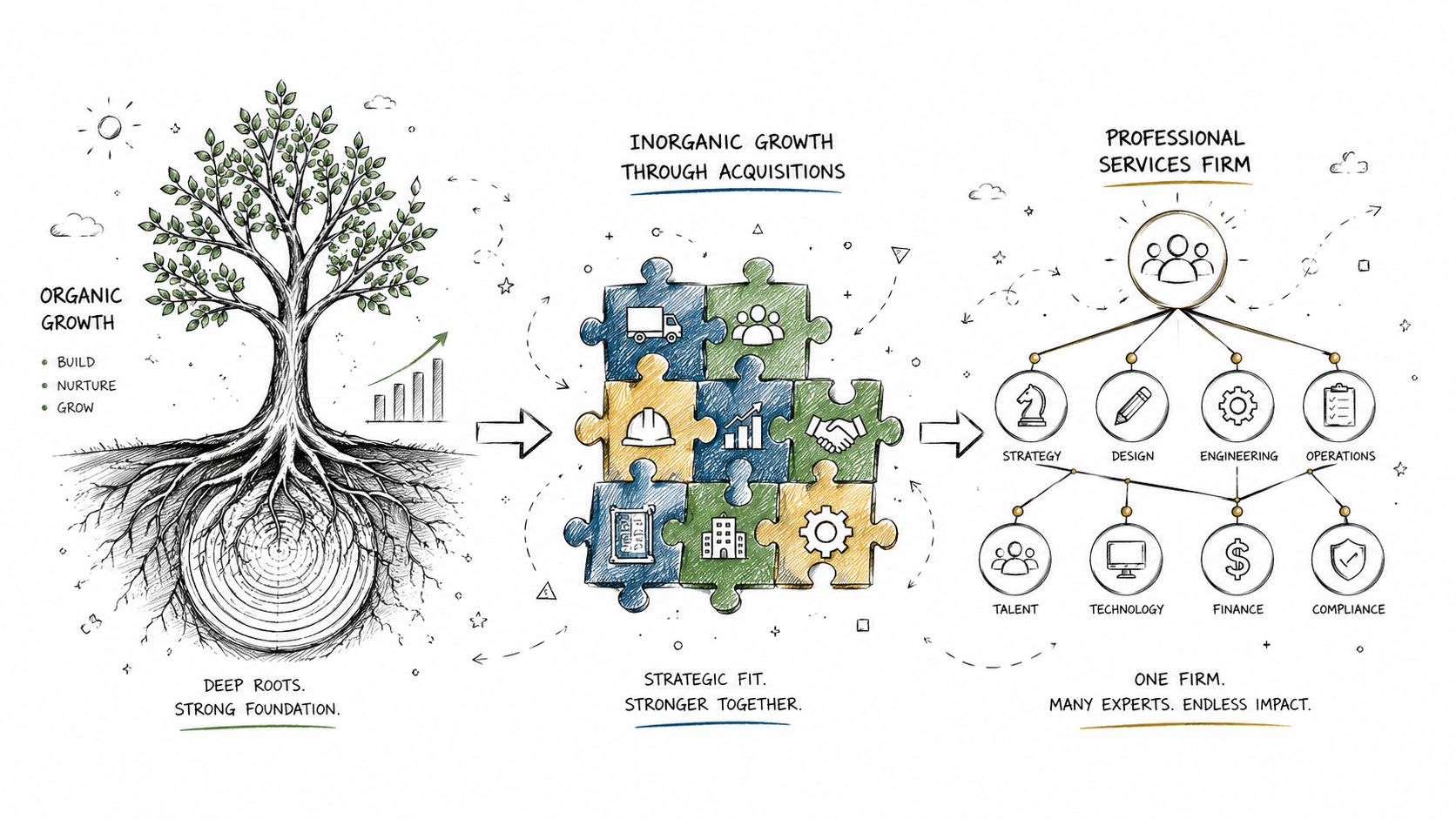
Organic growth is expansion generated by a company's internal operations. It can come from winning new customers, selling more to existing customers, raising output, improving pricing, adding service lines, opening capacity, or entering adjacent markets with the existing organization.
Inorganic growth comes from external expansion. Common routes include mergers, acquisitions, takeovers, and new locations purchased or absorbed from another business. The distinction matters because organic growth tests the strength of your current business model, while inorganic growth tests your ability to price, finance, close, and integrate a transaction.
An owner growing organically asks, “Can our sales team, pricing model, people, and processes produce more profitable revenue?” An owner growing inorganically asks, “Can we acquire the right assets and combine them without losing customers, talent, margins, or cash?”
| Attribute | Organic Growth | Inorganic Growth |
|---|---|---|
| Definition | Expansion from existing operations, customers, products, and capacity | Expansion through mergers, acquisitions, takeovers, or purchased locations |
| Capital source | Retained earnings, operating cash flow, and internal investment | Cash on hand, acquisition financing, investors, or seller financing |
| Timeline | Builds progressively as the operating engine improves | Can create a rapid increase in revenue, customers, or capabilities |
| Risk profile | More control and generally lower integration risk | Higher deal, financing, cultural, and integration risk |
| Typical metrics | Year-over-year revenue, comparable-store sales, retention, margins, CLV/CAC | EBITDA accretion, leverage, synergy realization, retention, and integration milestones |
What each path reveals
Organic growth usually reflects whether your sales engine, pricing, product mix, and operations are working. If revenue rises but margins deteriorate, the business may be buying growth through discounts, overtime, poor job selection, or inefficient fulfillment.
Inorganic growth depends on external capital and deal execution. A buyer can purchase a company with attractive revenue, but the value case only works if customers stay, employees remain productive, systems connect, and expected synergies become real cash savings or profitable revenue.
Owners seeking external capital for an organic plan may also benefit from reviewing this curated startup investor list as a general resource for understanding investor categories and funding conversations. For acquisition planning, use a disciplined mergers and acquisitions checklist that covers commercial, operational, financial, legal, and people-related diligence.
A practical example makes the distinction clear. A distributor adding a sales representative, improving warehouse throughput, and expanding its existing product range is growing organically. The same distributor buying a competing warehouse and taking over its customers is growing inorganically. Both can increase revenue. Only one requires the buyer to integrate another company while servicing acquisition financing.
KPIs and Financial Outcomes That Separate the Two Paths
The wrong metric can make a weak strategy look successful. Organic growth should be measured without deal-driven revenue. Inorganic growth requires a separate scorecard for the transaction and the combined business.
For organic growth, track year-over-year revenue growth, comparable-store sales, customer retention, margin progression, customer lifetime value, and customer acquisition cost. Mature companies often target 5%–15% annual organic revenue growth, while leading organizations may aim for 12–18 month CAC payback periods and CLV/CAC of 3:1 or better, according to the guidance summarized by PCE Companies on M&A versus organic growth.
Measure the core business separately
A company pursuing organic growth should connect revenue to operational drivers. A construction owner might examine gross margin by job, change-order performance, backlog quality, labor utilization, and collections. A professional services owner should examine revenue per billable employee, realization, client concentration, retention, and margin by client or service line.
The purpose isn't to create a dashboard full of activity metrics. It's to identify whether the company can produce additional revenue without consuming disproportionate working capital or management time.
For inorganic growth, monitor deal volume, EBITDA accretion, debt-to-equity, customer and employee retention, synergy realization, and integration milestones. Revenue added at closing isn't proof of success. The acquired customer base must remain profitable, and the combined organization must deliver the operating improvements used to justify the purchase price.
McKinsey's analysis of 550 U.S. and European companies over 15 years found that, at comparable revenue growth levels, firms with more organic growth generated higher shareholder returns than acquisition-heavy peers. The reported annualized excess shareholder returns relative to the S&P 500 increased from 3.5% to 11.5% across the revenue-growth bands shown, with the difference attributed mainly to lower upfront capital requirements and higher ROIC for organic initiatives (McKinsey analysis summarized by Wise).
Treat M&A failure data as a planning warning
Major consulting research cited in industry coverage reports that 70%–90% of M&A deals fail to create shareholder value, a risk that helps explain why many companies favor organic expansion for steadier growth (Investopedia's organic growth overview). Inorganic growth can produce faster market share gains, but the buyer pays for that speed with more execution variables.
The financial question is therefore not whether the target has attractive EBITDA. Ask whether the purchase price, financing structure, integration budget, and management capacity can produce an acceptable return on invested capital. Use a monthly scorecard, assign an owner to every synergy, and compare the original deal thesis with actual cash results.
For a broader operating dashboard, review the framework covering the financial metrics every business owner should track. The most useful reporting system separates organic performance from acquisition performance so the core team can see whether the original company is getting stronger or merely carrying a larger structure.
Real-World Growth Scenarios by Industry
The right growth path changes with the company's cash cycle, capacity constraints, and competitive position. A construction firm, distributor, and professional services firm can all have the same revenue target but need entirely different strategies.
Construction
A specialty contractor has strong demand but can't accept more work because its backlog already strains project management and field supervision. Hiring internally may be slow, especially if the owner lacks a second layer of operational leadership. Acquiring a complementary trade can provide crews, supervisors, customer relationships, and a broader bid offering.
That transaction only makes sense if the buyer can model retainage, billing terms, underbilled work, payroll timing, equipment needs, bonding implications, and project-level margin quality. A target with attractive reported EBITDA may still consume cash if its receivables are delayed or its backlog contains poorly priced contracts.
Organic growth is preferable when the contractor has unused estimating capacity, strong project managers, reliable collections, and a clear opportunity to improve pricing or job selection. In that situation, investing in sales capacity and operational discipline can add revenue without inheriting another company's contract risk.
Distribution
A distributor with healthy customer demand but warehouse bottlenecks may not need an acquisition. Slotting improvements, inventory discipline, warehouse automation, better purchasing, and additional sales capacity can increase throughput within the existing footprint.
Buying another distributor becomes more compelling when the target offers a distinct geography, exclusive supplier access, or customer segment that would take too long to build. The buyer must examine inventory aging, vendor terms, stockouts, customer concentration, and the working-capital requirement of maintaining service levels after closing.
A larger warehouse or customer list doesn't help if the combined company can't convert inventory and receivables into cash fast enough to service its obligations.
Professional services
A professional services firm can often grow organically by improving utilization, pricing, specialization, referral generation, and client retention. These changes strengthen the operating model and reduce dependence on the founder's personal relationships.
An acquisition may be the only practical way to obtain specialized talent, a new market presence, or a capability such as advanced technology. The buyer should identify which people carry the client relationships and determine whether they'll stay after closing. A transaction that loses key professionals can destroy the very capability the buyer purchased.
Across all three industries, the decision starts with the constraint. If the constraint is sales capacity, organic investment may solve it. If the constraint is market access or scarce capability, inorganic growth may be warranted. If the constraint is cash visibility, neither path should proceed until the financial model is credible.
The Hidden Cash-Flow Mechanics of Acquisitions
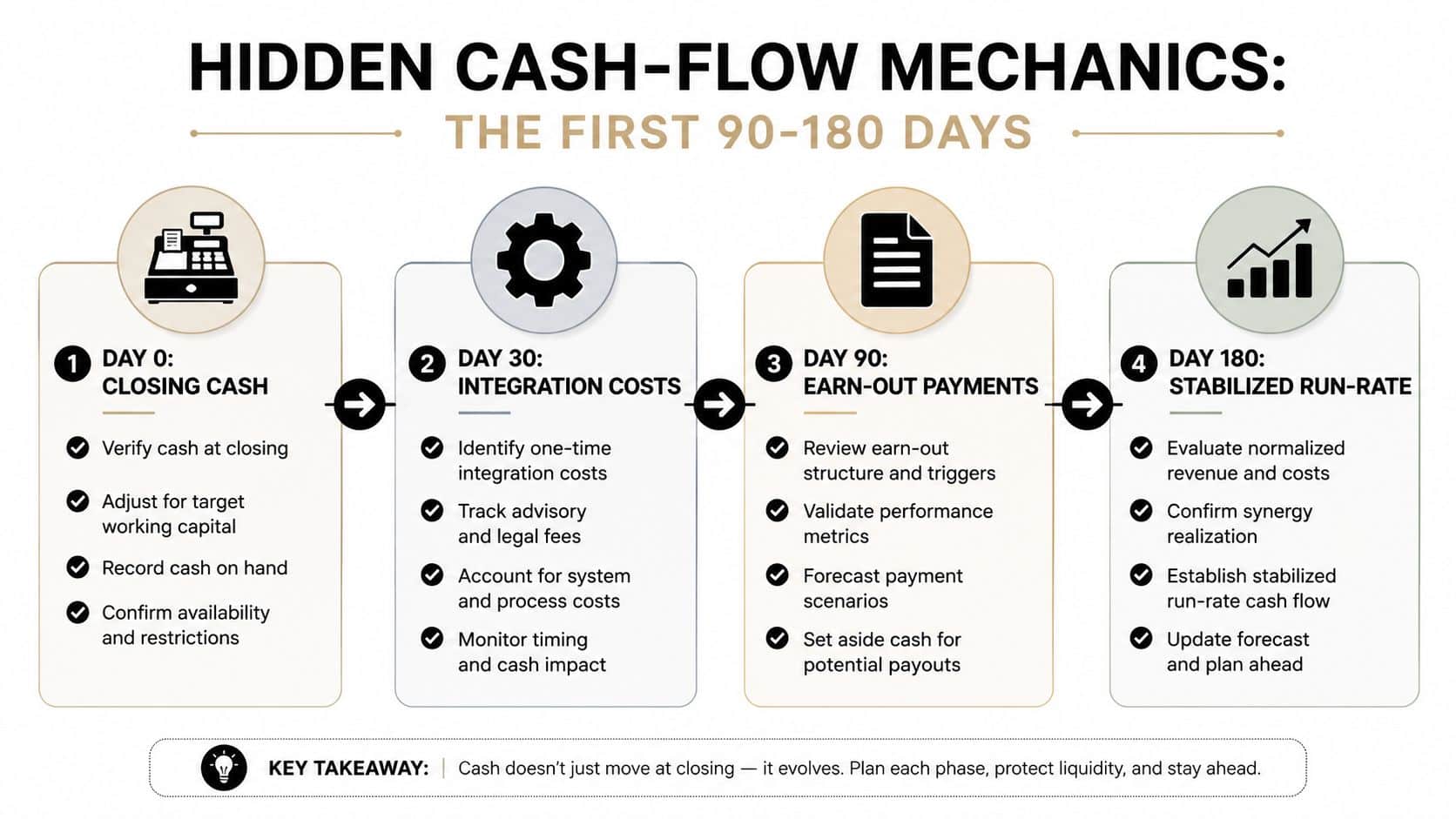
Owners often begin acquisition analysis with revenue, EBITDA, and purchase price. That order creates problems. Start with the cash bridge from closing through stabilization.
At closing, the buyer may fund the purchase, fees, refinancing, working-capital adjustments, and required cash left in the target. After closing, the combined company may pay for system conversion, legal support, retention arrangements, recruiting, facility changes, duplicate payroll, and operational disruption.
Build the 90 to 180 day cash bridge
Use a weekly forecast and separate the acquired company from the legacy business. Model:
- Closing cash: Purchase funding, transaction fees, refinancing, required minimum cash, and working-capital adjustments.
- Receivables timing: Collection performance, disputed invoices, retainage, underbilling, and customer payment behavior.
- Inventory requirements: Replenishment needs, aged stock, supplier terms, and service-level commitments.
- People costs: Retention payments, duplicate roles, payroll changes, recruiting, severance, and training.
- Systems and facilities: ERP conversion, software licenses, cybersecurity, equipment, lease changes, and professional fees.
- Financing obligations: Principal, interest, covenants, earn-outs, seller notes, and minimum liquidity requirements.
- Integration benefits: The date each cost saving or revenue synergy becomes measurable cash flow, not merely an assumption.
Public M&A buyers have retained only about 50% of expected synergies over the past 15 years, according to McKinsey reporting cited by BCG's lessons for successful mergers and acquisitions. Another study cited by the same source found that roughly 70% of mergers failed to achieve expected synergy targets.
Integration execution determines the outcome
Recent summaries cite that approximately 70% to 83% of M&A failures are tied to poor post-merger integration, rather than flawed strategy (integration failure analysis by Melissa Martin Fernandez). That makes integration capability a financial competency, not an administrative task.
For a founder-led company, the pre-close diligence process should produce a cash-risk register. Assign each risk an owner, a trigger, a dollar impact in the model, and a contingency action. A detailed financial due diligence process can help validate earnings quality, working capital, debt obligations, and the assumptions behind the transaction.
The key test is simple: if the acquisition underperforms during integration, can the core business continue funding payroll, suppliers, taxes, equipment, and customer commitments? If the answer is uncertain, the deal isn't ready.
A Decision Framework for Founder-Led Companies
Use this sequence before choosing a growth path.
Start with cash stability
Review cash conversion, collections, margin consistency, debt obligations, and forecast accuracy. If you can't explain the next several weeks of cash needs, don't add acquisition complexity. Organic growth still requires investment, but it gives you more control over the pace and amount of that investment.
Identify the binding constraint
Write down the one constraint that prevents the business from reaching its next operating goal. It may be sales coverage, skilled labor, warehouse capacity, technology, geographic access, management depth, or capital.
Then ask whether you can build the missing capability internally. If the answer is yes, organic growth is usually the cleaner choice. If the capability is scarce, time-sensitive, or embedded in a target's people and relationships, an acquisition may be the only viable route.
Test management depth and exit objectives
An acquisition adds another layer of decisions to a company that may already depend heavily on the founder. Owners planning succession or an exit within 3 to 10 years should evaluate whether the strategy builds transferable systems, management depth, and dependable reporting.
A larger company isn't automatically more valuable to a future buyer. A buyer may gain confidence from repeatable processes and a capable leadership team, while discounting a business whose size depends on the founder or an unstable integration.
| Factor | Favors Organic | Favors Inorganic |
|---|---|---|
| Cash flow | Stable operating cash flow can fund measured investment | Strong liquidity and financing capacity can absorb integration volatility |
| Management | Existing leaders have capacity to manage growth | A dedicated integration leader and capable operating team are available |
| Market position | The core business has untapped customers, pricing, or capacity | Market access or competitive positioning requires an external platform |
| Capability gap | The company can develop the needed talent or technology | The target owns scarce talent, technology, licenses, or relationships |
| Exit timeline | There's time to build systems and leadership gradually | A transaction can accelerate strategic positioning without weakening execution |
| Risk tolerance | The owner prioritizes control and predictable deployment of capital | The owner accepts deal and integration risk for a specific strategic outcome |
Score the decision honestly
Give each factor a simple internal rating such as ready, uncertain, or not ready. Don't use a favorable deal model to conceal weak management capacity or a fragile cash cycle.
My recommendation is to pursue organic growth by default. Choose inorganic growth only when the target solves a clearly defined constraint, the integration plan has an accountable owner, and the 90 to 180 day cash forecast remains survivable under a downside scenario.
How a Fractional CFO Supports Your Chosen Growth Path
A fractional CFO gives the owner a financial operating system for either strategy. For organic growth, that typically means a 13-week cash-flow model, margin analysis by job or client, KPI dashboards, budgeting, forecasting, and reporting that show which investments the business can fund without weakening liquidity.
For inorganic growth, the work shifts to acquisition modeling, quality-of-earnings analysis, working-capital normalization, debt capacity, synergy tracking, integration budgets, and post-close cash management. The CFO should connect every deal assumption to an owner, a date, and a cash-flow outcome.
The role also includes challenging the plan. If the core business has unresolved margin leakage or unreliable reporting, the right recommendation may be to delay the acquisition. If a target provides specialized talent, technology, or market access that can't be built efficiently, the CFO can help structure the transaction around downside protection.
Owners evaluating succession or a transition within 3 to 10 years should also connect growth decisions to transferable systems and management depth. Certified Exit Planning can keep the focus on enterprise value, buyer confidence, and the company's ability to operate without the founder.
Marketing, sales capacity, and operating execution still matter. Owners comparing financial leadership with broader growth operations support from Crescade should define who owns each commercial and financial deliverable. To understand the broader role, review what a fractional CFO does.
AmbitionCFO works with founder-led construction, distribution, and professional services companies on cash flow management, profitability improvement, forecasting, acquisition preparation, and exit planning. The firm serves businesses nationally and embeds with the owner and leadership team rather than providing bookkeeping, tax preparation, audit, valuation, or fundraising services.
Visit AmbitionCFO to discuss whether your next stage of growth should be funded internally or supported by an acquisition. Bring your latest financial statements, cash forecast, and growth plan, and use the conversation to identify the cash risks, capability gaps, and decision criteria that should guide your next move.