

You're staring at stock that looks healthy on paper and still getting calls from customers who want to know why their order isn't ready. That's the trap. Safety stock and reorder point sound like inventory jargon, but for an owner they're really questions about cash, service, and control. Get them wrong, and you either tie up working capital on the shelf or lose revenue because the shelf goes empty at the worst possible moment.
Here's the practical difference. Safety stock is the buffer you hold for uncertainty, and reorder point is the trigger that tells you when to buy again before you run out. One answers, “How much extra protection do I need?” The other answers, “When do I place the order?” Treat them like separate levers, because they are.
| Criterion | Safety Stock | Reorder Point |
|---|---|---|
| What it answers | How much extra inventory to hold for uncertainty | When to trigger a replenishment order |
| Main job | Absorb demand spikes and supplier delays | Prevent stockout before lead time expires |
| What drives it | Demand variability, lead-time variability, service level | Average demand during lead time, plus safety stock |
| Who usually owns it | Operations and finance together | Operations, purchasing, and planning |
| KPIs it touches | Fill rate, stockout risk, working capital | Fill rate, purchase timing, inventory turns |
| What happens if it's too low | Stockouts, missed sales, production stops | Reorder happens too late |
| What happens if it's too high | Cash gets trapped in excess inventory | Orders trigger too early, stock piles up |
A lot of owners blur the two into one number and then wonder why the system feels off. That's the mistake. Safety stock sets the floor. Reorder point sets the trigger. If you want a simple visual on replenishment flow in a production or print environment, the prepress-to-warehouse replenishment guide shows how those decisions sit inside a broader order cycle.
Table of Contents
- Why These Two Numbers Decide Your Cash Position
- Safety Stock vs Reorder Point Compared
- The Formulas With a Worked Example
- When the Formulas Mislead Your Business
- The Working Capital and Cash Flow Impact
- Tuning the Model for Construction, Distribution, and Professional Services
- A 30-Day Implementation Plan and Policy Template
Why These Two Numbers Decide Your Cash Position
A distribution owner told me the same story in different words twice. The warehouse was full of beige widgets nobody wanted, and one key customer was threatening to leave because a fast-moving line was out of stock again. That's not an inventory problem. That's a cash problem wearing an inventory costume.
Safety stock is the extra inventory you keep so a surprise doesn't immediately become a stockout. Reorder point is the level that tells you to buy again before you hit that safety stock. One is the cushion, the other is the tripwire.
Practical rule: If you can't explain which number protects you and which number tells you to act, you're probably carrying too much stock and still missing fills.
The owner's real question is never “What's the textbook formula?” It's “How much cash am I willing to lock on the shelf so I don't disappoint customers or stall production?” That's why these numbers belong in the same conversation as payroll, debt paydown, and growth capital. If you want the finance side of that tradeoff, the inventory carrying cost formula belongs on your desk, not in a forgotten spreadsheet.
A clean way to think about it is simple. Safety stock protects against randomness. Reorder point protects against timing. If lead times stretch, demand jumps, or both change at once, the trigger and the buffer need to move together. That's where owners get burned, because a fixed trigger with a stale buffer can look disciplined while creating either shortages or dead cash.
One more thing. If you're making decisions from a cash seat, not an operations textbook, the question isn't whether inventory is “optimal.” The question is whether it's funding service, or draining it.
Safety Stock vs Reorder Point Compared
The fastest way to stop mixing these up is to compare them in the same frame. Safety stock is the reserve. Reorder point is the action threshold. They interact, but they do different jobs.
Safety Stock and Reorder Point at a Glance
| Criterion | Safety Stock | Reorder Point |
|---|---|---|
| Core purpose | Protect against uncertainty | Tell you when to reorder |
| What it answers | How much extra should we hold? | At what level do we place the order? |
| Main inputs | Variability in demand and lead times | Average demand during lead time, plus safety stock |
| What it ignores | The exact buying trigger | The deeper uncertainty absorbed by the buffer |
| Best owner | Operations with finance oversight | Purchasing, planning, and operations |
| Risk when mis-set | Excess stock or stockouts | Late orders or premature orders |
| Business effect | Cash tied up or service protected | Inventory turns and fill rate shift |
For businesses that run paper, packaging, or book-related replenishment, automation can help, but the policy still has to be right. A useful operational example is the lead-time-aware replenishment approach that puts lead time control at the center of ordering rather than treating it as a fixed promise.
The mistake I see most often is treating safety stock and reorder point as one blended number. That's lazy planning. The correct sequence is: estimate demand during lead time, add a buffer that reflects your risk tolerance, then set the reorder trigger high enough that the new order arrives before the reserve is exhausted.
If you're already reviewing inventory aging, this should sound familiar. Slow-moving stock and bad trigger points often show up together, because both are symptoms of stale assumptions. The inventory aging report tells you what is sitting too long. The reorder logic tells you whether you're about to add to the pile.
Reorder point answers timing. Safety stock answers uncertainty. Confuse them, and you'll either buy too early or run out too soon.
The Formulas With a Worked Example
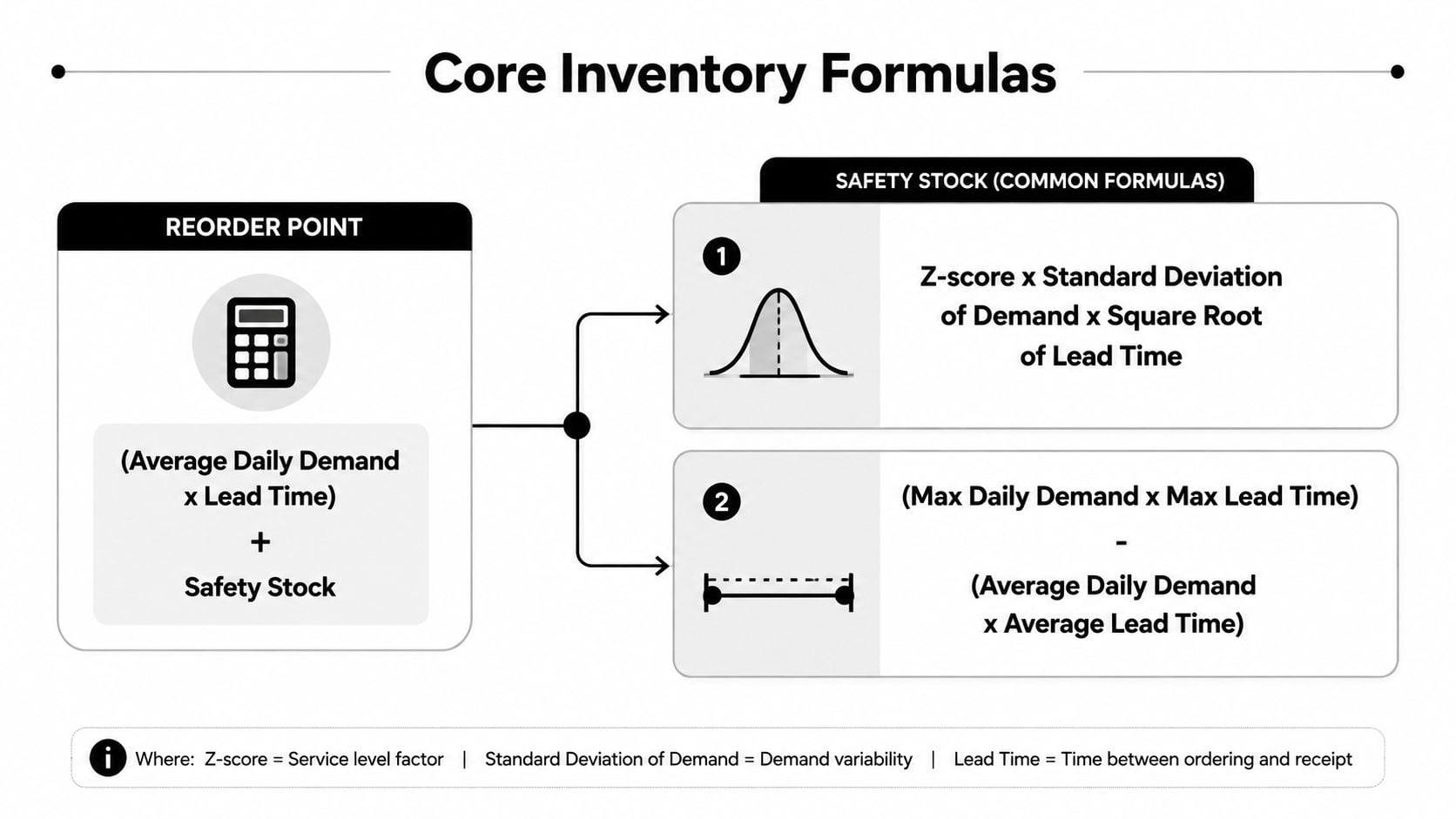
The standard reorder point formula is straightforward:
Reorder Point = Average Daily Demand × Lead Time + Safety Stock
That's the base calculation. The decision sits inside the safety stock number, because that's where service-level ambition turns into cash committed to inventory.
A basic version of safety stock uses average demand and average lead time. A more disciplined version uses variability and a service-level factor, often called a Z-score. The higher the service level, the more stock you hold to reduce the chance of a stockout.
A Worked Example You Can Copy
Use a mid-market distributor with these inputs:
- Average daily demand: 50 units
- Lead time: 7 days
- Target service level: 95%
The working formula for reorder point starts with demand during lead time.
Demand during lead time = 50 × 7 = 350 units
If the calculated safety stock for that item is, for example, 75 units, then:
Reorder Point = 350 + 75 = 425 units
That means you trigger the purchase order when inventory falls to 425 units, not when you're nearly out.
Now raise the service level to 99%. The demand and lead time haven't changed, but your required safety stock goes up because you're trying to guard against a tighter stockout risk. The exact amount depends on the variability in your demand during lead time, but the point is the same. A small move in service-level target can create a much larger jump in cash tied up.
Use the Same Logic on Your Own Items
If you want to pressure-test a SKU, work through it in this order:
- Measure average daily demand using a recent period that reflects current reality.
- Confirm actual lead time, not the supplier's optimistic promise.
- Set the service level based on how expensive a stockout really is.
- Calculate safety stock using the same assumptions every month.
- Set the reorder point from those updated inputs.
If your forecasting discipline is weak, the formula won't save you. The forecasting accuracy guide matters here because bad forecasts turn neat formulas into expensive fiction.
The point isn't to worship the math. It's to use it to make tradeoffs visible. The more aggressive your service target, the more cash you commit. That's the decision.
When the Formulas Mislead Your Business
A construction owner does not lose sleep over the formula itself. He loses sleep when a late job, a changed spec, or a supplier slip turns a neat reorder point into dead cash sitting on the shelf.
That is the core problem. The formula assumes repeatable demand and clean replenishment, while project work creates spikes, gaps, and buying constraints that do not fit a tidy monthly pattern.
Construction and distribution owners feel this first. One large job can wipe out a component, then the next few weeks go quiet. A supplier delay, a rush order, or a minimum-order quantity forces a purchase that has more to do with operating reality than with the math on paper.
Where Static Models Fail
- Demand is lumpy: One project can burn through a quarter's worth of a component, then demand goes quiet for weeks.
- Lead times move: Supplier dates shift, especially when freight or trade conditions are unstable.
- Cash is tight: The formula can call for more buffer than the business can afford to carry.
- Minimum-order quantities distort reality: You do not buy the exact amount the formula suggests. You buy what the supplier will sell.
The current situation makes that worse. U.S. manufacturing sentiment remained in contraction territory at 49.0 in July 2026, which signals ongoing weakness and uncertainty in factory demand conditions, and broader freight and trade disruption keeps variability inside replenishment planning operations management reference. In plain English, stable demand and stable supply are much less reliable than many planning systems pretend.
That is why I prefer service-level segmentation over universal rules. Put critical items in one bucket, intermittent items in another, and low-risk items in a third. Then use exception-based replenishment for the items that stop production or revenue if they miss. For some custom or project-heavy businesses, the right call is less buffer, not more.
This is also where a scenario analysis review matters more than a single-point forecast, while a sensitivity pass only tells you how one variable moves on its own. Service-level segmentation should test what happens if lead times slip, demand spikes, or buying constraints force a larger order. The difference between sensitivity analysis and scenario analysis matters because you do not run a lumpy business on one clean assumption.
Sometimes you should deliberately hold less safety stock than the formula suggests. Excess inventory ties up cash, and the occasional expedite or planned shortage can be the cheaper outcome. That is a management decision, not a math mistake.
Static formulas feel safe because they are tidy. They turn dangerous when the business is lumpy, the supplier is inconsistent, and the owner needs cash more than another pallet.
The Working Capital and Cash Flow Impact
Inventory decisions show up in your bank account whether you track them there or not. A distributor carrying too much stock doesn't just have a warehouse problem. It has less cash to fund payroll, less room on the line, and less flexibility when a better order comes along.
Take a $25M construction materials distributor. If it carries 60 days of inventory instead of 35 days, the difference isn't theoretical. It's money sitting in inventory that could have been released. A fractional CFO would pressure-test that against a 13-week cash flow model and ask whether the business wants inventory on the shelf or liquidity on the balance sheet.
A simple way to think about the impact is to compare inventory coverage before and after a tighter policy. If the company's demand base is steady enough to support a reduction in days of supply, then every week trimmed from safety stock frees working capital that can go toward debt paydown, supplier discounts, or growth.
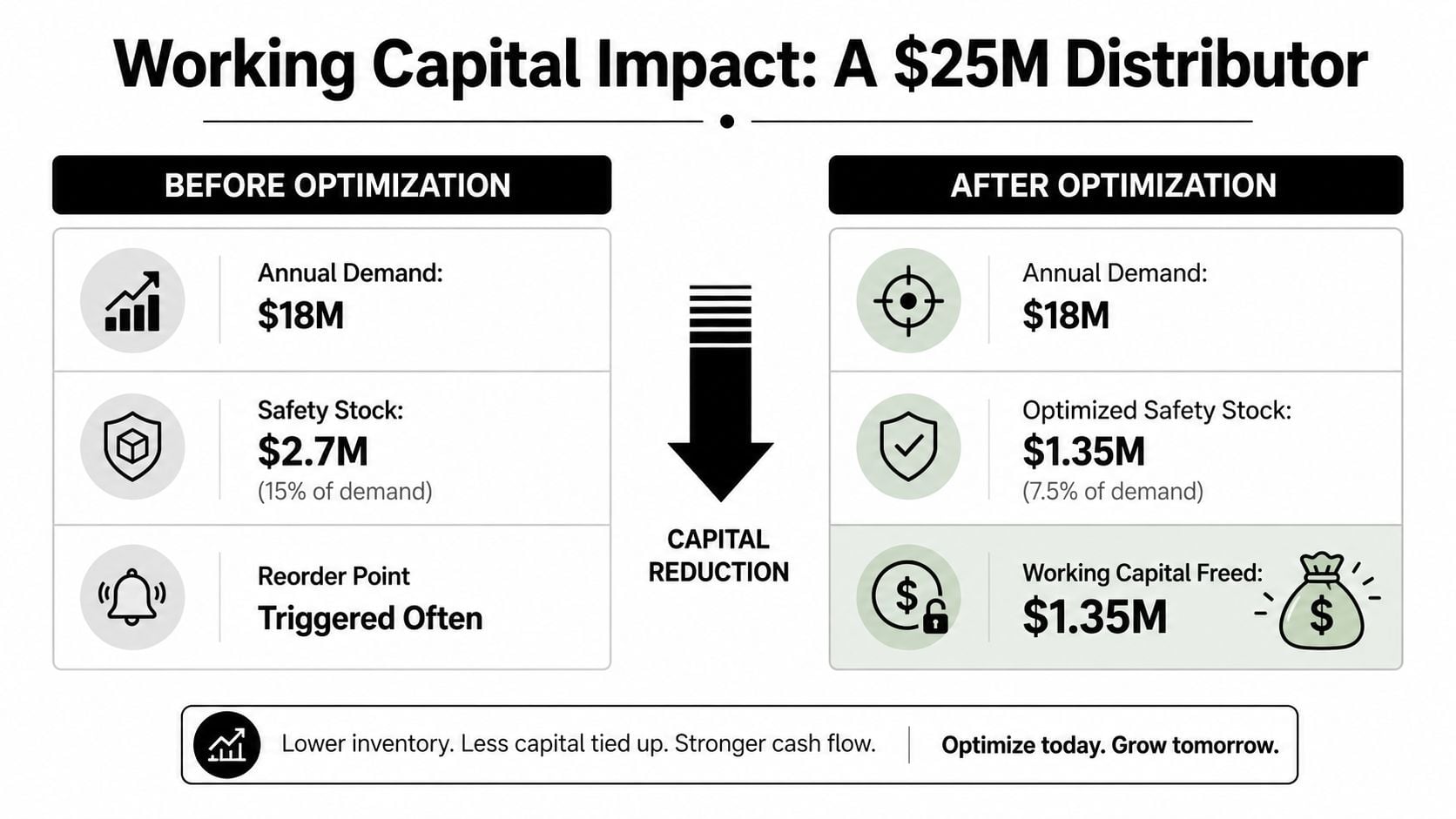
The financial model matters because inventory is only one line in the working capital story. If you want the balance sheet and cash flow to talk to each other properly, a financial model for service business owners gives you the structure to test those tradeoffs before you buy the next shipment.
The rule I give owners is blunt. Every additional week of safety stock is a week of cash you no longer control. That cash is paying rent on a shelf instead of funding operations. If your line of credit is expensive or your growth plans need liquidity, inventory policy is a finance decision first and an operations decision second.
Tuning the Model for Construction, Distribution, and Professional Services
Construction, distribution, and service-adjacent firms should not run the same inventory policy. The operating rhythm is too different. What works for a fast-turn distributor can choke a project business, and what protects a jobsite can overload a lean service team with unnecessary stock.
Construction
Construction owners need to treat long-lead materials as project risk, not generic inventory. Steel, custom windows, and specialty fittings often need a separate policy because the job schedule, retainage timing, and supplier lead times don't behave like retail demand. The right question is whether a material is critical to a milestone, not whether it fits a standard replenishment template.
Distribution
Distribution needs SKU velocity tiers. Fast movers deserve tighter monitoring and more frequent trigger reviews. Slow movers should not get the same safety stock logic as the A items, especially when supplier minimums force awkward buys. If you don't separate A, B, and C items, you'll overprotect the wrong products and underprotect the ones that matter.
Professional Services Adjacent
For equipment-heavy firms or productized services, a formal safety stock policy may be overkill for many items. A simple reorder trigger tied to recurring client demand is often enough. If the item doesn't create revenue by being available on demand, don't let the formula bully you into carrying it.
The key is to match the policy to the business model, not the spreadsheet. If you need a cash-flow view of project timing and inventory exposure together, the construction cash flow management discussion is the right companion to this decision.

A 30-Day Implementation Plan and Policy Template
Don't try to “fix inventory” in one meeting. Put the work into a 30-day rhythm and make operations and finance share the same numbers.
Week 1
Pull the data that matters, recent sales history, actual lead times, supplier variability, and any stockout history. If the data is messy, that's useful. It tells you where the assumptions are weak.
Week 2
Calculate reorder points and safety stock for your top 20 SKUs by revenue. Don't start with the whole catalog. Start with the items that move cash and customer service the most.
Week 3
Build a simple dashboard that shows fill rate, inventory turns, and weeks of supply. Those three metrics tell you whether the policy is working without burying you in noise.
Week 4
Write a one-page inventory policy. Include:
- Trigger levels for each SKU tier
- Owner of each replenishment decision
- Review cadence for demand and lead-time updates
- Exception rules for project orders, custom buys, and critical items
A good policy template also forces accountability. If no one owns the trigger, the trigger doesn't exist.
Monthly checklist: review fill rate, weeks of supply, items aging past policy, supplier lead-time shifts, and any SKU that missed service targets.
If you want help pressure-testing the assumptions and tying inventory policy into the broader 13-week cash flow model, book a working session with the AmbitionCFO team and use the policy as a finance tool, not just an operations document.
AmbitionCFO helps owners connect inventory policy to cash flow, working capital, and the decisions that move the business. If you're tired of stockouts, excess inventory, and spreadsheet logic that doesn't match reality, visit AmbitionCFO and start with a working session that pressure-tests your assumptions.