

You're staring at a strong revenue line and a weak bank balance, and the story doesn't add up. The crews are busy, invoices are going out, and yet one client or one project keeps dragging cash tighter every month. That's usually the moment a founder realizes the blended P&L is lying by omission.
Job order costing is the fix when you need to know which job is making money, not just whether the company looks profitable in aggregate. It forces every contract, engagement, or work order to carry its own costs, including the overhead that gets hidden in the average. For founders in construction, distribution, and professional services, that's the difference between guessing and pricing with discipline.
Table of Contents
- Why Your Best Client Might Be Your Worst Job
- What Job Order Costing Is
- Job Order Costing vs Process Costing at a Glance
- The Hidden Lever in Overhead Allocation
- Implementing Job Order Costing Step by Step
- Connecting Job Costing to Cash Flow, Margin Analysis, and Exit Planning
- KPIs, Common Pitfalls, and Your Next Step
Why Your Best Client Might Be Your Worst Job
A construction owner can look at a year-end statement and feel good because revenue is up. Then the accounting team closes the books, the line of credit stays stretched, and one flagship client turns out to have eaten the gross margin on three other jobs. That's not bad luck. That's what happens when you let blended financials hide job-level reality.
Job order costing is the discipline that cuts through that noise. It assigns direct materials, direct labor, and applied overhead to each individual job, then closes the books on that job only when the work is done, which is why it gives management a job-specific profit basis instead of a company-wide average NSC Politeknik Negeri Surabaya. That's exactly what you need when a client swears the scope was “simple” but the job cost sheet says otherwise.
Blended margins hide bad decisions
A company-wide gross margin can look fine while one job burns cash. That happens because setup time, rework, change orders, and indirect support costs don't show up evenly across every contract. The same average that makes the P&L readable also makes it dangerous.
Practical rule: If a founder can name the customer, the scope, and the delivery team, that work should have its own job cost sheet.
You can see the point in the way AmbitionCFO frames how to improve profit margins, because margin improvement starts with knowing where profit is leaking. A founder who only reviews monthly totals is usually one pricing decision behind the truth.
What you should be able to answer
By the end of this article, you should be able to answer five practical questions. Which jobs are profitable. Which clients keep expanding scope. Which overhead base is distorting bids. Which costs you should capture weekly. And which work you should stop chasing entirely.
The value here lies not in the spreadsheet, but in the pricing risk you finally see.
What Job Order Costing Is
A custom deck, a tenant fit-out, and a one-off advisory engagement are not the same kind of work as producing the same unit over and over. Job order costing fits the first category. It tracks each order as its own job, with its own labor, materials, and overhead burden. A blended company-wide P&L hides that separation, which is how a profitable business can keep bidding bad work without realizing it.
The method treats the job as the cost object, the unit being measured. Costs are not averaged across the whole operation. They are collected on a job cost sheet for each specific order, so you can see what that work consumed before you price the next one NSC Polteksby cost accounting chapter.
The three cost buckets
Every job breaks into three buckets. Direct materials are the inputs you can trace to the job itself. Direct labor is the work of the people doing the job. Manufacturing overhead is the indirect support that keeps the work moving, such as shop rent, utilities, supervision, and similar production costs. The overhead bucket is where many founders get careless, because the allocation base can distort margin and make a bad client look acceptable NSC Polteksby cost accounting chapter.
That is the mechanic. Costs accumulate on one job record, then the total job cost is known when the order closes, not when the month ends NSC Polteksby cost accounting chapter.
Who should use it
Any business that sells custom work should be thinking this way. Contractors, custom manufacturers, agencies, legal firms, accounting firms, medical practices with unique cases, and event planners all face the same issue. Each client engagement behaves like its own little profit center, and the overhead base you choose decides whether that profit center looks healthy or broken.
If you want a practical walkthrough for field work, job costing for contractors shows how project labor and materials get tied back to a job. The point is not bookkeeping for its own sake. The point is knowing what each order really costs before you accept the next one.
Advisory note: If you cannot isolate one engagement from another, you are probably averaging away the exact information you need to protect margin.
Use flexible budgeting for project-based work alongside job order costing if your workload shifts by scope, crew mix, or site conditions. It helps you separate a clean plan from a job that drifted because the assumptions were wrong.
In one sentence, job order costing tells you what one specific job cost, not what your company cost to operate.
Job Order Costing vs Process Costing at a Glance
Use the right costing method or you'll create false confidence. Job order costing belongs in businesses where customers buy something distinct. Process costing belongs in businesses that make the same thing over and over.
That difference sounds academic until a banker or controller asks why margins swing by contract while the company-wide average stays calm. A founder who can answer that question clearly has a much stronger handle on pricing discipline. A founder who cannot is probably using the wrong cost model, or half of two models at once.
Choosing Between Job Order and Process Costing
| Criterion | Job Order Costing | Process Costing |
|---|---|---|
| Cost object | Individual job, contract, or engagement | Large volume of identical units |
| When to use | Custom work, separate batches, unique projects | Standardized production, continuous flow |
| Data intensity | Higher, because costs are tracked by job | Lower, because costs are averaged by process |
| Industries served | Construction, custom manufacturing, professional services | Commodity manufacturing, uniform output operations |
The clearest decision rule is simple. If the customer can describe what they bought in a way that makes one order materially different from the next, job order costing is the default. If you are producing a homogeneous output in a repeatable flow, process costing is usually the better fit.
Many founders run a hybrid whether they realize it or not. The back office can be process-driven, while the revenue-generating work is project-driven. That's why AmbitionCFO's flexible budgeting framework matters here, because the budget needs to flex with the way the work is delivered.
The cost system should match how the customer experiences the product, not how the chart of accounts wants to simplify it.
That is the defensible answer a controller, lender, or investor will eventually want. One of two things is true. Either your business is selling unique jobs, or it is not. If it is, job order costing is the right default.
The Hidden Lever in Overhead Allocation
Overhead is where margin gets distorted. Materials are visible. Labor is visible. Overhead is not. It has to be assigned through a base, such as labor hours or machine hours, because the cost is indirect and cannot be traced to the job one line item at a time Indian Railways mechanical department manual.
That is why overhead allocation is the lever, not the footnote. If you choose the wrong driver, a job can look profitable on paper while consuming more coordination, software, compliance, or supervision than the rate ever captured. For founders in modern service and project businesses, that is where pricing mistakes start.
Why labor hours can mislead you
Labor hours work well in shops where people and machines drive most of the cost. They break down when the job is really being consumed by coordination, approvals, software, or client management. In those businesses, the worker on the floor is not always the primary cost driver.
Activity-based costing tries to close that gap. The basic idea is simple, trace overhead to the activities that create it, rather than using labor as a blunt proxy. Traditional job costing often stops at the base rate, but the literature shows that this can distort margins when overhead is indirect-heavy and labor is no longer the main driver University of Rome management paper.
A practical contrast you should care about
If a job uses fewer labor hours but a lot more coordination, a labor-hour base will undercharge it. If another job is labor-heavy but simple to manage, the same base can overcharge it. One client subsidizes another, and the blended P&L never tells you.
Decision rule: Small, labor-driven shop, use direct labor hours. Coordination-, software-, or compliance-driven work, run an ABC pilot before the next bidding season.
If you want a practical starting point for the indirect side, overhead calculation for tradies is a solid companion resource because it forces the owner to name what belongs in overhead before assigning it. The mistake most firms make is not that they calculate overhead. It's that they calculate it with a driver that no longer matches the job.
A good variance process catches this early. AmbitionCFO's budget vs actual variance analysis is the next filter, because once overhead is applied, the comparison between estimate and actual tells you whether the base is doing real work or just creating accounting noise.
Implementing Job Order Costing Step by Step
Do not try to “boil the ocean” here. A founder-led business only needs a disciplined workflow that starts before work begins and ends with a clean reconciliation at closeout. If you can't control the handoff points, you will never trust the numbers.
Phase one, capture the inputs
Start with materials requisitions, time tickets, and a defined overhead pool. Materials requisitions prove what was pulled for the job. Time tickets show who worked, when they worked, and against which job number. The overhead pool defines what indirect costs will be spread across jobs and what base will be used to apply them Indian Railways mechanical department manual.
You need approvals here, not after the job is done. The operations manager should verify that every requisition and time ticket maps to a job number. If the job number doesn't exist, the cost doesn't belong anywhere yet.
Phase two, open the job before work starts
Set up the job with a unique identifier, customer name, scope, budget, and start date. That job record is the container for every cost that follows. If the work starts before the job opens, you've already lost traceability.
Operational rule: No job number, no spend. No job setup, no labor coding. No budget, no meaningful variance review.
FP&A vs accounting is relevant because accounting records what happened while FP&A tells you what should happen. You need both. One captures the cost, the other tells you whether the job is drifting.
Phase three, code costs weekly
Do not wait until month-end. Labor and materials should be coded to the correct job every week, and overhead should be applied on schedule. Weekly coding keeps the estimate honest while there is still time to change course.
A simple approval stack works well. Project manager reviews hours. Purchasing confirms material receipts. Finance applies overhead. Ownership reviews exceptions only, not every line item.
Phase four, reconcile at closeout
At completion, compare actual job cost to estimated job cost and record the variance. Then feed that variance into the next bid, not just the next report. That is how the model improves.
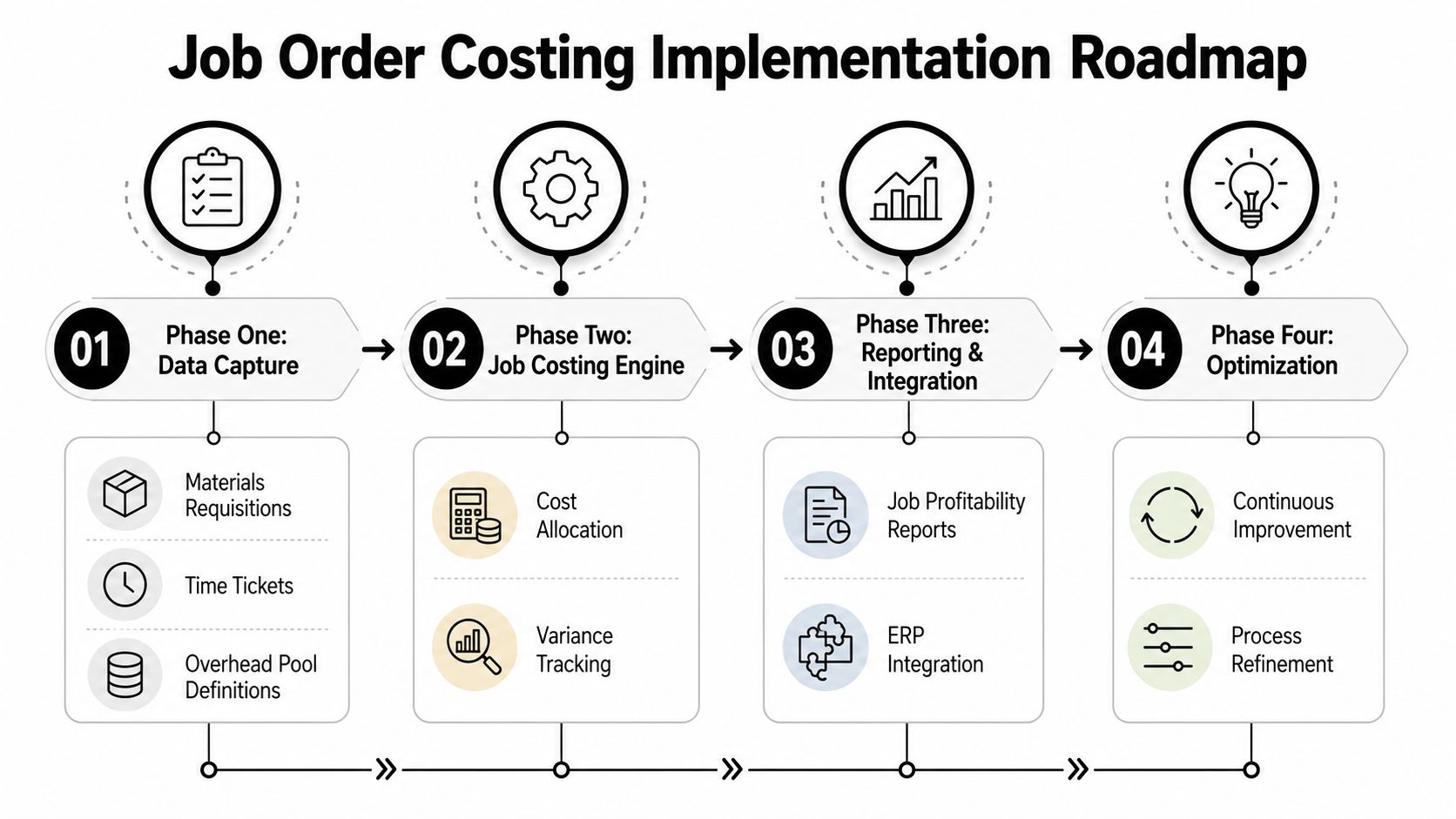
If you want a systems lens on the workflow, AmbitionCFO's FP&A vs accounting distinction is useful because it reminds you that the cost engine and the planning engine are not the same thing. One records the job. The other improves the next one.
A strong implementation is less about software and more about discipline. The documents matter, the approvals matter, and the closeout meeting matters.
Connecting Job Costing to Cash Flow, Margin Analysis, and Exit Planning
A clean job cost sheet is not just a historical record. It is the input that tells you which work funds payroll, which work starves cash, and which work deserves more of your next bid. That is why the best founders treat job costing as part of the management system, not an accounting afterthought.

Here is how it plays out in practice. A construction firm can win a major contract and still feel cash pressure because progress billing lags the labor and material outlay. A distributor can land a custom order that looks healthy at invoice time but gets crushed by handling, split shipments, or returns. A professional-services firm can keep a client happy while absorbing partner time that never gets billed.
What the Robinson Company example proves
A textbook job-order case for Western Pulp and Paper showed the Robinson Company job carrying total manufacturing costs of $9,705, with overhead applied by multiplying the actual allocation-base quantity by the budgeted indirect cost rate Studocu job-order costing case. The lesson is not the number itself. The lesson is that overhead is applied through a rate, and if the rate is wrong, the job story is wrong too.
That single mechanism is why founders should look at a weekly job margin report alongside the 13-week cash forecast. If your billing terms are net 60, you cannot average collections across the company and expect the forecast to be useful. The job that looks profitable may still tie up cash for weeks.
Three use cases that expose hidden profit
Construction. The job looks healthy until change orders and rework are counted on the sheet. Then the margin shifts, and the owner sees whether the client or the estimating process caused it.
Distribution. The order ships on time, but labor for picking, packing, and special handling can make a custom shipment weaker than a standard one.
Professional services. The client pays the fixed fee, but partner review time, nonbillable meetings, and scope creep can swallow the return. A job sheet beats a departmental P&L every time.
Practical rule: A customer you want to keep is not automatically a customer you should keep at the same price.
If you use a work-order system, Zynthoro's work order management guide is worth reviewing because it helps connect execution data to project control. For exit planning, AmbitionCFO's exit planning for business owners is the relevant lens, since a buyer underwrites quality of earnings by job, not by hand-wavy company average.
A business with three years of clean job sheets is easier to price, easier to diligence, and easier to defend. That is not compliance. That is valuation hygiene.
KPIs, Common Pitfalls, and Your Next Step
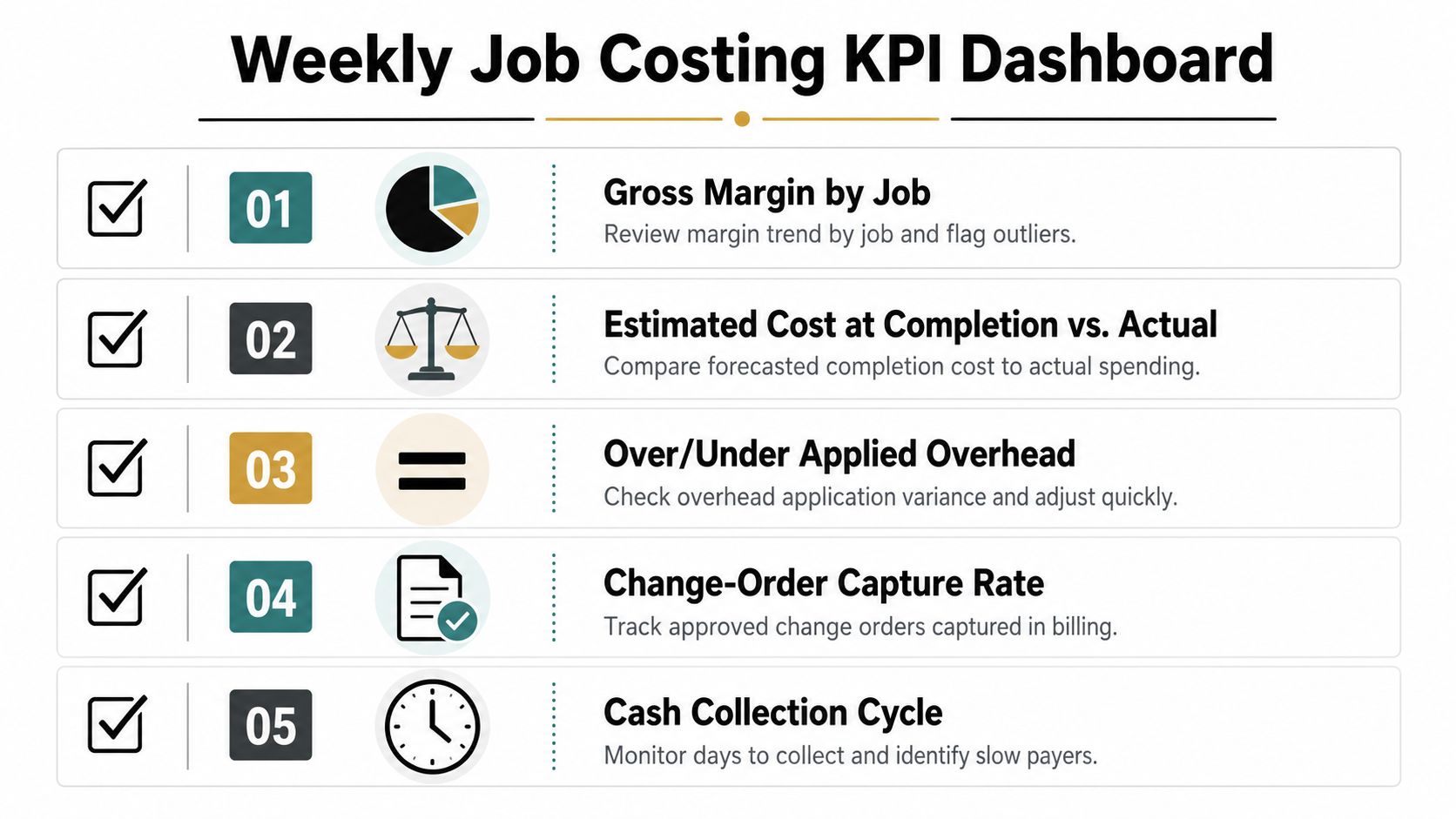
Keep the dashboard small enough that your team will use it. I want founders reviewing gross margin by job, estimated cost at completion versus actual, over or under applied overhead, change-order capture rate, and cash collection cycle every week. Those five KPIs show whether the system is catching margin leaks before they become write-offs.
The mistakes I see most often
- Coding labor to overhead accounts. That hides the job cost and makes productivity look better than it is.
- Opening jobs after work starts. Once the team has already spent time and materials, traceability is compromised.
- Skipping closeout reconciliation. If actual versus estimated never gets compared, the next bid repeats the same error.
- Using the wrong allocation base. That is how a strong job subsidizes a weak one without anyone noticing.
The weekly review should be short and ruthless. If a job is drifting, fix the estimate, the scope, or the client conversation now, not after the quarter closes.
If you want a clean starting point, download a one-page job setup template, or book a 30-minute working session with the AmbitionCFO team to pressure-test your overhead allocation and see where your best client might be your worst job.
AmbitionCFO works with founder-led businesses that have outgrown simple bookkeeping and need real job-level visibility into margin, cash flow, and overhead allocation. If you want a fractional CFO who will sit with your team, pressure-test your job costing, and help you use the numbers to price better, visit AmbitionCFO and start the conversation.