

A flexible budget adjusts budgeted revenues and costs to the actual level of activity, not a single fixed assumption, which is why it's the right tool for variance analysis. For a founder, that means you stop asking whether the year's plan was “right” and start asking what drove the gap.
You're probably looking at a January budget that felt disciplined at the time and now looks stale. Revenue shifted, jobs slipped, utilization moved, labor didn't land where you expected, and the static plan is now creating false comfort or false panic.
Table of Contents
- Why a January Budget Stops Working by March
- How a Flexible Budget Actually Works
- Flexible Budgeting vs Static Budgeting
- Connecting the Budget to Cash Flow and Margin
- Industry Snapshots From Construction Distribution and Professional Services
- When Flexible Budgeting Misleads Instead of Helps
- Putting It in Place Templates Metrics and Next Steps
Why a January Budget Stops Working by March
A January budget usually fails for a simple reason. It was built for the business you thought you'd run, not the one you're running by March.
That matters most in founder-led construction, distribution, and professional services firms, where activity changes fast and the annual plan lags behind reality. A static budget can still be a planning anchor, but it becomes a weak control tool once jobs, utilization, freight, or demand shift. A flexible budget fixes that by comparing performance at the actual output level, so you can see what should have happened at the level of activity you really produced, not the level you hoped for. That's why it's widely used for variance analysis and operational review, especially on a monthly rhythm. Flexible budget performance reporting
Core definition: A flexible budget adjusts revenues and costs to the actual level of activity, then measures variance against that adjusted amount.
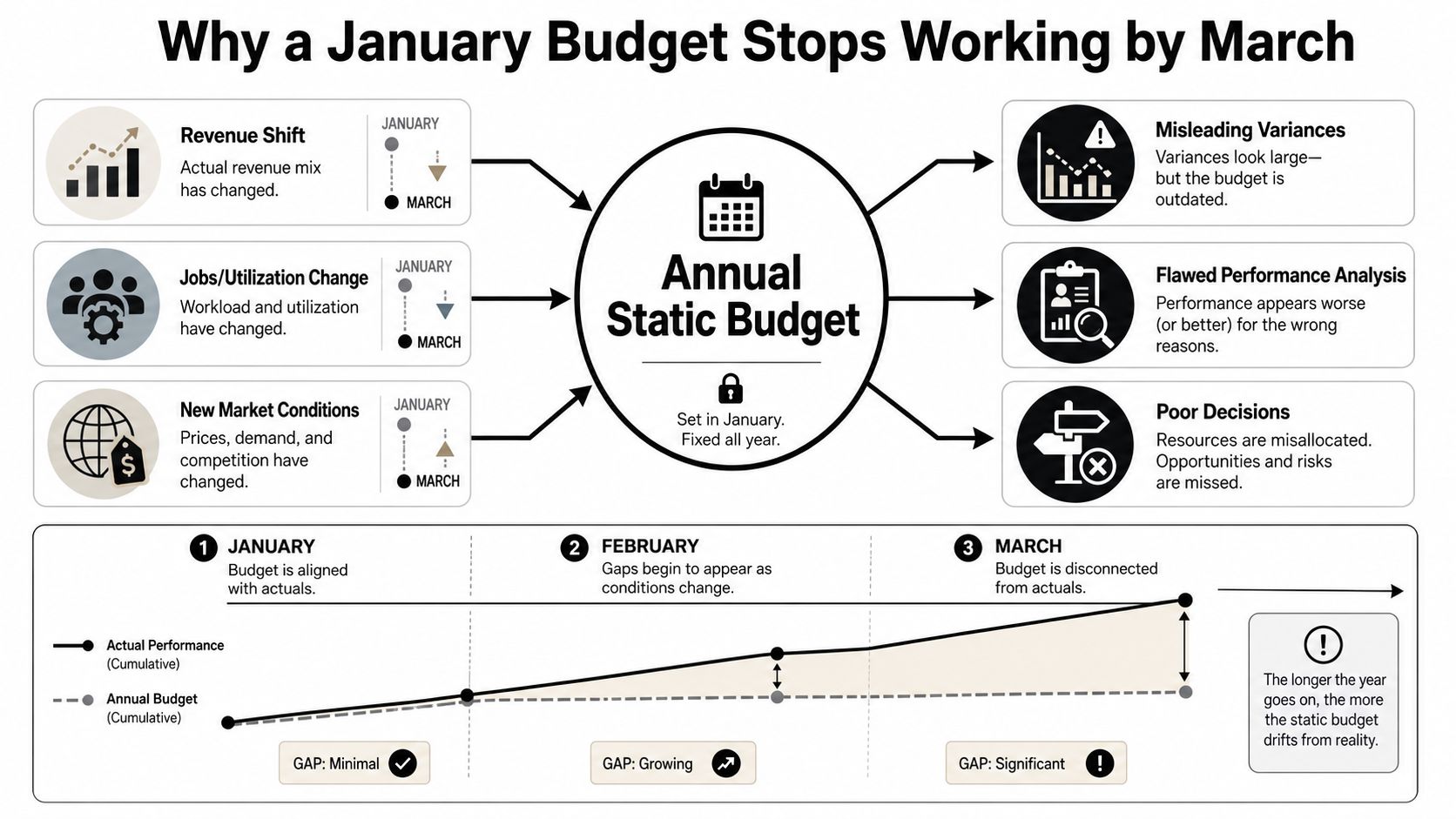
The point isn't to make finance fancier. The point is to stop judging a business against a number that no longer matches the operating environment. If March activity is lower, a static budget can make the team look inefficient when the underlying issue is volume. If March activity is higher, it can hide cost leaks by making overspend look “expected.”
The founder question is practical: do I have a reporting system that tells me what happened because of volume, and what happened because of execution? If you don't, the budget is just decoration.
Use the same lens you'd use in financial reporting discipline, where clean structure matters more than fancy presentation. financial reporting best practices
How a Flexible Budget Actually Works
The mechanics are straightforward once you stop treating every cost the same. Fixed costs stay flat, variable costs move with activity, and semi-variable costs need a judgment call because they contain both behaviors. That classification step is where most founders either get clarity or create garbage-in, garbage-out reporting.
Start with the cost behavior, not the spreadsheet
A flexible budget only works if you know what changes with activity and what doesn't. Rent, salaries, and insurance often sit in the fixed bucket. Materials, freight, subcontract labor, and billable support costs often flex. Semi-variable items, like a phone plan with a base fee plus usage charges, need to be split or you'll distort the result. IBM's overview makes that separation central because the wrong activity driver can misstate performance. Flexible budget basics
The standard formula is blunt and useful: Fixed Costs + Actual Units of Activity × Variable Cost per Unit of Activity. Prophix presents that exact structure, and it's the version I'd use in a board pack, a job review, or a weekly finance meeting. Flexible budget formula
A simple example makes it real. If fixed costs are steady and variable costs run per unit of activity, the budget should expand when volume expands and contract when volume contracts. That's how you isolate efficiency. If actual spend is above the flexed amount, you've found an operating issue. If it's below, you've probably found a savings opportunity or a timing issue.
Prepare it after the period, not before
A flexible budget is usually built after actual activity is known, often on a monthly basis, so the comparison is fair. OpenStax is direct on that timing rule, and it's the reason the model works for management control instead of just annual planning. Prepare flexible budgets monthly
Practical rule: If you can't tie a line item to an activity driver, don't pretend it's flexible.
Before you roll this out, pressure-test the cost structure and assumptions with a working cost-control process. Snyp helps you control costs is a useful reference if you're tightening spend discipline while you build the model.
A quick readiness checklist for your team:
- Fixed cost cleanly separated: You know what stays flat month to month.
- Variable driver identified: You know which activity measure drives the cost.
- Semi-variable items split: You've separated the base from the usage component where needed.
- Monthly timing in place: You can rebuild the budget after the close.
- Variance owner assigned: Someone has to explain the difference between actual and allowed cost.
If those five boxes aren't checked, the model isn't ready yet. Use your forecasting process to close that gap before you rely on the output. forecasting accuracy
Flexible Budgeting vs Static Budgeting
A static budget is a plan. A flexible budget is a control system. Those are not the same thing, and founders get into trouble when they expect one document to do both jobs.
Side-by-side, not as theory, as a decision tool
| Criterion | Static Budget | Flexible Budget |
|---|---|---|
| Primary use | Annual planning | Variance analysis and performance control |
| Reaction to volume changes | Stays fixed | Adjusts to actual activity |
| Speed of insight | Good at the start of the year | Better after the close |
| Maintenance effort | Lower | Higher |
| Usefulness when volumes swing | Weak | Strong |
| Fit with cash decisions | Indirect | Much stronger |
That table is why most growth-stage firms need both. The static budget gives the board a plan to approve. The flexible budget tells the operator whether the team performed well at the volume produced.
The upside isn't just conceptual. A recent empirical study reported a strong positive correlation (r = 0.78) between budget adjustments and profit margins, and very high revenue predictability (R² = 0.987) for firms that dynamically adjusted budgets, according to the data in the study. It also found a strong negative correlation (r = -0.88) between market volatility and budgeting flexibility. Empirical flexible budgeting study
That's the business case. More adaptive budgeting lines up better with margin and predictability when the operating environment is moving. But don't confuse that with “easy.” A flexible budget takes more discipline, more clean data, and better ownership.
The clean rule of thumb is simple: static for the plan, flexible for the read. Use the static version to set direction, then use the flexible version to judge execution and manage the month. That's the standard I'd hold any leadership team to.
For a sharper finance lens on the difference between baseline planning and actual-performance review, the variance framing here pairs well with budget vs actual variance analysis.
Connecting the Budget to Cash Flow and Margin
A flexible budget matters when it changes operating decisions, not just the monthly report. Good operators do not ask whether they missed budget. They ask whether the miss came from volume, price, mix, or timing.
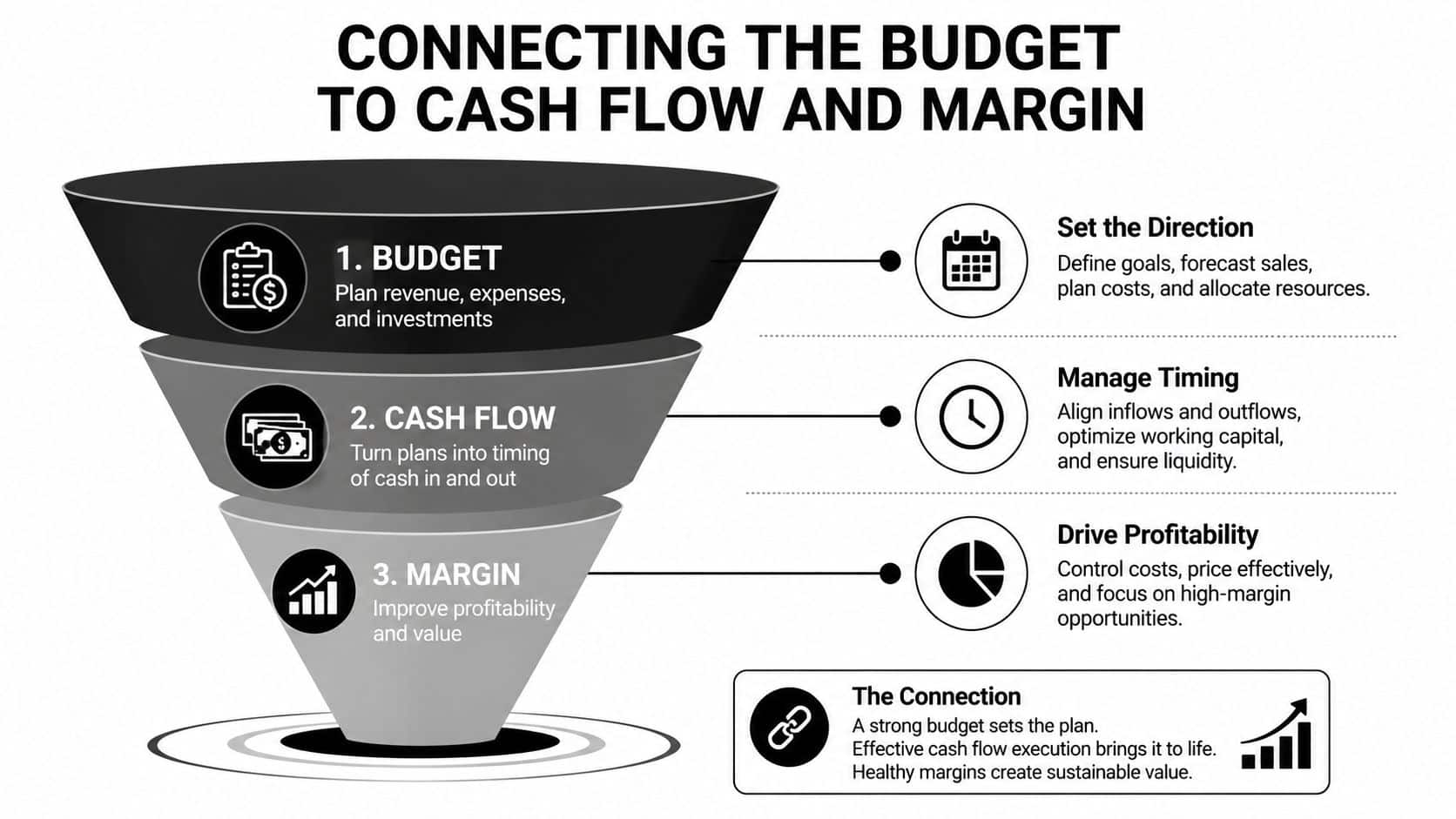
The monthly flex gives you the operating layer. A 13-week cash flow model gives you the timing layer. Put them together, and you can separate a margin problem from a cash problem. If actual activity is down, the flexed budget shows what cost should have been. The 13-week model shows when the cash impact hits, which is the part founders need to manage.
Where key operational decisions originate
That combination belongs on a whiteboard, not buried in a report. If the flexed margin on a job or client is weaker than expected, the decision is pricing, staffing, or whether to take the next piece of work. If cash is tight while the flexed margin still looks acceptable, the issue is billing lag, collections, or the timing of payroll and vendor payments.
Margin-by-job or margin-by-client variance strips out noise. It shows whether profitability changed because the business did more or less work, or because execution changed on the work already in flight. That is the level where hiring, subcontracting, and capital spend decisions get made.
For a practical way to tie those judgments back to operating discipline, how to measure operational efficiency is a useful companion. It forces the team to separate speed, output, and cost control instead of blending them into one vague score.
A flexible budget also helps you sequence weekly actions:
- Hiring: Add headcount only after the activity driver clearly supports it.
- Pricing: Raise rates when the flex shows margin erosion that volume does not explain.
- Project go or no-go: Decline low-quality work when the flexed margin is weak.
- Capital timing: Delay equipment purchases when the cash model shows a squeeze ahead.
The cleanest finance teams link the monthly flex to the weekly cash model, then use both to steer decisions. If your reporting does not do that, you are missing the operating point of the exercise. A practical setup starts with cash flow forecasting best practices.
Industry Snapshots From Construction Distribution and Professional Services
The same model behaves differently depending on the business. That's why a good flexible budget isn't built from a generic template. It's built from the activity driver in the business.
Construction
In construction, a slow month can mean two very different things. The schedule may have slipped, which is a volume problem, or the schedule may be fine while labor, subcontracting, or materials blew out, which is a margin problem. A flexible budget tied to job activity makes that distinction obvious.
The cleanest version is job-level. You compare what a job should have cost at the actual stage of completion against what it cost. That's why job costing discipline matters so much in this industry. construction job costing helps turn the budget into a real operating tool instead of a monthly accounting exercise.
Distribution
In distribution, the driver choice matters even more. Freight, fuel surcharges, picking labor, and order volume don't all move at the same pace. If you flex everything off revenue alone, you can misread the month and blame the wrong team.
The right move is to separate the cost behavior first, then flex by the activity measure that drives each line. IBM's guidance is useful here because it warns that the wrong driver can misstate performance. Flexible budget basics That's not an academic point. It changes whether you cut headcount, renegotiate freight, or accept that volume dipped.
Professional Services
Professional services firms need a utilization-based lens. Billable hours, staffing mix, and client-specific delivery costs should drive the flex, not just topline revenue. If a senior team member is underutilized, a static budget can hide the problem until payroll hits. A flexed view surfaces it sooner.
If the activity driver is wrong, the budget will lie politely.
The outcome you want from all three industries is the same, clearer decisions with less noise. In construction, that means cleaner job margin calls. In distribution, it means fewer false alarms on logistics cost. In professional services, it means better staffing and pricing decisions before the month is over.
When Flexible Budgeting Misleads Instead of Helps
Flexible budgeting is a control tool, not a truth machine. If the assumptions are stale, the model can normalize a broken operation and make bad performance look acceptable.
The strongest warning sign is volatility. The empirical data showed a strong negative correlation (r = -0.88) between market volatility and budgeting flexibility, which tells you the harder the environment swings, the harder it is to keep the flexed model accurate. Empirical flexible budgeting study That doesn't mean you abandon the method. It means you update the drivers and rates more often, and you stop pretending a quarterly refresh is enough when the business moves weekly.
Three warning signs to watch
- Drivers haven't been refreshed: If the activity basis is still set to last quarter's reality, the flex report is already behind.
- Semi-variable costs are treated as fully variable: That makes overhead look more efficient than it is.
- No one outside finance can explain it: If operators can't read the model, they won't use it.
The contrarian takeaway is simple. Flexible budgets are best for explaining variance. They do not automatically improve forecast accuracy. That still depends on the quality of the assumptions, the choice of driver, and the speed at which the model is updated.
Use the report to diagnose. Don't use it to hide staleness behind math.
Putting It in Place Templates Metrics and Next Steps
Start with a three-part template. Keep it simple enough that your accountant, controller, or fractional CFO can maintain it without turning it into a science project.
- Cost classification. List fixed, variable, and semi-variable costs.
- Activity driver and rate. Tie each variable line to the right measure, such as units, hours, jobs, or clients.
- Monthly flex calculation. Rebuild the budget after the close so actual activity drives the comparison.
OpenStax is clear that flexible budgets are prepared at each analysis period, usually monthly, rather than in advance, which is exactly why they stay useful when activity shifts. Prepare flexible budgets monthly
Metrics that tell you it's working
- Gross margin variance by job or service line: This shows where execution is slipping.
- Weeks of cash visible in the 13-week model: This shows whether the budget is changing real decisions.
- Monthly variance explained by volume versus price or mix: This shows whether you understand the cause, not just the result.
A simple troubleshooting checklist keeps the rollout honest:
- Misclassified semi-variable costs: Revisit the split.
- Stale driver rates: Refresh them from actuals.
- Invisible assumptions: Document them so leaders can challenge them.
- Low trust from operators: Simplify the layout until non-finance users can explain it back to you.
If you want to tighten the approval process around budget changes, it also helps to approve budgets online so the team isn't chasing versions in email threads.
Book a working session with AmbitionCFO to wire a flexible budget into your existing 13-week cash flow model. If you're running a $10M to $100M business and the budget no longer matches the month you're living in, that's the next fix to make.