

You're looking at your jobs, the revenue looks strong, and the bank balance still feels tight. The problem usually isn't that you sold bad work, it's that nobody is translating project data into decisions fast enough, so margins leak through change orders, retainage, labor drift, and slow billing.
That's where a construction accounting consultant earns a seat at the table. The right one doesn't just “keep the books.” They tell you which jobs are making money, which clients are tying up cash, and whether you can safely take the next project without choking working capital.
Table of Contents
- Why Construction Owners Need a Specialized Accounting Consultant
- Core Services a Construction Accounting Consultant Delivers
- How a Construction Accounting Consultant Compares to Bookkeepers and CPAs
- When and How to Engage a Construction Accounting Consultant
- Pricing Ranges and ROI Examples for Construction Accounting Consulting
- Interview Checklist and Red Flags When Hiring a Construction Accounting Consultant
- Your Next Steps to Better Construction Financial Leadership
Why Construction Owners Need a Specialized Accounting Consultant
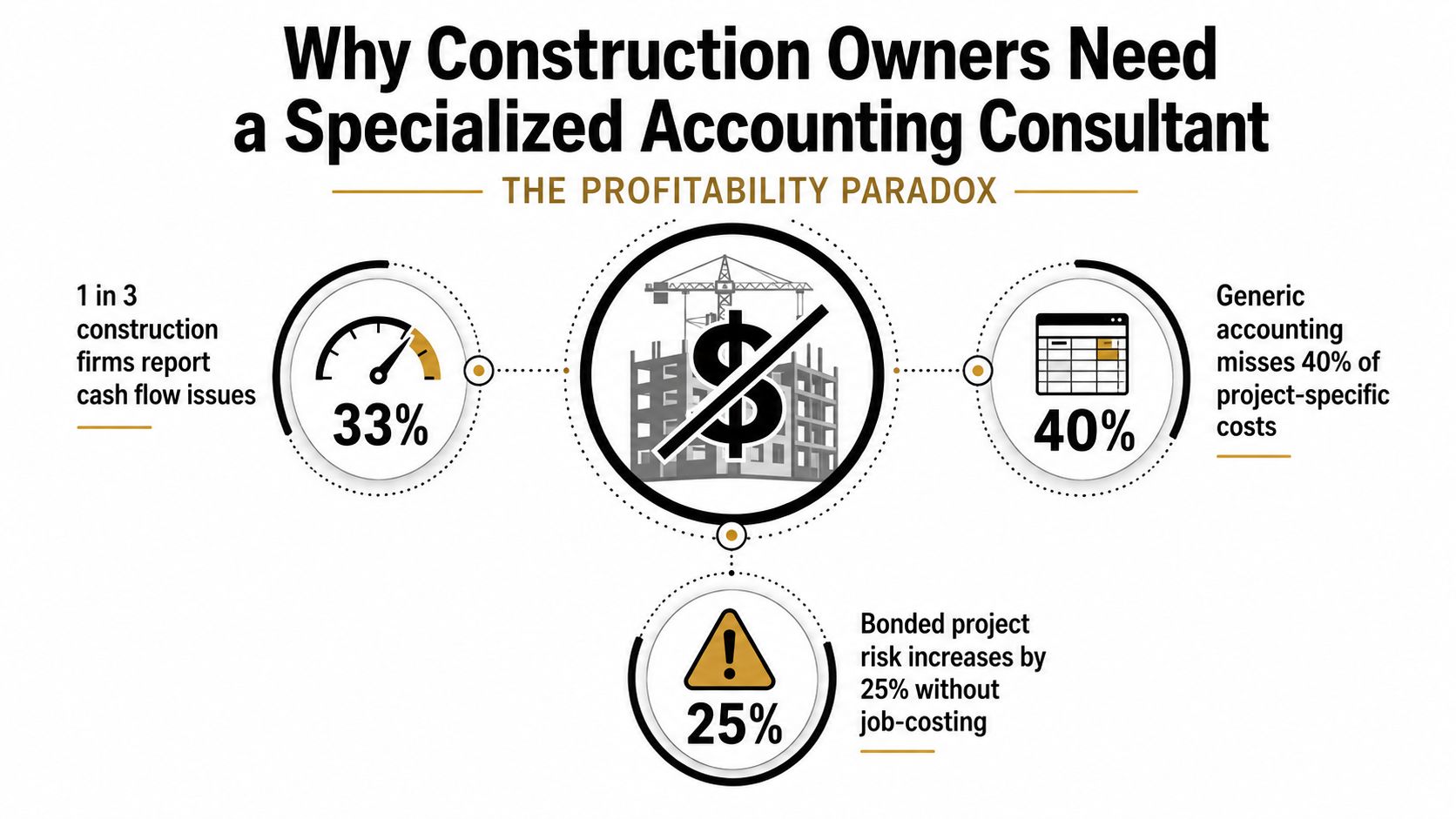
A contractor can have a full backlog, good-looking estimates, and a bookkeeper who closes the month on time, then still wonder why there's never enough cash to breathe. That is a working-capital problem tied to billing, cost timing, and project controls.
Construction accounting is different because the work is built around percentage-of-completion revenue recognition, WIP schedules, retainage, change orders, and job-level cost tracking. Those mechanics demand more than generic ledger work. Industry sources identify POC, job costing, and WIP reporting as core technical requirements for contractor financial statements and surety support, because long-duration jobs have to match revenue and cost to contract progress instead of cash timing (BTCPA).
Why the numbers force specialization
The UK construction sector is a major part of the economy, and the pressure shows up in failure rates, thin margins, and constant cash strain. One source reports strong sector-wide output and employment, but also 3,971 construction company insolvencies in 2024, which accounted for 16% of all business failures, and says the average construction profit margin is only 3.5%. That is the kind of margin profile that punishes weak billing discipline and sloppy job-cost coding (Apex Accountants).
When a business runs on low single-digit margin, one bad billing cycle or one sloppy cost code can erase the profit from an otherwise healthy job. A generalist accountant may get the compliance right and still miss the operational story. The consultant's real value is turning project-level data into decisions on pricing, overhead absorption, working-capital management, and bond readiness.
Practical rule: if your financial reports answer “what happened last month” but not “what should we bid, bill, or stop doing next,” you are under-supported.
A good construction accounting consultant should be able to look at a job, a draw schedule, and the cash position, then tell you whether the work is creating real value or just revenue on paper. If your current setup cannot do that, you are leaving money on the table. For a closer look at the cash side, review construction cash flow management.
Strong operators also pay attention to adjacent systems that feed the books. If equipment, vehicles, and field assets are tracked poorly, job costs get distorted and the margin story gets messy. That is where tools like fleet accounting software matter, because they help keep operational spending tied to the jobs that consume it.
Core Services a Construction Accounting Consultant Delivers
A real consultant doesn't show up with a prettier general ledger. They bring operating tools that change decisions. The point is not to produce more reports, it's to produce the right ones fast enough to act on.
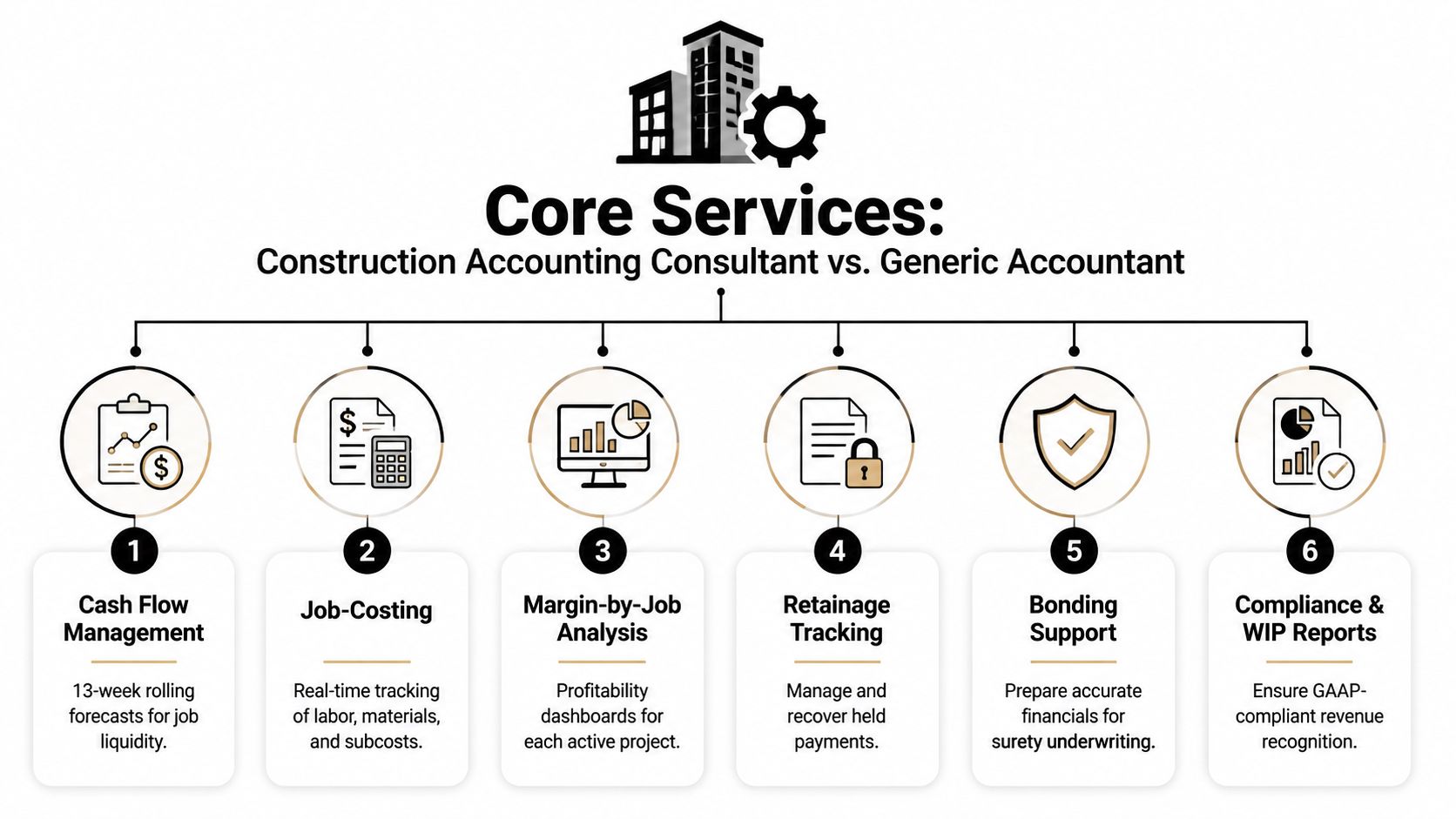
The six deliverables owners should expect
Start with cash flow management. A consultant should build a 13-week rolling forecast that shows when payments are due, when retainage lands, and where the shortfalls appear before payroll or vendor bills become a panic. That model is useful because it stops owners from accepting a new job just because the backlog looks strong.
Next is job costing and margin-by-job analysis. The deliverable should be a report that breaks labor, materials, subs, and overhead by project, then shows whether the bid assumptions are holding up. If you want the discipline behind this work, review construction job costing.
A contractor doesn't need another monthly report. They need a report that tells them whether the drywall package, the change order, or the client is making or losing money.
Then comes percentage-of-completion revenue recognition and WIP schedules. The consultant should keep earned revenue aligned with actual progress and show underbilling or overbilling before it becomes a balance sheet surprise. That matters on long-duration work, where cash receipts and earned revenue rarely move together.
Bonding and lender readiness is another core deliverable. A consultant should prepare bonding- and lender-ready financial reporting with job cost analysis, indirect cost allocation, and cash flow forecasts. Advisory firms tie timely reporting and financial statement analysis directly to contractor access to working capital (Warren Averett).
The fifth service is KPI dashboards. These should track the metrics management uses, not vanity numbers. If the owner can't see backlog quality, margin trend, billing lag, and labor drift in one view, the dashboard is decoration.
Finally, for owners thinking about succession, the consultant should support exit planning. A strong financial story makes the business easier to transfer, finance, or sell.
If you're comparing tools, a platform like fleet accounting software can help centralize job and vehicle-related financial data, but software alone won't interpret the numbers. That's the consultant's job. For more detail on the accounting mechanics, see fractional CFO vs accounting.
How a Construction Accounting Consultant Compares to Bookkeepers and CPAs
Owners usually build the finance stack in the wrong sequence. They hire a bookkeeper, add a tax CPA, and assume the business now has the financial leadership it needs. That setup handles transactions and compliance, but it leaves the owner without someone focused on margin control, cash timing, and project-level decision support.
Construction Financial Roles Compared
| Role | Primary Focus | Construction Expertise | Forward-Looking Strategy | Typical Cost Range |
|---|---|---|---|---|
| Bookkeeper | Transaction entry, reconciliations, AP, AR | Usually limited unless trained in construction | Low | Lower cost, but narrow scope |
| CPA | Tax compliance, annual filings, financial statements | Varies, often strong on compliance but light on job mechanics | Moderate | Moderate, depending on scope |
| Full-Time CFO | Strategic finance, capital planning, executive leadership | Can be strong if hired from construction | High | Highest cost, typically a major fixed payroll commitment |
| Construction Accounting Consultant | Job-level reporting, cash flow, WIP, bonding readiness, margin analysis | High, when specialized | High | Project-based or fractional, usually below a full-time CFO commitment |
Bookkeepers keep transactions current, and CPAs keep filings clean. A construction accounting consultant sits above that layer and turns the numbers into operating decisions. That is the role owners need once job volume, retainage, and backlog start driving real complexity.
The difference shows up in measurable outcomes. A consultant should improve cash flow visibility, tighten job-level profitability analysis, and support better capital decisions before the owner signs the next contract. At that point, the business is no longer asking only whether the books are accurate. It is asking whether the next crew, the next bond, or the next project can be financed without creating a cash squeeze.
For a plain-English breakdown of the functions, Business Loan Warrior's finance glossary is useful background. It explains why bookkeeping and accounting are different jobs, which matters in construction where job costing and WIP reporting go beyond data entry.
A full-time CFO can be the right answer, but only when the business can justify the fixed cost and use that depth every week. A fractional consultant is often the better move when the owner needs senior judgment, cleaner reporting, and sharper forecasting without adding a permanent executive salary. That setup fits companies that are still scaling into more complex work and need finance leadership tied to operating results, not just month-end close.
The upgrade path is clear. Bookkeeper for transactions, CPA for compliance, consultant for operating decisions, CFO for fully embedded leadership.
The mistake is treating those roles as interchangeable. If your team can report what happened last quarter but cannot show which job type is dragging margin down, the business has outgrown the setup. For a sharper look at that boundary, see FP&A versus accounting.
When and How to Engage a Construction Accounting Consultant
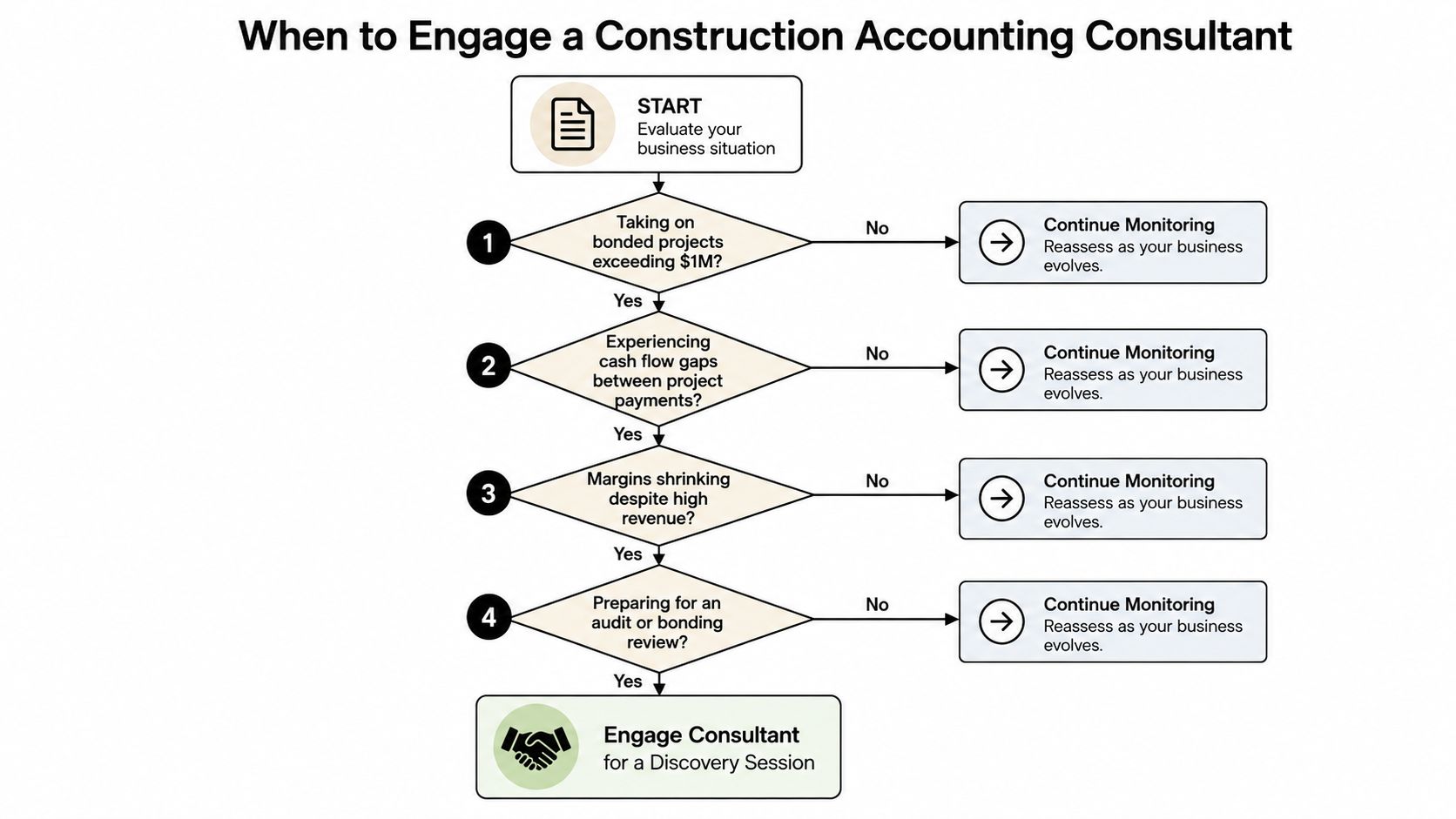
Most owners wait too long. They call for help after a cash squeeze, a bonding problem, or a messy year-end close. That's backward. The right time is when the business starts producing financial complexity faster than the current team can interpret it.
The triggers that should get your attention
If you're taking on larger bonded projects, you need cleaner reporting and tighter forecast discipline. If you're seeing cash flow crunches even though jobs look profitable, that's a sign your billing, retainage, or cost tracking is lagging reality. If you're preparing for a sale or succession, your financial story needs to be credible and repeatable.
Expansion is another trigger. New markets, new service lines, and more concurrent projects all multiply accounting complexity. A consultant becomes useful the moment the owner needs one person to connect project performance, finance, and operating decisions.
The market is also drifting toward remote and outsourced construction accounting as a default, not a compromise. Geography matters less when the firm needs recurring forecasting, KPI dashboards, and cash-flow visibility more than on-site transactional work. The key question is whether the consultant can integrate into your process, not whether they sit in your zip code.
What the first 30 days should look like
Start with a discovery session that maps your current systems, bank accounts, job coding, billing process, and reporting calendar. Then give the consultant access to your active project list, estimate structure, and prior financials. If they can't quickly identify where the data breaks, they're not the right fit.
The first month should end with three things, a cash view, a project margin view, and a reporting cadence. Anything less is too vague. A strong consultant will also define who owns each data input, because construction finance fails when field, office, and ownership all think someone else is updating the numbers.
One useful model is the fractional engagement. That means a senior financial professional works part-time with the owner and leadership team, usually on a recurring schedule, while giving strategic guidance without the cost of a full-time CFO. For many contractors, that's the cleanest way to get executive-level thinking without adding a permanent salary burden.
You can see the same logic in construction accounting consultant job postings, which often require practical tools like job cost accounting, change orders, subcontractor pay applications, and Excel-based controls. This is operational finance, not theory, and the engagement should be built that way.
Pricing Ranges and ROI Examples for Construction Accounting Consulting
Owners ask about price first because they should. The wrong comparison is consulting versus bookkeeping, as if both purchases solve the same problem. They do not. You are paying for judgment, forecasting, and margin protection.
What the investment usually buys
Project-based consulting is usually the starting point when the company needs a specific fix, such as cleaning up WIP reporting, setting up job-cost structure, or building a cash forecast. Fractional engagements make sense when the owner needs recurring leadership, monthly reviews, and direct involvement in operating decisions. The more the consultant is expected to influence planning and capital allocation, the more the relationship shifts from cleanup to embedded advisory.
The business case should be built around avoided mistakes and recovered margin. If a consultant catches underpriced change orders, the value shows up in jobs you stop giving away. If they build a 13-week forecast that keeps you from drawing on expensive short-term debt, the savings show up in preserved liquidity. If they identify a project type that consistently underperforms, the gain is in what you stop bidding.
Construction scale makes that expertise worth paying for. Global construction spending is forecast to reach US$15.7 trillion in 2025, and US construction spending was estimated at US$2.152 trillion as of April 2025, according to Autodesk. Autodesk also reports that construction accounting software is projected to grow from US$2.14 billion in 2026 to US$4.17 billion by 2036, a 6.90% CAGR, with accounts payable and receivable tools expected to hold 39.6% of market revenue in 2025. That points in one direction, more data, more process, and more financial visibility.
A practical tool if you are measuring related financial work is a roofing estimate ROI calculator. The principle is the same, if a change in estimating or accounting process does not improve project economics, it is not worth the spend.
Rule of thumb: pay for consulting when the cost of one avoided mistake is bigger than the engagement fee.
If you need a broader reference point on how a senior finance function pays back, review fractional CFO ROI analysis. The logic carries over directly to construction, because cash timing and margin discipline matter more than aesthetics in the P&L.
Interview Checklist and Red Flags When Hiring a Construction Accounting Consultant
Forget the polished resume-first approach. Credentials matter, but they don't tell you whether someone can keep a contractor out of trouble. You need an interview that tests outcomes, not job titles.
Questions that reveal real capability
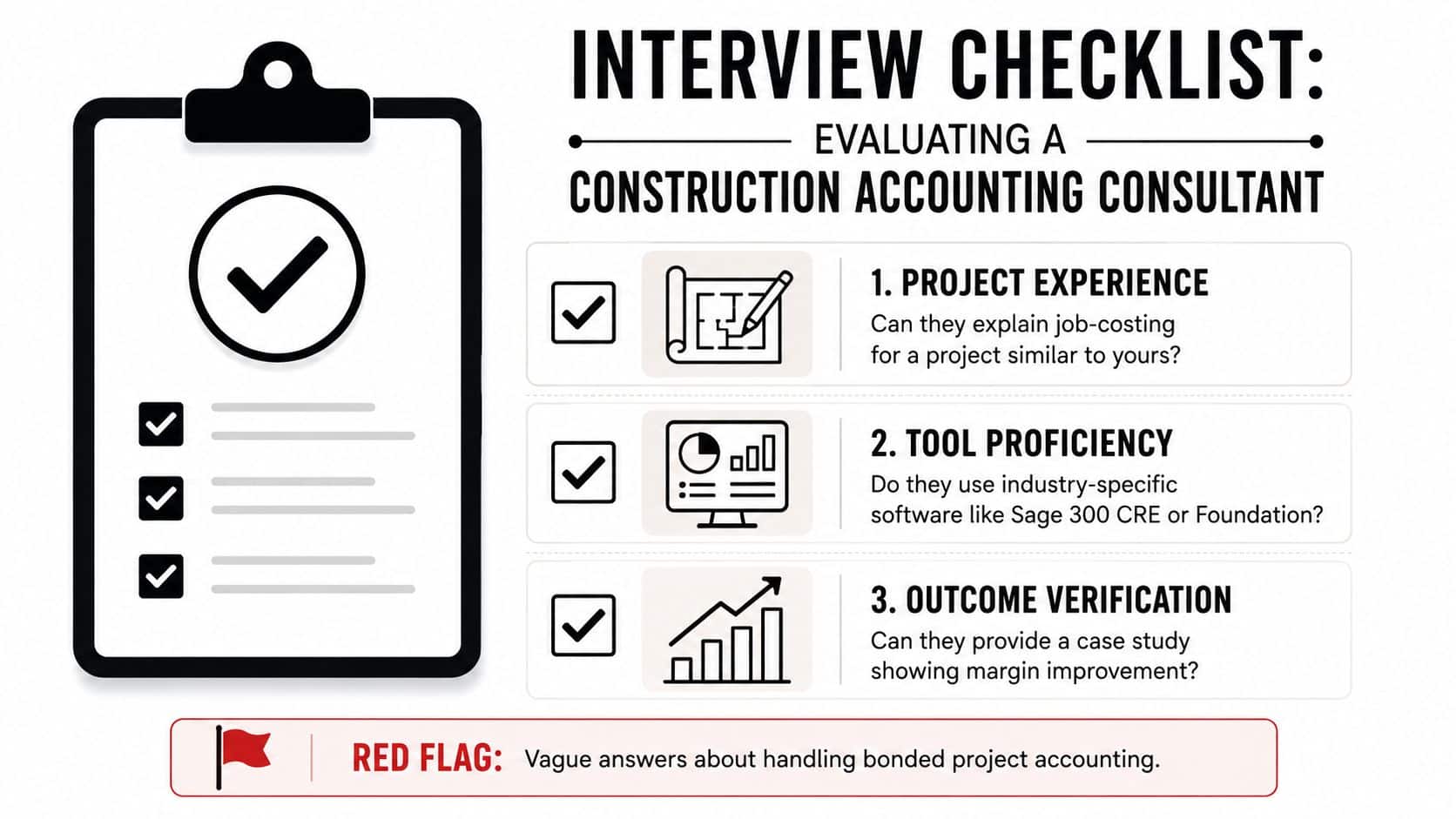
Ask the candidate to walk through a project where they improved job-level margin. Don't accept vague answers. You want to hear what they changed in cost coding, billing, or reporting, and how management used the information.
Then ask how they built a 13-week cash flow model. A qualified consultant should explain the inputs, update cadence, and who owns the forecast. If they can't describe how receivables, payables, payroll, and retainage feed the model, they're not ready for construction work.
Finally, ask how they prepared financials for bonding capacity. Industry guidance ties contractor access to working capital to timely reporting and financial statement analysis, so the answer should show an understanding of surety expectations, not just tax filing.
A strong candidate should also be fluent in WIP schedules, job cost accounting, change order management, subcontractor pay applications, and construction software like Foundation, Trimble, or Viewpoint Vista. Job postings reflect that reality directly, including roles that ask for hands-on construction field accounting, 3 plus years of accounting experience, strong Excel skills, and familiarity with project financial controls (Indeed construction accounting consultant jobs).
If they can't explain how a change order hits the WIP or how retainage affects cash, keep moving.
Red flags that should end the interview
A consultant who talks only about credentials and never about project outcomes is a weak hire. So is someone who treats construction like generic bookkeeping with a hard hat. That mindset misses the mechanics that drive profit.
Watch for answers that stay abstract. If they can't speak to actual construction workflows, monthly reporting cadence, or the difference between cleanup and decision support, they're probably not operating at the level you need. One construction advisory listing even asks for a CPA-track educational background plus Foundation or Trimble experience and prefers CPA and CCIFP credentials, which shows how technical the role can get (Indeed construction advisory listing).
One posting for a controller consultant role requires 8+ years of controller experience, including 5 recent years in construction, plus a working knowledge of WIP schedules, job costing, and full-cycle month-end close, with Viewpoint Vista highly preferred (LinkedIn controller consultant listing). Another construction compliance consulting role lists a 4-year degree and just 1 year of professional experience as minimum qualifications, with a pay range of $62,000 to $95,610 in Madison, WI (ZipRecruiter listing). That spread tells you the market is broad, but your interview still has to focus on outcome, not title.
Your Next Steps to Better Construction Financial Leadership
Construction accounting is too specialized, and too consequential, to leave to generalists. If you want better margins, clearer cash visibility, and stronger decisions on bonding or growth, you need a finance partner who understands how construction really works.
Start with a hard audit of your current setup. Check whether you have monthly WIP reporting, job-level margin analysis, a rolling cash forecast, and a clean process for change orders and retainage. If those pieces are missing, or if they exist but nobody uses them to make decisions, that's the gap costing you money.
Then decide what role you need. If you only need transaction cleanup, a bookkeeper may be enough. If you need tax compliance, a construction-aware CPA belongs in the mix. If you need senior-level planning, forecasting, and margin management, a construction accounting consultant or fractional CFO is the right move.
AmbitionCFO works with founder-led companies that have outgrown basic bookkeeping and need senior financial leadership, including construction businesses that want clearer cash flow, better reporting, and job-level visibility. Use that as your benchmark when you evaluate help, because the right standard is operational impact, not a credential checklist. For a closer look at the metrics that should already be on your dashboard, see construction KPIs.
If your construction business is winning work but still fighting cash and margin leaks, AmbitionCFO can help you clean up the numbers and turn them into decisions. Visit AmbitionCFO to talk about fractional CFO support built for construction owners who need better forecasting, job-level insight, and a stronger financial grip on growth.