

If you're asking whether your business can withstand buyer, lender, or auditor scrutiny, start with a formal internal controls assessment. COSO's framework, established in 1992 and refreshed in 2013, gives you the structure, while FY 2021 data shows ineffective controls were disclosed in 5.8% of SOX 404(b) auditor attestations, 23.7% of management reports, and 41.9% of management-only reports.
The warning usually arrives at the worst possible time. A founder is preparing for a major acquisition, refinancing, expansion, or exit when a buyer asks for reconciliations, approval records, customer balances, access logs, and evidence that someone independent reviewed the numbers. The finance team produces spreadsheets and explanations, but not a reliable system.
That gap doesn't mean the business is badly run. It means growth outran governance.

An internal controls assessment is a structured review of the policies, approvals, reconciliations, system permissions, reviews, and evidence that support reliable financial reporting and responsible operations. For a founder-led company, it should answer a practical question: Can the business prevent or detect a meaningful error, fraud, or reporting failure before a buyer or lender discovers it?
Table of Contents
- Why Internal Controls Assessment Matters for Founders
- The Step-by-Step Assessment Methodology
- Risk Scoring and Deficiency Prioritization
- Common Assessment Approaches and When to Use Them
- Reporting KPIs for Leadership and Boards
- Next Steps, Engaging a Fractional CFO
Why Internal Controls Assessment Matters for Founders
A founder-led company can run for years on knowledge held in one person's head. The founder knows which controller reviews vendor payments, which project manager approves change orders, and which employee resolves unusual customer balances. That arrangement works until the business adds locations, product lines, managers, lenders, or outside investors.
Growth then exposes undocumented judgment as a control weakness.
COSO created its modern internal control framework as a private-sector initiative in 1985 to investigate fraudulent financial reporting. It published the Internal Control, Integrated Framework in 1992, refreshed it in 2013, and stated that the updated version superseded the earlier framework on December 15, 2014. The 2013 framework formalized 17 underlying principles while retaining five components, giving organizations of different sizes and industries a clearer way to assess controls. Review the framework through COSO's internal control guidance.
COSO gives a growing private company a common language for risk, accountability, evidence, and corrective action.
Founder's rule: If only one person knows how a critical control works, you don't have a dependable control. You have a dependency.
Consider a construction company preparing for a sale. The owner trusts the controller, the controller trusts project managers, and project managers approve costs through email. The statements may be broadly accurate, yet a buyer still must determine whether job costs, change orders, retainage, revenue recognition, and cash disbursements are controlled consistently.
That uncertainty can delay diligence, trigger purchase-price adjustments, or force the founder to reconstruct evidence under pressure.
An internal controls assessment converts informal knowledge into documented answers. It reviews policies, approvals, reconciliations, system permissions, management reviews, and the evidence supporting them. For a founder-led business, the central question is direct: Can the company prevent or detect a meaningful error, fraud, or reporting failure before a buyer or lender discovers it?
The assessment also gives leadership a practical investment filter. It can catch billing failures that threaten revenue, expose approval weaknesses that put cash at risk, and strengthen the reporting package presented to banks or buyers. It shows which procedures deserve attention and which add paperwork without reducing a meaningful risk.
Founder-led companies should adopt the discipline without importing public-company bureaucracy. Build controls early enough for an external reviewer to understand them, test them, and trust the evidence. Keep ownership clear, retain usable documentation, and focus testing on risks that could affect cash, reporting, operations, or a transaction.
Use these financial reporting best practices alongside the assessment to strengthen the reporting foundation. The payoff is a company that can expand or approach an exit without making the founder the final checkpoint for every important transaction.
The Step-by-Step Assessment Methodology
Start with the risks that could distort financial statements, drain cash, disrupt operations, or damage a transaction. Don't begin by collecting every policy in the company. That approach creates a large binder and little assurance.
A lean assessment follows a clear sequence.
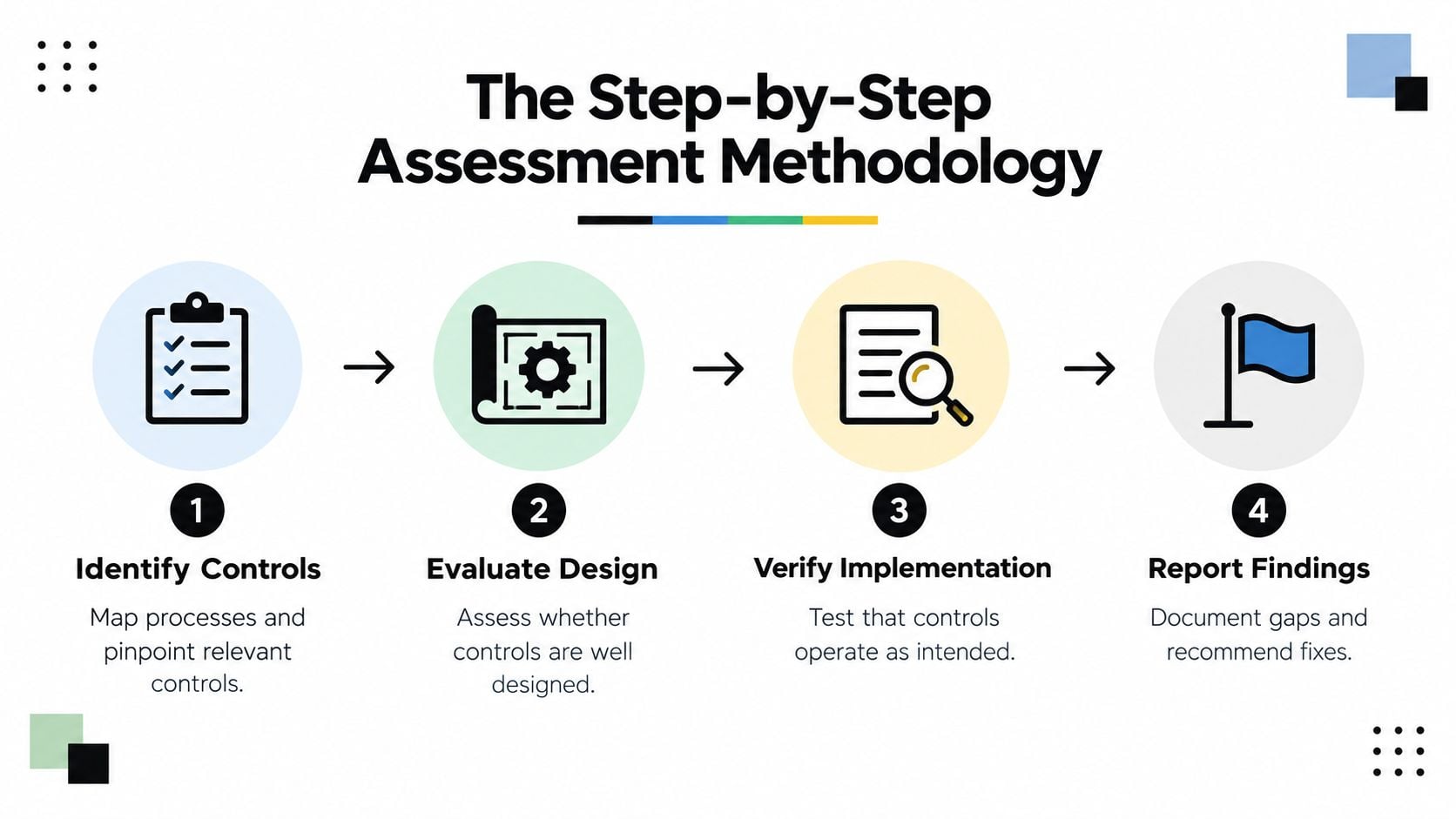
Identify the relevant controls
Map the major processes first. For most mid-market companies, that includes order-to-cash, procure-to-pay, payroll, treasury, inventory, fixed assets, financial close, and user access.
For each process, write down:
- Risk: What could go wrong?
- Assertion: What must be true about the reported information, such as existence, completeness, accuracy, valuation, or cutoff?
- Control: What action prevents or detects the problem?
- Owner: Who performs and reviews it?
- Evidence: What record proves the control occurred?
A good control statement is specific. “Management reviews revenue” is weak. “The controller reviews unusual revenue entries against contracts and supporting invoices before the monthly close is finalized” gives you something that can be evaluated.
Evaluate design effectiveness
Design effectiveness asks whether the control could prevent or detect the relevant error if someone performed it exactly as described. A control can operate consistently and still be badly designed.
Suppose a controller reviews a gross margin report once a month. If the report combines all jobs and hides individual project losses, the review may not be precise enough to identify a material problem. The control exists, but its design may not address the risk.
The Journal of Accountancy guidance on evaluating internal control supports separating design effectiveness from operating effectiveness and mapping each control to the risk assertion it addresses.
Verify implementation and operation
Operating effectiveness asks whether the control operated as designed during the period under review. Check evidence, not recollections.
Inspect approvals, reconciliations, exception reports, review notes, access changes, and documentation of follow-up. Ask whether the assigned owner had the authority, knowledge, time, and system access to perform the task.
The workflow should then assess control risk and document the linkage between the risk and the procedure set. That linkage is what makes your assessment understandable to an auditor, lender, board member, or buyer.
Watch this short overview before building your testing plan:
Finish with a finding record for each exception. Include the control, failed step, affected process, likely consequence, root cause, owner, corrective action, and target date. Your financial due diligence resource can help connect this work to a transaction-readiness process.
Risk Scoring and Deficiency Prioritization
A founder-led business needs a scoring system that separates inconvenient paperwork from threats to cash, reporting, or a transaction. A missing receipt on a low-value expense is different from one employee creating vendors, approving payments, and reconciling the bank account. Banks and buyers will focus on the second weakness because it combines access, judgment, and limited independent review.
Score each finding with a consistent decision model:
| Question | Practical test |
|---|---|
| Financial impact | Could the issue create a material misstatement or meaningful cash loss? |
| Likelihood | Could the failure occur in normal operations, or is it unusual? |
| Detection speed | Would someone discover it quickly, or could it remain hidden? |
| Control reach | Does the weakness affect one transaction, a process, or several reporting areas? |
| Transaction sensitivity | Would a buyer, lender, or board consider the gap important? |
An internal control deficiency exists when a control's design or operation does not let management or employees prevent or detect misstatements on a timely basis during normal duties. Record the failed control, affected assertion, and evidence supporting the rating.
A material weakness is more serious. Under PCAOB standards, it is a deficiency, or combination of deficiencies, where there is a reasonable possibility that a material misstatement in annual or interim financial statements will not be prevented or detected on time. Use the label only when the documented facts support it, then address the issue directly rather than softening the report.
The sampling trap
Sampling can create false comfort. One published analysis estimated that testing only 2 examples of a monthly control leaves an 83% chance of missing a single annual failure, while testing 8 examples of a weekly control leaves an 85% chance of missing a failure. Even testing 30 examples of a daily control leaves an 88% chance of missing a single failure, as documented in the Wolters Kluwer analysis of internal controls testing.
Frequency determines what your sample can miss, so a two-item monthly sample carries far more risk than a thirty-item daily sample.
Use full-population testing or data analytics for high-frequency, structured controls where the data is available. Analyze every payment above an approval threshold, every vendor-bank-account change, or every journal entry posted after the close. Reserve manual sampling for controls where population testing is impractical or judgment matters.
For exposure across cash, fraud, customer concentration, and operational dependencies, the guide to fraud prevention for directors provides a useful risk-matrix perspective. Use it to challenge scores that reflect internal familiarity rather than the consequence of failure.
Fix the issues buyers will notice first
Prioritize weaknesses involving cash disbursements, revenue recognition, inventory, payroll, related parties, debt compliance, financial close, and access to accounting systems. These areas affect the numbers and the credibility of management's explanations.
Use financial risk management strategies to connect remediation priorities to cash preservation and decision-making. A founder needs a visible, documented plan that addresses the risks with the greatest financial and transaction consequences, without forcing a growth business into unnecessary bureaucracy. That evidence gives lenders and buyers confidence while showing the team exactly what to fix first.
Common Assessment Approaches and When to Use Them
The right assessment model depends on timing, complexity, and the consequences of being wrong. A founder preparing for a routine operating review shouldn't spend like a public company facing an investor diligence process. A founder entering a sale process shouldn't rely on an informal self-review.
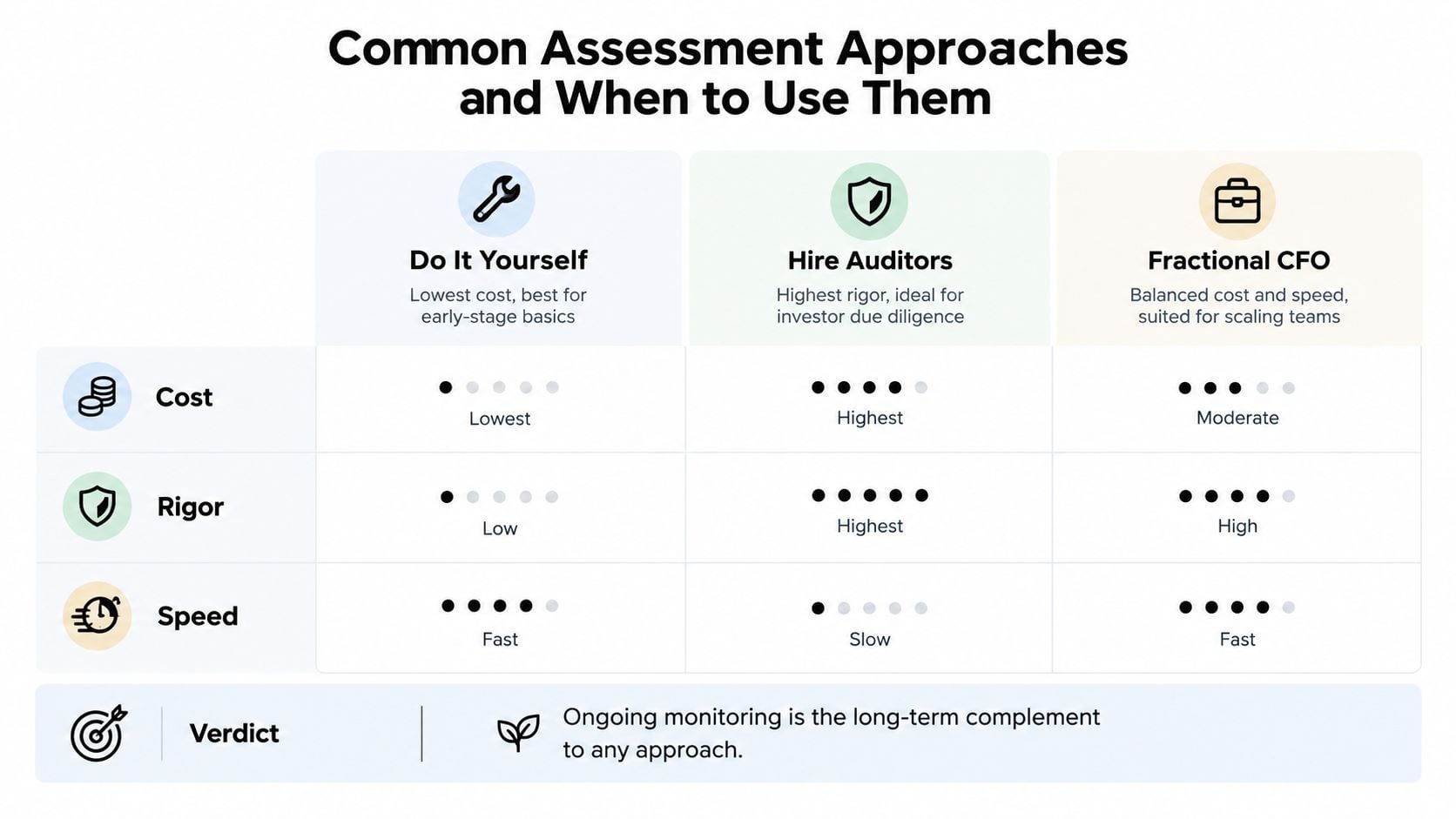
Do it yourself
A self-assessment works when the process is limited, ownership is clear, and the leadership team can challenge its own assumptions. Use a control register, process walkthroughs, evidence requests, and a remediation tracker.
The weakness is independence. People tend to rate familiar procedures generously, especially when the procedure depends on their own judgment. A self-assessment is a sensible starting point, not always a credible final opinion.
Hire auditors
External auditors bring the strongest independent challenge and are the right choice when a formal opinion, investor requirement, or regulated reporting obligation drives the work. They also bring rigor that can expose design weaknesses the operating team overlooks.
The trade-off is speed, cost, and scope. Auditors are not a substitute for management ownership. Your team still needs to define processes, preserve evidence, and remediate issues.
Use a fractional CFO
A fractional CFO can sit between internal self-review and a formal audit. This model fits a scaling company that needs a practical control framework, financial reporting discipline, risk prioritization, and leadership accountability without adding a full-time executive.
AmbitionCFO, for example, works with founder-led businesses on financial reporting, forecasting, cash flow visibility, KPI dashboards, and internal controls within a broader financial control framework. That role can help translate an assessment into operating routines instead of leaving the findings in a report.
KPMG reports that the average number of SOX key controls rose 18% from FY22 to FY24, while 69% of organizations still modified their control portfolios and the cost of maintaining SOX controls rose 45% between the 2023 and 2025 surveys (KPMG's SOX survey). The message for founders is direct: adding controls forever isn't a strategy.
Control rationalization means removing duplicate, low-value, or outdated controls while preserving assurance. COSO calls for ongoing evaluations, separate evaluations, or both to determine whether its five components and relevant principles are present and functioning. Choose the lightest approach that produces credible evidence, then keep monitoring as the business changes.
Reporting KPIs for Leadership and Boards
A board doesn't need a spreadsheet full of control IDs. It needs to know whether the company can produce reliable information, whether serious risks are covered, and whether management is correcting problems before they become transaction obstacles.
Your reporting package should combine status with trend.
Lead with coverage and exposure
Report the proportion of significant processes with documented controls, tested controls, and assigned owners. Then identify the areas where evidence is incomplete or where a control depends on one person.
Coverage alone isn't enough. A company can have many documented controls and still miss its most important risk. Show which financial reporting risks have no effective control, which controls operate manually, and which exceptions affect cash, revenue, close, or access.
Measure remediation honestly
Track open findings by severity, age, owner, and overdue status. Show whether management completed the corrective action, whether someone independently validated it, and whether the fix addresses the root cause.
A rewritten policy isn't remediation if employees still can't produce evidence that the control operates. The board should see the difference between a promised fix, an implemented fix, and a tested fix.
Translate technical findings
Under PCAOB AS 2201, management's ICFR assessment must identify and test controls designed to address financial reporting risks, then judge whether a deficiency reaches the level of a material weakness based on the likelihood and magnitude of a possible misstatement. SEC rules use the same material-weakness threshold, as described in PCAOB AS 2201.
Use plain business language:
- Finding: The same person can create a vendor and release payment.
- Business risk: Unauthorized payments could be processed without timely detection.
- Response: Separate vendor maintenance from payment approval and review changes independently.
- Evidence: Retain the change log, approval record, and review sign-off.
A useful KPI dashboard design framework can help leadership see control health alongside cash, margin, backlog, customer concentration, and operating performance. The strongest report makes financial integrity part of operating management, not a once-a-year compliance presentation.
Next Steps, Engaging a Fractional CFO
Start with a two-hour leadership workshop. List the processes that could materially affect cash, financial reporting, customer trust, or a pending transaction. Assign an owner to each process, collect the existing evidence, and mark every control as designed, implemented, operating, or unproven.
Then decide whether your team has enough independence and expertise to challenge its own conclusions. If it doesn't, bring in a fractional CFO before the buyer, lender, or auditor raises the issue for you.
A fractional CFO can lead the risk mapping, build the control register, test evidence, prioritize deficiencies, coordinate with your CPA or audit team, and establish a monitoring rhythm that fits your operating calendar. The role is especially valuable when the founder needs senior financial judgment but isn't ready to carry the cost of a full-time CFO. Learn more about what a fractional CFO does and how that role can support the assessment.
Don't wait for a signed letter of intent to discover that your controls exist only in conversations. Build the framework while you can still choose the pace, fix the root causes, and show stakeholders that the company is ready for its next stage.
AmbitionCFO helps founder-led businesses build lean internal controls, improve financial reporting, and connect remediation to cash flow, growth, and exit readiness. Visit AmbitionCFO to discuss your control gaps and create an assessment plan your leadership team can execute.