

Fractional CFOs in 2026 typically charge $200 to $350 per hour or $5,000 to $7,500 per month on retainer, with broader market ranges of $175 to $450 hourly and $3,000 to $15,000 monthly depending on scope. The right price depends less on revenue than on how densely you need the CFO involved in decisions, reporting, cash management, and execution.
That distinction matters for a founder-led business between $10M and $100M in revenue. A $30M consultancy with straightforward reporting may need a light advisory relationship. A $30M contractor may need job-costing analysis, work-in-progress accounting, bonding support, weekly cash decisions, and lender reporting. The companies have the same revenue, but the second engagement can reasonably cost twice as much because the CFO is carrying more decision risk and more operating work.
The question isn't just, “What does a fractional CFO charge?” Ask instead: How many hours, deliverables, and decisions does the fee cover? That scope-density lens will help you compare proposals without getting distracted by a low hourly rate or an impressive title.
Table of Contents
- What a Fractional CFO Costs in 2026
- The Three Pricing Models Side by Side
- What Drives the Price Up or Down
- Sample Pricing Scenarios at $10M, $40M, and $100M
- Fractional CFO Versus a Full-Time CFO
- Pricing Traps Founders Should Watch For
- Your Next Step and Questions to Ask
What a Fractional CFO Costs in 2026
The headline market answer is straightforward. The most common 2026 pricing falls around $200 to $350 per hour, while a typical monthly retainer for a small or mid-market company sits near $5,000 to $7,500. Broader observed ranges extend from roughly $175 to $450 per hour and $3,000 to $15,000 per month, based on experience, specialization, and engagement scope. OpsFi's 2026 pricing guide provides the underlying market ranges and explains why retainers vary.
A retainer is usually the practical choice once the CFO becomes part of the operating rhythm. You aren't paying only for a spreadsheet. You're paying for recurring judgment, preparation, meetings, follow-up, and the ability to respond when cash, margins, lenders, or major contracts create pressure.
Use scope density as your benchmark
Start with three questions:
- How much time will the CFO spend each month?
- What must be delivered, and how often?
- Which decisions will the CFO own or influence?
Published 2026 pricing guidance describes lighter advisory work near 8 to 12 hours per month, operational support around 15 to 25 hours, and embedded leadership at 25 to 40 or more hours. The CFO Index explains these workload bands and stresses that the same “fractional CFO” label can represent very different service loads.
That's why a $6,000 quote may be reasonable for one company and inadequate for another. If it covers a monthly forecast review and owner call, it's a light engagement. If it includes a 13-week cash-flow model, weekly cash meetings, KPI dashboards, lender reporting, and board preparation, it's a much denser assignment.
You should also separate CFO work from bookkeeping and accounting operations. If you need help understanding the underlying bookkeeping budget, this guide to bookkeeping costs with Allied Tax gives useful context before you price senior financial leadership.
For a practical definition of the role, review what a fractional CFO does. The key point is simple: you're buying financial leadership, not merely accounting output.
The Three Pricing Models Side by Side
Fractional CFO work usually fits one of three commercial structures. Choose the structure based on how predictable the need is, not on which format looks cheapest in a proposal.
| Pricing Model | Typical Rate | Best For |
|---|---|---|
| Hourly | $200 to $350 per hour for common engagements | Short diagnostic work, limited advisory support, or defined M&A preparation |
| Monthly retainer | $5,000 to $7,500 typically, with broader ranges of $3,000 to $15,000 | Ongoing forecasting, cash management, dashboards, lender reporting, and leadership support |
| Project-based | Qualitative scope-based pricing, with broader market project ranges varying materially by complexity | Finite deliverables such as a cash-flow rebuild, financial model, or board package redesign |
Hourly pricing
Hourly billing works when the assignment has a clear beginning and end. A diagnostic review, cash conversion assessment, or transaction-preparation sprint may not justify a continuing monthly commitment. You can authorize a defined number of hours, receive a specific output, and decide whether more support is necessary.
The weakness is that hourly work creates friction when priorities change. A lender asks for a revised schedule, an owner needs a scenario model, or a board meeting moves forward. Each request consumes more billable time, and the effective cost becomes difficult to predict.
Monthly retainers
A retainer creates continuity. The CFO can maintain dashboards, update forecasts, participate in leadership meetings, and notice changes before they become emergencies. The monthly fee also gives both sides a clearer capacity commitment.
Retainers don't automatically provide unlimited access. Your agreement should state the expected hours, meeting cadence, deliverables, response expectations, and treatment of excess work. A $5,000 retainer with limited advisory coverage is not comparable to a $5,000 retainer with embedded operating responsibility.
Project fees
Project pricing fits a defined deliverable. You might engage a CFO to rebuild a 13-week cash-flow model, redesign board reporting, prepare a lender package, or organize transaction data. The contract should identify the output, assumptions, review rounds, deadline, and what falls outside the project.
For startup-specific context, CFO services for startups can help distinguish early-stage finance needs from the heavier operating requirements of a $10M-plus company.
Practical rule: If the work keeps generating new decisions after the original deliverable is complete, stop treating it as a project and price the continuing responsibility as a retainer.
What Drives the Price Up or Down
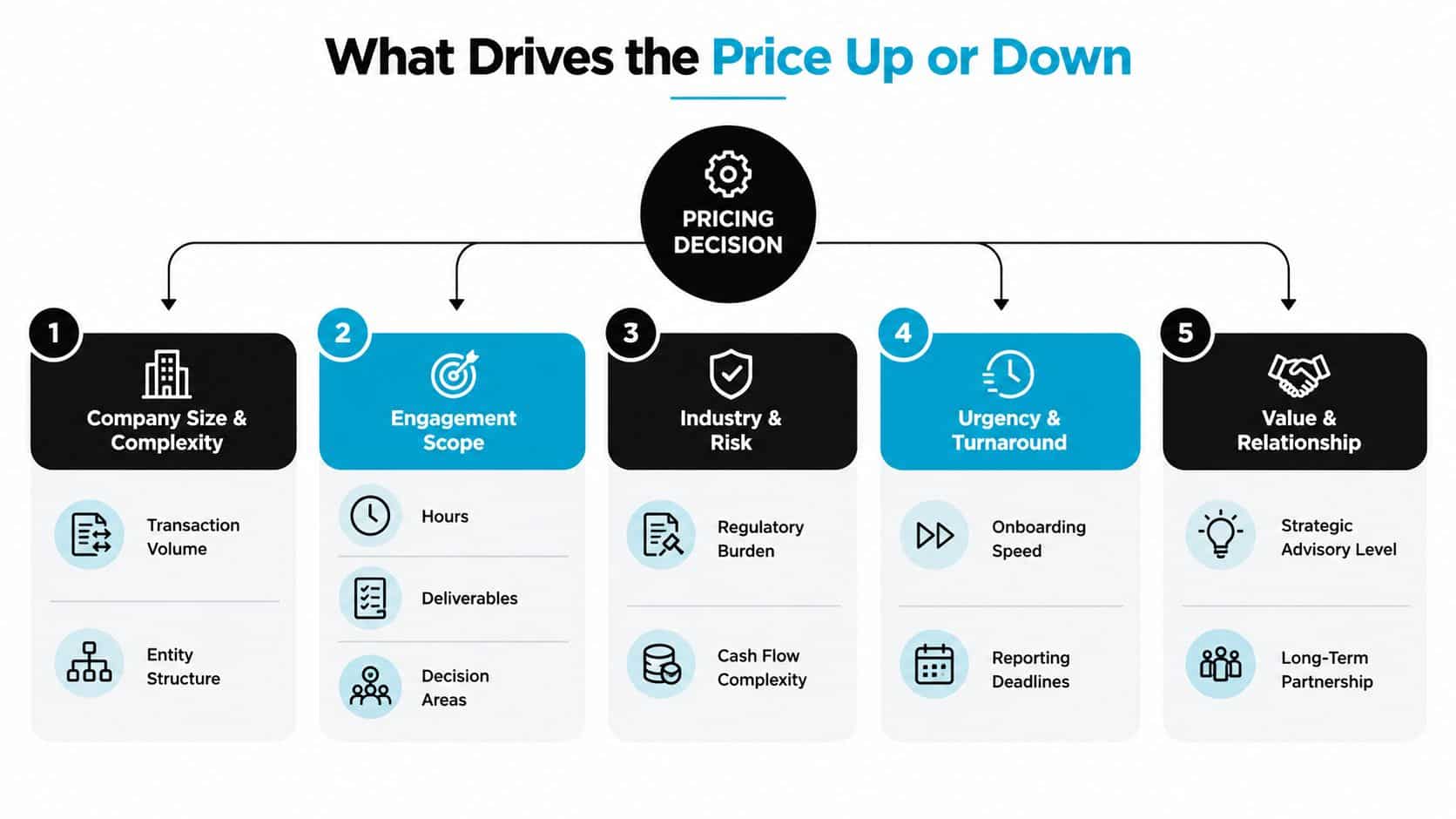
Revenue is only a rough starting point. The quote moves when the CFO must understand more entities, reconcile more operational data, support more stakeholders, or make decisions under tighter deadlines.
Company complexity
A single-entity business with clean books and one revenue stream consumes less senior attention than a multi-entity operator with intercompany activity, project accounting, inventory, or multiple operating divisions. Complexity creates review work before the CFO can even interpret the numbers.
A $30M consultancy may have predictable billing and relatively simple margin reporting. A $30M contractor may need WIP schedules, job-level margin analysis, retainage tracking, bonding information, change-order visibility, and cash planning around project timing. The revenue is identical. The finance workload isn't.
Engagement scope
Ask for the hours and decision areas behind the fee. A CFO who only reviews monthly results has a different job from one who owns the forecast, challenges hiring plans, joins lender calls, and prepares the owner for a board meeting.
The guide to when to hire a fractional CFO is useful for identifying the problems that require strategic finance rather than routine accounting.
Industry and risk
Industry economics affect the effort required. Published pricing data places manufacturing at roughly a 5% to 15% premium over baseline, with a typical monthly range of $5,000 to $10,000, while professional services is listed near baseline at $4,500 to $9,000 per month. Eagle Rock CFO's pricing survey provides those industry comparisons.
Project-based, regulated, low-margin, or capital-intensive businesses often require more specialized analysis. Owners looking at lending should also understand overhead allocation for SBA loans, because weak allocation logic can distort both lender reporting and internal decisions.
Deliverables and seniority
A basic monthly reporting pack costs less effort than a rolling cash forecast, KPI dashboard, lender package, board deck, margin-by-job analysis, and exit-planning support. Seniority matters too. Partner-level operators bring deeper pattern recognition and may command more, but you should pay for relevant experience, not credentials you won't use.
Urgency raises the quote when the CFO must onboard quickly, meet a reporting deadline, or stabilize a cash problem. The fastest way to receive a fair proposal is to list the deliverables, deadlines, attendees, and decisions before asking for a price.
Sample Pricing Scenarios at $10M, $40M, and $100M
These scenarios show why revenue alone doesn't determine the answer. They're planning examples built around the market ranges and workload mechanics described in current pricing guides, not promises that every provider will quote the same amount.
A $10M professional services firm may have strong revenue but limited finance infrastructure. The owner needs a reliable cash forecast, monthly owner reporting, and periodic lender communication. A light engagement of 10 to 15 hours per month can often support those needs, with a planning retainer of $4,000 to $5,000 per month.
The CFO isn't embedded in every operating decision. The assignment centers on visibility, accountability, and timely escalation. If the owner later adds pricing analysis, hiring models, or acquisition work, the scope should be repriced rather than absorbed.
The $40M contractor is different. Job-costing complexity, WIP accounting, bonding requirements, a 13-week cash-flow forecast, and a KPI dashboard create a much denser operating role. At 25 to 30 hours per month, a reasonable planning range is $7,500 to $9,500 monthly.
That fee buys more than a recurring report. It supports interpretation of project performance, cash timing, lender conversations, and management decisions. If the contractor has multiple entities or active transaction work, the quote may move higher.
A $100M multi-entity operator preparing for a transaction needs still more involvement. Exit-planning deliverables, custom KPIs, quarterly board preparation, and 40 or more hours per month can support a monthly range of $12,000 to $15,000, or a separate project fee of $35,000 to $50,000 when the transaction work is finite. Madras Accountancy's 2026 pricing discussion reinforces the importance of matching fee to complexity and decision support.
| Revenue | Business Type | Monthly Hours | Key Deliverables | Monthly Fee |
|---|---|---|---|---|
| $10M | Professional services firm | 10 to 15 | Cash forecasting, owner reporting, lender check-ins | $4,000 to $5,000 |
| $40M | Project-based contractor | 25 to 30 | WIP and job-costing analysis, 13-week cash flow, KPI dashboard, bonding support | $7,500 to $9,500 |
| $100M | Multi-entity operator preparing for a transaction | 40+ | Exit planning, custom KPIs, quarterly board preparation, transaction support | $12,000 to $15,000, or $35,000 to $50,000 for a defined project |
Use the closest scenario as a starting point, then adjust for data quality, meeting load, urgency, and the number of leaders who depend on the CFO.
Fractional CFO Versus a Full-Time CFO
A full-time CFO offers continuous availability, institutional knowledge, and direct authority over the finance function. A fractional CFO offers senior leadership without requiring the company to carry a full executive position before the workload justifies it.
One 2026 executive compensation benchmark cites a mid-experience CFO base salary of $269,750. A separate benchmark places a Series B-level in-house CFO at roughly $350,000 to $500,000 or more once the full employment cost is considered. PRL International's executive compensation report provides the cited base-salary benchmark.
The comparison must include more than salary. Benefits, bonus, taxes, equity, recruiting, onboarding, and severance can materially increase the all-in cost of an internal hire. A fractional engagement converts that fixed executive burden into a variable cost tied to the hours and responsibility the company needs.
| Factor | Fractional CFO | Full-Time CFO |
|---|---|---|
| Coverage | Defined monthly capacity, commonly 15 to 40 hours | Full-time executive coverage |
| Cost structure | Retainer, hourly, or project fee | Salary plus employment and recruiting costs |
| Flexibility | Scope can expand for a transaction or contract down after a project | More difficult to resize quickly |
| Strategic depth | High, when the provider matches the company's needs | High, with continuous institutional involvement |
| Recruiting risk | Provider replacement is generally simpler than executive replacement | Hiring risk, ramp time, and retention exposure |
| Best fit | Founder-led companies that need senior judgment but not full-time coverage | Businesses with sustained complexity requiring daily finance leadership |
The break-even question
Don't ask whether a full-time CFO is “better.” Ask whether you need full-time coverage. If the finance leader will spend every week managing a team, negotiating capital, guiding acquisitions, owning operating cadence, and making daily decisions, internal hiring may be appropriate.
If the company needs senior oversight for forecasting, cash management, profitability, lender reporting, and owner decisions, a fractional structure usually creates better economic alignment. That is especially true for founder-led companies in the $10M to $60M range, where the need for judgment can be substantial but the need for 40 hours every week may not be sustained.
A $100M company may still use a fractional CFO during a transition, but sustained multi-entity complexity, a growing internal finance team, and constant transaction activity can justify a full-time executive. The decision should follow workload, not a revenue milestone alone.
For the underlying bookkeeping question, DIY versus professional bookkeeping costs can help you separate accounting production from the higher-level CFO role. For a value-focused framework, review fractional CFO ROI and connect the engagement to specific decisions, risks, and cash outcomes.
Pricing Traps Founders Should Watch For
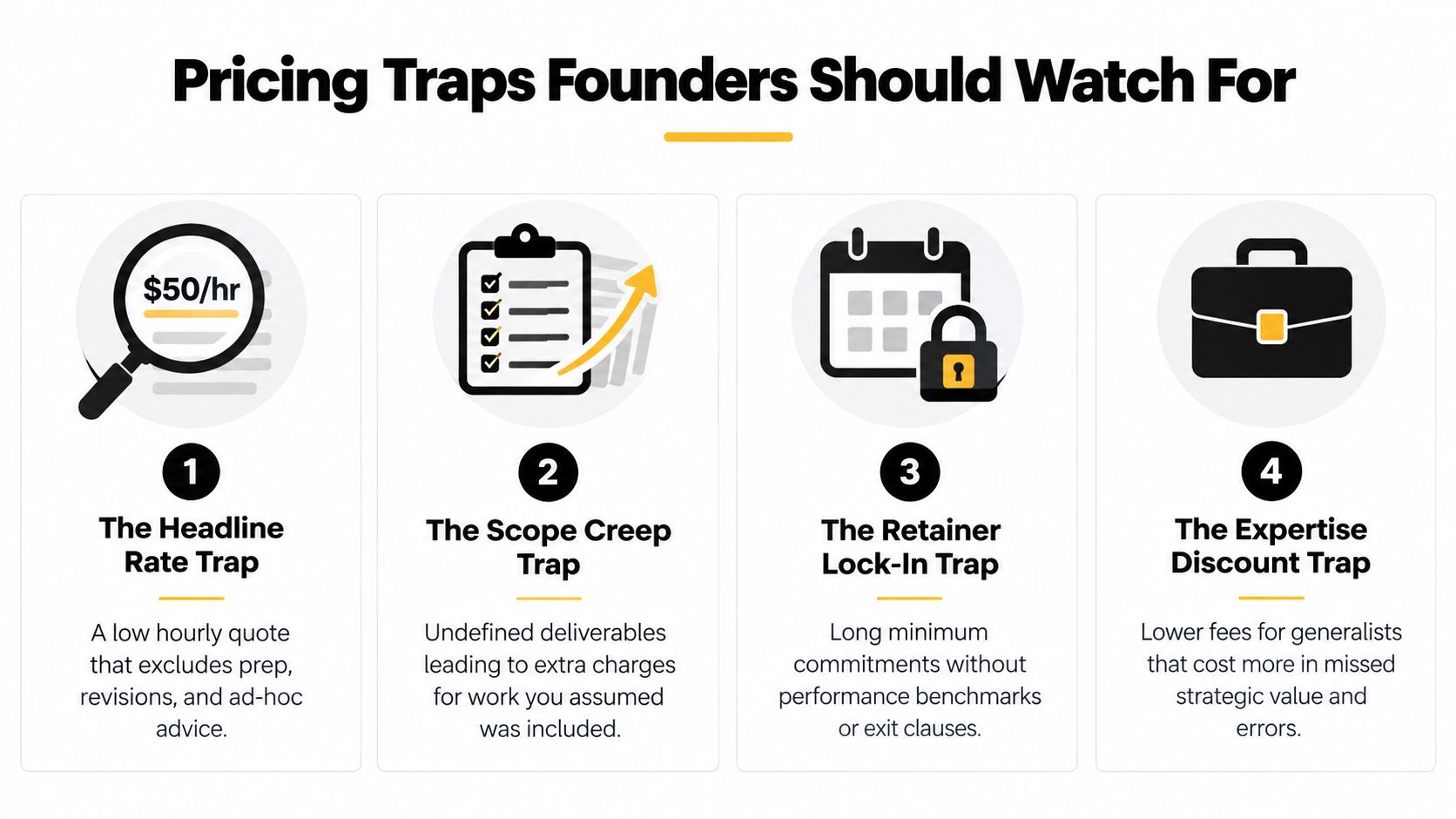
A low quote isn't necessarily a bargain. It may exclude the work you assumed was included.
The headline rate trap
A provider advertises a low hourly rate, then bills separately for preparation, revisions, calls, and follow-up. Ask whether the quoted rate includes meeting preparation, data review, email communication, and corrections. If it doesn't, compare the total expected monthly cost, not the number printed beside “hourly rate.”
The scope-creep trap
Investor decks, lender calls, hiring models, and ad hoc analysis often appear after the engagement begins. Put the recurring deliverables in writing and define a change-order process before the first invoice.
The industry-premium trap
Specialized work can justify a higher fee, but the provider should explain what expertise changes in the deliverables. Ask for examples of the reporting, analysis, or decision support that requires the premium. A vague “complexity adjustment” isn't enough.
The exit-planning trap
Exit work can expand from preparation into diligence support, quality-of-earnings responses, buyer questions, and negotiation assistance. Define whether the CFO is preparing the business, supporting diligence, or participating in the transaction process.
Use the guide to upgrading a system when weak systems create avoidable manual work. A better engagement letter should include a scope cap, written approval for additional work, a rate ceiling, billing rules for meetings and travel, and a clear termination clause.
Your Next Step and Questions to Ask
Book a 30-minute scoping call with two or three fractional CFOs this week. Bring a written list of the hours, deliverables, decision areas, reporting deadlines, and meetings you expect.
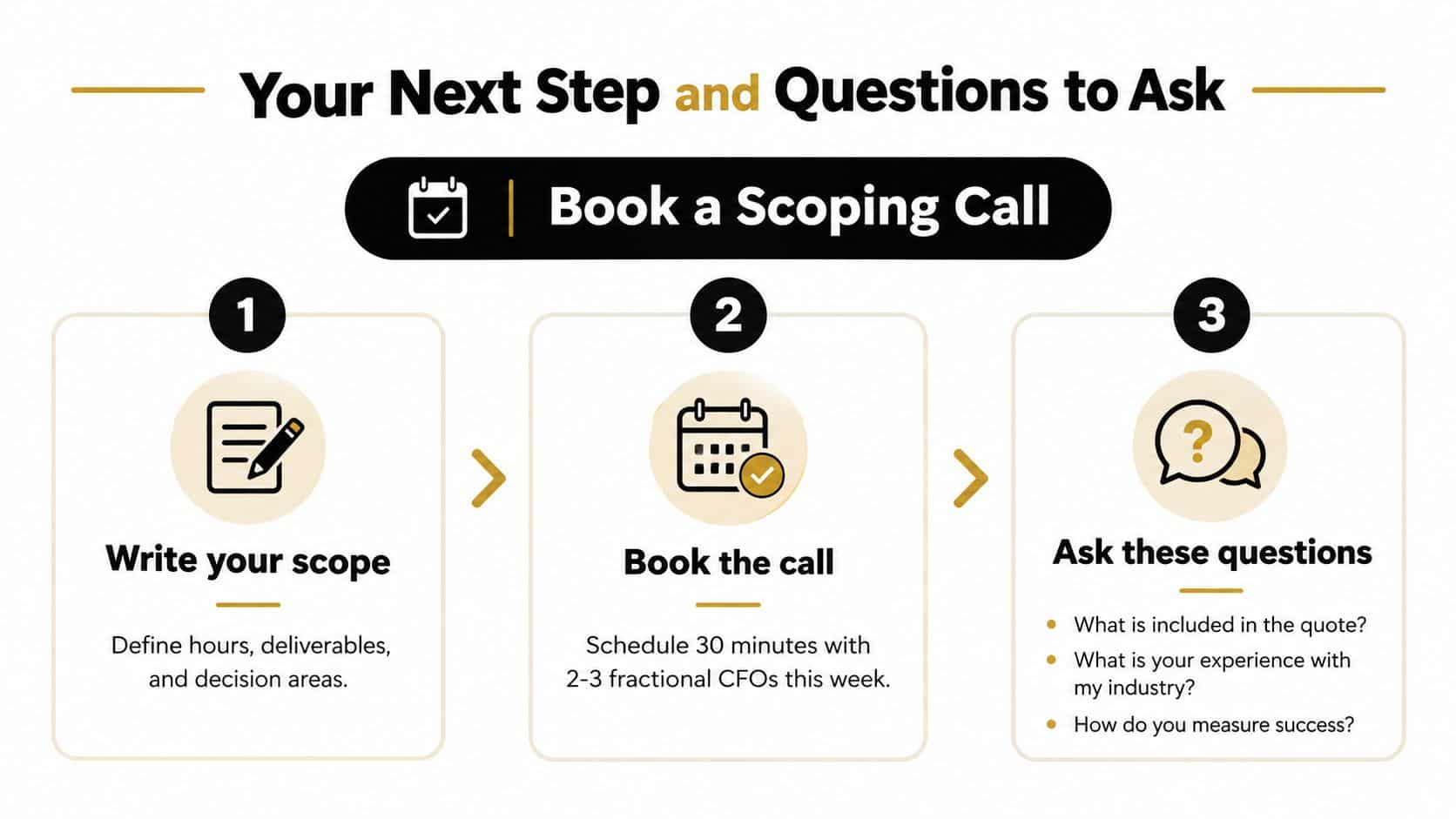
Ask every candidate the same questions:
- Retainer structure: What hours, meetings, deliverables, and response times are included?
- Meeting participation: Who attends the monthly finance meeting, and who prepares for it?
- Emergency revisions: What happens when the 13-week cash flow needs an urgent update?
- Renewal terms: Does the agreement auto-renew, and how can either party end it?
- Additional time: How are work outside the scope, travel, and board-meeting time billed?
- Relevant experience: Which businesses of similar revenue and industry has the CFO supported?
- Success measures: Which financial decisions or reporting improvements will define a successful engagement?
Request a sample statement of work with line-itemed hours and an exit clause after 90 days. Compare the proposals apples to apples by hours per month, deliverables, decision support, and availability, not by monthly fee alone.
Check references from companies with similar operating complexity. A reference from a simple services business won't tell you whether the provider can handle WIP accounting, lender pressure, multi-entity reporting, or transaction preparation.
AmbitionCFO provides fractional CFO advisory services for founder-led businesses in the $10M to $100M range, including 13-week cash-flow modeling, profitability analysis, KPI dashboards, forecasting, and exit planning. Visit AmbitionCFO to request a scoping conversation and compare the financial leadership your business needs with a clearly defined engagement.