
Commercial contractor overhead typically falls between 10% and 18% of revenue, while specialty contractors often run 12% to 20%, and the total including profit commonly lands around 18% to 21% of revenue. That range looks simple until you put it on a real bid, because a few points of overhead can decide whether you stay competitive or subsidize the job.

A contractor can appear financially stable yet lose money if the overhead percentage is calculated on an incorrect base. I've encountered this pattern in enough construction offices: the owner sees a “normal” percentage, wins work aggressively, and later discovers the markup never covered the true indirect load.
Practical rule: if your overhead number isn't tied to the way you actually estimate work, it isn't a pricing tool yet.
In U.S. nonresidential building construction, the Bureau of Labor Statistics found that overhead and profit markups are embedded directly into contract pricing rather than treated as separate line items in many cases, and the study documents that these markups vary materially by project type and cost structure (BLS). That matters because labor, insurance, office staff, and estimating costs all have to be recovered somewhere, and on multimillion-dollar jobs even a small shift in overhead can change competitiveness.
Construction overhead means the indirect costs that keep the business operating, things like office rent, administrative salaries, insurance, estimating labor, vehicles, software, and project management. Those costs support multiple jobs, so they usually get recovered through markup, not billed cleanly to one project. For owners, that's why overhead has always been part of commercial construction economics, not an accounting afterthought.
Use your KPI dashboard as the companion to this topic, because overhead only becomes useful when you track it against the rest of the business. A good starting point is construction KPIs, since overhead should never be read in isolation from backlog, margin, and cash.
Table of Contents
- Introduction Why Construction Overhead Percentage Matters
- How to Calculate Construction Overhead Percentage
- Revenue Based Versus Direct Cost Based Overhead
- Industry Benchmarks and Overhead Drivers
- Job Level Versus Company Level Overhead Allocation
- How Overhead Percentage Affects Estimating and Margin
- Actionable Strategies to Measure and Lower Overhead
- When to Use a Worksheet and When to Engage a Fractional CFO
Introduction Why Construction Overhead Percentage Matters
A commercial job can look profitable until the office cost, truck fleet, software stack, and estimating labor hit the books. That is why owners should ask a sharper question than, “What is a normal overhead percentage?” The better question is whether indirect costs are being recovered fully, or whether current jobs are paying for the business.
A peer-reviewed construction study reports that site overhead costs are normally 10% to 12% of contract value, and when company overhead is included, the total can rise to 15% of contract value (IJRET). Another construction research paper says overhead can represent up to 35% to 40% of total costs, and that in the U.S. overhead typically ranges between 10% and 40% of direct costs (Building journal paper). Those ranges are broad because project type, segment, and company size all push the number in different directions.
What overhead actually covers
Overhead is the business's support system. It includes indirect costs like office rent, administrative salaries, insurance, estimating labor, vehicles, software, and project management. These costs are not tied neatly to one concrete pour or one framing crew, but they still have to be paid every month.
In construction, the BLS found that overhead and profit markups are often built directly into contract pricing rather than treated as separate line items, and those markups vary by project type and cost structure (BLS). That matters because a few points of difference can change how competitive a bid looks, especially on larger jobs where indirect costs have to be spread across fewer billable project hours.
Overhead is one of the numbers that decides the selling price from the start, a residual after the job is sold.
Owners also need to separate how they measure overhead from how they manage performance. A practical KPI set, such as the one outlined in this construction KPI guide, helps keep overhead from drifting into a catch-all line item that nobody owns.
Industry benchmarking sources commonly place contractor overhead in the low-to-mid teens for commercial work, with general contractors often around 10% to 18% of revenue and specialty contractors around 12% to 20% (Struvia). Another guide notes that general contractors often price jobs with roughly 13% overhead and 8% profit, or 21% combined, while commercial construction sits around 11% overhead and 7% profit, or 18% combined. Those figures are not universal, but they work as a reality check when a company's pricing feels tight or its backlog looks busy but cash still runs thin.
The practical takeaway is blunt. If you do not know how your overhead is measured, you cannot know whether the percentage is healthy. If you do not know whether you are pricing off revenue or direct costs, the same company can look efficient on one report and strained on another. And if your overhead number is not tied to the way you estimate work, it is not a pricing tool yet.
How to Calculate Construction Overhead Percentage
The math is simple, but the denominator changes the meaning. That's where most owners get tripped up, because they borrow one formula from a blog or accountant and then use it for every decision.
Two formulas that both matter
First, calculate overhead as a percentage of revenue:
Overhead percentage = Total overhead ÷ Total revenue
Using the example in the brief, a contractor with $600,000 in annual overhead and $3,000,000 in revenue has an overhead rate of 20%. That number tells you how much of every revenue dollar is consumed by indirect business cost.
Second, calculate overhead as a percentage of direct costs:
Overhead percentage = Total overhead ÷ Total direct costs
With the same contractor and $2,000,000 in direct costs, the overhead rate is 30%. That number is often more useful in estimating, because bids usually start with direct job cost and then add markup.
A quick way to test your own numbers is to pull your trailing twelve months, then run both formulas side by side. If you want a simple companion tool for the profit side of that calculation, calculate contractor profit margins alongside your overhead so you can see whether your markup still leaves room for actual profit.
A short worksheet you can copy today
Use this on a spreadsheet or even a legal pad:
- Total overhead costs. Add office rent, admin salaries, insurance, estimating, vehicles, software, and other indirect costs.
- Total revenue. Use gross revenue for the same period.
- Total direct costs. Include materials, field labor, subcontractors, and project-specific costs.
- Run both formulas. Revenue-based overhead shows the administrative burden, while direct-cost-based overhead helps with bidding and markup.
The distinction matters because construction pricing usually starts from direct costs plus markup. If you only use the revenue-based view, you may know how heavy the business feels, but you still won't know what to add to a bid. If you only use the direct-cost view, you might miss how much fixed administrative weight the company is carrying.
For a tighter internal process, tie this to job order costing, because that's where the direct and indirect pieces need to stay cleanly separated.
Revenue Based Versus Direct Cost Based Overhead
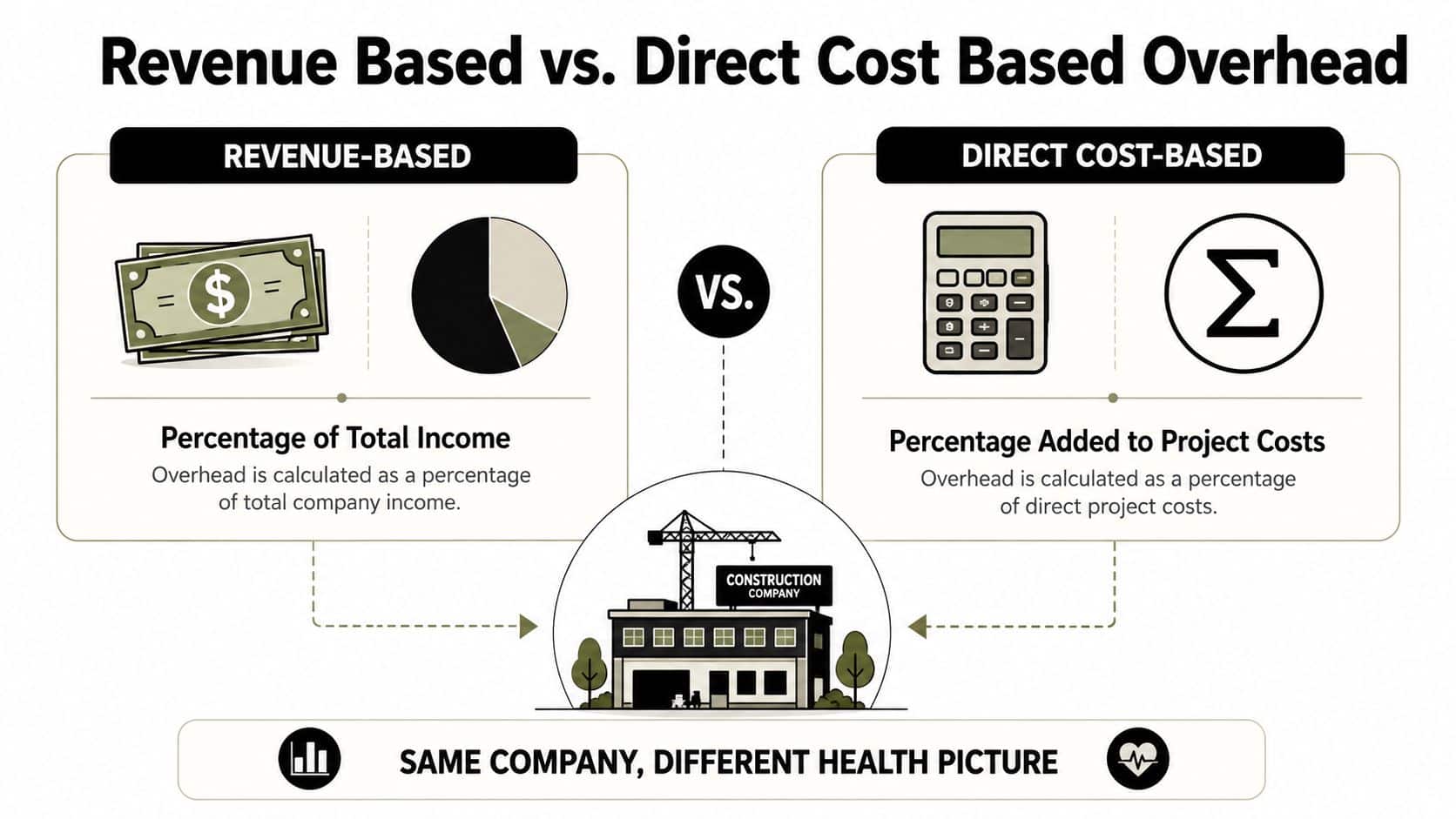
The same contractor can look efficient under one formula and stretched under another. The denominator changes the story, and that is why overhead discussions get messy inside construction firms.
Why the same business tells two different stories
A revenue-based overhead percentage answers a management question. How much of total income goes to support costs? That figure belongs in dashboards, lender conversations, and broad financial oversight.
A direct-cost-based overhead percentage answers an estimating question. How much overhead should sit on top of project cost so the business recovers its indirect load? That is the version owners need when they price work.
Industry guidance from EdgeStrat Finance shows both approaches in use, and the same contractor can look healthy under one method and strained under the other. Revenue and direct cost do not move together. If a contractor's direct-cost base shrinks, the overhead percentage can rise even when administrative spending stays flat.
Compare overhead both ways, revenue and direct cost. If the story changes a lot, the issue may be structure, not only spending.
What to separate before you judge the number
Separate fixed costs from variable overhead before you draw conclusions. Rent and administrative salaries behave like fixed overhead. They usually do not change much with each added job. Vehicles, estimating labor, and some field support costs can rise and fall with workload, backlog, and project mix.
That is why the same absolute overhead can produce a different percentage from one period to the next. More revenue can make the burden look lighter. A weaker direct-cost base can make it look heavier. Both views can be correct, because each one answers a different question.
For management reporting, revenue-based overhead is often the cleaner burden measure. For estimating, direct-cost-based overhead usually fits better because it matches how bids are built. The practical move is to compare both, then ask whether the pressure comes from scale, cost control, or a misclassified expense.
For owners who want the reporting side tightened up, construction overhead and job-cost reporting is where the separation between direct and indirect costs usually needs the most discipline.
How to use both views without confusing the team
Do not let one percentage replace the other. Revenue-based overhead helps you judge how heavy the company feels relative to sales. Direct-cost-based overhead helps you decide what to add into a bid so the job carries its share of indirect costs.
A practical two-tier allocation model works better than a single company-wide ratio. First, collect overhead that belongs at the company level, such as office rent, admin pay, software, insurance, and owner oversight. Then allocate job-level support costs, such as estimating time, project management, and vehicles, to the work that consumed them. That split gives you a cleaner worksheet and fewer arguments when a project looks profitable on paper but still leaves the office short on cash.
If you want a simple internal test, run both formulas every month. Revenue-based overhead belongs in your management view. Direct-cost-based overhead belongs in your estimating view. When the two diverge sharply, that usually points to a job mix shift, a staffing issue, or a cost classification problem that needs attention before the next round of bids.
Industry Benchmarks and Overhead Drivers
Benchmarking overhead helps only when the comparison set matches the business in front of you. A small specialty contractor, a growing general contractor, and a heavy civil firm can all land in different places and still be run well.
A practical range map
| Contractor Type | Overhead as % of Revenue | Overhead as % of Direct Costs |
|---|---|---|
| Solo or small crews | roughly 15% to 25% | benchmark varies by structure |
| Commercial general contractors | 10% to 18% | typically higher than revenue-based view |
| Specialty contractors | 12% to 20% | typically higher than revenue-based view |
| Mid-market firms | roughly 10% to 25% | depends on allocation discipline |
| Larger firms | roughly 35% to 45% or higher in some benchmark sets | varies by complexity and scale |
Those benchmark ranges come from construction industry synthesis and guidance that show wide variation by size and segment. A real-estate construction study found a sector-weighted median overhead cost rate of 8.8% and a total indirect cost rate of 11.9% (CIB DC24093). That same source is a reminder that owners need to separate overhead from total indirect cost before they draw conclusions from the number.
The practical takeaway is simple. Benchmarks are useful only if you know which denominator produced them and what costs were included.
What pushes the percentage up or down
Company size matters, but it is not the whole story. Project mix changes the number fast. Commercial work, residential remodeling, industrial work, and heavy civil all consume support resources in different ways, so the benchmark range widens or tightens depending on the firm's workload.
As noted in industry guidance, overhead can sit closer to the lower end in industrial or heavy civil work and rise in residential remodeling. Struvia also points out that growth does not automatically reduce overhead percentage, because admin hiring, software, insurance, and compliance can expand ahead of backlog. That is the trap for fast-growing contractors. More work does not always dilute overhead, and it can push it higher if support costs scale faster than revenue.
The same pressure shows up in the metrics owners track every month. If you are not watching gross margin, overhead ratio, backlog, and billing timing together, construction financial metrics can look healthy on paper while cash gets tighter in the office.
The cleanest way to use a benchmark is to ask three questions. Is the percentage driven by scale, by structure, or by a cost category that got misclassified? If you cannot answer that, the benchmark is just a number on a slide.
Job Level Versus Company Level Overhead Allocation
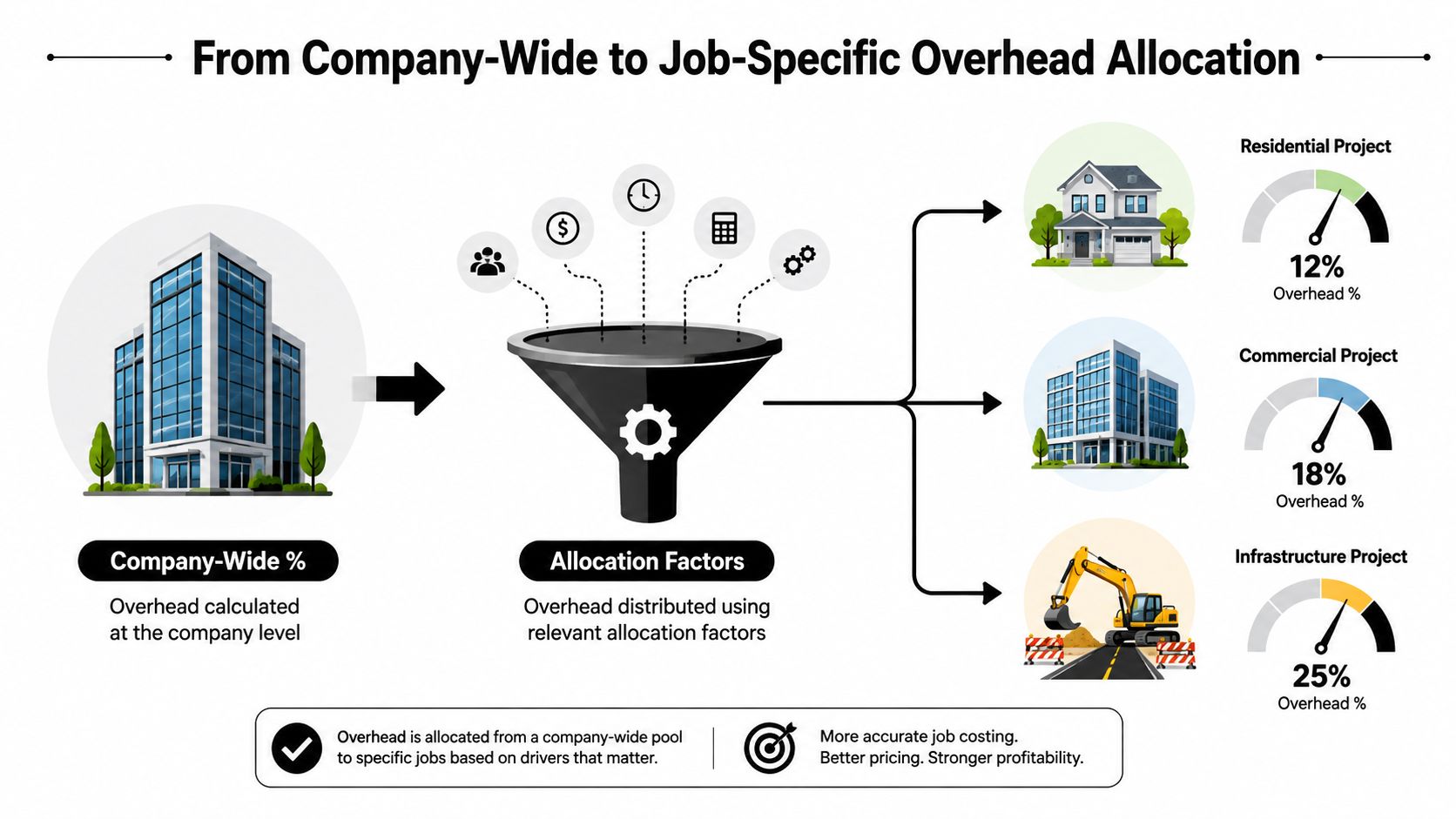
Company-wide overhead helps with oversight. Job-level overhead keeps bids honest. If you leave the company load out of your estimates, jobs can look profitable until the month closes and the indirect costs hit the books.
Start with an allocation base
The simplest allocation framework starts with three steps. Identify and classify indirect costs, choose an allocation base that reflects how overhead is consumed, then calculate the overhead rate by dividing total overhead by that base. Deltek describes that sequence in its construction accounting guidance, and the order matters because overhead recovery depends on the cost driver you choose (Deltek).
The base changes the meaning of the rate. If the base is direct costs, the rate shows how much indirect load sits on top of each job dollar. If the base is revenue, the rate gives a broader view of business burden, but it does not always tell you what to add to an estimate.
A simple allocation model
Suppose a firm has company-wide overhead of $600,000 and uses direct costs as the allocation base. If annual direct costs total $2,000,000, the overhead rate is 30%. A job with $100,000 in direct costs would carry $30,000 in allocated overhead. A job with $250,000 in direct costs would carry $75,000.
That model only works when direct and indirect costs stay cleanly separated. If field labor, equipment, or project-specific utilities are booked as overhead, the estimate stops reflecting the actual job structure. The result is underrecovered indirect cost and a compressed gross margin because the markup begins covering the wrong bucket (construction job costing).
Quick check: if a cost can clearly be tied to one project, it probably doesn't belong in company overhead.
A practical internal audit is to review field charges, truck expense, and project utilities and confirm they sit in the right bucket. If the answer is “not sure,” the overhead rate is probably not the only issue. The job costing structure may be hiding the leak.
How Overhead Percentage Affects Estimating and Margin
A construction bid can look profitable and still drain cash if the overhead rate is too low. The estimator gets the job, the owner celebrates the win, and the company starts funding office support, insurance, estimating time, and fleet expense out of margin.
That is where the denominator matters. Revenue-based overhead and direct-cost-based overhead push the estimate in different directions, so the same job can carry a very different burden depending on how the company sets markup. If the rate sits below the actual support cost, the missing amount usually shows up later as a thinner gross margin and less room to absorb change orders, rework, or slow-paying clients.
A lower overhead load can make a bid look sharper on paper, especially on a competitive public or commercial job. The trade-off is simple. A price that ignores true indirect cost may win the award, but it leaves less capacity to cover the business that makes field work possible.
The BLS discussion of nonresidential construction markups shows why this matters. Indirect cost recovery sits inside the markup, so even a small shift in the overhead assumption changes the final bid total and the margin left after the job is complete.
Why a one-point shift matters
A one-point change in overhead can move a bid far enough to affect award decisions. On a large project, that difference may be the gap between landing the work and being too expensive, even when direct costs are identical.
The risk shows up after the contract is signed. Two estimates can have the same labor and material base, yet produce very different margins if one uses a stale overhead rate and the other uses the current company burden. The first job may look efficient in the estimating sheet and still underperform once office support, supervision, and compliance costs are allocated correctly.
An estimate that wins by ignoring overhead borrows from the next project's profit.
How to keep the rate current
Recalculate overhead at least once a year, and do it again sooner if your backlog, project mix, insurance, or admin structure changes. A rate built for last year's workload can miss the cost profile of this year's jobs, which leads to underpricing even when market prices stay steady.
The estimating process should also separate revenue-based markups from direct-cost-based allocations so the company knows which number is driving the bid. That is where construction job costing becomes the control point, because the estimate has to match how the job will be tracked in the books and in the field.
A contractor who wants tighter pricing discipline should review the overhead rate, the markup policy, and the job costing setup together. If those three pieces do not agree, the bid may still get signed, but the margin usually pays the price.
Actionable Strategies to Measure and Lower Overhead
Cutting overhead isn't the same as slashing expense. The right move is to remove waste without damaging the support system that keeps jobs on schedule and estimates accurate.
High-impact moves that don't wait for a full reorg
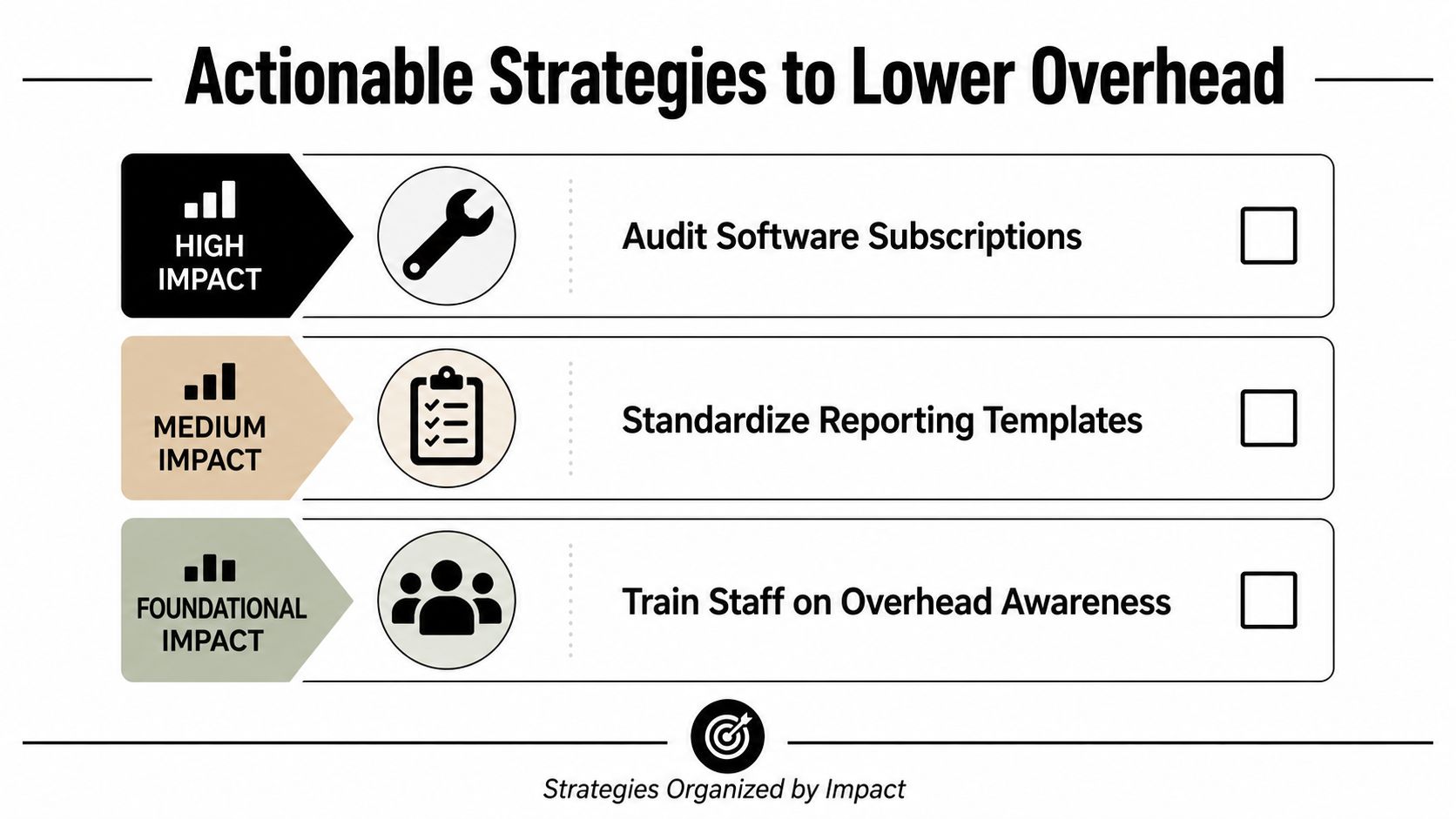
Start by reconciling the allocation base. If your direct costs are misclassified, your overhead percentage is lying to you. Reclassify field labor, equipment, and job-specific utilities so the rate reflects reality.
Next, audit subscriptions and software. Construction offices often carry tools nobody uses anymore, and the fix is usually fast once someone reviews the card statements line by line. I've seen that kind of cleanup free up spend without touching field capacity.
Insurance and lease terms deserve a fresh look too. When a contractor's coverage or office footprint drifted away from current needs, the overhead load rose without adding value. Renegotiation doesn't solve everything, but it can stop the slow bleed.
For a useful framing on what an audit can surface, the discussion at the value of an overhead audit is worth reading before you start cutting.
A 90-day checklist
- Audit misclassified costs. Pull field labor, equipment, and utilities out of overhead if they belong in direct cost.
- Review recurring software and subscriptions. Cancel tools no one uses.
- Check insurance and lease terms. Ask whether the current coverage and space still match the business.
- Standardize estimating labor. Shared estimating resources often reduce duplicate effort.
- Track overhead monthly. Don't wait until year-end to discover the rate drifted.
The mistake to avoid is cutting indiscriminately. Trimming estimating support, reporting, or project coordination can lower overhead on paper and raise risk in the field. Owners should separate fixed overhead from variable overhead first, then decide what is waste and what is just the cost of staying disciplined.
When to Use a Worksheet and When to Engage a Fractional CFO
A worksheet is enough when the problem is visibility. A fractional CFO becomes useful when the problem is interpretation, pricing, and cash flow all at once.
What the worksheet should capture
Keep it simple. List total overhead, total revenue, total direct costs, and the resulting overhead percentages using both formulas. Update it monthly so the number doesn't go stale, and compare the trend to the last few periods instead of a single point in time.
That worksheet becomes even more useful when it's paired with job-level reporting and a clean chart of accounts. If your books can't separate direct and indirect costs reliably, the worksheet will only reflect the confusion already in the accounting.
For owners who want to build the process into a bigger financial rhythm, when to hire a fractional CFO is the right next read. The trigger isn't just revenue growth, it's when margin pressure, cash flow timing, and job costing all start pointing in different directions.
When senior financial help earns its keep
A fractional CFO can model overhead by segment, analyze margin by job, and build a 13-week cash flow forecast that tells you whether the business can absorb the current cost structure. That kind of support matters when the company has outgrown its bookkeeper or CPA but can't justify a full-time CFO.
AmbitionCFO is one option for that work, since the firm embeds with owners and leadership teams to handle margin analysis, forecasting, KPI dashboards, and exit planning for businesses preparing for a transition within three to ten years. In construction, that kind of senior-level support is most valuable when overhead is changing faster than the owner can interpret it alone.
Simple rule: use the worksheet to see the number. Use CFO support when you need to decide what the number means and how to act on it.
Download the worksheet, run your trailing twelve months, and look at both overhead formulas side by side. If the result shows unclear cost allocation or margin pressure that keeps repeating, that's the point to bring in help before the next round of bids goes out.
AmbitionCFO helps construction owners turn overhead from a vague percentage into a pricing and cash flow decision they can trust. If your current bids aren't clearly covering indirect costs, visit AmbitionCFO to see how fractional CFO support can improve job margin visibility, overhead allocation, and financial forecasting.