

You've got inventory that keeps you awake at night. One week, a key SKU runs out and the team scrambles, expediting product to save a customer relationship. The next week, shelves are full, cash is stuck in boxes, and you're staring at working capital that could've funded payroll, hiring, or a new contract. The question underneath all of it is simple, when do I reorder so I don't run out, without tying up more cash than I need?
Table of Contents
- The Hidden Cash Drain in Your Warehouse
- The Basic Reorder Point Formula Explained
- Why Safety Stock Is Your Cash Flow Buffer
- Advanced Formulas for Real-World Volatility
- Reorder Point Examples in Action
- How to Implement Your Reorder Point System
- From Formula to Financial Strategy
The Hidden Cash Drain in Your Warehouse
A founder doesn't need a finance degree to feel inventory pain. You feel it when a missing part stops production, when a distributor misses a shipment window, or when a warehouse full of slow-moving stock drains funds month after month. The reorder point formula exists to replace that guesswork with a trigger that provides a reliable basis for business operations.
The reason this matters gets sharper as the business grows. In a company that's moved past early-stage chaos, inventory mistakes stop being small operational annoyances and start becoming balance sheet problems. A stockout hurts revenue and customer trust. Overstocking hurts liquidity and makes every other decision, from hiring to equipment purchases, harder than it should be.
Practical rule: if inventory decisions are still being made by memory, habits, or panic, your cash is already doing more work than it should.
One useful way to think about it is this. Every unit sitting on a shelf is cash that's not available for something else. Every unit you fail to have on hand at the right time is a sale, job, or schedule that can slip through your fingers. That's why inventory control isn't just an operations issue, it's a profit issue.
If you want the financial side of that trade-off in plain language, it helps to understand the inventory carrying cost formula. Carrying cost is the price of holding too much, and the reorder point is one of the cleanest levers for reducing it without gambling on stockouts.
The Basic Reorder Point Formula Explained
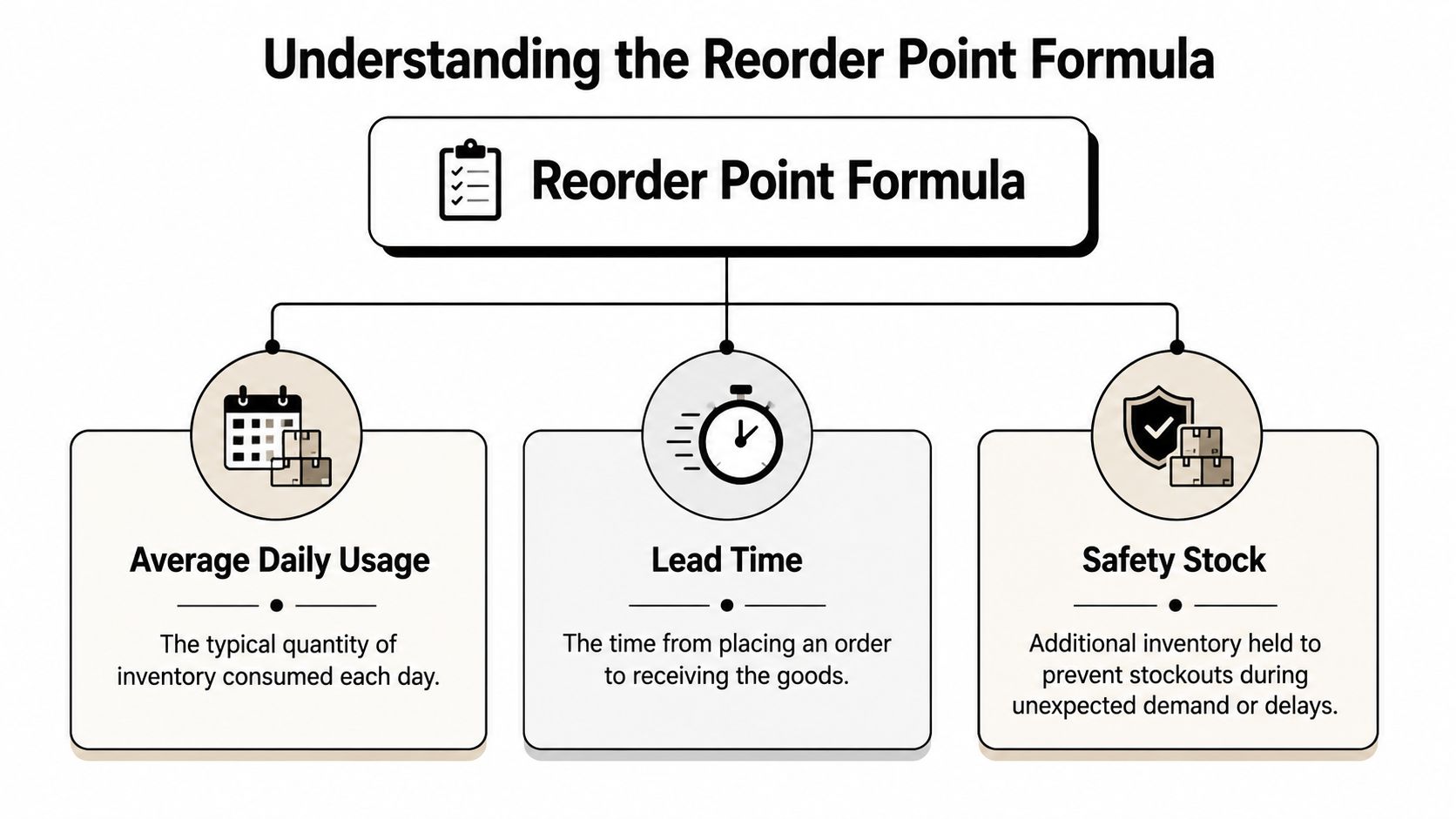
The basic reorder point formula is straightforward enough to explain at a whiteboard, and that's why it's so useful. The formula states: reorder point = average daily usage × lead time + safety stock. That same logic appears in inventory references as “lead time demand + safety stock” or “normal consumption during lead-time + safety stock,” because the point is to cover demand while you wait for replenishment and to add a buffer for uncertainty. Inflow Inventory's explanation captures that core logic clearly.
The three moving parts
Average daily usage is how much of an item you consume on an ordinary day. For a distributor, that might be units shipped. For a contractor, it might be materials consumed per job. For a manufacturer, it's what production burns through.
Lead time is how long it takes from placing the order to receiving usable inventory. That includes the supplier's processing time, transit, receiving, and any inspection lag. If you guess low here, the formula tells you to reorder too late.
Safety stock is the buffer. It's the part that protects you from delays, demand spikes, and the annoying reality that “normal” isn't always normal.
A gas tank makes the logic easy to see. Your commute is average daily usage, the station distance is lead time, and the spare fuel in the tank is safety stock. If you wait until the light comes on, you're already late. If you refill too early every time, you waste time and money. Inventory works the same way.
The reorder-point model is often presented as a three-variable system built on average daily usage, lead time, and safety stock. If safety stock is removed, it reduces to lead time demand, which shows the buffer is what protects against demand spikes and supplier delays. QuickBooks' reorder point guide makes that structure easy to see in practice.
A simple example shows the logic. If average daily usage is 20 units, lead time is 12 days, and safety stock is 60 units, lead-time demand is 240 units and the reorder point is 300 units. That means you place the order before inventory falls to 300, not after the shelf is empty. For a founder, that's the difference between a controlled system and a series of expensive surprises.
For a practical planning tool that pairs well with this math, a projected sales forecast template helps you keep demand assumptions current instead of stale.
Why Safety Stock Is Your Cash Flow Buffer
Safety stock is where inventory strategy becomes financial strategy. It's tempting to treat it as “extra stock just in case,” but that misses the point. It's really a buffer against uncertainty, and in a founder-led business, uncertainty shows up as delayed freight, supplier slippage, and customers who order more than forecast.
The reorder point formula is a foundational inventory rule that tells a business when to place a new order before stock runs out, and it converts inventory control from intuition into a measurable trigger. That's the key shift. You stop arguing with gut feel and start using a rule that can be reviewed, adjusted, and defended. InFlow Inventory frames that conversion well.

The trade-off that actually matters
Zero safety stock sounds disciplined until the first late truck or unexpected spike. Then your team pays for it in expediting, overtime, missed shipments, or a damaged customer relationship. The cost of carrying extra inventory is visible, but the cost of being wrong on the low side is usually worse because it hits both cash flow and reputation.
Useful lens: safety stock isn't “wasted inventory.” It's a controlled expense that buys resilience when demand and supply don't behave perfectly.
That said, more isn't always better. Overpadding safety stock can hide bad forecasting, weak supplier performance, or sloppy planning. If you just keep adding buffer without understanding why the buffer is needed, you turn a planning tool into a pile of dead cash.
For a more detailed breakdown of the difference between the two concepts, safety stock vs. reorder point is worth keeping handy. Safety stock answers how much risk you're willing to absorb. Reorder point answers when you need to act.
If you want a tactical walkthrough of the buffer itself, it's also useful to understand safety stock formulas. The point isn't to become an inventory scientist. The point is to choose a buffer intentionally instead of padding it emotionally.
Later in the process, a video can help reinforce the mental model for your team.
Advanced Formulas for Real-World Volatility
Averages are useful, but they can fool you. If demand bounces around or suppliers miss dates, a simple formula can understate risk. More technical inventory approaches say variability in both demand and lead time should be incorporated, using the combined standard deviation of demand and lead time. NetSuite's reorder point overview is explicit that the basic formula is often a planning shortcut, not a risk-adjusted policy.
When the basic formula stops being enough
Service level is the business question behind the math. It's just a practical way of asking, “How often do we want to have stock available when customers need it?” If you want to be more confident, the safety-stock buffer needs to grow. If your operation can tolerate more risk, the buffer can be smaller.
That's why static reorder points break down in volatile environments. A company with imported goods, seasonal swings, or supplier inconsistency can't rely on a single average and expect clean results. The trigger has to reflect the fact that demand and lead time both move.
One common advanced expression uses safety stock defined by maximum daily usage × maximum lead time minus average daily usage × average lead time. That approach directly acknowledges variability, and it's a useful way to think when you know the worst case matters more than the average case. Wikipedia's reorder point entry shows that style of formulation.
A simple comparison of approaches
| Formula Type | Calculation | Best For |
|---|---|---|
| Basic reorder point | Average daily usage × lead time + safety stock | Stable items with predictable demand and supplier timing |
| Maximum-variance buffer | Maximum daily usage × maximum lead time minus average daily usage × average lead time | Items with visible spikes or inconsistent replenishment |
| Risk-adjusted reorder point | Demand during lead time plus a variability-based safety stock | Businesses that need a more disciplined service-level target |
This sensitivity and scenario analysis guide is a good companion if you want to test how a delayed shipment or demand spike changes the reorder trigger. That's the right mindset. Don't ask whether one formula is “correct” in the abstract. Ask whether it matches the risk profile of the item and the cost of being wrong.
A founder doesn't need to calculate every SKU with the same precision. Critical items deserve tighter modeling. Cheap, easy-to-replace items often don't. The financial win comes from matching the method to the business risk, not from making every line item academically perfect.
Reorder Point Examples in Action
The best way to understand the reorder point formula is to see what changes when the number is wrong. One mistake is expensive in a different way depending on the business model. For a construction firm, a stockout can stop a crew and throw off a schedule. For a distributor, excess inventory can trap cash and drag down flexibility.

A construction job with a hard deadline
A project team is waiting on custom windows. The issue isn't abstract, because every missing unit affects sequencing. The right reorder point isn't just about keeping stock on hand, it's about protecting the schedule, the labor plan, and the client relationship.
If the team sets the trigger too low, the order arrives late and the crew burns time waiting. If the trigger is too high, the company ties up cash in items that sit longer than necessary. That cash could have supported the next mobilization or covered another urgent purchase.
The useful move here is to calculate the reorder point by item criticality, not by treating every material the same. A high-risk, long-lead-time component deserves a larger buffer than a commodity item you can replace quickly. For job-based businesses, inventory aging should also be on the radar, because slow-moving materials often reveal where cash is stuck longer than planned. An inventory aging report helps surface those problems before they become write-offs or storage headaches.
A distributor facing demand swings
Now take a fast-moving distributor with seasonal variation. The average may look fine on paper, but the actual issue is the gap between average demand and peak demand. That's where the more advanced buffer logic matters, because the reorder point has to reflect actual volatility, not a smooth spreadsheet line.
A distributor that ignores that gap usually pays twice. First, it loses sales or incurs expediting costs when stock runs out. Then it overorders later to compensate, which weakens cash flow and muddies the planning process.
Decision rule: use the plain formula for stable items, and move to a variability-aware trigger when supplier timing or demand stops behaving predictably.
The practical result of a tighter reorder system is simple. The company knows when to place the next order, the warehouse spends less time reacting, and cash stops leaking into unnecessary buffer stock. That's what makes the formula a strategic lever, not just an operations metric.
How to Implement Your Reorder Point System
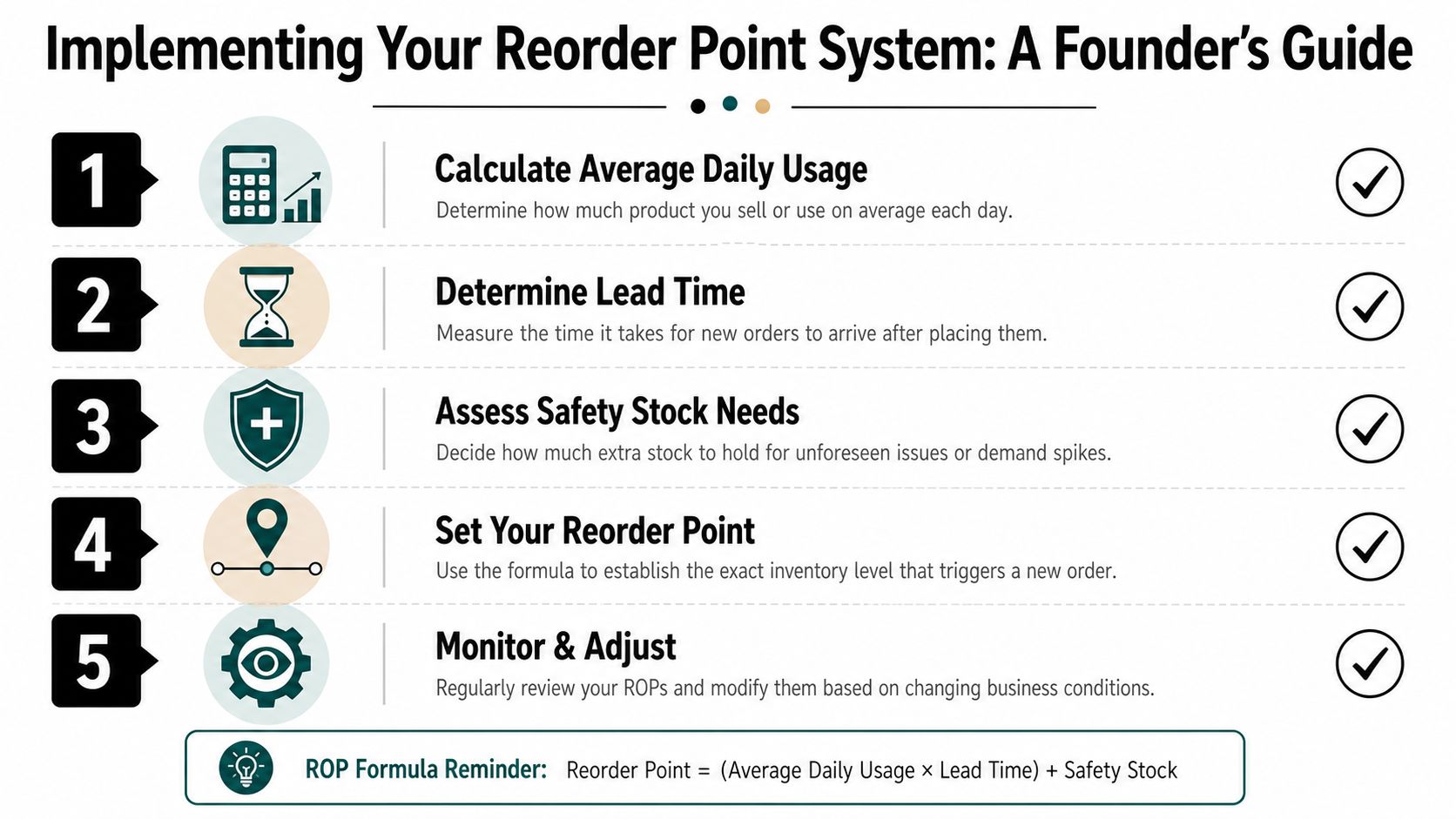
You don't need a heavyweight system to get started. A clean spreadsheet and reliable inputs are enough for many founder-led businesses, especially if you focus on the SKUs that matter. The goal is to start with the items that drive the most revenue, production risk, or customer pain.
Build the system from data you already have
Start with sales or consumption history from your accounting system, ERP, or production records. Then pull actual supplier lead times, not the lead time that was promised six months ago. If the business already uses an inventory tool, a simple logistics platform comparison like Routelink's picks for logistics software can help you think through whether your current setup is giving you enough visibility.
Your spreadsheet doesn't need to be fancy. It just needs to answer four questions for each item, how much goes out, how long replenishment takes, how much buffer you want, and what the current on-hand quantity is. Once those inputs are stable, the reorder trigger becomes repeatable.
A useful way to organize it:
- SKU or item name: Keep the item list specific so there's no confusion between similar parts.
- Average daily usage: Use the best recent consumption estimate you can defend.
- Lead time: Track what occurs from PO to receipt.
- Safety stock: Set the buffer deliberately, not by habit.
- Current inventory: Compare the live number against the trigger.
Focus on the right items first
Don't try to boil the ocean. Start with the SKUs that make up the bulk of your revenue, create the largest stockout risk, or consume the most cash when overbought. That's where the return shows up fastest.
A good implementation habit is to review reorder points when demand changes, suppliers change, or the business launches new products. Static numbers get stale fast. The more your operation changes, the more often you should review the inputs.
Practical rule: if a supplier delay, a major new customer, or a product shift changes the real-world pattern, the reorder point needs a refresh.
The point of the system is discipline, not perfection. A decent reorder point that's updated regularly beats a “perfect” number that nobody trusts or uses.
From Formula to Financial Strategy
The reorder point formula looks operational on the surface, but the payoff lands in the financial statements. Fewer stockouts mean fewer rushed purchases and fewer expensive expedites. Lower excess inventory means less cash trapped on the balance sheet. Better timing means more predictable margins and less noise in working capital.
That's why founders should treat reorder points as a strategic control, not a warehouse task. The formula gives you a disciplined trigger, but its primary value comes from how it shapes cash flow, supplier behavior, and customer reliability. In plain terms, it helps the business grow without turning every new sale into an inventory gamble.
The best companies don't just ask whether they have enough product. They ask whether the inventory policy supports the business they're trying to build. That's a CFO question, even if it starts on the warehouse floor.
If you want help turning inventory rules into a cash flow strategy, AmbitionCFO works with founder-led businesses that need sharper visibility into profitability, working capital, and forecasting. Visit AmbitionCFO to explore how a fractional CFO can help you set smarter reorder points and build a more resilient financial system.