
Your revenue is up. The P&L says you're profitable. But you're still hesitating on a hire, an equipment purchase, or a new contract because your bank balance feels tighter than it should.
That disconnect is where founders get into trouble. You can run a good business on paper and still make a bad cash decision in real life. If you lead a construction, distribution, or professional services company, that risk is even higher because timing drives everything. Work gets booked before cash lands. Expenses hit before customers pay. Growth can strain cash faster than poor sales ever will.
The question you're trying to answer is simple: How do I create a cash flow forecast I can trust enough to make decisions with?
That's what matters. Not a pretty spreadsheet. Not an accounting exercise. A working tool that tells you whether you can make payroll, buy equipment, add people, take on a project, or prepare for an exit without guessing.
If you want a deeper look at why growth often creates hidden financial strain, read The Hidden Costs of Rapid Growth Financial Forecasting for Growing Businesses.
Table of Contents
- From Gut Feel to Financial Fact The Power of a Forecast
- Choosing Your Forecasting Method and Horizon
- Gathering and Validating Your Core Financial Inputs
- Building Your Forecast Model from the Ground Up
- Stress-Test Your Business with Scenario Planning
- Forecasting for Project-Based and B2B Service Businesses
- Operationalize Your Forecast for Strategic Decisions
- Your Next Step Toward Financial Clarity
From Gut Feel to Financial Fact The Power of a Forecast
A founder I work with described it perfectly. “We're making money, but I still don't know if we can afford to move.” That's the tension. The income statement says one thing. The checking account says another.
That usually shows up right when the stakes get bigger. You're considering a key operations hire. You want to replace aging equipment. A large customer is asking for more work. You know the opportunity is real, but you don't know if the cash timing will support the decision.
A cash flow forecast fixes that problem because it answers a forward-looking question. It estimates when cash will come in, when cash will go out, and what your bank position will be if current assumptions hold. That's very different from your P&L, which records revenue and expense based on accounting rules, not bank activity.
A profitable company can still run short on cash. Founders who confuse those two ideas usually find out at the worst possible moment.
I don't treat forecasting as a finance department chore. I treat it as your operating control panel. If you're asking whether you can hire, spend, borrow, or distribute cash, this is the model that should answer it.
Here's the shift I want you to make:
- Stop using the bank balance alone. It tells you where cash is today, not where it will be when payroll, debt service, and vendor payments hit.
- Stop relying on the P&L to judge liquidity. Profit can look healthy while collections lag.
- Start using a forecast as your decision filter. Before you commit, run the cash impact.
When founders learn how to create a cash flow forecast the right way, they stop managing by instinct. They start managing by timing, visibility, and choices.
Choosing Your Forecasting Method and Horizon
The wrong method gives you false confidence. The wrong horizon gives you late warnings. If you want a forecast that helps you run the business, choose both carefully.
Profit doesn't tell you when cash moves
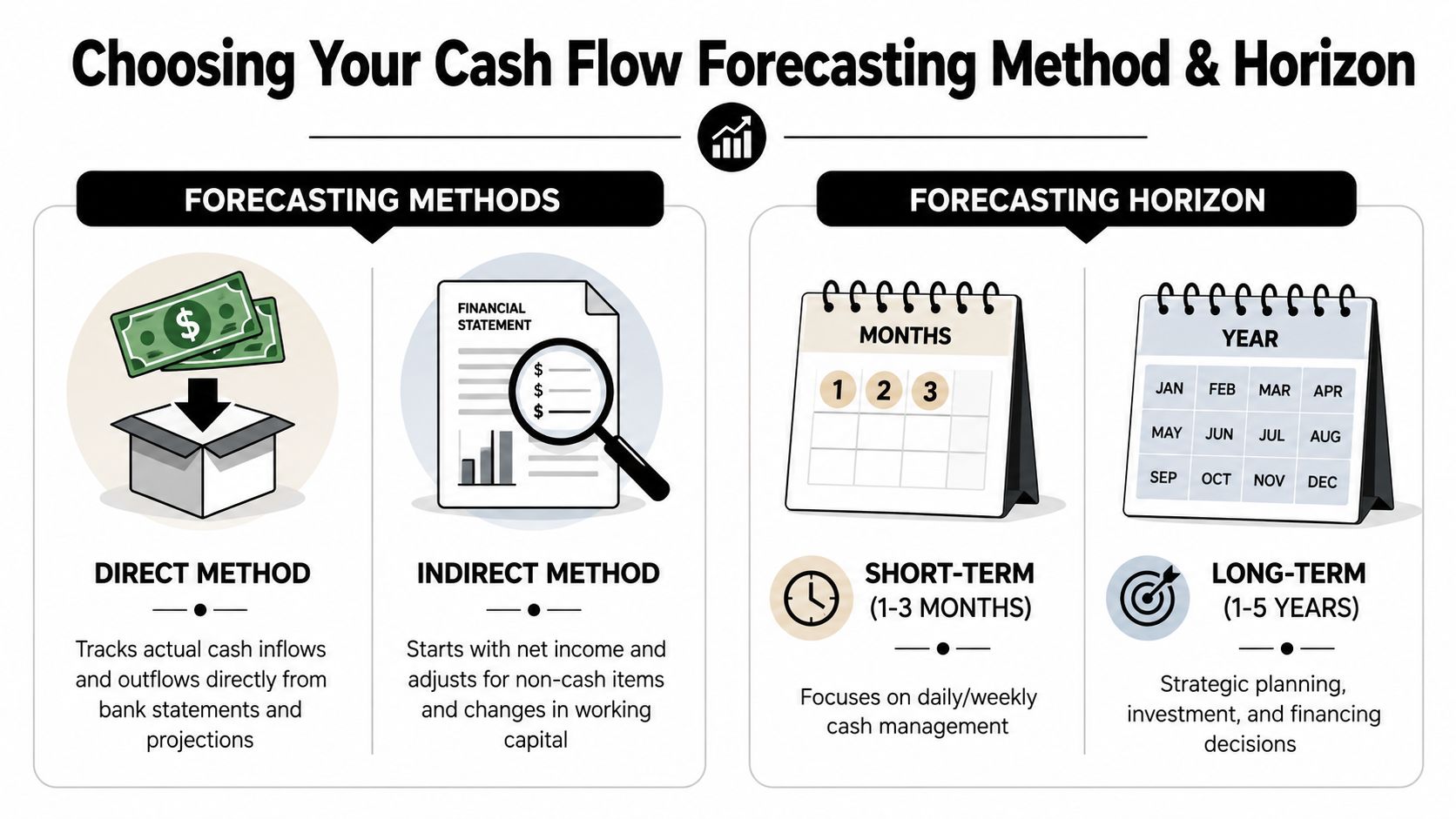
There are two common forecasting methods.
The indirect method starts with net income and adjusts for non-cash items and working capital changes. It has a place. It's useful for longer-range planning, board reporting, and linking to your financial statements.
The direct method tracks expected cash receipts and cash disbursements by period. It follows the actual movement of money. That's what you need when you're deciding whether cash will be available on the date an obligation comes due.
Use the direct method for operating decisions
My recommendation is straightforward. Use the direct method for short-term operating control. If you're trying to manage liquidity, there isn't a serious debate here.
Atlar's explanation of the 13-week cash flow forecast states that the 13-week cash flow forecast is the most popular short-term financial model, projecting inflows and outflows over exactly 13 weeks using the direct method, which is critical for capturing precise weekly liquidity where timing mismatches between revenue recognition and cash collection are common.
That last point matters more than most founders realize. Timing mismatches are where trouble starts. Your books may show a strong month. Your actual cash position may still get squeezed because collections trail invoices.
If you're a startup founder building early systems, financial forecasting for startups gives helpful context on how forecasting discipline evolves as complexity grows.
Why 13 weeks works better than a static monthly view
I'm opinionated on this. For most founder-led businesses, the right short-term model is a rolling 13-week forecast.
Why 13 weeks?
- It matches operating reality. It usually captures receivable cycles, payroll cycles, and recurring vendor payments.
- It forces weekly visibility. A monthly view is too blunt when timing is tight.
- It keeps you current. Rolling means you replace forecast with actuals and add a new week instead of staring at a stale file.
J.P. Morgan's guidance in Cash Forecasting Best Practices for Midsize Businesses recommends rolling forecasts over static monthly or quarterly updates because they let businesses continuously update projections with the latest information, reducing the risk of unexpected cash shortfalls by up to 40% in volatile markets. That same guidance identifies the 13-week structure as the standard liquidity-management horizon because it lines up with common receivable collection periods of 30–45 days and payroll schedules that are often biweekly or monthly.
Treasury4 also emphasizes that weekly time buckets in a 13-week model should be refreshed at least weekly, with more frequent updates when liquidity is tight. In practice, that cadence helps leadership spot a variance within 3–5 days and act before the problem grows. Internal benchmarks cited in that guidance show forecast accuracy of 85–90% for rolling models compared with 60–65% for static annual forecasts.
A short comparison makes the choice obvious:
| Approach | What it does well | Where it fails |
|---|---|---|
| Static monthly forecast | Budgeting and broad planning | Misses weekly timing issues |
| Indirect forecast | Links to financial statements | Doesn't show exact cash movement clearly |
| Rolling 13-week direct forecast | Weekly liquidity management and fast decisions | Requires discipline to update |
Practical rule: If a decision affects cash in the next few months, put it through a 13-week rolling forecast before you approve it.
Gathering and Validating Your Core Financial Inputs
Most broken forecasts don't fail because the spreadsheet is weak. They fail because the inputs are wrong.
Start with reconciled cash and nothing else
The opening cash balance is the anchor for the whole model. If that number is off, every week that follows is off too. That's why I start with bank-reconciled cash, not a guessed number from a dashboard and not an unreconciled general ledger balance.
Numeric's cash flow forecasting guide is clear on this point. A high-precision forecast starts by gathering and verifying data from bank statements, ERP or general ledger, AR and AP aging, payroll, tax, and loan schedules, using only reconciled cash balances. That approach matters because relying on unaudited estimates leads to forecast errors exceeding 20% in 65% of firms.
If your sales planning is still rough, a projected sales forecast template can help tighten one of the biggest input categories before it distorts the cash model.
Your weekly input checklist
You don't need a complicated workflow. You need a disciplined one. Pull the same core inputs every week and validate each against reality.
Use this checklist:
- Bank activity first. Pull current bank statements or bank feed data and confirm the reconciled opening cash balance.
- Receivables aging next. Review open invoices, due dates, disputed balances, and known late payers.
- Payables aging after that. Identify what's due now, what can wait, and what absolutely cannot slip.
- Payroll and benefits calendar. Include payroll dates, taxes, benefits drafts, and bonuses if they're scheduled.
- Debt and lease payments. Use actual amortization schedules and payment dates.
- Tax obligations. Include sales tax, payroll tax, income tax estimates, and any known catch-up payments.
- Planned non-routine cash uses. Equipment deposits, owner distributions, legal settlements, insurance renewals, or large project mobilization costs.
Here's the validation standard I use with clients:
| Input | What to verify |
|---|---|
| Cash | Reconciles to the bank |
| AR | Matches aging and reflects real collection timing |
| AP | Tied to vendor due dates and management intent |
| Payroll | Reflects actual draft date, not just pay period |
| Debt and tax | Based on schedule, not memory |
If your controller says, “We'll clean that up later,” don't load it into the forecast yet.
The discipline here is simple. Clean inputs beat fancy models. Every time.
Building Your Forecast Model from the Ground Up
A forecast model should help you make decisions fast. If it takes ten minutes to explain where cash gets tight, the model is failing.
Lay out the sheet so it mirrors how cash moves
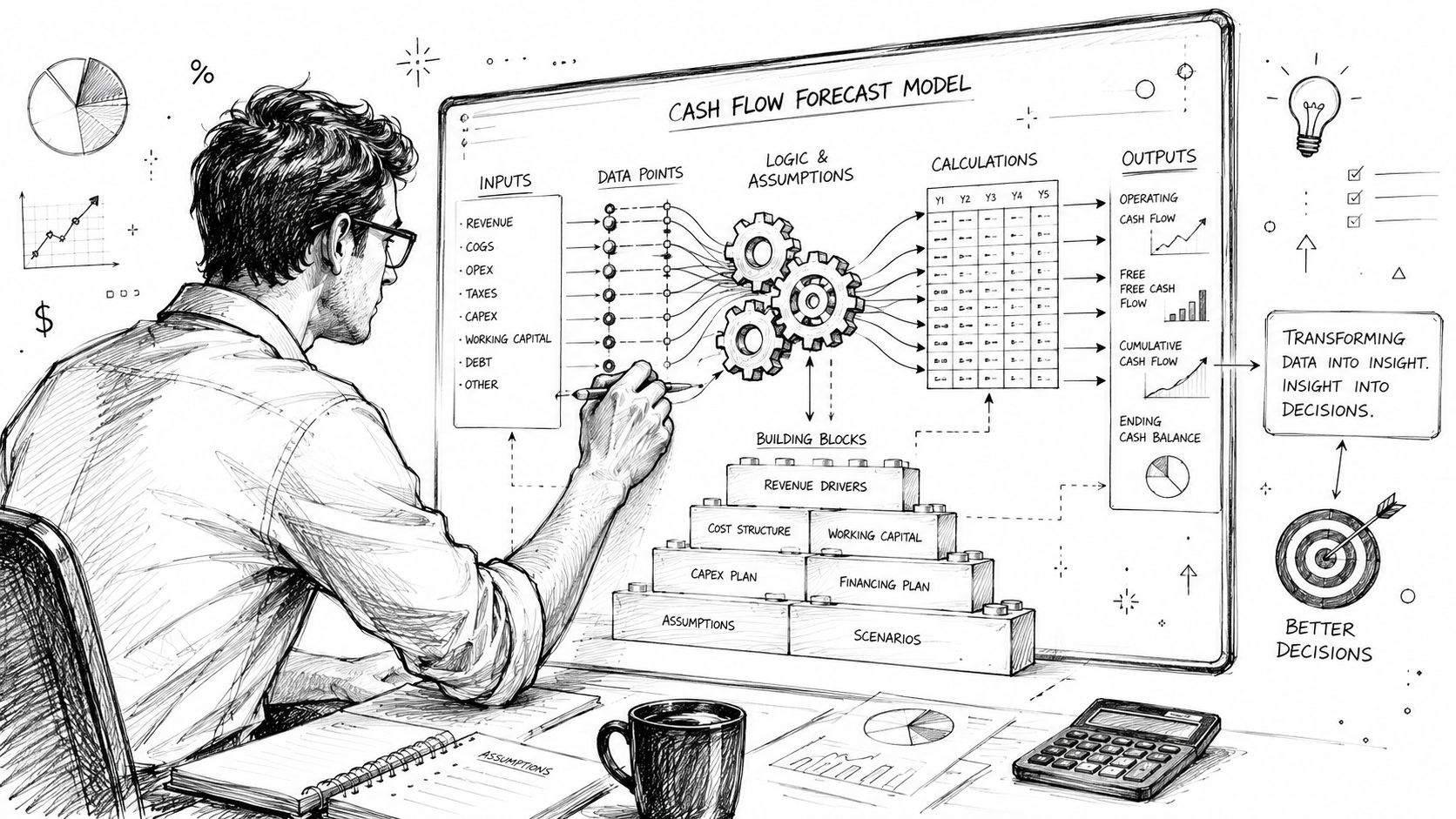
Start with 13 weekly columns and a row structure that gives you a clean roll-forward of cash. Founders do not need a dense model. They need one they can trust in a leadership meeting.
At minimum, include:
- Opening cash balance
- Cash inflows
- Cash outflows
- Net cash flow
- Ending cash balance
Then break inflows and outflows into the categories that drive timing in your business. That last part matters. A founder-led company in construction or distribution should not use the same row logic as a simple subscription business, because the cash conversion gap is wider and more dangerous.
A practical layout usually looks like this:
| Section | Typical rows |
|---|---|
| Inflows | AR collections, progress billings, customer deposits, financing proceeds, tax refunds, asset sales |
| Operating outflows | Payroll, benefits, rent, software, subcontractors, inventory, freight, insurance |
| Non-operating outflows | Debt service, equipment purchases, owner distributions, legal, taxes |
| Control rows | Net cash flow, minimum cash threshold, ending cash |
If your business lives on projects, inventory turns, or long customer terms, add rows that expose the delay between paying cash out and getting cash back in. That is the cash conversion gap. If you do not model it clearly, you will miss the exact weeks when growth starts draining cash instead of building value.
Model inflows based on collections, not bookings
Revenue does not pay payroll. Collections do.
Too many founders load the forecast with booked sales and call it done. That mistake hides risk, especially in B2B service, distribution, and construction businesses where billing milestones, retainage, backorders, and customer payment habits distort timing. This guide to financial risk management strategies matters here because collection timing is one of the first places liquidity pressure shows up.
Build inflows in this order:
- Known AR collections. Review large invoices customer by customer.
- Contracted future billings. Include them only when the billing date is real.
- Expected collections on those billings. Push receipts based on terms and customer behavior.
- Other inflows. Financing draws, asset sales, tax refunds, owner contributions.
A simple example makes the point:
| Item | Week 1 | Week 2 | Week 3 |
|---|---|---|---|
| Open invoice due from Customer A | collect | ||
| New invoice issued this week with 45-day terms | not collected yet | ||
| Equipment sale proceeds | collect |
That timing gap is where founders get surprised. In project-based companies, it gets worse when you buy materials, mobilize labor, or pay subcontractors weeks before the invoice is approved and paid. Put those timing gaps in the model on purpose.
Forecast cash for the week it should hit the bank, not the week revenue lands on the P&L.
Model outflows by payment date and strategic priority
Outflows are more controllable than inflows. Treat them that way.
Do not smooth expenses evenly across the month. That creates a false sense of stability and leads to bad decisions on hiring, equipment purchases, and distributions. Build outflows around the dates cash leaves the account:
- Payroll draft dates
- Major vendor due dates
- Loan and lease payments
- Tax remittance dates
- Insurance renewals
- Capital expenditures
- Project mobilization costs
- Inventory buys tied to lead times
Then separate outflows into two buckets. First, the payments you must make to keep the business running. Second, the payments you can sequence based on cash position and strategic return. That distinction turns the model from a reporting tool into a management tool.
This is also where exit planning starts to show up in the forecast. If you are preparing the business for a sale, lender review, or CEPA-driven value plan, your model should highlight discretionary cash uses such as owner distributions, one-off capital spending, and investments that improve transferable value. A buyer cares about durable cash generation, not your ability to explain away bad timing later.
Use a worksheet structure your team will maintain
Keep the math simple and the controls obvious.
- Net cash flow = total inflows – total outflows
- Ending cash = opening cash + net cash flow
- Next week's opening cash = prior week's ending cash
Add three controls that founders should insist on:
- A flag when ending cash falls below your minimum threshold
- A note row for one-time events or management assumptions
- A variance section that compares forecast to actual once the week closes
That last control matters more than fancy formatting. If collections keep slipping, subcontractor costs keep landing early, or project starts keep moving, the variance view tells you whether the issue is execution, assumptions, or both.
You can build this in Excel, Google Sheets, or an FP&A tool. AmbitionCFO often helps founder-led companies build and maintain 13-week cash models that tie directly to hiring, debt decisions, capital allocation, and owner planning.
Stress-Test Your Business with Scenario Planning
A single forecast is a weak management tool. It tells you one story and pretends the business will cooperate.
Build three versions not one
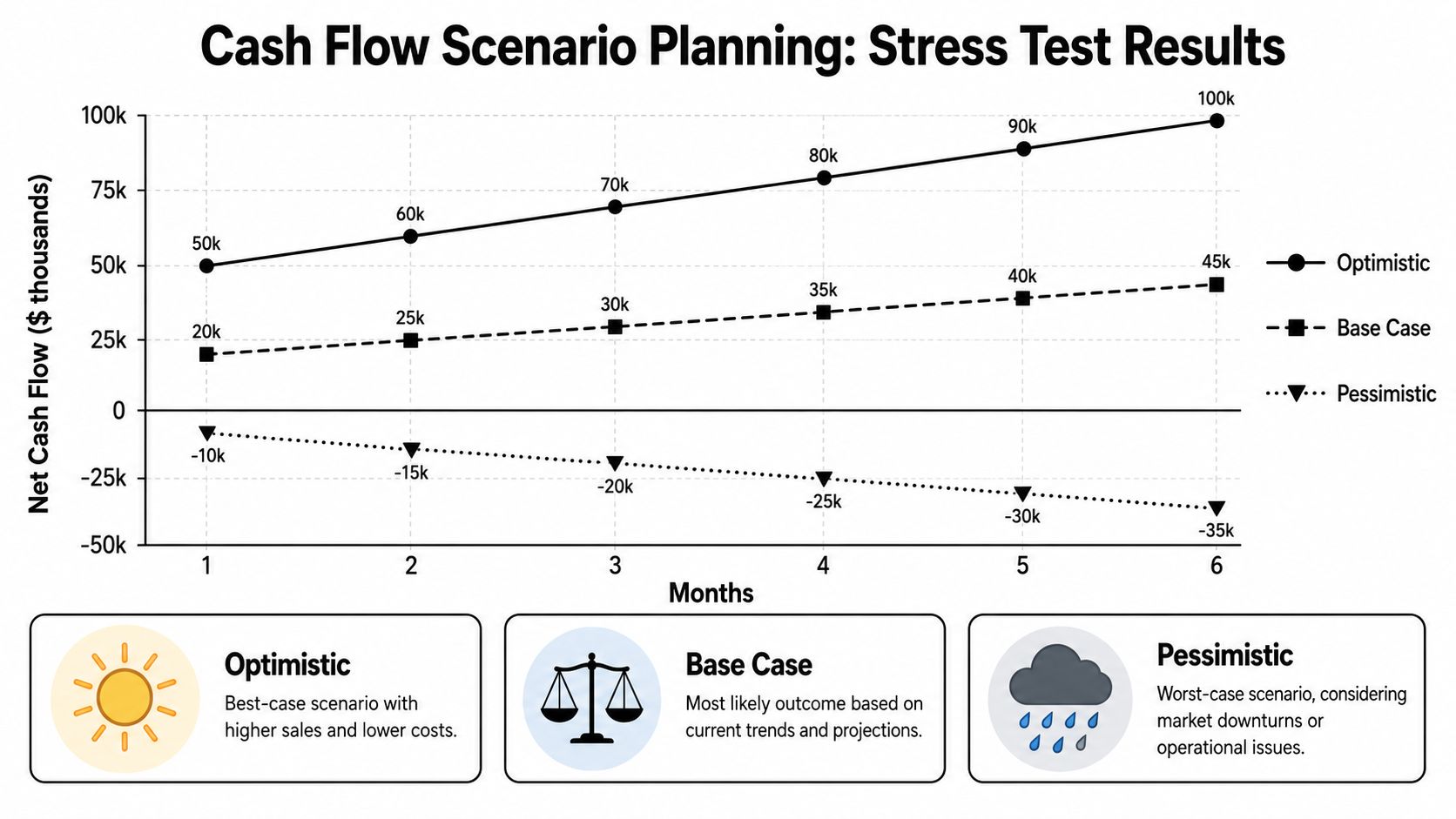
The fix is simple. Build best-case, worst-case, and most-likely scenarios.
The reason isn't academic. The average forecast accuracy for businesses improves from 60% to over 85% when they incorporate multiple cash flow scenarios rather than relying on a single static projection. That same process has been shown to reduce cash flow surprise incidents by 50%.
A useful scenario model changes a few key drivers, not every line item in the sheet. Focus on the variables that move cash:
- Collections timing
- Sales volume or project start dates
- Gross margin pressure
- Inventory purchases or subcontractor costs
- Capital spending
- Owner distributions
This video gives a practical look at how teams think about cash forecasting and scenario use in real operating environments.
If you want a broader operating lens on downside planning, financial risk management strategies is a useful companion read.
A practical stress test example
Take a distribution business with one oversized customer and one critical supplier.
Your most-likely case assumes normal payment timing and current purchasing levels.
Your worst-case changes only a few inputs:
- the largest customer pays later than usual
- supplier costs rise before you pass pricing through
- a planned equipment deposit still goes out
Your best-case assumes:
- collections come in on time
- a new contract starts as expected
- inventory buys stay disciplined
Now the model becomes useful. Instead of asking, “Do we think we'll be okay?” you ask better questions:
- If the worst-case happens, when does cash get tight?
- What action do we take first?
- Which payments are movable, and which are fixed?
- Should we line up bank communication now instead of later?
Scenario planning doesn't predict the future. It gives you a decision path before pressure forces bad choices.
Forecasting for Project-Based and B2B Service Businesses
Most cash forecasting advice is built for simple sales models. Your business probably isn't simple.
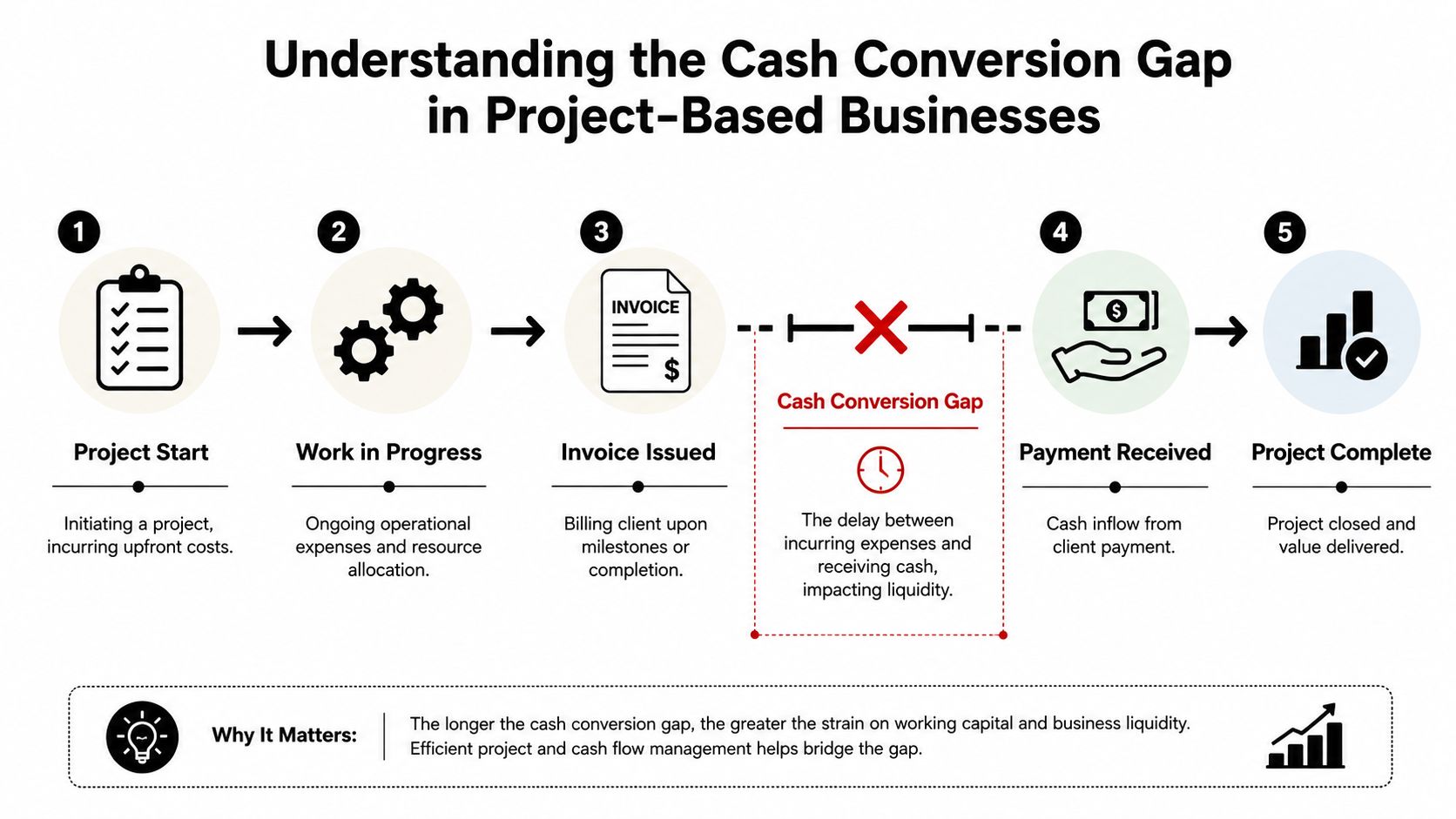
If you run construction, distribution, or professional services, your biggest forecasting problem is often the cash conversion gap. That's the lag between doing the work and getting the cash.
What the cash conversion gap actually means
You might mobilize a job, pay labor, buy materials, and carry overhead long before the customer pays the invoice. You may even recognize revenue before the cash arrives. If your forecast treats booked revenue like bankable cash, it will lie to you.
The gap is bigger than many owners realize. Research cited by Wells Fargo's cash flow projection resource states that 65% of SMBs in project-based sectors fail their 13-week cash flow models because they conflate booked revenue with cash collected. That same research notes the cash conversion gap can exceed 90 days, and 40% of construction firms face cash gaps due to delayed payments.
If you run jobs with retainage, milestone billing, customer approval delays, or pay-when-paid terms, generic monthly forecasting won't protect you. You need a collections model tied to contract mechanics.
For firms that need tighter visibility by project, construction job costing is a critical companion process because poor job-level data weakens cash forecasting fast.
How to forecast project cash the right way
Here's the model I recommend for project-based businesses:
- Track contract milestones. Don't forecast one lump revenue number. Break cash expectations by billing trigger.
- Separate invoice timing from work timing. Work completed this week may not be billable this week.
- Apply real payment behavior. If a customer pays late consistently, forecast late.
- Include retainage explicitly. Don't bury it inside AR.
- Map upfront project costs first. Labor, materials, mobilization, and subcontractor deposits often hit before collections.
- Review large jobs individually. A few contracts usually drive most of the risk.
A simple project cash worksheet should include:
| Project | Billing trigger | Invoice date | Terms | Expected collection week | Key upfront cash costs |
|---|---|---|---|---|---|
| Project A | Milestone completion | scheduled | contract terms | forecasted by customer behavior | labor and materials |
| Project B | Monthly progress billing | scheduled | contract terms | forecasted by aging and history | subcontractor and equipment |
That's how you avoid the classic founder mistake of saying, “We've got plenty of work,” right before cash gets tight.
Operationalize Your Forecast for Strategic Decisions
A forecast only matters if your leadership team uses it. That means cadence, ownership, and decision discipline.
Run a weekly forecasting rhythm
For a 13-week forecast, the operating rhythm should be weekly. Every week, update the prior period with actual cash activity, review variances, adjust assumptions, and add a new week to maintain the rolling view.
A strong weekly routine looks like this:
- Replace forecast with actuals for the prior week.
- Reconcile material variances between expected and actual inflows or outflows.
- Update timing assumptions based on what you learned.
- Roll the model forward by one new week.
- Review it with leadership before major commitments are made.
That's the difference between a living tool and a dead spreadsheet.
The forecast should show up in your leadership meeting before the spending decision, not after the cash problem.
Use the model before major decisions
At this point, forecasting becomes strategic. You should run major decisions through the model before you approve them.
Use it to answer questions like:
- Can we afford three hires if collections slip?
- What happens to cash if we buy equipment before a large receivable lands?
- Can we take on this new contract without stressing payroll or vendors?
- If we want to prepare for a sale, does our liquidity profile support diligence scrutiny?
This matters even more if you're planning an ownership transition. British Business Bank's guidance is cited with a sobering stat. 72% of SMB owners planning exits within 3–5 years lack integrated cash flow models that project exit-ready liquidity metrics, and that gap often causes valuation reductions of 15–25% during due diligence.
In other words, if you want optionality later, you need visibility now. Buyers don't just look at your earnings. They look at working capital quality, liquidity discipline, and whether management understands cash.
Your Next Step Toward Financial Clarity
A good cash flow forecast changes the quality of your decisions. You stop reacting to surprises and start seeing pressure points early enough to do something about them.
Build the habit around a rolling 13-week view. Base it on verified inputs. Forecast cash collections and cash disbursements, not accounting revenue. Then use it before you approve hires, equipment purchases, debt draws, owner distributions, or aggressive growth targets.
If you lead a project-based or distribution business, focus hard on the cash conversion gap. That gap is where margin on paper turns into stress in the bank account. Revenue can look healthy while retainage, slow pay customers, inventory timing, and front-loaded job costs drain liquidity. If your forecast does not model that timing risk clearly, it is not decision-grade.
The payoff shows up fast. You gain tighter control over payroll, vendor payments, borrowing needs, and capital timing. You also get a stronger position for lender conversations, ownership transition planning, and CEPA-driven exit preparation because you can show how the business converts earnings into cash, not just how it books sales.
If you want help building a practical 13-week cash flow forecast for your business, contact AmbitionCFO. We work with founder-led companies in construction, distribution, and professional services to turn cash visibility into better operating and ownership decisions.