
Nearly two-thirds of family-owned small businesses lack a documented and communicated succession plan according to 2025 succession planning statistics compiled by Teamshares. That should change how you think about succession planning for small business.
Most owners treat succession like estate paperwork. That's a mistake. A real succession plan is a value-building plan. It forces you to answer the question you're already circling around: Could this business keep performing if I stepped back, got sick, or wanted to sell in a few years?
If the answer is unclear, your business has a transferability problem.
A strong plan doesn't start with legal documents. It starts with financial visibility, management depth, and a transition structure that works for your goals. If you want retirement security, family harmony, a credible internal successor, or a better sale outcome, you need a CFO mindset before you need signatures.
Table of Contents
- Why Your Business Needs a Succession Plan Today
- Assess Your Business Readiness and True Value
- Choose and Prepare Your Future Successor
- Design the Right Transition Structure and Financing
- Address Critical Tax, Legal, and Operational Hurdles
- Build Your Succession Timeline and Communication Plan
- Your Next Step Toward a Secure Legacy
Why Your Business Needs a Succession Plan Today
About half of small business owners expect to leave their companies within the next 10 years, according to the U.S. Chamber of Commerce and MetLife Small Business Index. That matters because timing is rarely the primary problem. Financial dependence on the owner is.
If revenue, client retention, pricing decisions, hiring calls, and lender confidence all run through you, your business has a succession problem now. Waiting until retirement gets closer only gives you fewer options, weaker negotiating power, and more pressure to accept a bad transfer structure.
Succession planning is value protection.
Owners often treat it like estate paperwork. That is too narrow. A real succession plan reduces key-person risk, strengthens cash flow discipline, clarifies who owns customer relationships, and makes the company easier to finance, sell, or transfer in stages. Those are CFO issues before they are legal issues.
The immediate risk is not just an unexpected exit. It is a preventable drop in value. A founder-dependent company usually gets discounted because the next owner inherits uncertainty. Buyers see concentration risk. Lenders see repayment risk. Internal successors see a business they may not be able to run without constant owner intervention.
Practical rule: If your business would stall for 30 days without you, you do not have a succession plan. You have owner dependency.
That is why smart owners start early. Early planning gives you time to clean up financial reporting, separate personal expenses from business results, build management accountability, and test whether the company can perform without daily founder rescue. Those steps improve current profitability and future transfer value at the same time.
Ask a harder question than "Who takes over?" Ask, "Can this business support a financially sound transition on terms that protect my wealth?" That question forces better decisions about compensation, debt capacity, equity structure, and timing.
If you want a practical framework for preparing both the owner and the business, review this roadmap to a stress-free business exit. The goal is not to announce your departure. The goal is to build a company that can survive your absence and command better terms when the transition happens.
Assess Your Business Readiness and True Value
Most owners overestimate value because they confuse effort with transferability. Buyers, lenders, employees, and successors don't pay for your grind. They pay for a business that produces reliable results without heroic owner intervention.
That means your first move is a readiness audit, not a handshake conversation with family or management.
Businesses with formal succession plans are 2.5 times more likely to outperform their competitors financially, according to EDSI's research on small business succession planning. I read that as proof that disciplined planning improves operations long before the transition happens.
Look at the business the way a buyer would
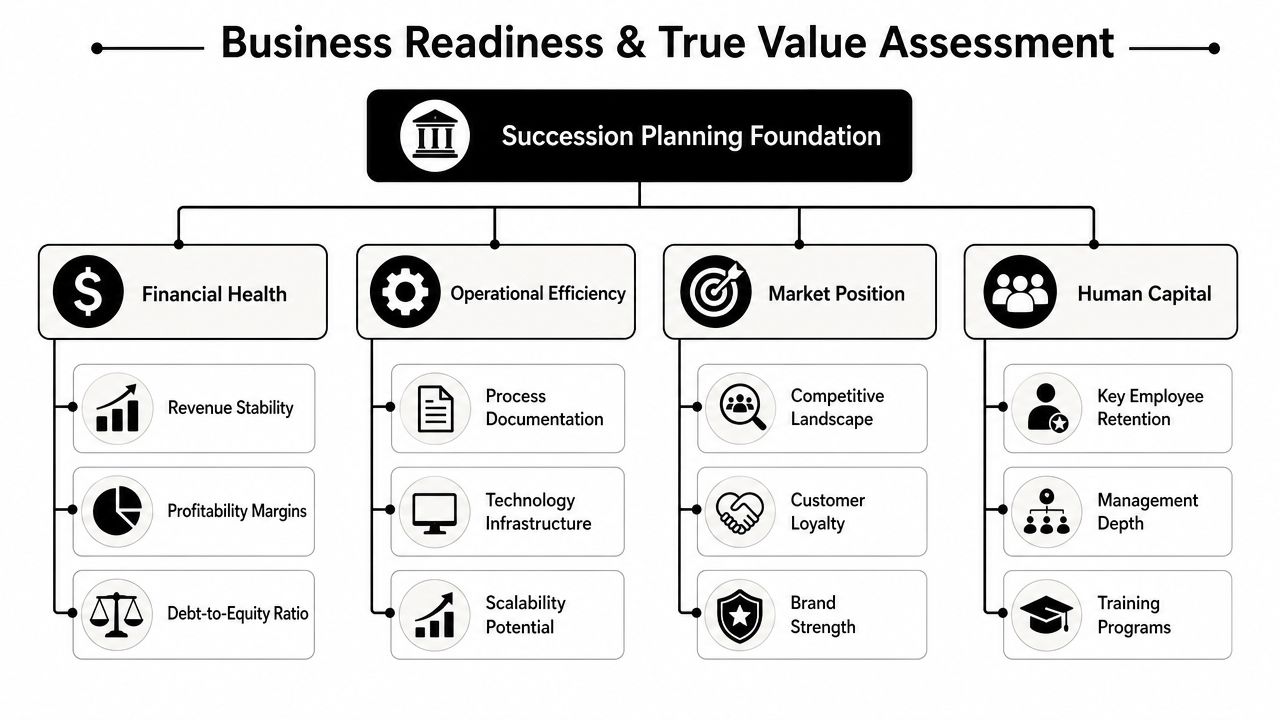
Start with four lenses.
| Lens | What to review | What weakens value |
|---|---|---|
| Financial quality | Revenue consistency, margin trends, cash conversion, debt obligations | Volatile earnings, poor reporting, unexplained adjustments |
| Operational discipline | Process documentation, workflow handoffs, systems reliability | Tribal knowledge, founder approvals on routine work |
| Market strength | Customer concentration, sales pipeline quality, repeat business | Relationships tied to owner only, weak positioning |
| Leadership depth | Department heads, decision rights, accountability, retention | No second layer, one star employee carrying too much |
Use common finance terms correctly. EBITDA is earnings before interest, taxes, depreciation, and amortization. Owners use it as a shorthand for operating performance, but for succession planning, what's more important is whether those earnings are sustainable without you. A nice EBITDA number with heavy owner dependence is fragile.
Cash flow matters even more. If a successor takes over and the business immediately runs into working capital pressure, the transition gets ugly fast. Review cash collections, inventory discipline if applicable, payment terms, backlog quality, and how often you need to inject personal judgment to keep cash moving.
For a deeper look at valuation mechanics, this guide on how to value a small business for sale is worth reading before you talk about transfer price.
Use a simple owner dependency score
You don't need a complex model to spot the biggest threat. Score yourself on these questions using green, yellow, or red.
- Customer ownership: Are major client relationships tied to the company or to you personally?
- Sales authority: Can someone else price, negotiate, and close without you stepping in?
- Financial control: Does the team understand reporting, forecasting, and cash decisions, or do you hold that knowledge alone?
- Operational decisions: Do routine issues funnel to you because nobody else has documented authority?
- Team credibility: Would employees stay confident if you stepped back for a month?
- External relationships: Are banking, legal, supplier, and strategic relationships shared with the team?
If you mark more reds than greens, the business isn't ready for a clean transition. That's not a reason to panic. It's a reason to focus.
The owner dependency score is often the fastest way to find the gap between what the owner believes the business is worth and what a real successor can safely take on.
Build a readiness worksheet you can use this quarter
Keep this practical. Create a one-page worksheet with these fields and review it monthly.
Financial readiness
- Reporting speed: How quickly do you get accurate monthly financials?
- Margin visibility: Can you see profit by job, client, product line, or location?
- Cash forecast: Do you run a rolling forecast, or are you reacting after cash tightens?
- Add-backs discipline: Have you clearly separated personal or one-time expenses from true operating performance?
Operational readiness
Write down the five processes that would hurt the business most if they failed tomorrow. In many companies, that's quoting, project handoff, collections, purchasing, and key account management. Then ask whether each process is documented, measured, and owned by someone other than the founder.
Leadership readiness
List your top leaders and identify where each can already operate independently, where they need coaching, and where they aren't ready. If no one can own sales, operations, and finance at a senior level without you, your succession plan is still theory.
Transferability readiness
This is the toughest part. Ask whether the business has a brand, system, and management rhythm that can survive a change in owner. If your answer starts with "Yes, but only if I stay involved every day," transferability is still low.
A quick example. In a founder-led distribution company, the owner often believes the business is stable because revenue is strong and customers are loyal. Then the audit shows that key pricing decisions sit in the owner's inbox, sales reps escalate every exception, and only the owner can explain true gross margin by account. That's not a succession-ready business. That's a business with hidden concentration risk in one human being.
Fixing that gap improves today's performance. It also gives you options later. And options create value.
Choose and Prepare Your Future Successor
A lot of succession plans fail before they start because the owner chooses the wrong person for the wrong role.
The common mistake is assuming the future owner and the future leader should be the same person. They don't have to be. In many businesses, they shouldn't be.
Separate the future leader from the future owner
A critical rule in succession planning for small business is this: leadership succession and ownership succession must be treated separately. According to FamilyBusiness.org's succession planning guidance, 25% of all succession attempts fail, often because owners blur those two decisions together.
A child may be a fair inheritor of equity and still not be the right CEO. A longtime operations leader may be the best next president and still not have the balance sheet or desire to buy the company outright. Once you accept that distinction, the process gets clearer.
Use two different profiles.
| Role | What matters most | Wrong assumption to avoid |
|---|---|---|
| Future leader | Judgment, credibility, operating discipline, ability to drive results through others | "They're family, so they should run it" |
| Future owner | Capital capacity, governance maturity, risk tolerance, long-term alignment | "If they lead it, they must own all of it" |
Emotions distort decisions. Family history, loyalty, and tenure all matter, but they can't substitute for capability. If you want the business to survive, you need an honest answer about who can lead at the level the company now requires.
Use an objective successor scorecard
Build a scorecard around the business you expect to have, not the business you had ten years ago.
Include these criteria:
- Strategic judgment: Can this person make decisions with incomplete information and still protect cash and margin?
- Functional range: Have they led across departments, or have they only excelled in one silo?
- People leadership: Do strong employees trust them, or merely tolerate them?
- Commercial strength: Can they protect customer relationships and represent the company credibly?
- Financial fluency: Do they understand pricing, profitability, and cash consequences?
- Values fit: Will they preserve what makes the business work while still improving it?
Don't score candidates alone. Bring in a small review group that can challenge your blind spots. That might include your senior operator, outside advisor, and someone who can evaluate financial competence clearly. The process should feel more like selecting a CEO than honoring a family tradition.
Owner test: If this candidate weren't related to you or already on payroll, would you still trust them to run the company?
If the answer is no, you have your answer.
A strong internal candidate usually needs broader exposure before they're ready. Put them in situations where they have to lead cross-functionally, present financial results, handle difficult personnel issues, and own customer-facing decisions. If they only succeed inside a protected lane, they're not ready yet.
For owners who need help turning scattered financial and operating insight into a structured leadership development plan, this overview of what a fractional CFO does helps clarify where strategic finance support fits.
Create a development plan with visible milestones
Don't "groom" a successor in vague terms. Build a written plan.
A practical development plan should include:
Expanded operating scope
Give the candidate responsibility for a larger part of the business than they're comfortable with. That reveals where they can scale and where they stall.Financial ownership
Require them to review monthly results, explain variances, and defend decisions that affect margin and cash.Relationship transfer
Move key banker, customer, supplier, and legal relationships from founder-only access to shared ownership.Decision rights
Define which decisions they can make independently now, which need consultation, and which still remain with the owner.Readiness reviews
Review progress on a set cadence. Don't assume time in seat equals readiness.
Here is a simple example of how that can work. A founder in professional services identifies two possible successors. One is a family member with strong client rapport but weak operating discipline. The other is a non-family executive who runs delivery well but hasn't managed external relationships. The answer may be a split model: the executive leads the company, the family member retains ownership interest and serves in a commercial or board role. That's often cleaner than forcing one person into a role they can't carry.
The business deserves a qualified leader. Your family deserves clarity. Your employees deserve a plan they can trust.
Design the Right Transition Structure and Financing
The transition structure decides who gets control, how you get paid, how risk gets shared, and whether the business stays stable after the handoff. Many owners, however, often drift into wishful thinking.
They say they want a family transfer, management buyout, employee transition, or outside sale. But they haven't modeled the cash, the timeline, or the impact on control. That's not planning. That's preference.
One issue gets ignored far too often. An underserved angle is the lack of financial modeling for partial succession or staged equity transfer to employees, with 78% of succession reviews focusing solely on leadership roles rather than ownership equity splits, as discussed in this Unshakeables succession planning episode. That's a real gap, especially for businesses in the middle market where the best successor may be inside the company but can't buy everything at once.
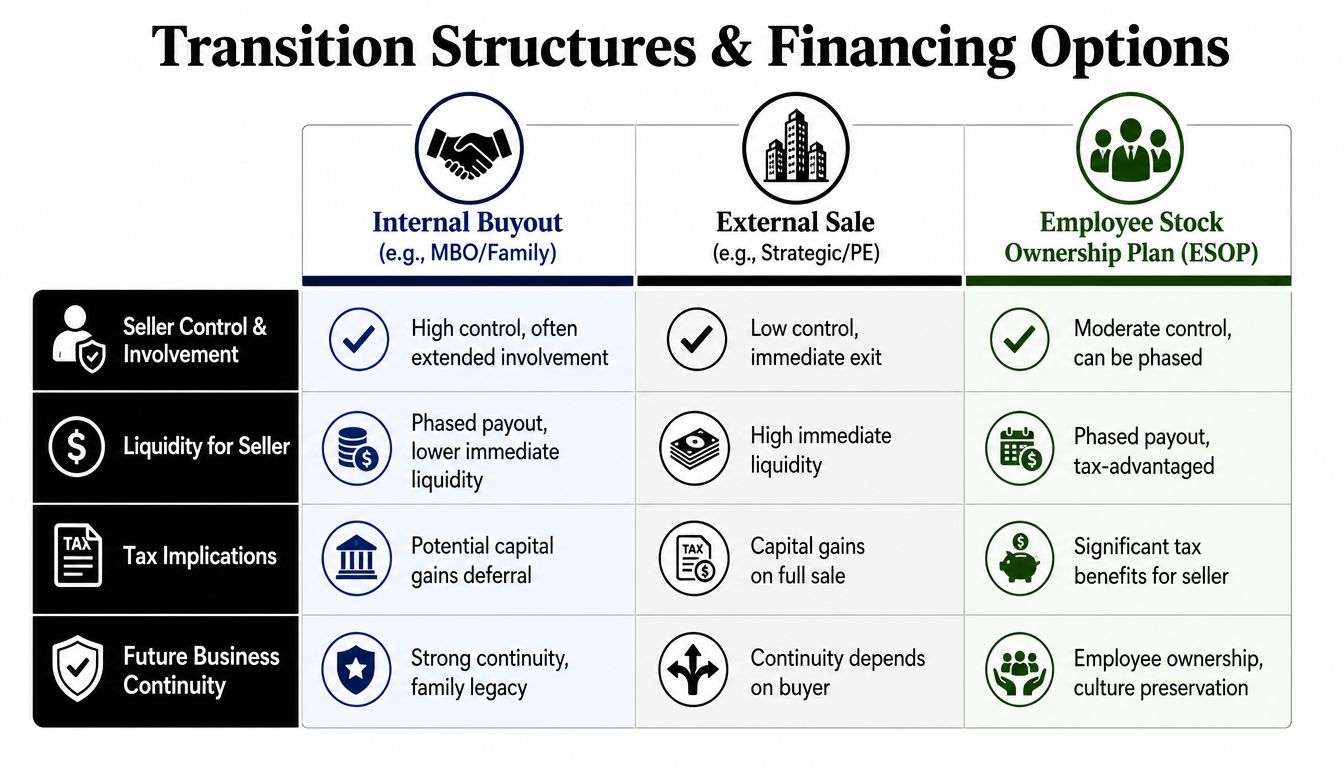
Compare the main transition paths
Here are the four structures I see most often.
Full external sale
This is a sale to a strategic buyer, private equity group, or outside party.
Best fit: Owners who want cleaner liquidity and are less attached to ongoing control.
Strength: Simpler transfer of ownership in one transaction.
Problem: Culture, legacy, and post-close continuity may change fast.
Management buyout
The management team buys some or all of the business over time.
Best fit: Companies with proven internal leadership and owners who value continuity.
Strength: The buyers already know the business.
Problem: Financing can be the hardest part because good operators don't always have enough capital personally.
ESOP
An employee stock ownership plan can create a path to employee ownership over time.
Best fit: Owners who value employee continuity and want a structured internal transfer.
Strength: Can preserve culture and broaden ownership participation.
Problem: It requires serious planning, valuation work, and ongoing administration.
Staged equity transfer
This is the option more owners should consider. Instead of selling all at once, you transfer a minority stake first, then additional ownership as the successor proves capability and financing develops.
Best fit: Owners who want gradual liquidity, retention advantage, and a lower-risk internal transition.
Strength: You can align incentives without giving up full control on day one.
Problem: If the economics and governance aren't modeled carefully, you create confusion instead of commitment.
For owners evaluating any of these routes in more depth, transaction advisory services can help frame the analysis before legal drafting begins.
Why staged equity transfers deserve more attention
A staged transfer solves a common middle-market problem. The most capable successor is often a key employee or small leadership group, but they can't fund a full buyout immediately. The owner, meanwhile, needs eventual liquidity and doesn't want to donate value through a poorly structured deal.
A staged model gives both sides a path.
You can tie ownership transfer to operational milestones, financing capacity, and business performance. You can also separate economics from day-one control. For example, the owner may retain majority voting control early while the successor earns or purchases a minority stake tied to role expansion and accountability.
Staged transfers work best when the numbers are explicit. If nobody can explain how the future owner pays, how the current owner gets liquidity, and what happens if performance slips, the structure isn't ready.
A CFO-style model plays a significant role. Build scenarios around:
- Cash available for distributions or seller payments
- Impact on debt capacity
- Compensation versus equity economics
- Owner retirement cash needs
- Successor affordability
- What happens if the transfer pauses or leadership changes
Don't copy a template from a legal form library and assume the deal works. Most of those documents describe ownership mechanics. They don't answer whether the business can financially support the transition.
Questions to answer before you pick a structure
Use these as your decision filter.
- How much liquidity do you need, and how soon do you need it?
- Do you want to stay involved after the transition, and in what role?
- Is preserving family legacy or employee continuity more important than maximizing immediate proceeds?
- Can the business support debt, seller financing, or phased payouts without starving operations?
- Do you trust the successor enough to share economics before they take full control?
- What governance will protect everyone if expectations diverge?
A short worksheet can help:
| Question | Internal transfer | External sale | Staged employee transfer |
|---|---|---|---|
| Preserves culture | Usually strong | Depends on buyer | Often strong |
| Immediate liquidity | Usually lower | Usually stronger | Usually phased |
| Owner involvement after closing | Often higher | Often lower | Flexible |
| Complexity of modeling | Moderate | Moderate | High |
The right answer isn't universal. The right answer is the structure that fits your financial goals, successor reality, and tolerance for ongoing involvement.
Address Critical Tax, Legal, and Operational Hurdles
Poor transitions rarely collapse because the owner lacked intent. They collapse because tax exposure, legal gaps, and operating dependencies stayed hidden until the handoff was already in motion.
That is expensive.
A good succession plan protects enterprise value all the way through the transfer. That means tightening the legal documents, reducing tax drag, and making sure the business can keep producing cash if the owner steps back tomorrow. Legal paperwork alone does not do that. A financial transition plan does.
Get the legal foundation aligned with reality
Your documents should reflect how the company operates, who controls decisions, and what happens when ownership changes. If they do not, the business loses negotiating power fast.
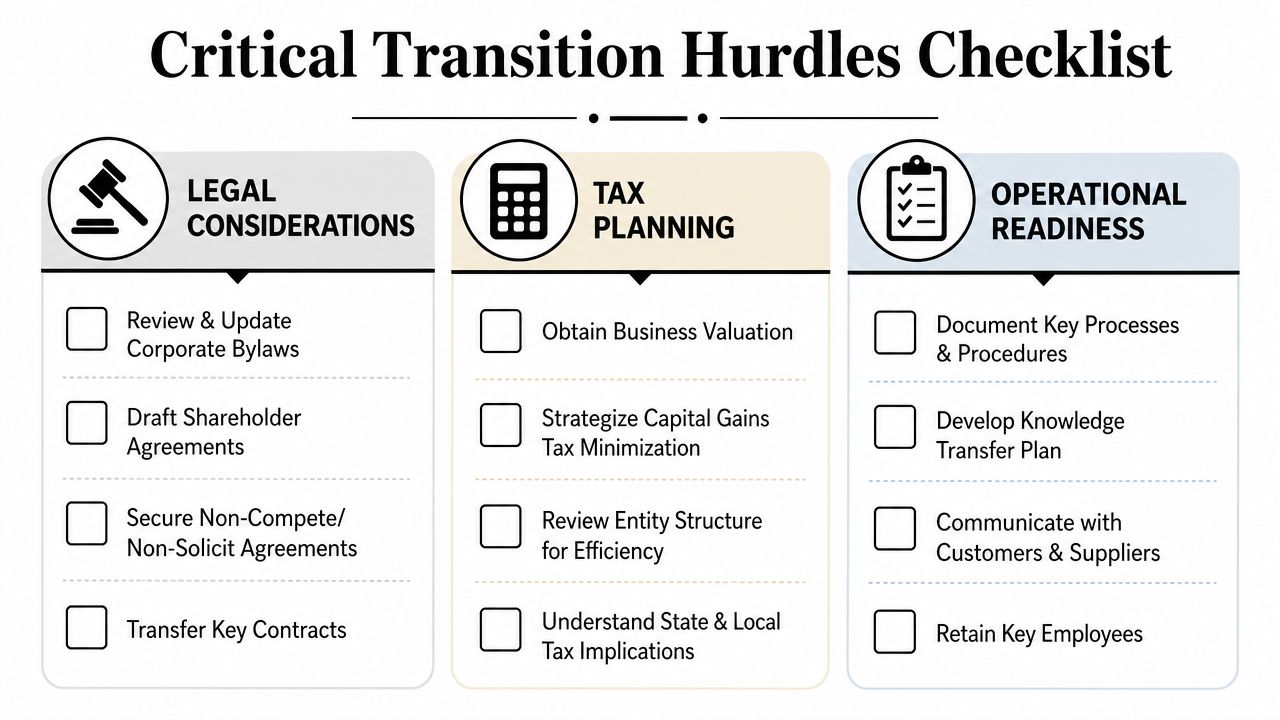
Review and update:
- Buy-sell agreements that define transfer rights, trigger events, funding terms, and valuation method
- Shareholder or operating agreements that match current ownership, voting rights, and restrictions
- Employment agreements for the successor and other key leaders
- Non-compete and non-solicit protections where state law allows them
- Assignment and consent provisions in customer contracts, leases, loan agreements, and vendor relationships
Owners often treat this as a legal cleanup project. That is too narrow. Each document affects value, control, cash flow, and deal execution. If lender consent is required, if a landlord can block assignment, or if a minority owner has stronger rights than expected, the transition gets weaker and more expensive.
Run the company through an M&A lens before anyone else does. This mergers and acquisitions due diligence checklist gives you a practical way to pressure-test the records, contracts, and risks that surface during a transfer.
Set the tax path before drafting terms
Tax planning belongs at the front of the process because structure drives net proceeds. Owners who focus on headline price and ignore tax treatment leave money on the table.
Your CPA, tax strategist, and attorney should answer a short list of hard questions early:
- Does your entity structure still fit the transfer you want?
- Will the deal be taxed in a way that cuts proceeds more than necessary?
- Are gifting, trusts, or estate planning vehicles appropriate for a family or insider transfer?
- Does the timing of the transfer create unnecessary income tax or estate tax friction?
- Are state and local tax rules likely to change the structure?
A staged equity transfer, for example, can look attractive on paper and still fail financially if basis, compensation treatment, or installment mechanics are handled poorly. The same is true for redemptions, management buyouts, and family transfers. Structure first for after-tax outcomes, then document it.
Good succession planning protects what you keep, not just what you sign for.
Build an operating system the next owner can run
Operational continuity is where many plans break. The owner assumes the team knows how the business runs. Usually, the team knows only their piece of it.
Fix that before the transition starts.
Create a focused continuity playbook that captures how cash moves, how decisions get made, and where performance can slip. Keep it practical. The successor does not need a binder full of theory. They need a working system.
Include:
Critical recurring processes
Billing, payroll approvals, purchasing, scheduling, collections, estimating, service delivery, safety, and quality controlRelationship ownership
Top customers, referral sources, suppliers, lenders, insurance contacts, and the internal owner for each relationshipDecision authority
Hiring approvals, pricing exceptions, contract signatures, capital spending, customer credits, and banking accessManagement cadence
Weekly operating meetings, monthly financial package, forecast updates, KPI reviews, and escalation rulesOwner-dependent knowledge
Judgment calls, exceptions, tribal knowledge, and recurring issues that currently live in the founder's head
The financial layer matters most here. A successor should be able to read the monthly package, understand margin by line of business, spot cash pressure early, and know which indicators require action. If your reporting cannot support that, the business is not operationally ready for transfer.
A simple example proves the point. In a construction company, the founder may personally control change-order strategy, payment pressure on slow customers, subcontractor exceptions, and problem-job triage. If that judgment never gets translated into process, reporting, and authority rules, the new leader inherits volatility instead of a transferable company.
Legal structure protects rights. Tax planning protects proceeds. Operational discipline protects performance. You need all three working together.
Build Your Succession Timeline and Communication Plan
A succession plan without a timeline is just a preference list. The work has to be sequenced.
Owners usually compress this process too late. They wait until fatigue, health, market interest, or family pressure forces action. That leads to rushed valuation discussions, weak successor development, and sloppy communication.
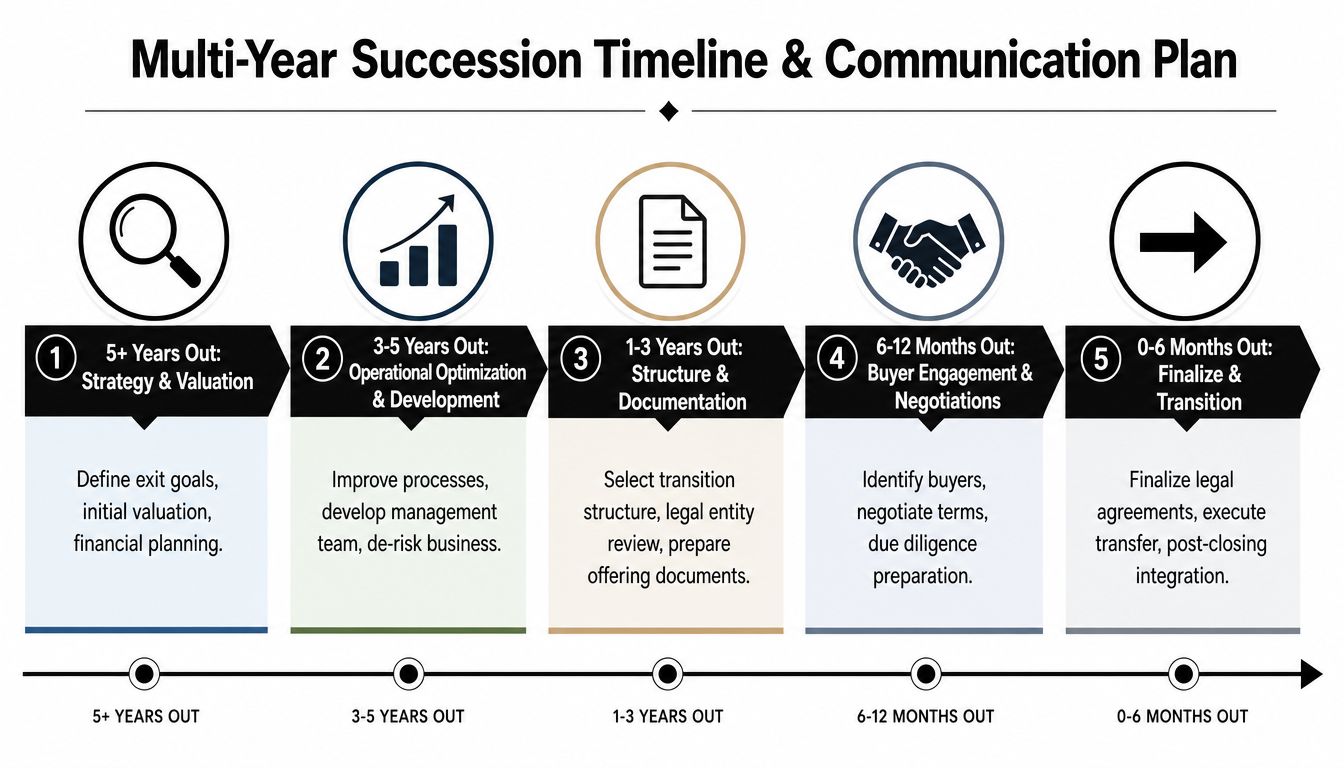
A practical multi-year timeline
Use this as a working model and adjust for your situation.
Five or more years out
Clarify the owner's goals first. Do you want maximum value, family continuity, gradual involvement, employee ownership, or a clean third-party sale? Then benchmark current value, assess owner dependence, and identify the biggest transferability gaps.
This is also the right time to tighten reporting, forecasting, cash planning, and management accountability. If the business can't produce reliable numbers now, it won't inspire confidence later.
Three to five years out
Develop likely successors through expanded responsibility and measurable accountability. Reduce founder-only customer concentration. Document critical workflows and decision rights. Start modeling different transition structures, especially if an internal transfer is on the table.
If you're considering a staged transaction, this is when the financial model should get serious. You need time to test whether compensation, distributions, debt, and ownership transfer can coexist.
One to three years out
Choose the transition structure. Update legal documents. Align tax planning. Clarify governance and ownership rights. Prepare the business for diligence-quality scrutiny even if you aren't selling externally.
Many owners benefit from bringing in a strategic finance advisor or CEPA-level guidance. Not to replace legal or tax counsel, but to coordinate value, cash flow, timing, and decision tradeoffs.
Who needs to hear what and when
Communication should be deliberate, not secretive and not reckless.
Different stakeholders need different messages.
- Senior leadership: Share the transition path early enough that they can support execution and stay aligned.
- Successor candidates: Be explicit about expectations, timing, and what still needs to be earned.
- Family members or owners: Clarify the difference between leadership roles, economic rights, and governance authority.
- Key employees: Communicate enough to preserve confidence and retention without creating confusion.
- Customers and suppliers: Time this carefully. They need reassurance about continuity, not a dramatic announcement.
- Lenders and outside advisors: Bring them in when structure and timing are credible enough for useful input.
Say more to the people carrying execution risk. Say less to everyone else until the plan is real.
A simple communication worksheet helps:
| Stakeholder | Message | Timing | Owner |
|---|---|---|---|
| Leadership team | Transition direction and responsibilities | Early | Founder |
| Key successor | Role, milestones, accountability | Early and ongoing | Founder |
| Customers | Continuity and service stability | Later stage | Founder plus successor |
| Suppliers and bank | Stability, authority, continuity | Later stage | Finance lead or founder |
Most plans improve once the timeline becomes visible. People know what's happening, what matters now, and what still has to be proven.
Your Next Step Toward a Secure Legacy
Succession planning for small business isn't a legal event at the end of your career. It's a strategic discipline that starts while you still have time to improve the asset.
The work is straightforward even if it isn't easy. Assess the business objectively. Reduce owner dependence. Choose a successor based on role fit, not sentiment. Model the transition structure before you commit to it. Lock down legal, tax, and operational details before pressure shows up. Put the whole process on a timeline and communicate with intent.
If you do that, you gain more than an exit plan. You get a stronger company now. Better reporting. Better delegation. Better leadership accountability. More options.
That's the core point.
A business with no clear succession path traps the owner. A business with a disciplined plan creates flexibility. You can transfer it internally, sell it externally, phase out over time, or stay involved on your own terms. Those choices only exist when the company is financially ready and operationally transferable.
Start with a blank page and answer three questions today:
- What is this business worth without me in the middle of everything?
- Who could realistically lead it next?
- What transition structure would protect both the company and my personal goals?
Write your answers down. Then test them against reality.
If you're planning a transition in the next several years and want a clearer view of your starting point, contact AmbitionCFO for a succession readiness assessment. You'll get an objective look at value, owner dependence, cash flow readiness, and the financial roadmap needed for a successful and profitable exit.