

Most owners think exit planning starts when they're ready to sell. That's backwards. Nearly half of surveyed business owners plan to exit within the next five years, and 75% intend to exit within the next ten according to Project Equity's business owner exit planning data. Yet many wait until the exit is close, which cuts off the time needed to build value, reduce risk, and control the deal.
The question isn't “How do I sell my business someday?” It's “What has to be true for me to leave on my terms, with enough money, with a business buyers want?” That's the standard for serious exit planning for business owners.
If you own a construction firm, distribution company, or professional services business, your exit outcome will come down to a handful of practical issues. Can the company run without you? Are the numbers clean enough to survive diligence? Is your management team credible? Is cash flow predictable? Can a buyer see continuity the day after close? Those are CFO questions before they become deal questions.
Table of Contents
- Your Starting Point Define Your Exit Timeline and Goals
- Fortify Your Business for Maximum Valuation
- Prepare for Your Ideal Buyer and Exit Pathway
- Optimize Your Deal Structure for Tax and Legacy
- Your Prioritized Exit Planning Action Plan
Your Starting Point Define Your Exit Timeline and Goals
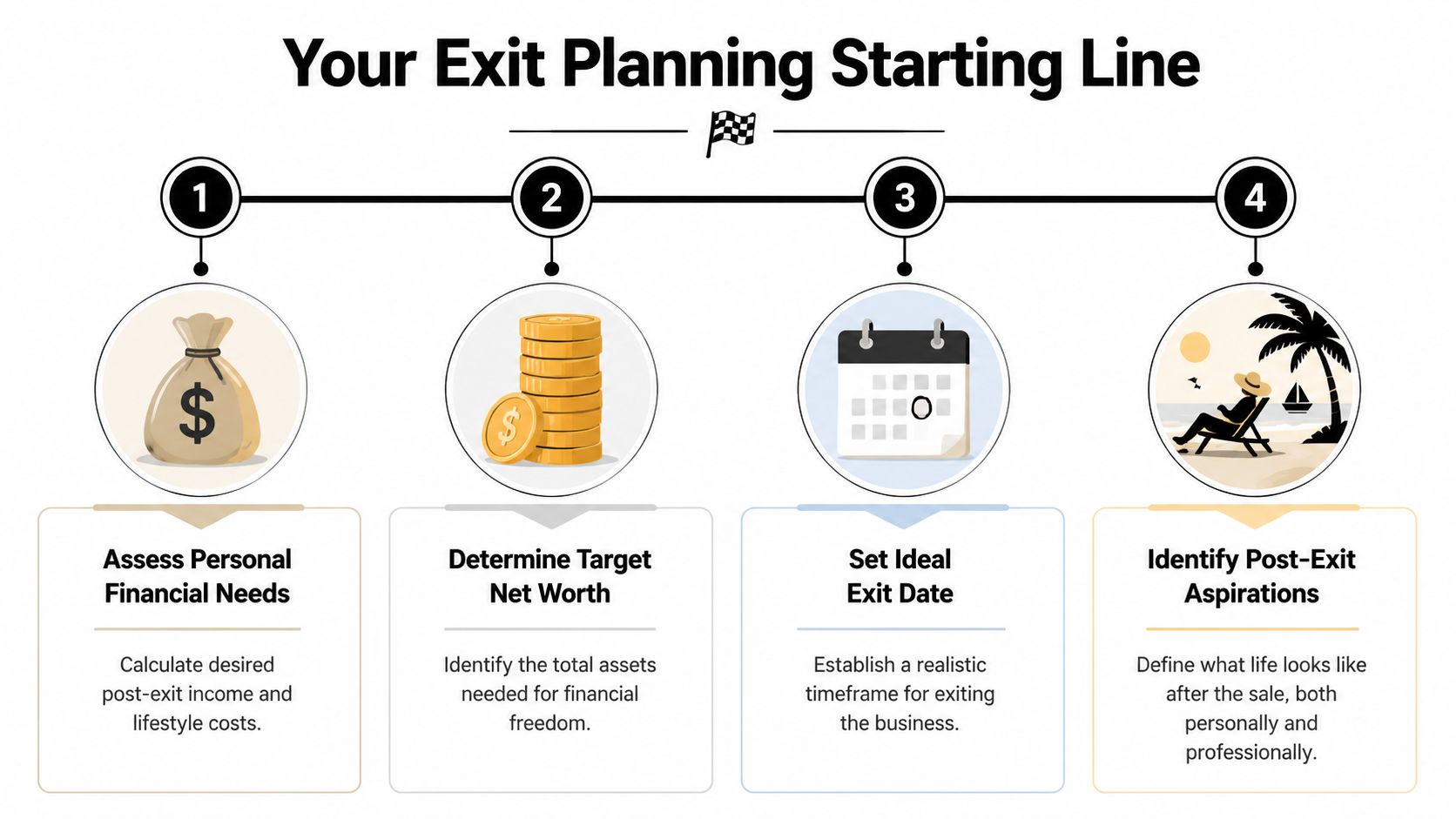
An exit plan that starts with the business and ignores your life is incomplete. You need two answers first. How much do you need after the exit to live the life you want? And when do you want to be out, or at least out of day-to-day operations?
That's where most owners get uncomfortable. They know revenue, backlog, and payroll. They don't know their personal financial finish line. Without that number, you can't judge whether your current business value is enough, whether you need more growth, or whether you should change the timing.
Start with your personal number
A practical rule of thumb from Regions on planning your exit is that retirement income often targets 75% of current pre-retirement income. That isn't a valuation formula. It's a planning benchmark that helps you estimate what your post-exit lifestyle may require.
Start with this worksheet:
- Define annual personal spending. Include housing, healthcare, travel, family support, taxes, and anything else you want your next chapter to fund.
- Estimate your target post-exit income. Use your current lifestyle as a baseline, then stress test it.
- List non-business assets. Retirement accounts, brokerage accounts, real estate, cash, and other investable assets matter.
- Compare that to likely after-tax exit proceeds. “After-tax” matters more than headline sale price.
That last point is where owners fool themselves. They think in gross value. You'll live on net proceeds.
Measure the asset gap
I call this the asset gap. It's the distance between what you need and what you currently have available to fund life after the business.
If the gap is small, your strategy might focus on tightening operations, reducing risk, and improving deal readiness. If the gap is large, you may need a longer runway, stronger margins, better leadership depth, and more disciplined forecasting to build value before you go to market.
Practical rule: If you haven't compared your target personal net worth to the current realistic value of the business, you don't have an exit plan. You have a hope.
Timing matters because value enhancement takes time. SVA's exit planning guide recommends beginning at least 5 years before departure, with a planning horizon of 5 to 7 years to build value, address taxes, and prepare succession. That aligns with what I see in the field. Good exits are built. They aren't improvised.
If you're still deciding whether this is the moment to bring in strategic finance help, this overview of when to hire a fractional CFO will help you recognize the point where bookkeeping and tax prep stop being enough.
Address the identity problem early
Owners usually underestimate the emotional side of exiting. AAFCPAs' discussion of business exit planning points to a real issue here. 60% of owners delay exits due to loss of identity, and 45% of retirees experience identity dissonance without structured transition planning.
That matters because hesitation shows up in the business. You delay delegation. You keep key relationships in your own hands. You avoid naming a second-in-command. You stay indispensable because stepping back feels like disappearing.
Use these prompts now:
- Role after exit: Do you want to retire fully, stay as chair, advise occasionally, or start something new?
- Personal purpose: What replaces the scorekeeping of ownership?
- Legacy decision: Do you care more about maximum cash, continuity for employees, family legacy, or preserving culture?
The cleanest transaction often starts with a personal decision, not a financial model.
When we work through exit planning for business owners, this is the first real checkpoint. We define your number, your timing, your role after the transaction, and the gap between where you are and where you need to be. Once that's clear, every operational decision has a purpose.
Fortify Your Business for Maximum Valuation
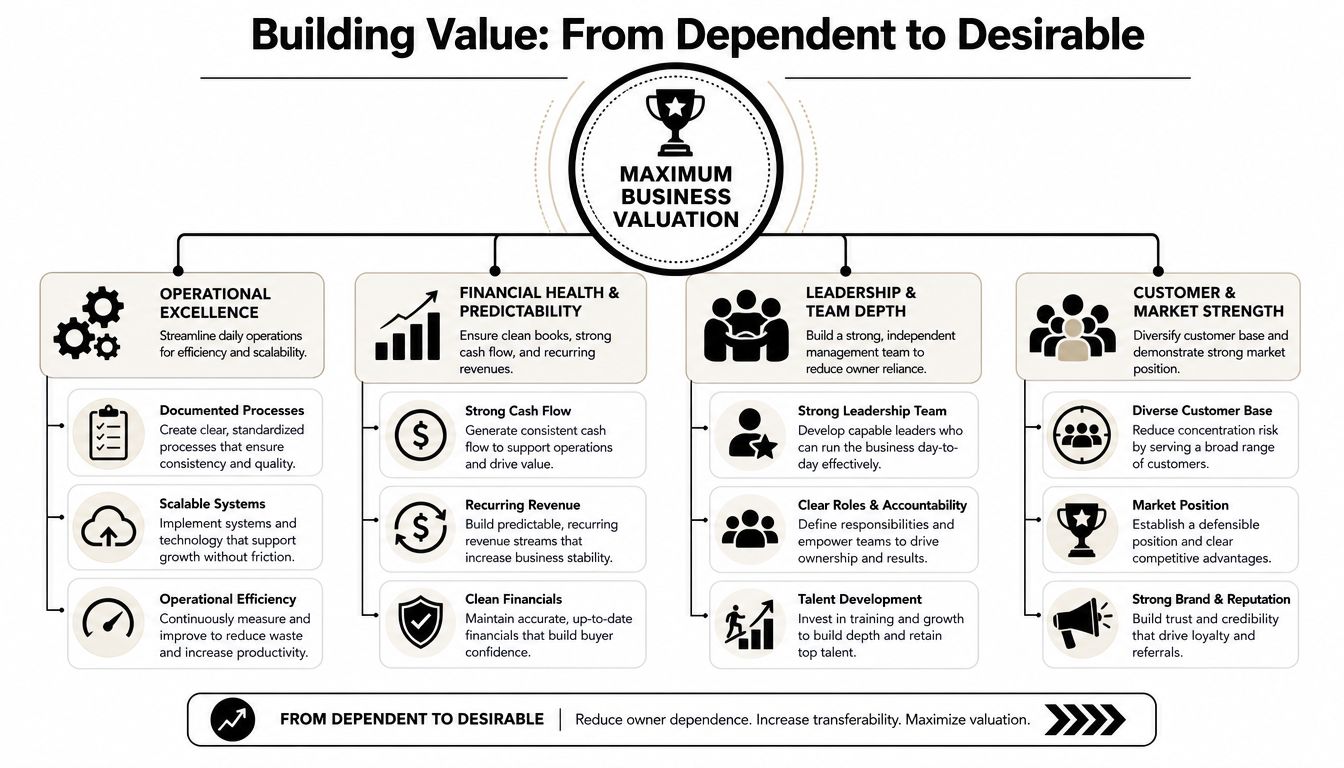
Most businesses aren't discounted because the owner didn't work hard. They're discounted because the company looks risky, messy, or too dependent on one person.
That's why this phase matters. You're not just trying to improve performance. You're trying to make the business transferable.
Clean up the financial story
Buyers don't buy your intentions. They buy what your numbers prove.
That means moving beyond tax-driven bookkeeping into financial management. You need clear monthly reporting, reliable accrual-based statements when appropriate, normalized earnings logic, visibility into margin by customer or job, and a cash forecast that leadership uses.
A practical valuation article on small business sale prep is useful here because valuation isn't just a formula. It reflects how believable, repeatable, and durable your earnings appear to a buyer.
A few specific tools matter more than owners expect:
- 13-week cash flow model: This creates short-term visibility into receipts, disbursements, covenant pressure, working capital strain, and timing issues.
- Client or job margin analysis: This separates profitable revenue from vanity revenue.
- KPI dashboard: This helps buyers see a managed business, not a reactive one.
The benchmark is harsh. SCH Group's exit planning guidance says less than 30% of businesses that go to market sell, primarily because of owner dependence and lack of documented processes. The same source notes that customer concentration above 20% revenue from a single client is a top red flag, and 40% of due diligence failures are caused by undiversified customer concentration.
That's not abstract. If one customer carries too much of your revenue, buyers will haircut the value or walk.
Here's a quick operating checklist:
| Area | What a buyer wants to see | What you should do now |
|---|---|---|
| Cash flow | Predictable short-term liquidity | Build and update a 13-week cash flow model |
| Margins | Proof that profits are real | Track margin by job, customer, or service line |
| Reporting | Consistent monthly close and clean statements | Standardize reporting packages and review cadence |
| Revenue quality | Low concentration and stable accounts | Reduce dependence on any single customer |
Reduce owner risk and concentration risk
In lower middle market deals, owner dependence kills momentum fast. If the seller is the top rainmaker, final approver, operating brain, recruiter, and relationship hub, then the buyer isn't buying a business. They're renting the owner for a transition period and hoping nothing breaks.
That's why leadership depth matters. The same SCH Group analysis says building a strong management team 3 to 5 years pre-exit can increase sale price by 15% to 25% in controlled industry studies.
That work usually includes:
- Documented processes: Sales handoff, estimating, project review, purchasing, hiring, collections, and account management should live outside your head.
- Named leaders: Operations, sales, finance, and delivery need clear ownership.
- Customer transfer plan: Key relationships should be shared before a sale, not after a letter of intent.
- Decision rights: Your team needs authority to run the business without waiting for you.
If you still approve every major quote, hire every key employee, and manage the biggest customer relationships yourself, the business isn't exit-ready.
A fractional CFO adds practical pressure to the process. Not by “consulting” in the abstract, but by forcing accountability into reporting, cash planning, margin analysis, and leadership review. For firms in the $10M to $100M range, that can include the same workstreams AmbitionCFO handles: 13-week cash flow modeling, profitability analysis by job or client, KPI dashboards, and exit planning support tied to a real timeline.
A short walkthrough may help frame what disciplined readiness looks like:
Build proof not promises
Experienced buyers want evidence that performance can continue after you leave. You create that evidence with operating discipline.
For a construction company, I'd want to see backlog quality, gross margin by project type, change order discipline, billing-to-collection timing, and which PMs can run jobs independently.
For a distributor, I'd want to see margin by customer and product category, purchasing controls, inventory logic, and account concentration.
For a professional services firm, I'd focus on utilization, realization, client retention, partner dependence, and handoff of delivery relationships.
Use a dashboard that answers three questions every month:
- Are we producing cash predictably?
- Are we earning healthy margins in the right places?
- Can this company perform without the owner at the center?
That's how you move from “good business” to “financeable, transferable, attractive business.”
Prepare for Your Ideal Buyer and Exit Pathway
A generic exit strategy creates generic preparation. That's a mistake. The right move is to prepare for the buyer you want.
Teamshares' succession planning statistics show that 70% of business owners prefer internal transfers, while 17% prefer external sales. The same source identifies common exit paths including ESOPs, third-party sales to private equity firms, and family succession.
That preference for continuity makes sense. Many owners want culture preserved and employees protected. But preference alone doesn't create a viable exit. Preparation does.
Different buyers pay for different strengths
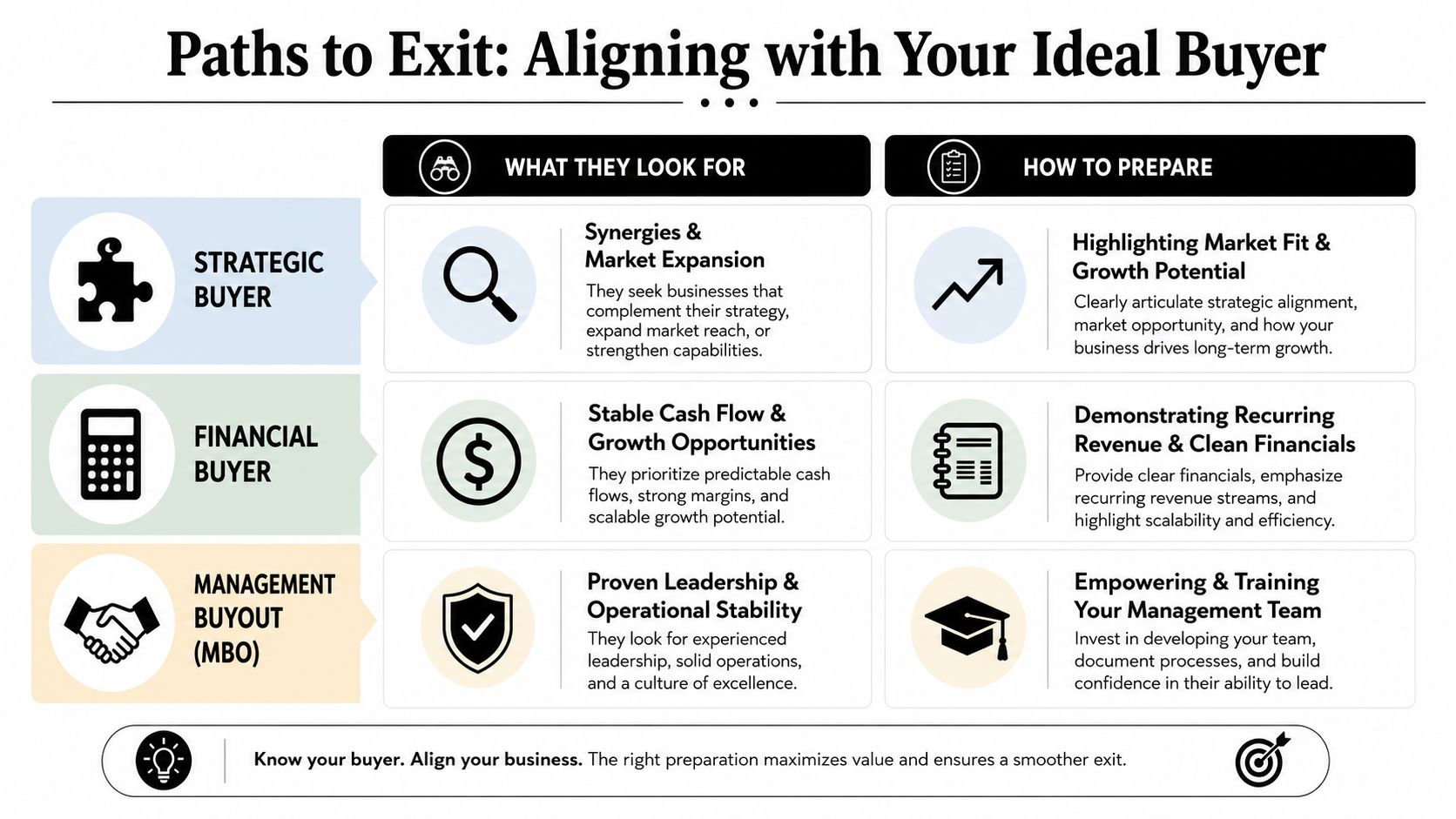
A strategic buyer usually looks for market expansion, customer overlap, geographic reach, service capability, or talent. They may care less about preserving your exact structure if they plan to integrate it.
A private equity buyer usually wants strong cash flow, clean reporting, durable margins, management depth, and a credible growth plan. They care about systems because they need the platform to scale.
A family or management transition depends on stability. Successor readiness matters more than headline polish. If the next generation or management team can't lead confidently, the transaction drags or never happens.
An ESOP introduces its own requirements. Regions' explanation of exit pathways and valuation notes that an ESOP requires an appraised fair market value to set the share price for employees. That means valuation readiness matters even when you aren't selling to an outside buyer.
A simple buyer readiness comparison
| Exit path | What they care about most | What you need to prove |
|---|---|---|
| Strategic buyer | Synergy, market access, capabilities | Why your company strengthens theirs fast |
| Private equity | Cash flow, systems, leadership depth | Repeatable performance and scalable infrastructure |
| Management or family transfer | Continuity and trust | The team can lead without disruption |
| ESOP | Sustainable value and structure | The company supports employee ownership responsibly |
The buyer type should shape your prep list. Otherwise you'll improve the wrong things.
Match your preparation to the exit path
Here's how this plays out in practice.
A construction company preparing for a PE process should tighten project margin reporting, reduce dependence on the founder in estimating and client relationships, and establish a stronger operator beneath the owner. PE will care about earnings quality, backlog visibility, and whether growth depends on one personality.
A professional services firm preparing for internal succession should focus less on market packaging and more on partner transition. That means migrating client relationships, defining compensation logic, and proving the next leaders can retain accounts and manage delivery.
A strategic sale often rewards a company that can show unique fit. Maybe your distribution footprint fills a geographic gap. Maybe your service capability opens a vertical the buyer wants. Those are story elements, but they still need financial support.
If you're heading toward a sale process, your diligence file shouldn't wait for the buyer to ask. This M&A due diligence checklist is a good way to pressure test how prepared you really are.
The key is simple. Stop saying you're “keeping options open” if you're not building toward any option specifically. Pick the likely path. Prepare for that path. Buyers reward targeted readiness.
Optimize Your Deal Structure for Tax and Legacy
Most owners spend too much time thinking about price and not enough time thinking about structure. That's expensive.
A deal can look strong on paper and still disappoint you after taxes, working capital adjustments, transition terms, and payout mechanics. You don't need to become your own tax attorney, but you do need to understand the questions early enough to shape the outcome.
Know the structure before the offer arrives
At a high level, many transactions lean toward either an asset sale or a stock sale. The tax impact, liability allocation, and buyer preference can differ significantly. The wrong time to learn that is after the letter of intent is signed.
You also need clarity around:
- Payment form: Cash at close, seller note, earnout, rollover equity, or some mix.
- Working capital target: What stays in the business and what gets adjusted at close.
- Employment and transition terms: Consulting agreements, stay periods, and post-close obligations.
- Entity and ownership issues: Minority interests, partner agreements, and legal cleanup.
This is exactly why planning can't be compressed into a few months. Contrail Financial's exit planning guidance notes that 74% of business owners in the under $500K revenue sector and 50% of all owners have no written exit plan. It also states that this delay eliminates the 3 to 10 year value enhancement window, because detailed plans require 3 to 5 years for implementation plus 12 to 24 months for transaction closure.
Even if your company is much larger than that smallest revenue bracket, the lesson still applies. Delay shrinks options.
Succession planning is a value issue
A clean succession plan does more than protect legacy. It directly supports value because buyers want continuity.
Here's a practical example. A distribution owner who wants to step back should identify a second-in-command years before the transition, shift operating authority gradually, and let customers, vendors, and employees see that leader in action. If the owner can move into a board or advisory role before a final exit, the business becomes easier to transfer because continuity is visible, not theoretical.
Buyers trust what they can observe. They discount what the seller promises will happen later.
This is also where transaction planning needs coordination. Your CFO, CPA, attorney, wealth advisor, and deal advisor shouldn't work in separate silos. If you're navigating structure, diligence, and sale preparation, transaction advisory services can help you understand how those workstreams fit together.
Questions to bring to your CPA and attorney
Bring these questions into your next meeting:
- What structure is most likely for my type of buyer, and why?
- What legal cleanup should happen now, not during diligence?
- What compensation, distributions, or related-party items should we normalize?
- What succession issues would weaken the deal if we ignore them?
- What part of my expected proceeds is likely to be delayed or contingent?
That's the right mindset. Don't wait for a buyer to expose weak structure. Fix it while you still control the timetable.
Your Prioritized Exit Planning Action Plan
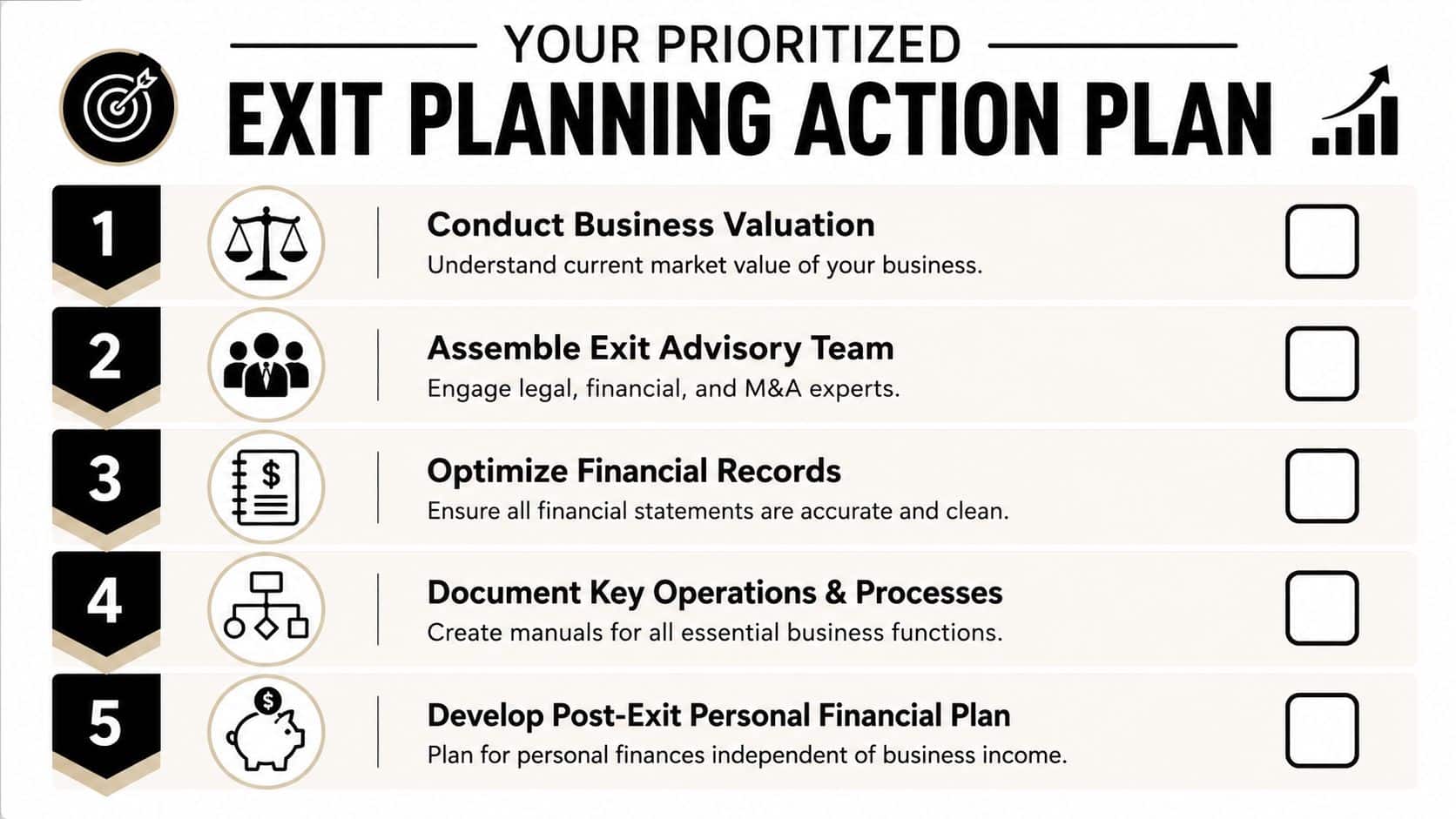
The biggest risk in exit planning for business owners isn't ignorance. It's drift. Owners know they should prepare, but they don't sequence the work, assign ownership, or push it into the operating calendar.
That's how they get trapped by the five Ds. Bernstein's summary of Exit Planning Institute guidance says 50% of all exits are triggered by death, divorce, disability, disagreement, and distress. If you want control over timing and value, the plan has to start before pressure shows up.
Foundation phase 5 to 7 years out
Owners create clarity and stop guessing.
- Set your personal finish line. Define post-exit income needs, desired role, and lifestyle target.
- Get a baseline view of business value. You don't need a rushed sale process to learn what the market may think.
- Install decision-grade reporting. Monthly financials should support management decisions, not just tax filing.
- Build a forecasting rhythm. Cash flow visibility and forward-looking review need to become routine.
A fractional CFO typically leads the operating side of this phase by creating the reporting cadence, sharpening forecasting, highlighting value gaps, and forcing management discussions around transferability.
Value building phase 2 to 4 years out
This phase is operational. You're reducing discount factors.
Use this checklist:
| Priority | Action | CFO role |
|---|---|---|
| Leadership | Build authority below the owner | Define metrics and accountability by function |
| Financial quality | Improve margin visibility and forecasting | Create dashboards, cash models, and analysis |
| Revenue quality | Reduce concentration and improve retention | Surface exposure by customer, service, and segment |
| Process transfer | Document critical workflows | Tie process discipline to KPI review |
This is also the right time to tighten your internal reporting discipline. These financial reporting best practices are useful because weak reporting creates confusion inside the business long before it creates problems in diligence.
A buyer should be able to understand how your business runs without sitting next to you for six months.
Transaction ready phase 0 to 2 years out
By this point, the work should feel organized, not frantic.
Your priorities now are different:
- Pressure test diligence readiness. Contracts, financials, legal documents, customer data, and leadership roles should be organized.
- Confirm the likely buyer path. Strategic, PE, ESOP, management, or family transition. Pick one and prepare accordingly.
- Model net proceeds. Focus on what you keep, not just what you sell for.
- Coordinate advisors. Your legal, tax, wealth, and finance teams need one operating plan.
A good transaction-ready business has clean numbers, visible leadership depth, credible customer transfer, and a seller who knows what outcome they want.
If that isn't your current position, fix it now. Start with the financial model, the management team, and the personal end goal. Those three decisions drive almost everything else.
If you're planning a transition and want a CFO-level view of what would increase value before a sale, contact AmbitionCFO. We help founder-led businesses build cash flow visibility, improve profitability, strengthen reporting, and prepare for exit with a practical roadmap tied to your timeline and goals.