

You probably already have a number in your head.
It might be the figure that would make all the long nights feel worth it. It might be the amount you think a buyer “should” pay because of the brand you built, the customers you kept, or the years you invested. Most owners arrive at a valuation conversation this way. They start with a hoped-for sale price and then look for math to support it.
That's understandable. It's also where sellers get into trouble.
If you're trying to figure out how to value a small business for sale, the core question isn't “What do I want for it?” The crucial question is, “What value can I defend when a serious buyer, lender, or advisor starts pulling apart my financials?” A valuation that holds up in diligence is far more useful than a number from an online calculator.
Done well, valuation isn't just math. It's financial preparation, risk reduction, and a clear story told through numbers.
Table of Contents
- What's Your Number? Moving Beyond the Guesswork
- Prepare Your Financials for Scrutiny
- Choose Your Valuation Playbook Core Methods Explained
- From Theory to Reality Calculating Your Value Range
- Common Valuation Pitfalls and Strategic Adjustments
- You Have Your Number Now What?
What's Your Number? Moving Beyond the Guesswork
A founder I've seen many times in practice usually starts in the same place. He says something like, “If I could get the right number, I'd sell tomorrow.” Then he tells me that number. It's often rounded, emotionally satisfying, and loosely based on a conversation, a rumor, or an online calculator that asked five questions and produced a neat answer in seconds.
That number may feel good. It usually isn't decision-grade.
Online calculators tend to miss the details that drive value. They don't know if your profit includes personal expenses. They don't know whether one customer drives too much of your revenue. They don't know if your management team can run the company without you. They definitely don't know what a buyer will challenge.
Practical rule: A valuation is only useful if you can defend the earnings, explain the risks, and support the assumptions.
Owners often think valuation is about finding a magic formula. It's closer to building a case. Your financial statements provide the raw material, but buyers want more than raw data. They want a clean earnings picture, credible adjustments, and a business that looks transferable.
That's why the strongest valuation work starts before anyone applies a multiple. It starts with preparation.
If you haven't already tightened your reporting, start with the financial metrics every business owner should track. A buyer won't pay more because you “feel” the business is healthy. They pay more when the numbers prove it.
A good valuation doesn't just tell you what the business may be worth today. It shows you what's dragging the number down, what a buyer will push back on, and what you can improve before going to market. That shift matters. It turns valuation from a pricing exercise into an exit strategy tool.
Prepare Your Financials for Scrutiny
The fastest way to undermine a sale process is to present financials that don't match economic reality.
Most small businesses don't run perfectly clean books for valuation purposes. That isn't a moral failure. It's normal. Owners run legitimate expenses through the business, mix in discretionary spending, pay themselves in ways that don't reflect market compensation, and absorb one-time costs that won't continue under a new owner. The problem starts when those items stay buried and nobody normalizes them.
Why clean financials matter more than clever math
For most small businesses, the critical earnings measure is Seller's Discretionary Earnings, or SDE. According to GValue's guide to valuing a small business for sale, the most critical step is calculating SDE by adding back non-essential owner expenses, including salary, vehicle payments, travel, and personal perks, to net profit, then subtracting debt payments. That normalized cash flow becomes the basis for industry-specific multiples that typically range from 2.0 to 4.0 for very small businesses and 3.0 to 6.0 for those with $10M+ revenue.
That one step changes the conversation. Instead of arguing over messy net income, you're showing the cash flow available to an owner-operator after removing noise.
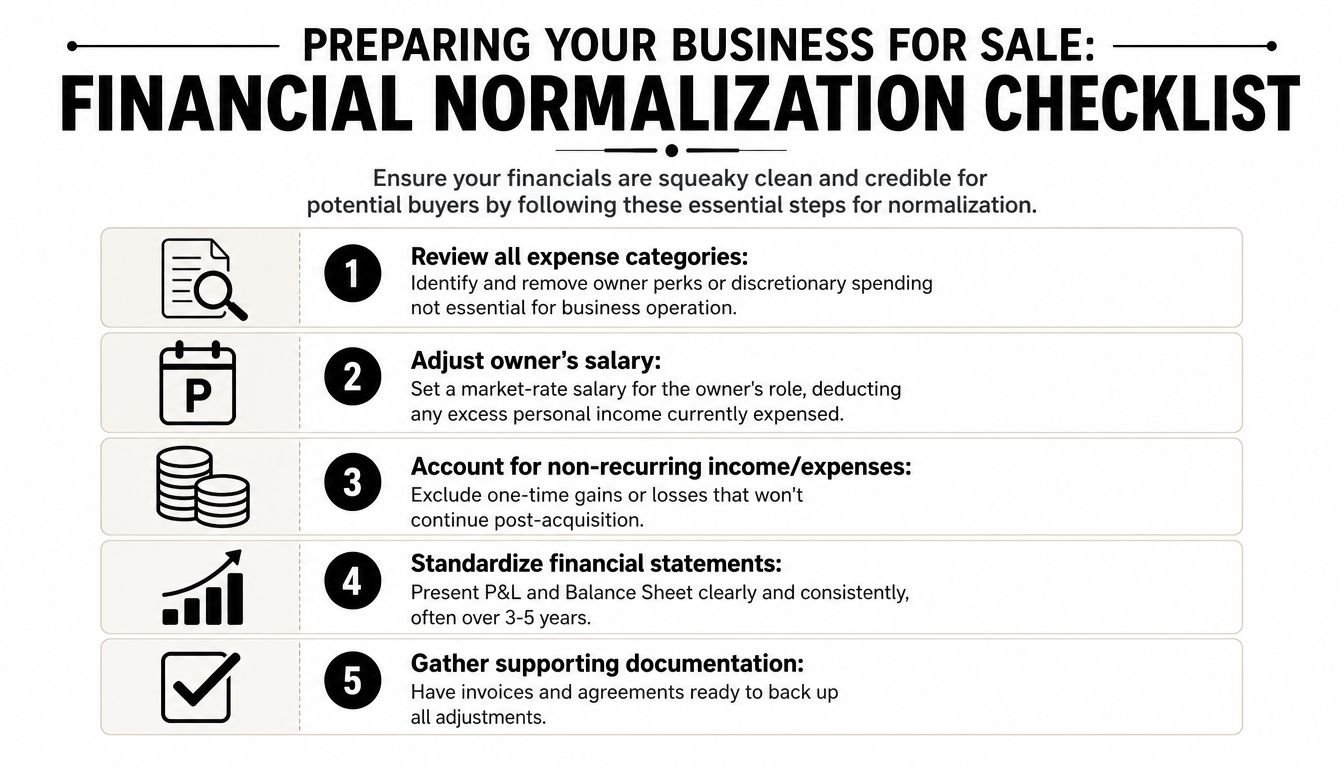
A buyer wants consistency, support, and logic. If you claim an expense is personal, you need to show why. If you claim a legal bill was one-time, make sure the invoice backs that up. If your books changed classification methods from one year to the next, clean that up before anyone else notices.
How to calculate SDE the right way
Start with your profit and loss statement and tax returns. Then work through a normalization pass.
- Start with pretax earnings or an operating earnings base. Use a figure grounded in your financial statements, not memory.
- Add back owner compensation. In a small owner-operated business, the owner's salary and benefits often get added back because SDE measures the total financial benefit to that owner.
- Add back discretionary or personal expenses. Common examples include vehicle costs, travel that isn't required to serve customers, charitable donations, and owner perks.
- Remove one-time items. A consulting project, legal matter, or unusual repair may distort the current year.
- Subtract debt payments if you're using an SDE framework that requires it. The point is to show normalized cash flow available to support ownership.
Here's a simple worksheet you can use:
| Line Item | Treatment | Why |
|---|---|---|
| Owner salary | Add back | Reflects owner benefit in SDE |
| Health insurance for owner | Add back | Often discretionary or owner-specific |
| Personal vehicle use | Add back | Not essential to ongoing operations |
| One-time legal fee | Add back | Non-recurring |
| Current debt payments | Subtract | Reduces cash available to owner under this SDE approach |
Two mistakes show up constantly.
- Calling normal operating costs “add-backs.” If the expense will continue after the sale, it usually stays.
- Forgetting support. Every adjustment should tie to invoices, payroll records, general ledger detail, or agreements.
Buyers don't object to add-backs because they exist. They object when the support is weak or the logic is self-serving.
This is also where diligence prep starts paying off. The cleaner your schedules, the easier the buyer's review. If you want a practical checklist for that stage, keep a mergers and acquisitions due diligence checklist alongside your normalization work.
When EBITDA becomes the better lens
EBITDA means earnings before interest, taxes, depreciation, and amortization. It's often the preferred metric when the business is larger, has professional management, and doesn't depend on a single owner-operator for its daily value creation.
In simple terms, SDE asks, “What benefit does a full-time owner receive from this business?” EBITDA asks, “What operating earnings does this company generate before financing and non-cash accounting items?”
That distinction matters.
Use SDE when the owner is central to operations and compensation runs through the business in a personal way. Use EBITDA when the company has a leadership layer, cleaner departmental accountability, and a buyer is evaluating the enterprise more than the owner's personal economics.
A practical test helps. If a buyer must replace you personally to keep the business functioning, SDE is often the better starting point. If a buyer can assess a management-led operating structure, EBITDA usually becomes more relevant.
Either way, the process is the same at its core. Clean the books. Strip out noise. Make the cash flow credible. Then value the business from that foundation.
Choose Your Valuation Playbook Core Methods Explained
Once your earnings are normalized, you can choose the valuation method that fits the business you own. Many owners tend to oversimplify. They hear one rule of thumb from a broker, one multiple from a friend, and one generic article online, then average them together and call it a valuation.
That's not how serious buyers think.
According to Axial's discussion of how to value a company for sale, three primary methodologies are universally applied when valuing a company for sale: Discounted Cash Flow, Comparable Companies Analysis, and Precedent Transactions. The same source notes that DCF is most appropriate when a business shows strong growth or significant volatility, while for healthy businesses listed on the open marketplace, the Earnings Multiplier method, often based on 4x cash flow, is frequently considered the most effective tool.
Earnings multipliers
This is the method most owners encounter first because it's practical and intuitive. You take a normalized earnings figure, usually SDE or EBITDA, and apply a multiple that reflects the company's size, quality, stability, and transfer risk.
If the earnings are clean and the company is reasonably stable, this method gives you a grounded first estimate. It's common because buyers, lenders, and brokers can all discuss it in plain language.
The strength of this method is speed and market relevance. The weakness is that owners often fixate on the multiple while ignoring the quality of the earnings underneath it.
Valuation Method Comparison
| Method | Best For | Pros | Cons |
|---|---|---|---|
| Earnings Multiplier | Stable small businesses with clear normalized earnings | Simple, practical, easy to discuss in negotiations | Heavily dependent on quality of add-backs and market multiple selection |
| Discounted Cash Flow | High-growth, volatile, or changing businesses | Captures future performance and business-specific risk | Sensitive to assumptions and forecasting quality |
| Comparable Companies and Precedent Transactions | Businesses with useful market deal references | Grounded in observed market behavior | Hard to find truly comparable private-company data |
Discounted cash flow
Discounted Cash Flow, or DCF, values a business based on the present value of future cash flows. In plain English, it asks what the future stream of cash is worth today after accounting for risk and the time value of money.
DCF is powerful when the past doesn't tell the full story. That includes companies with growth investments, uneven profitability, temporary margin compression, or major upcoming changes in scale.
The problem isn't the method. The problem is weak forecasting.
A DCF can produce a thoughtful answer, but only if your underlying forecast is credible. If management has never built a reliable forecast, the model can become a spreadsheet with polished formatting and fragile assumptions. Buyers know the difference.
Use DCF when future performance matters more than trailing results. Don't use it as a way to wish your way into a higher price.
Market evidence from comps and transactions
The market approach looks outward. Instead of starting solely from your cash flow, it asks what similar businesses sold for and how the market priced those deals.
There are two practical versions:
- Comparable companies analysis. This looks at similar businesses by industry, size, geography, and performance.
- Precedent transactions. This focuses on actual deal data from prior sales.
This is useful because it grounds valuation in buyer behavior, not seller preference. It also helps explain why two companies with similar revenue can command very different multiples. Transferability, concentration risk, recurring revenue, and management depth all matter.
For healthy businesses sold in active markets, I usually find that owners get the clearest picture from a blended view. Start with normalized earnings. Check that result against market evidence. Use DCF if the company's future profile differs meaningfully from its trailing results.
Here's the trade-off:
- The earnings multiplier is practical.
- DCF is customized.
- Market comps are reality checks.
A single method can be directionally useful. A defensible valuation usually comes from testing one method against another and understanding why the answers differ.
From Theory to Reality Calculating Your Value Range
Owners learn valuation faster when they see the math move.
Here's a practical example that mirrors the kind of review a buyer might perform on an owner-led company with enough scale to attract both individual and professional buyers.
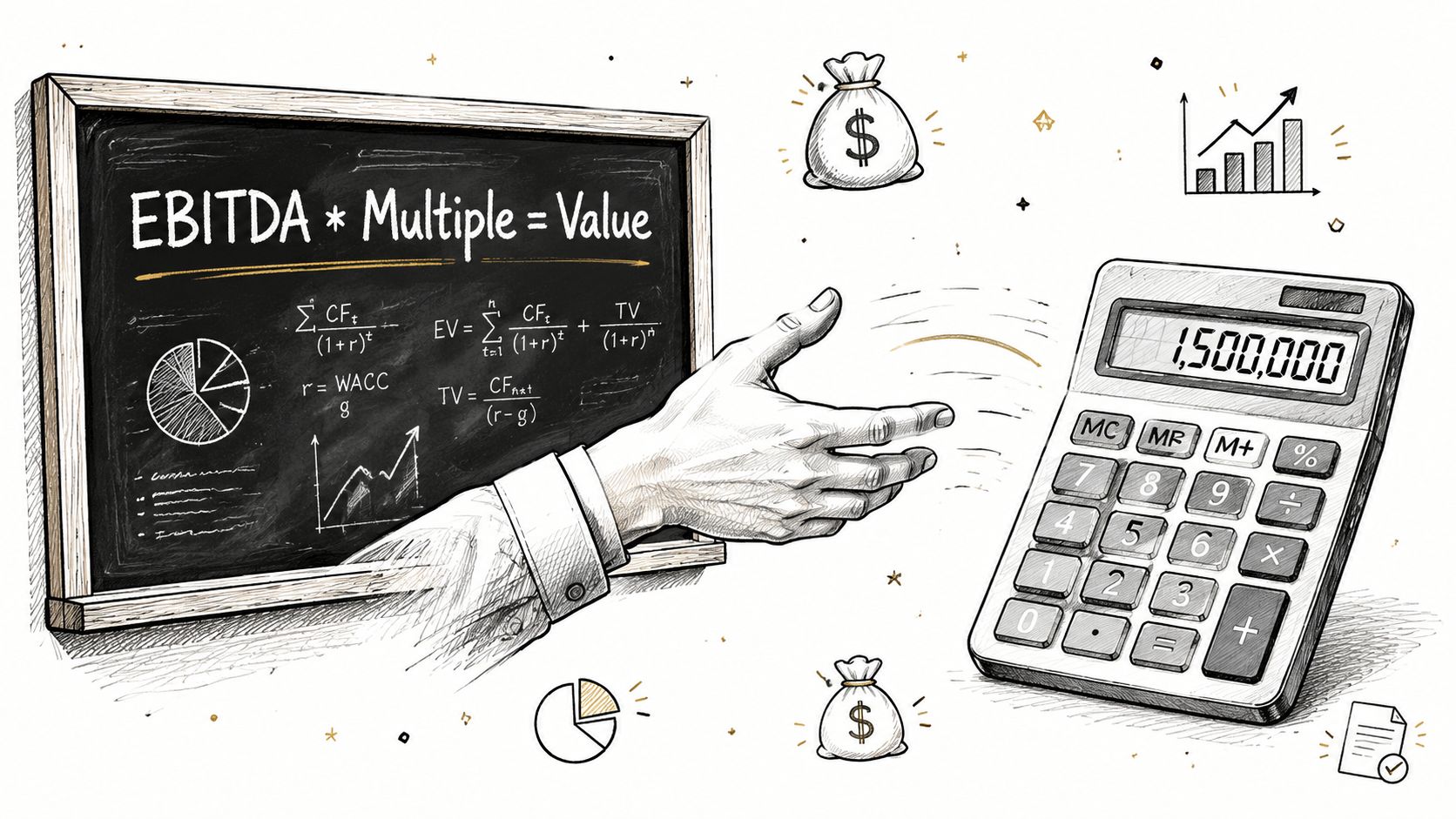
A practical example with real math
Assume a distribution company reports $15M in annual revenue. Because the verified data allows discussion of larger companies at the $10M+ revenue level, this is a useful middle-ground example for an owner preparing for sale.
Now assume the books show:
- Pretax net income of $900,000
- Owner salary of $250,000
- Owner health insurance and benefits of $25,000
- Personal vehicle expense of $20,000
- Travel that was discretionary and owner-specific of $30,000
- One-time consulting fee of $40,000
- Current debt payments of $65,000
Per Nav's explanation of small business valuation methods, when calculating SDE you must start with EBIT or EBITDA and add back the owner's salary, benefits such as health insurance, and non-essential recurring expenses like travel, one-time consulting fees, and personal vehicle use, because those costs may be avoidable or adjustable for a new owner.
Using that logic, the SDE calculation looks like this:
| SDE Calculation | Amount |
|---|---|
| Pretax net income | $900,000 |
| Add back owner salary | $250,000 |
| Add back owner benefits | $25,000 |
| Add back personal vehicle | $20,000 |
| Add back discretionary travel | $30,000 |
| Add back one-time consulting fee | $40,000 |
| Subtotal | $1,265,000 |
| Subtract current debt payments | $65,000 |
| Seller's Discretionary Earnings | $1,200,000 |
That result gives you a normalized earnings base. It's not the final answer. It's the clean starting point.
For a larger, more stable business, a buyer may lean toward a stronger multiple than a very small company, particularly if management depth and customer retention are solid. If a business like this supported a 4.0x SDE framework, the indication would be:
- $1,200,000 x 4.0 = $4,800,000
That gives you one valuation marker.
Turning one calculation into a valuation range
Now look at the same company through an enterprise lens.
Assume the business also produces EBITDA of $1,350,000 after proper operating adjustments. If relevant market data for comparable transactions in the sector suggested a midpoint around 3.5x EBITDA, which aligns with one of the verified transaction-style examples for industry-specific multiples, then the EBITDA indication would be:
- $1,350,000 x 3.5 = $4,725,000
Now you have two different, but close, indications:
- SDE method: $4,800,000
- EBITDA method: $4,725,000
That's why experienced advisors don't treat valuation as a single point estimate. They build a range and then pressure-test the assumptions behind it.
A buyer will also look at forecast quality. If your margins are rising, your customer base is broad, and your systems are transferable, the top end of the range becomes easier to defend. If revenue is lumpy or the owner still closes every major sale personally, the buyer will push toward the lower end.
If you want to improve that range before a sale, a strong financial forecast for your business is one of the most practical tools you can build. It helps you show whether current earnings are sustainable, improving, or vulnerable.
A short explainer can help if you want to hear another walkthrough of valuation logic in plain language.
The number that matters in negotiations isn't the one you prefer. It's the one your records, cash flow, and risk profile can support.
Common Valuation Pitfalls and Strategic Adjustments
A mathematically correct valuation can still miss the market by a wide margin if the business carries avoidable risk.
Owners often get blindsided. They clean up the earnings, apply a reasonable multiple, and assume the hard part is over. Then a buyer spots concentration risk, owner dependence, weak reporting discipline, or shaky cash flow conversion and starts trimming value.
Why buyers cut the multiple
Two businesses can show similar earnings and still receive very different offers.
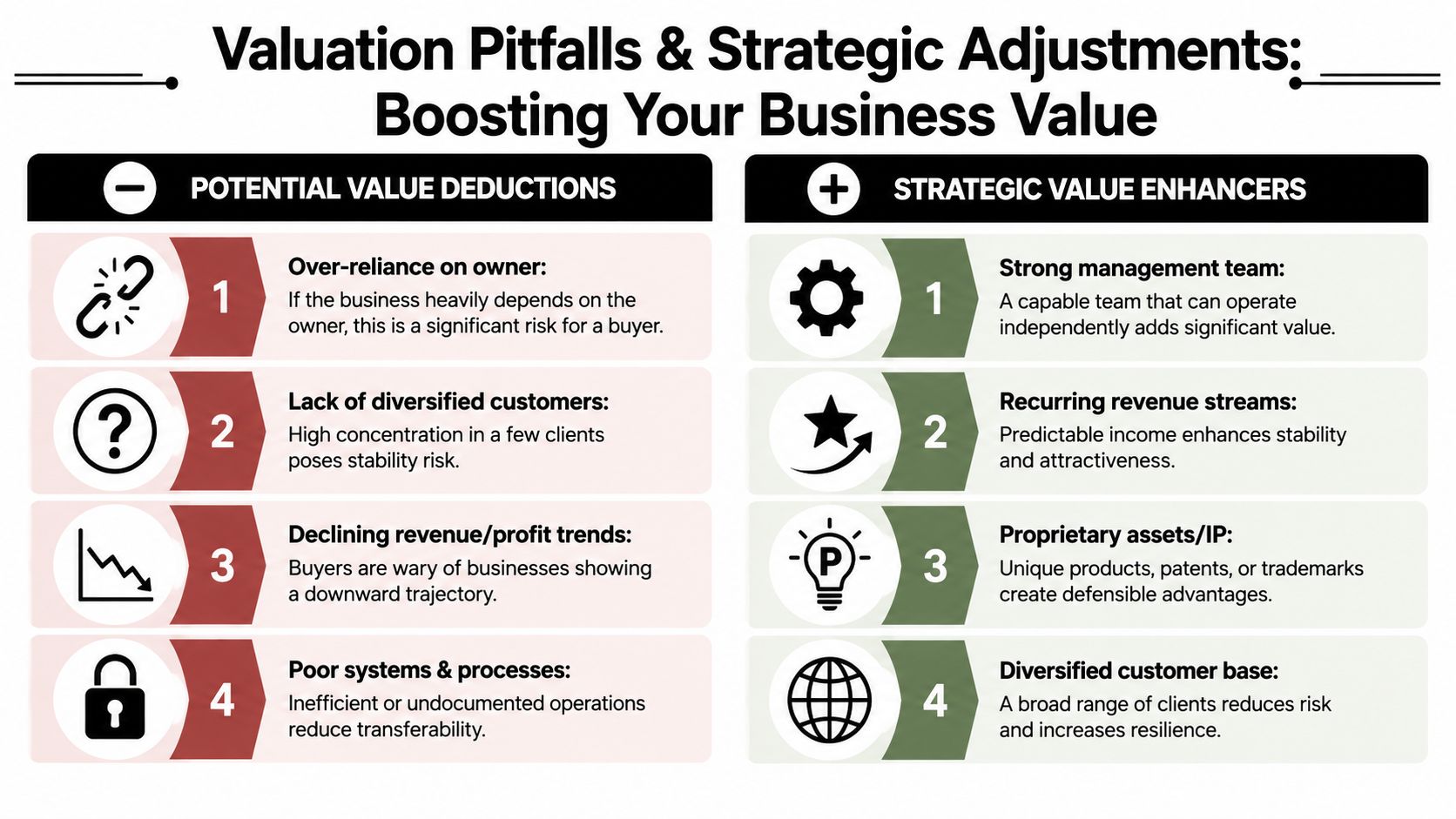
Here are the most common reasons:
- Customer concentration: If too much revenue sits with a small number of clients, the buyer sees fragility.
- Key person risk: If the owner holds the customer relationships, pricing authority, or operating know-how personally, transition risk rises.
- Declining trend lines: Even without precise deterioration metrics, a buyer will notice when margins or revenue direction weaken.
- Poor systems and process discipline: If reporting is inconsistent and operations are undocumented, transferability suffers.
These issues don't always kill a deal. They do reduce confidence. Reduced confidence usually shows up as a lower multiple, tougher terms, or both.
A buyer's mindset is practical. They aren't paying only for what the business earned. They're paying for how reliably it can keep earning after you leave.
If cash flow is already under pressure, address it before you pursue a sale process. The fixes often overlap with valuation preparation, especially around working capital, collections, and margin discipline. This guide to cash flow problems and solutions is a useful place to start.
How to think about an unprofitable business
Most mainstream valuation advice implicitly assumes the business is profitable. That leaves a lot of owners without a framework, especially founders investing for growth, firms in turnaround mode, and knowledge-based businesses that haven't converted scale into earnings yet.
According to Simply Business Valuation's discussion of valuing a business with no profit, 40% of small businesses sold in the last 12 months had negative or minimal earnings, yet most valuation frameworks ignore revenue-based or asset-based multiples. The same source notes that knowledge-intensive businesses often trade at 0.5 to 1.5x annual revenue when earnings are negative.
That doesn't mean every unprofitable business should use a revenue multiple. It means profitability isn't the only lens.
Use a different framework when the circumstances justify it:
| Situation | Better Starting Point | Why |
|---|---|---|
| Asset-heavy business with weak earnings | Asset-based view | Tangible value may matter more than current profit |
| Knowledge-intensive firm with negative earnings | Revenue-based lens | Buyers may value client base, contracts, or future economics |
| Temporary turnaround case | Forward-looking cash flow analysis | Current losses may not reflect normalized future performance |
Counterpoint: Negative earnings don't make a business worthless. They force you to be more precise about what the buyer is actually acquiring.
If you're selling an unprofitable company, the burden shifts. You need a sharper explanation of customer retention, contract quality, intellectual property, backlog, or strategic fit. Buyers won't give you the benefit of the doubt. They'll ask what drives future value if trailing earnings don't.
That's fair. Your job is to answer with evidence, not optimism.
You Have Your Number Now What?
A valuation is a snapshot. It tells you where the business stands today under current economics, current risks, and current assumptions.
That's useful, but it isn't the main event.
If you're serious about an exit, the better question becomes: What has to change over the next planning cycle to make this business more valuable, easier to sell, and less risky to a buyer? That's where valuation becomes strategic.
Treat valuation as a baseline, not a finish line
For very small businesses, the typical valuation multiple often falls in the 2.0x to 3.0x SDE range, while slightly larger or more stable businesses often command 4.0x SDE, according to this small business valuation discussion. That same source advises buyers of non-software businesses to avoid revenue multiples because they can lead to overpayment.
The takeaway isn't just which multiple to use. The deeper point is that your multiple reflects business quality.
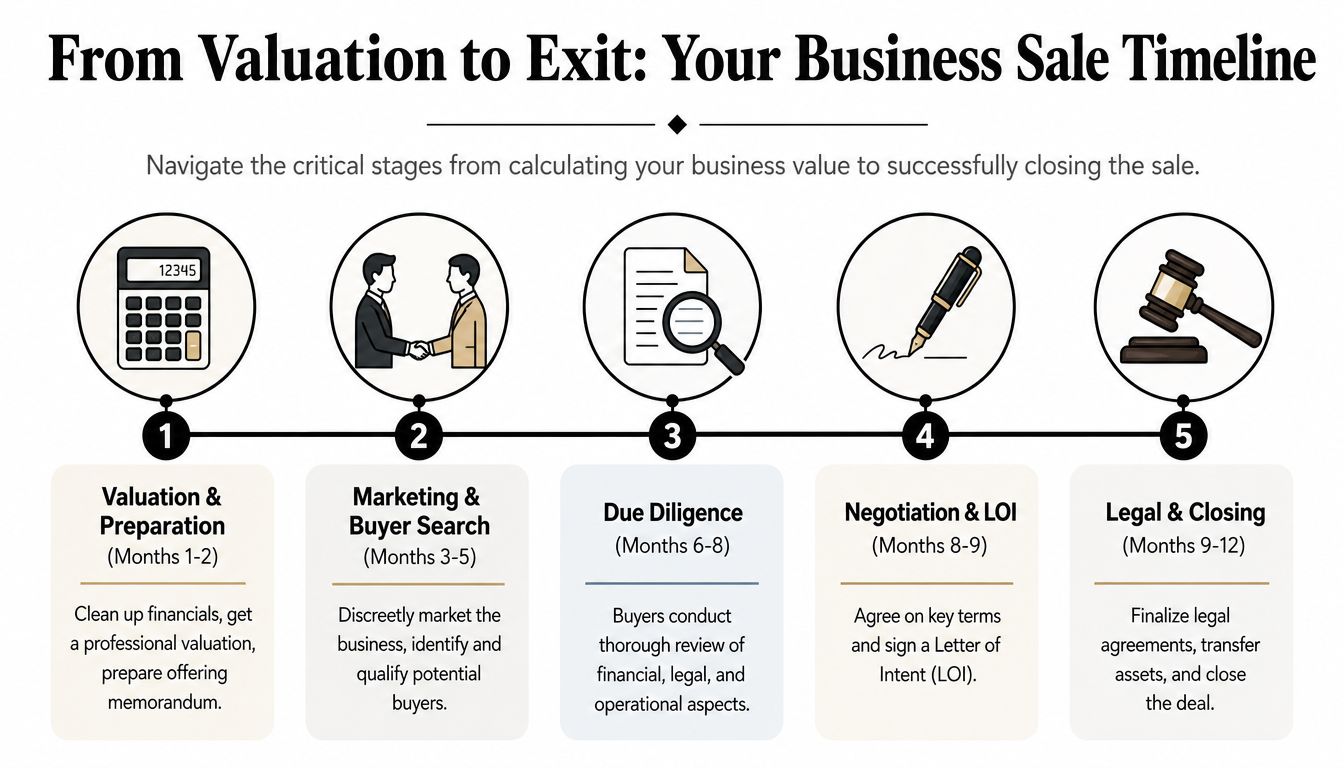
Owners usually focus on earnings first, and they should. But buyers also care about what sits behind those earnings:
- Management depth
- Customer diversification
- Recurring or repeatable revenue
- Process documentation
- Cash flow reliability
- A transition plan that doesn't depend on the owner staying forever
Those are value drivers. They're also preparation items.
What to do over the next planning cycle
Once you have a valuation range, put it to work.
Start with a simple owner worksheet:
- Write down your current valuation range.
- List the top three risks that would concern a buyer.
- Identify the top three improvements that would make the business more transferable.
- Build a financial plan to track progress.
- Set a review date and recalculate after meaningful changes.
That process turns valuation into an operating tool. It also creates discipline around the improvements that actually matter in a sale.
For most owners, the path to a better exit isn't guessing a higher number. It's building a stronger company, then documenting that strength with cleaner reporting, stronger forecasts, lower concentration, and clearer management accountability.
If you're preparing for a transition in the coming years, this roadmap to a stress-free business exit is a good next read. It helps connect today's valuation work to the broader exit process.
The best sale outcomes usually don't come from last-minute valuation work. They come from deliberate preparation well before the business goes to market.
If you want help turning today's valuation into a plan to improve future exit value, talk with AmbitionCFO. The firm works with founder-led businesses to strengthen cash flow, improve profitability, build better forecasts, and prepare for a more successful transition.