
Your company P&L says you made money. Your bank account says otherwise. Payroll is due, suppliers want to be paid, and you're staring at a stack of active jobs wondering which one is draining cash.
That's the question you're trying to answer: Which jobs are making money, which jobs are killing cash flow, and how do you know soon enough to do something about it?
Construction job costing is the answer. Not generic accounting. Not a year-end review. Not a monthly P&L that blends good jobs and bad jobs into one comforting lie. You need a system that tells you, job by job and phase by phase, where margin is holding and where it's slipping. If you want better bids, steadier cash, and a business a buyer can trust, you need better job cost data.
Table of Contents
- Why Your Company P&L Is Lying to You
- The Foundation Structuring Your Costs for Clarity
- Real-Time Capture Tracking Every Dollar from Field to Office
- The Allocation Engine Calculating True Job Profitability
- From Data to Decisions Using Reports to Drive Growth
- Your Next Move Building a Profit-Driven Business
Why Your Company P&L Is Lying to You
A lot of contractors think they have a margin problem when they really have a visibility problem. The company-level P&L can show profit while one or two active jobs are chewing through cash. By the time the monthly books catch up, the damage is already done.
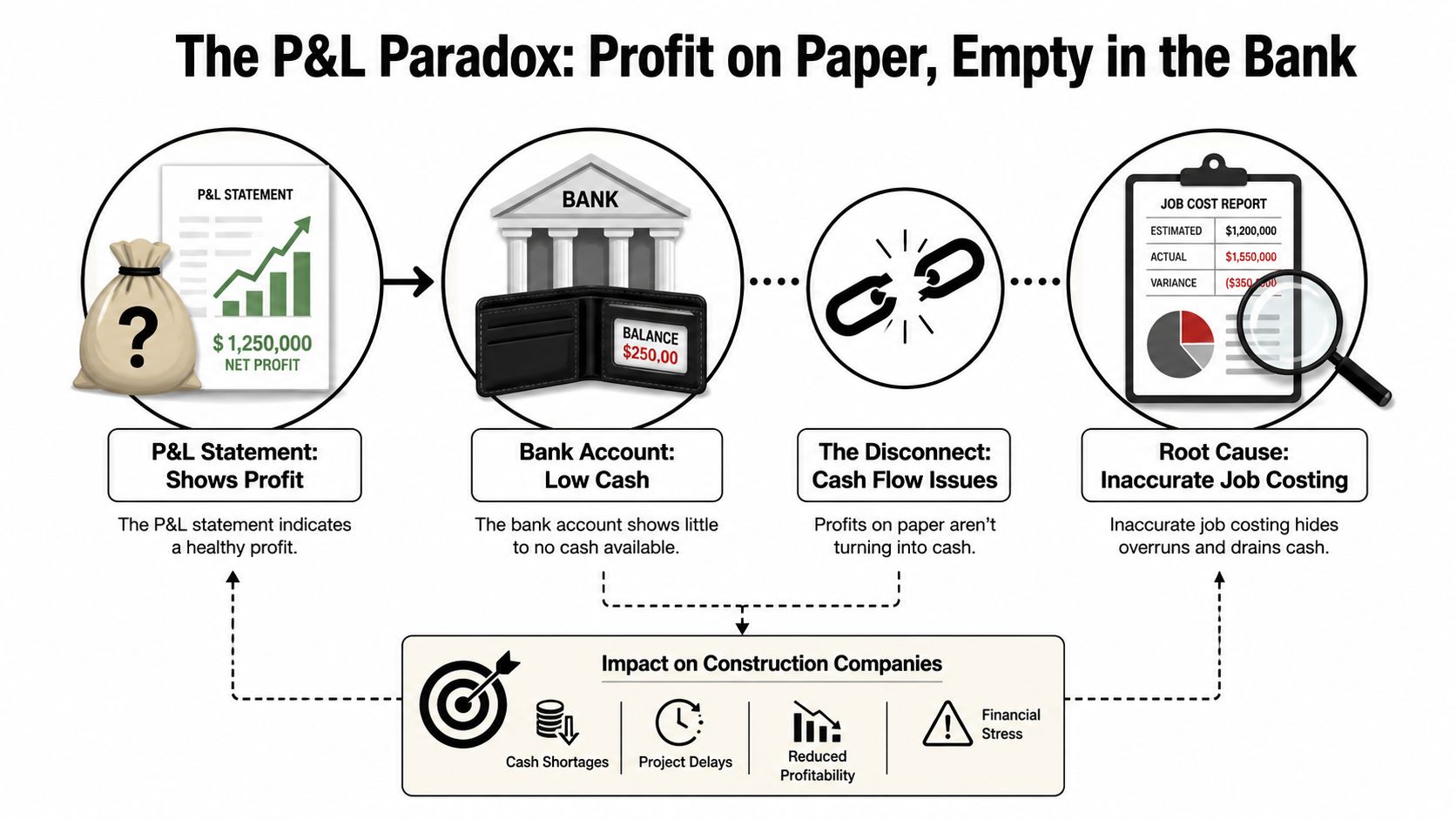
The problem is visibility, not effort
Construction is not a forgiving industry. Net profit margins for construction businesses typically range between 3% and 7%, with the industry average historically at approximately 6%. That leaves very little room for bad data, missed costs, or slow reaction time. In a margin band that tight, one mispriced phase or one labor-heavy overrun can flip a “profitable” job into a bad one. That's exactly why precise job costing matters so much in construction. It gives you the job-level detail a company P&L cannot give you.
If your financial reporting is still too broad to show which projects are carrying the business and which ones are dragging it down, fix that first. Stronger financial reporting practices for operators make the difference between reacting late and managing with intent.
A profitable company can still have unprofitable jobs. That's the trap.
What construction job costing actually means
Construction job costing means assigning every cost to the job and cost code where it belongs. Labor. Materials. Equipment. Subcontractors. Indirects. Overhead. Each project becomes its own financial unit instead of disappearing into one company-wide income statement.
That matters because general accounting answers one question: “How did the company do?” Job costing answers the question owners need: “Which job made money, which one didn't, and why?”
Here's the practical distinction:
| View | What it tells you | What it hides |
|---|---|---|
| Company P&L | Total revenue, total expense, total profit | Which jobs caused the result |
| Job cost report | Profitability by project and by phase | Very little, if the coding is disciplined |
Without job costing, you're estimating future work using blended, incomplete history. That's how owners keep winning jobs and losing cash at the same time.
The Foundation Structuring Your Costs for Clarity
If your cost structure is sloppy, your reporting will be sloppy. Owners often jump straight to software and dashboards. That's backwards. You need the underlying structure first.
Build the structure before you track the numbers
Start with three buckets:
Direct costs
These belong to a specific job. Labor, materials, equipment, subcontractors.Indirect job costs
These support a job but don't fit neatly into one production line item. Site security, temporary utilities, permits, supervision tied to the project.Overhead
These costs keep the company running. Office salaries, insurance, admin systems, rent, shared vehicles, accounting support.
That separation matters because most contractors understate labor and overhead. Most content on job costing misses the hidden 25-40% labor burden and indirect overhead. Contractors often undercount labor by 25-40% because they track only base wages, which can turn a $35/hour carpenter into a real cost of $47-$50/hour as outlined in Projul's construction job costing guide.
That one point changes everything. If your estimate uses wage rate instead of burdened labor rate, your bid is wrong before the job starts.
Practical rule: If your field labor is coded correctly but your burden, fringes, and shared costs sit in a vague overhead bucket, your job margins are inflated.
A clean chart of accounts and cost code library solves this. Your estimate categories should match your job cost categories. If estimating says “concrete labor” but accounting posts to “field payroll,” you can't run meaningful estimated versus actual analysis.
If you need to clean up the broader budgeting side around this structure, use a disciplined business budget process for owners so your annual model and your job-level reporting speak the same language.
A simple cost code example
Here's what a straightforward cost code setup for a concrete scope can look like:
| Cost code | Description | Cost type |
|---|---|---|
| 03-100 | Layout and prep | Direct labor |
| 03-200 | Formwork materials | Direct materials |
| 03-300 | Pour crew | Direct labor |
| 03-400 | Pump and equipment use | Direct equipment |
| 03-500 | Finishing sub | Direct subcontractor |
| 03-900 | Cleanup and temp protection | Indirect job cost |
This doesn't need to be fancy. It needs to be consistent.
A good system has a few traits:
- Match the bid structure so estimated versus actual is useful.
- Keep codes standardized across all jobs so you can compare one project to another.
- Avoid overbuilding the library. If your supers and PMs can't use it quickly, they won't use it correctly.
- Define ownership for each cost type. Field logs labor and equipment use. PMs review commitments and subs. Accounting validates coding and posting.
Owners who skip this step usually blame the software later. The software isn't the problem. The structure is.
Real-Time Capture Tracking Every Dollar from Field to Office
The biggest weakness in most construction job costing systems isn't the math. It's the delay. Costs happen in the field. Financial visibility shows up later in the office. That lag is where margin gets lost.
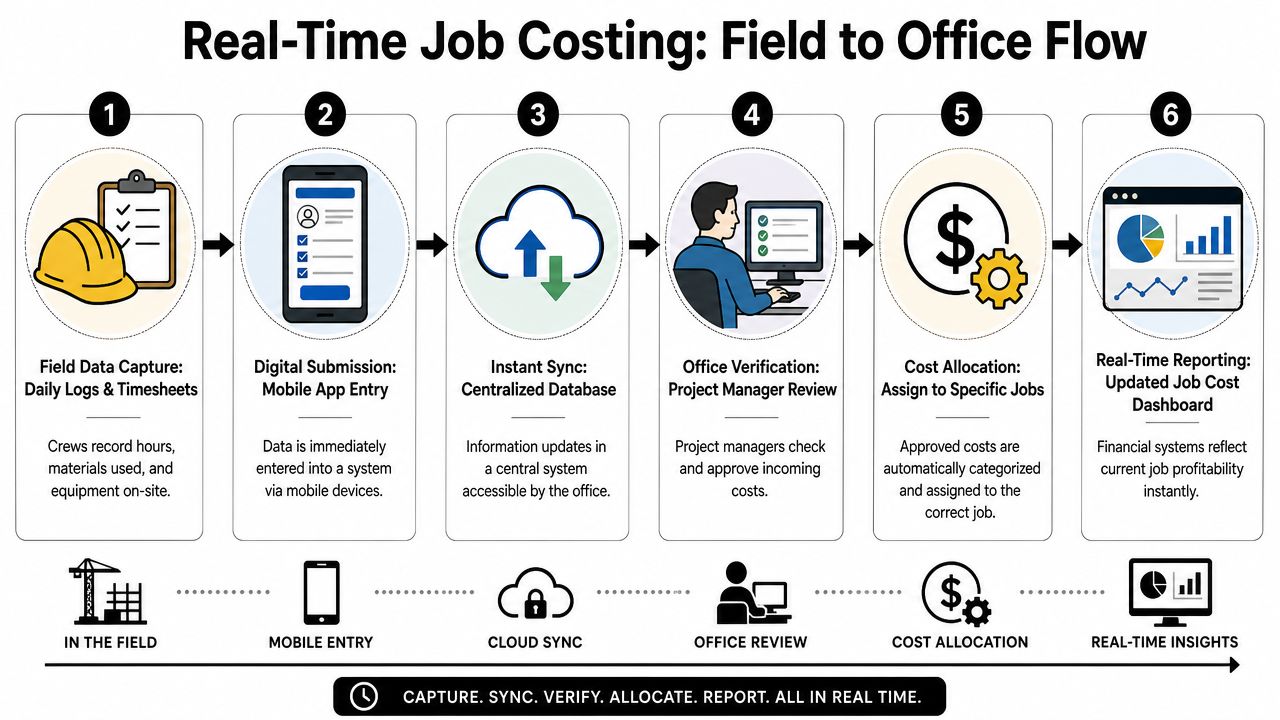
Labor first because labor moves fastest
Labor is where I tell owners to focus first because it changes daily and compounds quickly. Labor is often the largest and most variable cost on a construction project, with labor burden costs adding between 40% and 70% to base wages. Failing to account for these burden costs leads to major underestimation in bids.
If your team tracks hours but not burden, you don't know labor cost. You know payroll activity. Those are not the same thing.
Use mobile time tracking tied to:
- Job number
- Cost code
- Regular versus overtime
- Crew lead approval
- Same-day submission
A clean labor process gives you an early warning system. If framing hours are running hot in week one, you can act. If you wait until payroll closes and accounting posts the batch later, you're reacting after the margin is already gone.
Your cash model should pull from this same operating reality. Better cash flow management for small business owners gets far stronger when labor and commitments hit the model quickly instead of weeks late.
Here's a useful reference for the field-office handoff:
| Cost type | Capture point | Best owner |
|---|---|---|
| Labor | Daily timesheet or mobile app | Foreman and PM |
| Materials | At purchase or delivery | PM or field lead |
| Subcontractors | At commitment and invoice | PM and accounting |
| Equipment | Daily usage log | Field lead |
A short walkthrough can help owners visualize the workflow in practice:
The other three buckets that owners miss
Labor gets the attention, but three other categories regularly distort job profitability.
Materials need to be captured when ordered, received, and invoiced. If receipts sit in trucks or invoices wait for coding, your reports go stale fast. The PM should also track committed costs, not just paid bills. An unpaid purchase order is still a real obligation.
Subcontractors should be tracked from signed commitment through change order and invoice approval. Don't wait for the final bill to discover the scope shifted.
Equipment needs job-level charging whether it's rented or owned. Owned equipment isn't free because no invoice arrived this week. It still carries fuel, maintenance, and depreciation cost. If you skip equipment allocation, the jobs using your fleet will look artificially profitable.
Track committed cost as aggressively as actual spend. Cash leaves later. Margin disappears earlier.
What a daily capture routine should look like
This part should feel boring. That's good. Good job costing is operational discipline, not heroics.
Use a daily routine like this:
Field enters labor by cost code before day-end
Don't rely on memory at week-end.Material receipts are photographed and coded the same day
Small purchases become large leakage when they pile up.Equipment usage is logged against the active job
Especially for owned equipment.PM reviews exceptions every morning
Missing entries, wrong codes, unapproved overtime, open commitments.Accounting posts validated costs quickly
The office should verify, not reconstruct.
This is where software matters. Tools like Sage, QuickBooks paired with construction-specific field capture, and construction-focused platforms can all work if they close the gap between the jobsite and the ledger. AmbitionCFO often helps construction companies connect those inputs to forecasting, WIP reporting, and job-level margin analysis so owners can use the data operationally instead of just filing it away.
The Allocation Engine Calculating True Job Profitability
Most contractors can capture direct labor and materials reasonably well. Significant mistakes show up when they allocate indirect costs and overhead. That's where “good” margins turn into fantasy margins.
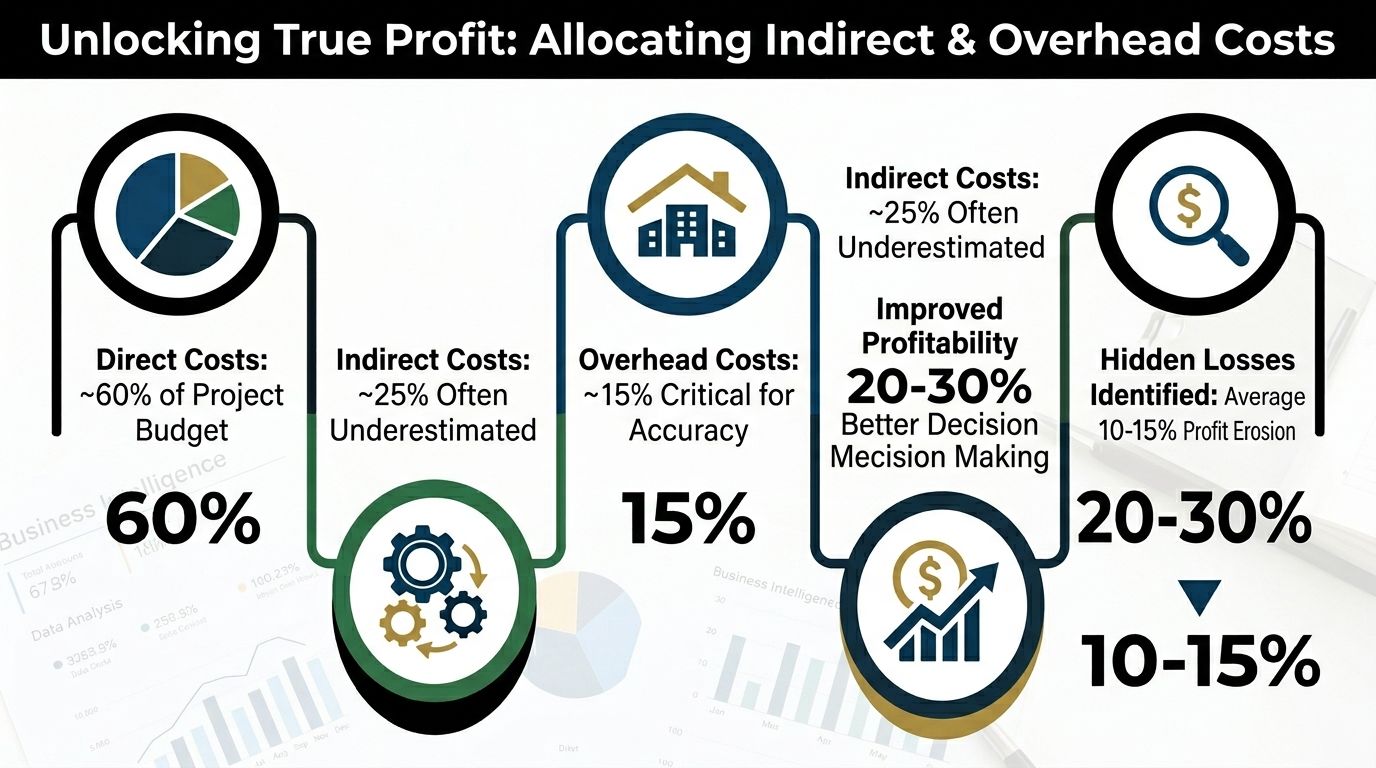
Use the full formula or accept false margins
The correct formula for Total Job Cost is:
Direct Labor (including burden) + Direct Materials + Direct Equipment + Direct Subcontractors + Indirect Costs + Overhead Allocation
That's the full picture. Not just labor, materials, and a rough markup.
Simplified approaches that omit categories such as equipment depreciation can create profitability errors of 7-15%. If you want dependable pricing and believable margins, use the complete cost stack.
A lot of owners ask me why their gross profit looks solid but the company still feels strained. This is why. Their job reports exclude meaningful cost.
Use a proper budget versus actual variance discipline to test whether your costing model is exposing reality or hiding it.
A practical way to allocate overhead
You don't need a complex formula nobody understands. You need a repeatable method.
A simple approach:
Step 1
Separate overhead from direct and indirect job costs. Keep the bucket clean.Step 2
Pick an allocation driver that fits how your business consumes resources. Direct labor hours often works well. In some firms, direct labor dollars may be cleaner.Step 3
Calculate an internal rate and apply it consistently across active jobs.Step 4
Review that rate regularly instead of leaving it untouched while the business changes.
Here's a plain example without pretending the numbers are universal:
| Item | Example treatment |
|---|---|
| Office salaries | Allocate through overhead rate |
| General liability insurance | Allocate through overhead rate |
| Project-specific temp utilities | Charge as indirect job cost |
| Owned equipment used on site | Charge directly to the job |
| Workers' comp and payroll taxes | Include in burdened labor rate |
The point is consistency. If one PM charges project supervision direct and another leaves it in overhead, your cross-job comparisons are useless.
False profitability is more dangerous than low profitability, because it leads you to repeat bad bids with confidence.
This is also why I push owners to stop using flat “sprinkle some overhead on it” pricing. That shortcut feels easy, but it trains the business to trust distorted margins. A buyer doing diligence won't trust those numbers, and frankly, they shouldn't.
From Data to Decisions Using Reports to Drive Growth
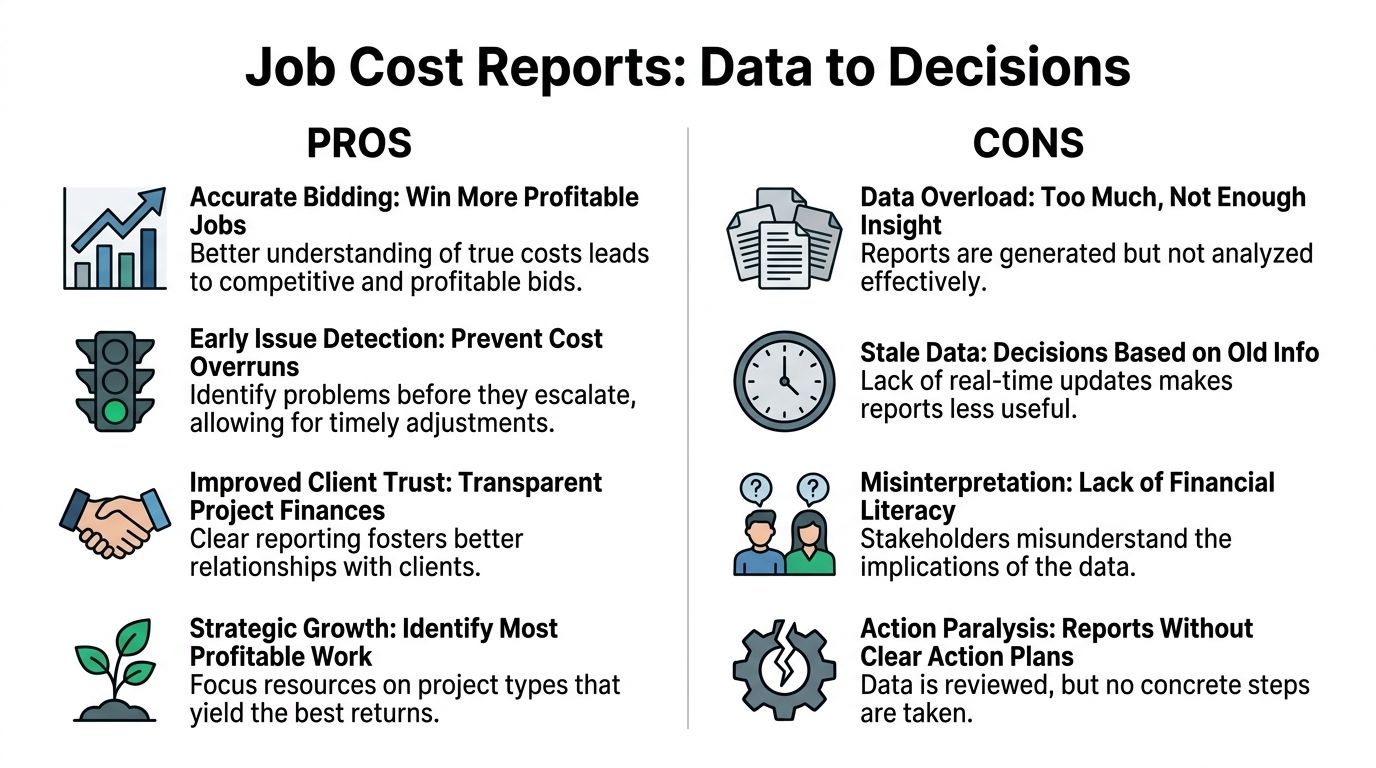
A clean system matters only if it changes decisions. The report I care about most is estimated versus actual by job and cost code. That report tells you whether your estimate was right, whether execution is drifting, and whether the issue is field productivity, purchasing, subcontractor scope, or bad assumptions.
The one report every owner should review weekly
If you review job costs monthly, you're late. Construction firms that execute weekly variance reviews rather than monthly reports reduce project cost overruns by an average of 12%, and any deviation exceeding a 10% variance threshold should trigger an immediate root-cause investigation.
That means every active job should be reviewed weekly with a short, disciplined agenda. Not a long meeting. A focused one.
Here's what the report should include:
| Report line | What you're checking |
|---|---|
| Estimated cost | Original budget by cost code |
| Actual cost to date | Posted spend and burdened labor |
| Committed cost | Open POs and signed sub commitments |
| Variance | Dollar and percent difference |
| Cost to complete | PM's updated forecast |
| Gross margin trend | Whether the job is improving or slipping |
When a code crosses that 10% variance threshold, don't just note it. Ask why. Scope creep. Productivity issue. Rework. Bad estimate. Late change order pricing. Wrong coding. You're not looking for blame. You're looking for a correction.
Why buyers care about your job costing discipline
Exit value isn't just about revenue size. It's about trust in the earnings.
A buyer reviewing your company wants evidence that margins are repeatable, forecasts are credible, and project profitability isn't based on guesswork. Clean job costing supports all three. It also strengthens WIP reporting, cash forecasting, and the owner story around what kinds of work the company should pursue.
That's why I connect construction job costing directly to exit planning. A buyer will dig into project history, margin consistency, and variance control. If your process depends on spreadsheets, memory, and cleanup after month-end, diligence gets painful fast.
Good job costing doesn't just help you run the company. It helps someone else believe the company is worth buying.
A weekly review agenda that actually works
Use this in your Monday operations meeting:
Start with jobs showing new variance
Review the exceptions first, not the entire portfolio in equal detail.Ask for one reason, one fix, one owner
Keep the conversation operational.Update cost to complete immediately
Don't wait for month-end to revise the forecast.Tie the output to billing and cash
If margin is slipping or a phase is ahead, your billing and collections strategy may need to change.Feed the result back to estimating
Finished jobs should improve future bids. If they don't, the system is incomplete.
That loop is where growth comes from. Better data produces better estimates. Better estimates produce cleaner jobs. Cleaner jobs produce stronger cash flow and a more defensible business.
Your Next Move Building a Profit-Driven Business
If you're serious about margin, stop treating job costing like back-office paperwork. It's an operating system. It tells you where cash is going, where profit is leaking, and which work deserves more of your time.
Most owners don't need more reports. They need a system they can trust. One structure. One set of cost codes. One discipline for field capture. One method for allocation. One weekly review habit.
Software and integration checklist
When you evaluate tools, use this checklist:
- Mobile field entry so crews can log labor, equipment, and receipts without friction
- Estimate-to-budget alignment so your job reports compare against the same structure you bid
- Purchase order and subcontract commitment tracking so committed cost shows up before cash leaves
- Payroll and accounting integration so burdened labor and invoice data post cleanly
- Equipment cost handling for both rented and owned assets
- Estimated versus actual reporting by job and cost code
- WIP visibility for jobs in progress
- Cash forecast connectivity so project data supports company-level decisions
- Role-based accountability so field, PMs, and accounting each own their part
If you're building the financial backbone around this process, a stronger financial plan for small business owners helps connect job profitability, overhead planning, and cash requirements into one working model.
What to do next
Start with one active job this week.
Clean up the cost codes. Force daily labor capture. Log committed cost. Allocate burden correctly. Review the variance at week-end. You'll learn more from one month of disciplined job costing than from a year of staring at a blended P&L.
Then standardize it across the business.
If you run a construction company in the $10M to $100M range and need sharper job costing, stronger cash flow visibility, and a financial system that supports exit planning, talk with AmbitionCFO. We work with owners and leadership teams to turn project data into decisions that improve margin, forecasting, and company value.