
Your business is profitable. Revenue is real. The sales team is producing. Projects are moving. On paper, things look healthy.
And yet you still feel a knot in your stomach before payroll, before a large inventory buy, or before saying yes to a new contract.
That disconnect is where many founder-led companies get stuck. It usually shows up after the business has outgrown basic bookkeeping but hasn't yet installed true financial operating discipline. The P&L says you made money. The bank account says something very different. Both can be accurate at the same time.
For established companies, especially in construction, distribution, and professional services, this is rarely a math problem. It's a visibility problem. Cash leaves on one schedule, arrives on another, and the gap between the two starts driving decisions. Hiring gets delayed. Equipment purchases get pushed. Good growth starts feeling risky.
A strong approach to cash flow management for small business isn't about becoming conservative for the sake of it. It's about building enough clarity that you can move faster with less fear. When you know what cash is going to do over the next several weeks, you stop managing by instinct alone and start allocating capital on purpose.
If you're trying to connect growth plans to actual liquidity, a solid financial plan for a small business is the right companion to the cash framework below.
Table of Contents
- Introduction Are You Running a Profitable Business That's Always Short on Cash
- The Foundation Build Your 13-Week Cash Flow Forecast
- From Forecasting to Control Establish Clear Cash Policies
- Stress-Test Your Business with Scenario Planning
- Create a Dashboard with the Right Cash Flow KPIs
- Smartly Use Short-Term Financing Options
- When to Call for Backup Know the Triggers for a Fractional CFO
- Conclusion Take Control of Your Financial Future
Introduction Are You Running a Profitable Business That's Always Short on Cash
A founder can tell me gross margin by memory and still have no clean answer to a simple question: what will cash look like six Fridays from now?
That's not incompetence. That's what happens when the business grows faster than the financial system around it.
In companies above the early stage, the P&L stops being enough. Revenue may be booked before cash arrives. Inventory may be purchased well before it's sold. Payroll, taxes, debt payments, and rent don't care when a client finally approves an invoice. The result is familiar: a profitable company that still feels cash-starved.
Take a distribution business. It lands a strong quarter, books healthy sales, and sees margin improvement. At the same time, it places inventory orders, carries receivables longer than expected, and funds payroll every week. The owner looks at the monthly financial statements and sees progress. Then a large payable comes due before collections hit, and the core operating question surfaces. Can we fund the business without scrambling?
Profits measure performance. Cash determines survival and timing.
That is why CFO-level cash management starts with near-term visibility, not with year-end hindsight. The most useful model for that job is the 13-week rolling cash flow forecast. It forces the leadership team to stop speaking in averages and start speaking in dates, dollars, and decision triggers.
For a founder, this isn't about adding administrative burden. It's about gaining the freedom to say yes to hiring, equipment, inventory, and growth moves with your eyes open.
The Foundation Build Your 13-Week Cash Flow Forecast
The single most practical tool in cash flow management for small business is the 13-week rolling forecast.
Yale SOM notes that 13-week rolling forecasts are widely recommended because they provide a practical near-term view of liquidity, and that the model should extend through EBITDA while also capturing working capital changes, interest, principal payments, taxes, and capital expenditures so leaders can manage to a pure free-cash-flow number rather than a partial picture, as described in Yale SOM's Cash Management Principles in a Small Business.
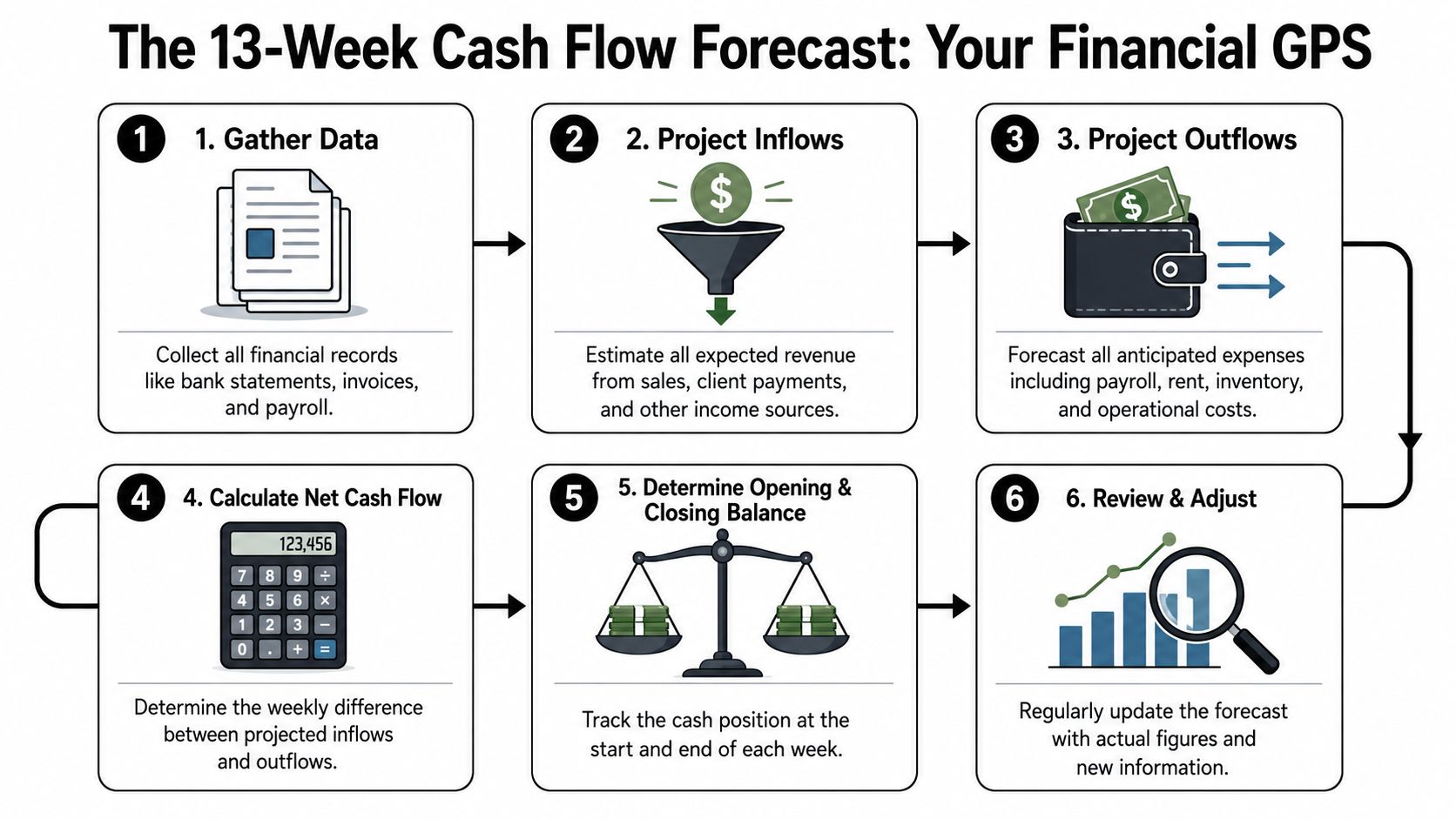
Start with the visual framework below.
Why the P and L keeps letting founders down
A monthly income statement answers whether the business earned money during a period. It does not answer whether the business will have enough cash next Thursday.
That gap matters most in companies with uneven billing, milestone payments, retainage, inventory buys, or large recurring labor costs. Construction and distribution businesses live here every day. The owner isn't wrong to feel confused. The accounting view and the cash view serve different purposes.
A cash forecast fixes that by focusing on timing. It tracks when money is expected to hit the bank and when it will leave.
Practical rule: If your team reviews financials monthly but cash gets tight weekly, your reporting cadence is too slow.
A forecast like this also gives structure to conversations that otherwise stay vague. Instead of saying, "collections are a little slow," the team can identify which customer payments are assumed in which week and what happens if one slips.
For growth-stage companies, that discipline matters as much as the spreadsheet itself. If you're seeing growth strain your systems, this guide on why financial forecasting matters during rapid business growth connects the operational side to the cash consequences.
What belongs in the forecast
Keep the model simple enough to maintain and detailed enough to matter.
At minimum, a practical weekly forecast should include:
- Beginning cash: The actual bank position at the start of each week.
- Expected collections: Customer payments by name or invoice group, based on likely payment behavior rather than hope.
- Payroll and payroll taxes: Often the least flexible outflow and the first line item owners worry about.
- Rent and fixed overhead: Lease payments, software, insurance, utilities, and other recurring commitments.
- Inventory or materials purchases: Critical for distribution and project-based businesses where cash goes out before revenue is collected.
- Debt service: Both interest and principal payments.
- Taxes and owner distributions: These get forgotten in weak models and create nasty surprises.
- Capital expenditures: Equipment, vehicles, systems, and any larger planned investment.
Here's the mistake I see most often. Teams forecast revenue and expenses, but they don't forecast cash timing. A booked sale is not a cash receipt. A planned purchase order is not a same-week disbursement. The model has to follow the bank account, not the accounting presentation.
The easiest way to improve forecast accuracy is to tighten assumptions around receivables and payables.
For receivables, use this checklist:
- Invoice immediately: Don't wait for month-end batches if the work is done or the shipment is out.
- Confirm documentation early: Missing approvals, lien releases, PODs, or job backup slow payment more than owners expect.
- Track customer behavior: Some customers pay by terms. Others pay by habit.
- Escalate before due dates: Collections work best before an invoice becomes old and disputed.
Later in the quarter, this walkthrough can help owners connect cash assumptions to budgeting discipline through a business budget process, but the forecast itself has to stay grounded in weekly bank reality.
To make the mechanics easier to picture, this short video gives a helpful operational view of the process.
A practical weekly operating rhythm
A strong model isn't built once. It rolls forward every week.
Use a cadence like this:
- Start Monday with actual cash. Pull the bank balance and update last week's real receipts and disbursements.
- Revise collections. Confirm what is truly expected this week, not what was originally budgeted.
- Review major outflows. Payroll, vendor payments, taxes, debt, and any unusual items.
- Decide on actions. Slow a discretionary spend, accelerate a billing, renegotiate a payment date, or pull a financing lever if needed.
- Roll the forecast forward one more week. The horizon should always stay at thirteen weeks.
Mature companies separate themselves from reactive ones. They don't wait for the controller to close the month before making a decision. They work from live assumptions and update them as new facts arrive.
From Forecasting to Control Establish Clear Cash Policies
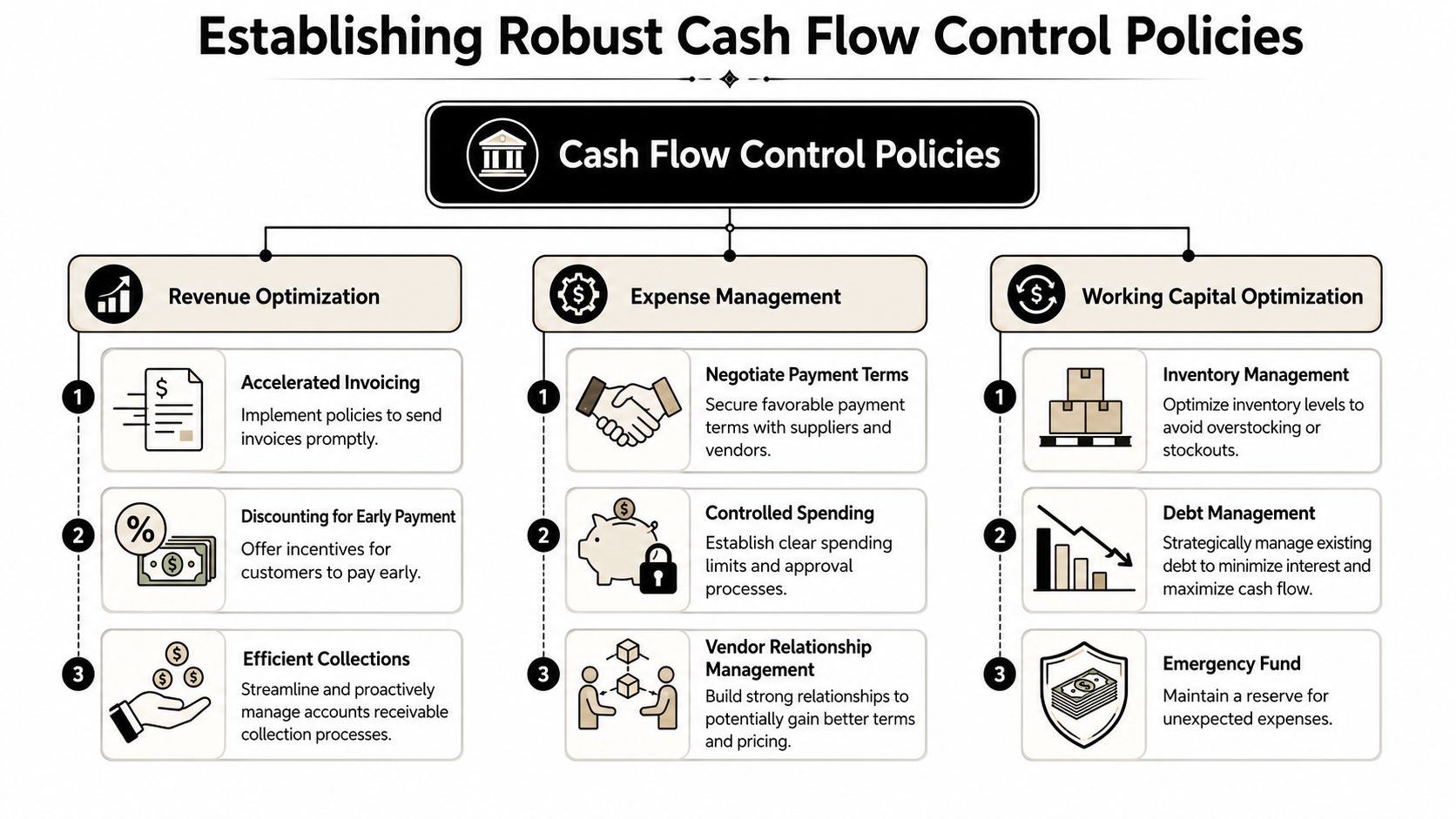
A forecast tells you what may happen. Policies determine what your team does about it.
Many companies stall at this point: they build the spreadsheet, review it once or twice, and then slide back into improvisation. Cash discipline only works when operating rules are clear enough for your team to execute without drama.
A construction example that shows the difference
Consider a construction company with several active jobs and a healthy backlog. On the surface, the owner feels busy and optimistic. Underneath, cash is fragile because billing, collections, labor, subcontractors, and materials are all moving on different schedules.
Three situations hit in the same quarter.
First, a project delay pushes a customer billing milestone later than expected. The forecast catches the shortfall before the bank account does. Because the issue shows up early, the company can defer a discretionary equipment purchase and tighten collections on open invoices instead of panicking at payroll.
Second, a material cost spike lands on a major job. Without a policy, the operations team might keep purchasing as usual and hope margin absorbs it. With a policy, the leadership team reviews whether the cost belongs to core execution, approved change orders, or expansion spending that can wait.
Third, a customer offers an early payment incentive if the company submits backup promptly. Teams that treat invoicing as clerical work miss that opportunity. Teams with strong policy treat billing packages as a cash lever.
Good cash policy turns finance into an operating discipline, not an accounting exercise.
Policies that improve cash without creating chaos
You don't need dozens of rules. You need a small set that your team follows every week.
Use these receivables policies:
- Send invoices the same day work is billable: Delay here is self-inflicted financing.
- Define ownership: One person prepares invoices, one confirms support documents, one owns follow-up.
- Set collection touchpoints: The customer should hear from you before due date, on due date, and quickly after if payment doesn't land.
- Document disputes fast: Slow collections often hide inside unresolved job or service issues.
Use these payables policies:
- Negotiate terms before you need help: Vendors are more flexible when your account is current and communication is proactive.
- Match payment timing to actual due dates: Paying too early can hurt just as much as paying too late.
- Separate critical from deferrable spend: Payroll and essential supply chain items are not the same as lower-priority purchases.
- Require approval for non-core spending: Especially when the forecast shows pressure ahead.
One policy matters more than owners want it to. Build a cash reserve.
BILL says a good starting point is 3 to 6 months of operating expenses, and FVCbank also states that advisors recommend at least three months of operating expenses as an emergency fund, as noted in BILL's guidance on small business cash flow.
That target gives leaders a practical way to think about resilience. Not every company can build that reserve immediately. But every company can define the policy, separate operating cash from reserve cash, and stop treating every dollar in the account as available for discretionary use.
A useful operating distinction looks like this:
| Cash bucket | Purpose | Management rule |
|---|---|---|
| Operating cash | Funds normal weekly activity | Reviewed inside the forecast |
| Reserve cash | Protects the business from shocks and timing gaps | Touched only by leadership decision |
| Strategic cash | Supports planned growth moves | Released against a defined return or priority |
Companies that adopt this structure usually make calmer decisions. They stop mixing emergency liquidity with expansion plans.
Stress-Test Your Business with Scenario Planning
A forecast becomes far more valuable when you stop treating it as a single expected outcome.
For companies with volatile revenue or strong seasonality, a reserve by itself isn't a full answer. Research on seasonal small businesses emphasizes a broader policy stack that includes weekly cash budgets, cost-volume-profit analysis, disciplined spending triggers, and prearranged liquidity when demand drops or pay cycles slip, as discussed in the article on thriving through seasonal cash flow challenges.
The three scenarios worth modeling first
Start with scenarios your business could realistically face in the next quarter. Don't begin with disaster movies. Begin with normal operating friction.
Late customer payment
A large customer pays later than expected. Model the effect on weekly cash, then identify what you would change. Would you pause nonessential purchases, push a vendor payment, or draw on an existing line? The value is not the prediction. The value is the response plan.
Cost increase on a key input
Distribution companies see this with inventory. Construction companies see it with materials and subcontracted labor. Model the cash impact if costs rise before you can reprice or bill a change order. This tells you whether margin pressure is also becoming a liquidity problem.
Opportunity case
Stress testing isn't only defensive. Model a scenario where a supplier offers favorable purchasing terms, a customer wants accelerated delivery, or a new project starts faster than expected. Growth can strain cash just as quickly as a slowdown.
The best scenario model answers one question clearly. What do we do next if this happens?
A simple dashboard for weekly risk review
You don't need a complicated FP&A system to make scenario planning useful. A simple weekly dashboard can do the job if the team actively reviews it.
Use a worksheet with these lines:
| Weekly risk view | Formula | What it tells you | Example green flag | Example red flag |
|---|---|---|---|---|
| Forecast ending cash | Beginning cash plus inflows minus outflows | Whether the week closes with enough liquidity | Positive closing cash | Negative closing cash |
| Collections variance | Actual collections minus forecast collections | Whether receivables assumptions are reliable | Actual at or above forecast | Actual below forecast |
| Discretionary spend queued | Sum of nonessential planned spending | What can be paused quickly | Low or controlled queue | Growing queue with weak cash outlook |
| Vendor concentration | Major payments due to a small set of suppliers | Where negotiation leverage matters most | Balanced due dates | Several large payments clustered together |
This kind of dashboard works because it forces action. If collections variance goes the wrong direction for more than a week or two, the issue is no longer "finance." It becomes a sales, operations, billing, or customer management issue.
Companies with seasonality should also define spending triggers ahead of time. When revenue softens, what gets frozen first? Which hires proceed only if collections hit plan? Which purchases require a second look? If those decisions wait until cash is already tight, they're harder and messier.
Create a Dashboard with the Right Cash Flow KPIs
Most owners watch the bank balance. That's understandable, but it's not enough. A bank balance is a result. A dashboard should show the operational drivers that are producing that result.
Then, cash flow management for small business starts to look less like bookkeeping and more like management.
Essential Cash Flow KPIs for Your Dashboard
Track a short list. If the dashboard gets crowded, no one uses it.
| KPI (Key Performance Indicator) | Formula | What It Measures |
|---|---|---|
| Days Sales Outstanding (DSO) | Accounts receivable divided by average daily credit sales | How quickly customers turn billed revenue into cash |
| Days Payable Outstanding (DPO) | Accounts payable divided by average daily purchases | How long the business takes to pay suppliers |
| Inventory Days | Inventory divided by average daily cost of goods sold | How long cash sits in inventory before converting |
| Cash Conversion Cycle (CCC) | DSO plus Inventory Days minus DPO | How long cash is tied up in operations |
| Burn or Build Rate | Cash outflows minus cash inflows, or the reverse if positive | Whether the business is consuming cash or generating it |
| Forecast Accuracy | Forecasted cash compared with actual cash | Whether the team can rely on the model for decisions |
A few notes matter here.
DSO tells you whether collections are slipping. DPO shows whether vendor terms are helping or hurting your position. Inventory Days is often the hidden culprit in distribution. CCC ties the whole operating cycle together. Burn or Build Rate tells you whether current operations are self-funding. Forecast Accuracy exposes whether the model is honest or optimistic.
For many owners, this article on the financial metrics every business owner should track is a useful next layer once the cash dashboard is in place.
When debt is a tool and when it's a trap
These KPIs also answer a bigger question. If you're using debt, are you financing a timing issue or covering up a structural one?
Debt is usually a tool when the dashboard shows that operations are healthy but cash timing is uneven. That might mean receivables are solid but concentrated, inventory turns are predictable, and the cash conversion cycle is manageable even if specific weeks are tight.
Debt starts becoming a trap when KPIs keep deteriorating and borrowing masks the underlying pattern. If DSO stretches, inventory lingers, forecast accuracy stays poor, and discretionary spend keeps leaking out, financing can delay the reckoning without fixing anything.
A good dashboard should help leadership distinguish between those two situations quickly.
Smartly Use Short-Term Financing Options
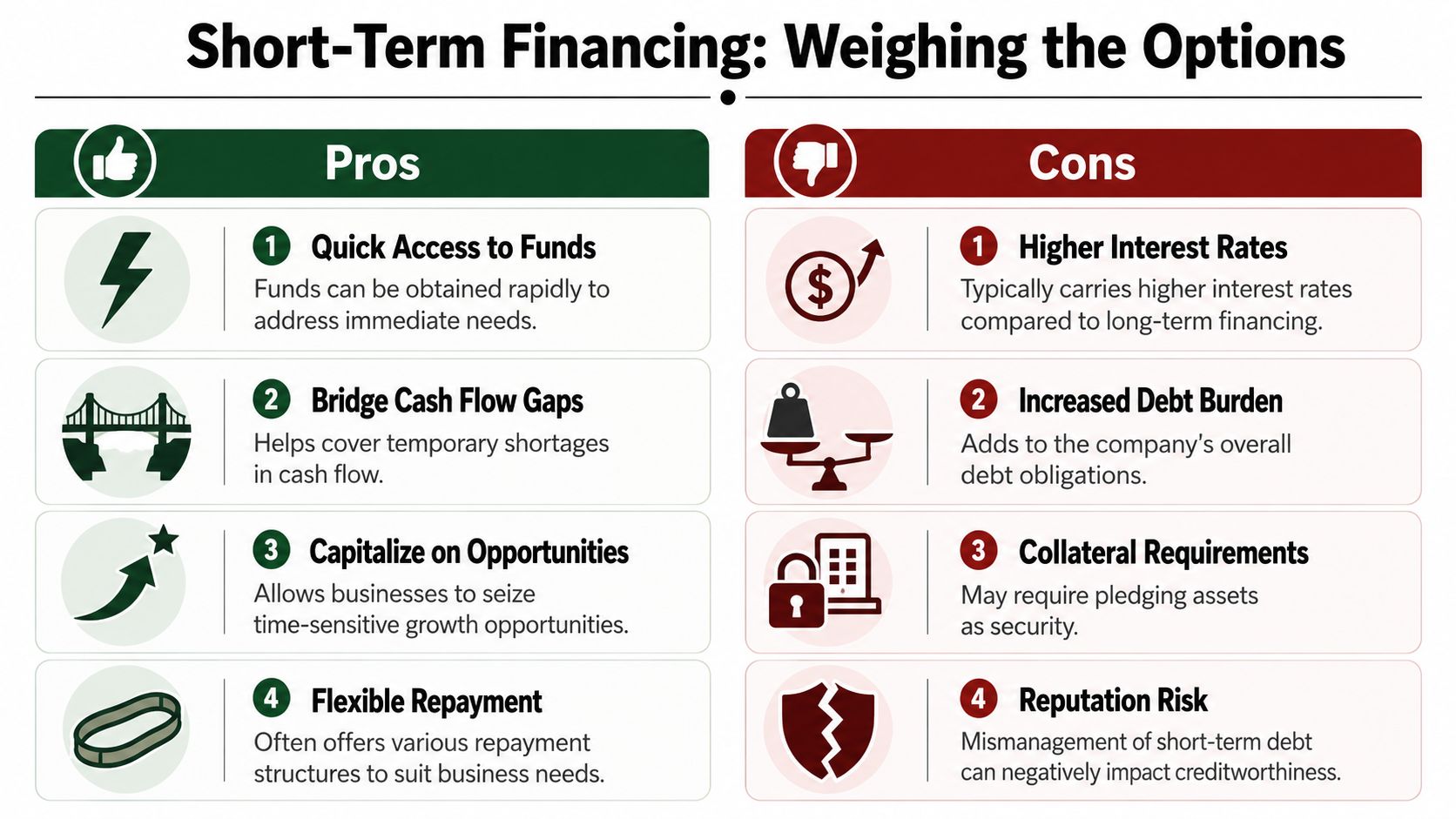
Short-term financing should match a specific operating need. For an established company, that usually means covering a timing gap inside a business that is otherwise generating acceptable margins and converting profit to cash on a reasonable schedule.
The mistake I see most often is treating financing as a substitute for operating discipline. If billing is late, change orders are unmanaged, inventory is overbought, or customer concentration creates collection risk, borrowed cash gives temporary relief but raises the cost of those weaknesses.
Compare the main options before you sign
At the $10M+ stage, the right question is not just "Can we get capital?" It is "Does this facility fit the cash cycle of the issue we are solving?"
| Option | Best use case | Speed | Risk profile | Practical caution |
|---|---|---|---|---|
| Business line of credit | Short-term timing gaps in otherwise healthy operations | Often relatively fast once in place | Moderate if managed closely | Easy to normalize repeated draws and call it working capital strategy when the business has not fixed the root cause |
| Invoice factoring | Cash tied up in receivables from creditworthy customers | Often tied to invoice approval and customer quality | Moderate to high depending on structure | Works better when invoices are clean, acceptance is clear, and disputes are rare |
| Merchant cash advance | Last-resort liquidity when conventional options are unavailable | Fast | High | Daily or frequent repayment pressure can choke cash at the exact moment the business needs flexibility |
A line of credit is usually the cleanest tool when the company has predictable collections, lender-ready reporting, and a short-term mismatch between outflows and inflows. Factoring can make sense when receivables are strong on paper and with the customer, but payment timing is too slow for current operating needs. Merchant cash advances are expensive pressure relief. They often create a tighter cash position within one or two cycles.
Senior finance support can help management choose the right facility before signing terms that are hard to unwind. The benefit is not capital itself. It is having someone pressure-test repayment assumptions, covenant risk, borrowing-base mechanics, and the operating changes required to avoid using the facility every month.
Questions a CEO should answer before borrowing
Put the answers in writing. If leadership cannot answer them clearly, the company is not ready to borrow with confidence.
- What exact gap are we funding? Delayed collections, a seasonal inventory build, payroll timing, equipment deposits, or a defined growth move all require different structures.
- What specific cash source repays this? Named customer receipts, recurring free cash flow, and contracted backlog are very different from projected sales that have not materialized.
- What has to improve operationally while this facility is in place? Better invoicing speed, tighter purchasing controls, revised payment terms, price increases, or active collections ownership.
- What is the downside case? If the expected receipt lands late, a major customer disputes an invoice, or margin comes in lower than plan, management should know how the company stays inside its obligations.
- What is the exit condition? Every short-term facility should have a clear path to reset, not become a permanent patch over weak cash conversion.
Used with discipline, short-term financing buys time for a healthy business. Used carelessly, it turns a manageable cash timing issue into a recurring capital problem.
When to Call for Backup Know the Triggers for a Fractional CFO
There is a point where good bookkeeping, a tax CPA, and a monthly close are no longer enough.
The company may still be functioning. Bills are getting paid. Reports are being produced. But leadership keeps making major decisions without clean forward visibility. That is the point where finance has to move from recordkeeping to decision support.
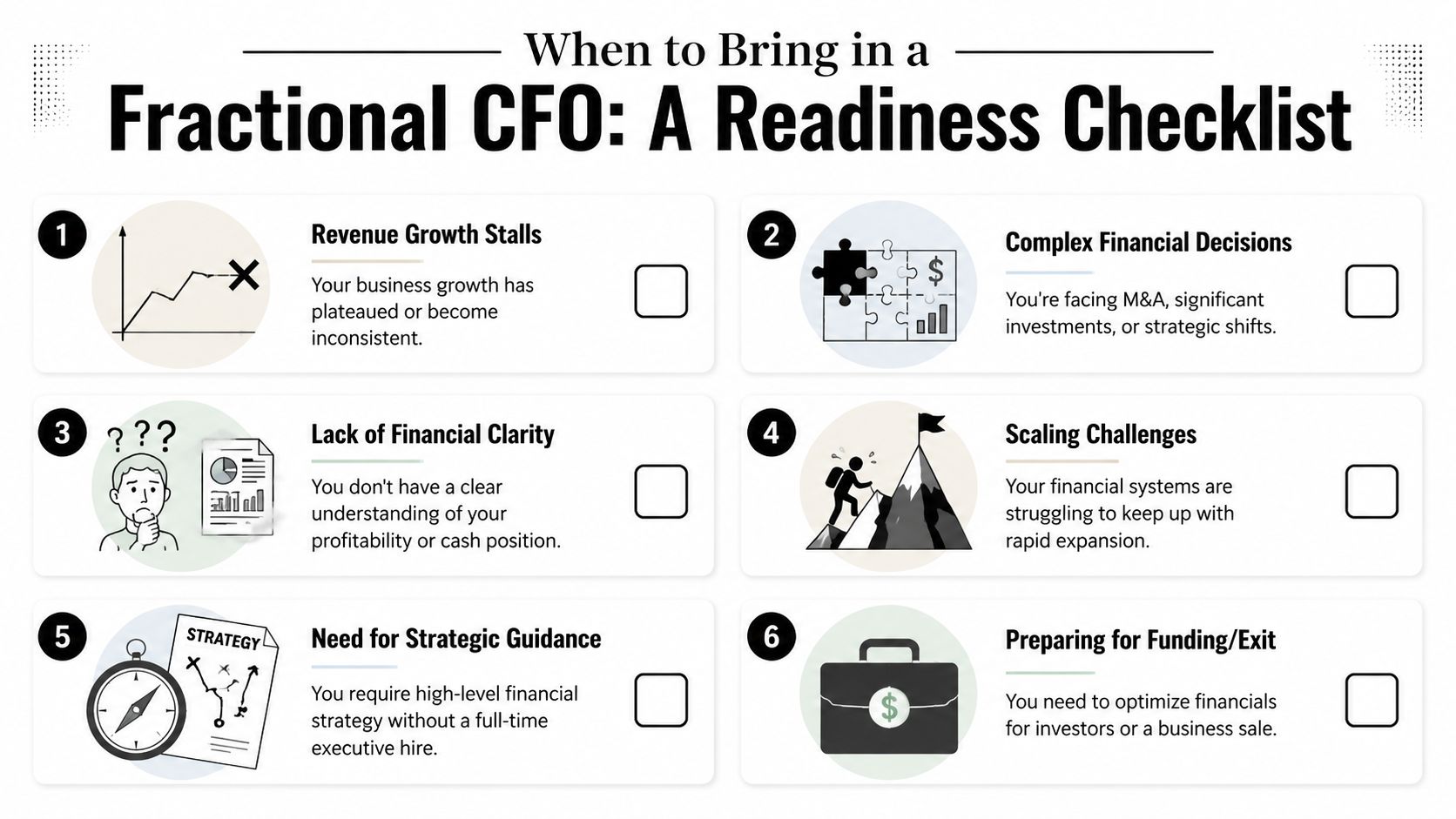
The point where bookkeeping stops being enough
For established businesses, especially around the $10M+ range described in the brief, a few signals show up repeatedly:
- You can't see forward clearly: The team can close the books, but no one can tell you with confidence what cash will look like over the next quarter.
- Growth decisions feel risky: Hiring, equipment, inventory, and expansion all feel heavier because the cash consequences aren't modeled.
- Profitability is blurry by job, customer, or service line: Revenue is growing, but you don't fully trust where the money is made.
- Bank conversations are reactive: Financing discussions start when pressure is already visible.
- Ownership is thinking about acquisition, transition, or exit: Strategic decisions require a level of financial modeling that basic accounting won't provide.
If M&A is on your horizon, this overview of the role of fractional CFOs in business mergers and acquisitions is a useful lens for what changes at that stage.
A senior finance leader should reduce uncertainty before the decision, not just explain results after it.
What senior financial help should actually do
The test is simple. Senior financial help should improve decisions, not just reporting.
That means building and maintaining a real cash forecast, tying budgets to operational assumptions, pressure-testing major moves, translating job or client economics into action, and helping the owner separate normal volatility from real financial risk.
If all you're getting is cleaner historical reporting, you still have an accounting function. You don't yet have financial leadership.
Conclusion Take Control of Your Financial Future
Cash stress usually isn't caused by a lack of effort. It's caused by a lack of structure.
When you install that structure, the business changes. A 13-week cash flow forecast gives visibility. Clear cash policies create consistency. Scenario planning prepares the team before problems hit. KPI tracking helps leadership see whether the operation is effectively converting effort into liquidity. Smart financing fills short gaps without becoming a habit.
That is what mature cash flow management for small business looks like. It is practical, disciplined, and closely tied to how the company runs.
Founders don't need more financial noise. They need a system that helps them decide when to hire, when to buy, when to push, and when to pause.
If your company has outgrown reactive cash management, the next move is to build the operating discipline that matches your scale.
If you'd like help building a 13-week cash forecast, tightening working capital policies, or identifying whether your business needs CFO-level support, contact AmbitionCFO to start a conversation.