
You have a signed Letter of Intent, and the mood shifts fast. One day you're discussing valuation, rollover equity, and timing. The next day a buyer sends a due diligence request list so long it feels like they want to crawl through every bank account, contract drawer, and server log your company has ever touched.
That reaction is normal. Most owners read the list as a document exercise. Buyers don't. They're trying to answer a harder question: is this business as durable, transferable, and profitable as it appears from the headline numbers? That's why the requests feel relentless. They're not just checking boxes. They're testing revenue quality, cash flow stability, compliance discipline, management depth, and how much risk could surface after closing.
A practical mergers and acquisitions due diligence checklist should help you see the deal through the buyer's eyes. It should also help you decide where to lean in, where to push back, and where a red flag needs a fix before it turns into a purchase price reduction, escrow, or indemnity fight. In lower middle market deals, especially in construction, distribution, and professional services, the companies that handle diligence well usually aren't the companies with perfect records. They're the companies that can explain their numbers, organize their evidence, and address issues before the buyer weaponizes them.
That's the right frame for this process. Due diligence isn't just a defense. It's a value-creation exercise when handled correctly. If your margins are stronger than reported because of owner-specific expenses, if your customer base is more stable than it looks, or if your working capital is cleaner than peers, diligence gives you a chance to prove it.
Get to the essentials quickly, organize by function, and treat every request as a negotiation point with evidence behind it.
Table of Contents
- 1. Financial Due Diligence Normalizing Statements for True Value
- 2. Tax Due Diligence Uncovering and Mitigating Hidden Liabilities
- 3. Commercial Due Diligence Assessing Customer Health and Revenue Quality
- 4. Legal & Liability Due Diligence Quantifying Debts and Contingencies
- 5. Operational Due Diligence Analyzing Working Capital and Cash Flow
- 6. HR Due Diligence Assessing People, Payroll, and Key Person Risk
- 7. IT & Cybersecurity Due Diligence Gauging Tech Health and Security
- 8. Environmental & Regulatory Due Diligence Checking Compliance
- 9. Insurance & Risk Management Evaluating Coverage and Claims
- 9-Area M&A Due Diligence Comparison
- Your Next Move Turn Diligence into a Strategic Advantage
1. Financial Due Diligence Normalizing Statements for True Value
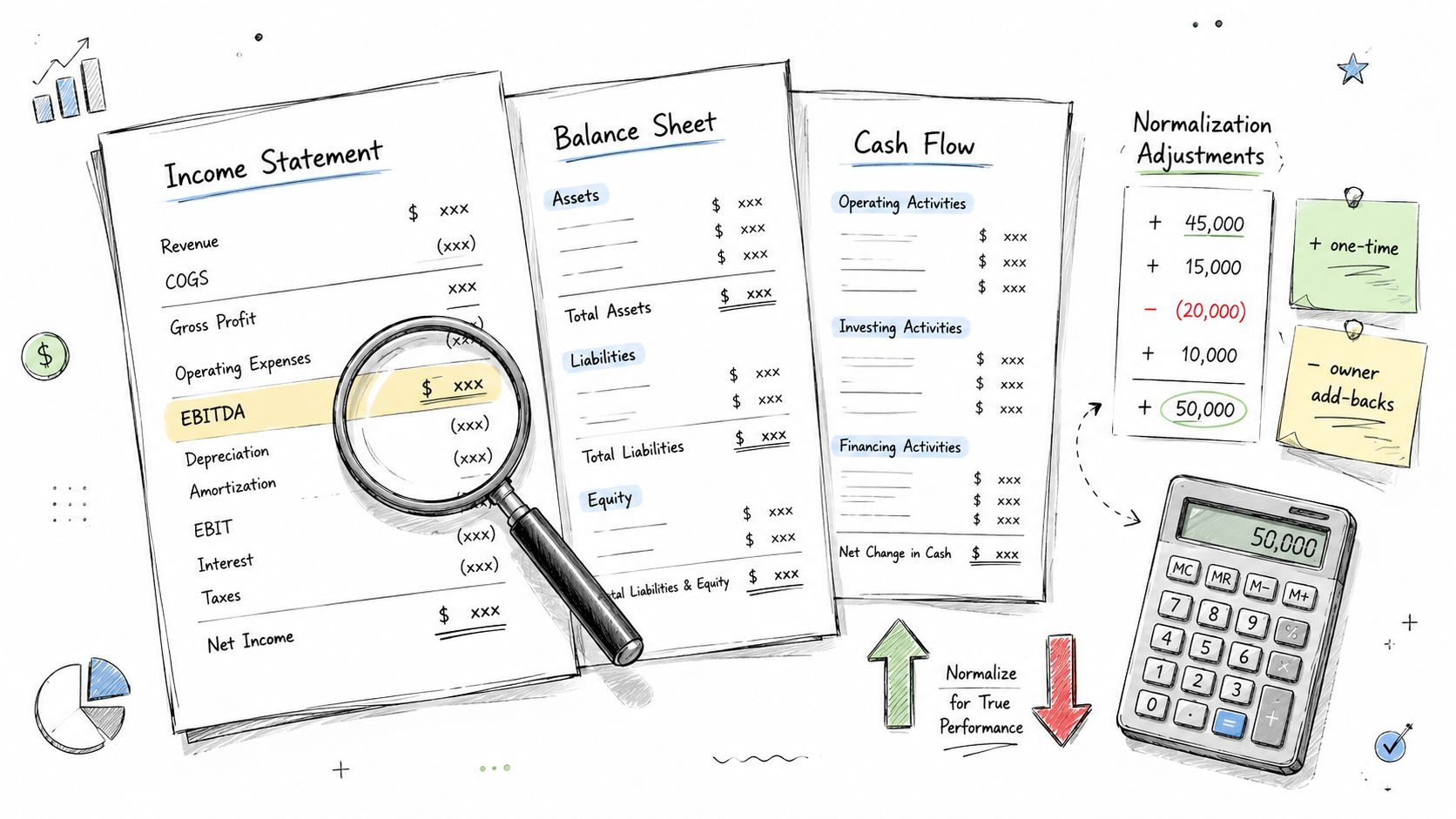
Financial diligence is where buyers decide whether your reported earnings can be trusted. If your P&L includes owner perks, one-time legal expenses, nonrecurring project overruns, or unusual bonuses, the raw statements won't tell the full story. A buyer will adjust those figures anyway, so you're better off getting there first with support.
A solid process starts with a minimum three-year lookback for core financial and tax documentation, including bank statements for all business accounts, trial balances, lines of credit agreements, business credit card statements, and tax returns, because that time window is the standard benchmark used to evaluate revenue quality, working capital efficiency, debt obligations, and quality of earnings in sound frameworks (Diligent on M&A due diligence checklist standards). If you can't produce that package cleanly, the buyer starts assuming there's a reason.
Build the earnings story before the buyer does
In practice, normalization usually comes down to three buckets:
- Owner-specific expenses. Vehicle leases, family payroll, above-market compensation, personal travel, and discretionary spend need support and a clear rationale.
- Nonrecurring events. A lawsuit settlement, storm loss, ERP conversion expense, or a one-off bad debt write-off may be legitimate add-backs if the event won't repeat.
- Accounting clean-up items. Revenue cut-off issues, stale accruals, and inconsistent inventory treatment weaken credibility fast.
A construction firm might show a weak year because one large job was estimated poorly and then corrected late. A distribution company might carry margin distortions because freight surcharges hit one period but customer pricing lagged. A professional services firm may understate earnings because the owner ran unusually high compensation through payroll. Those are fixable if documented well.
Practical rule: Don't hand over a financial package that forces the buyer to discover your adjustments alone. Present a bridge from reported EBITDA to normalized EBITDA and tie every adjustment to documents.
If your monthly closes are slow, this is the time to tighten them. Strong reporting discipline makes diligence smoother and valuation defense easier. AmbitionCFO's guide to financial reporting best practices is a good place to pressure-test your close process before the deal team does.
2. Tax Due Diligence Uncovering and Mitigating Hidden Liabilities
Tax issues rarely look dramatic at first. They show up as incomplete filings, payroll inconsistencies, nexus problems, old notices no one resolved, or a legal entity structure that made sense years ago but doesn't support the current deal. Buyers care because tax liabilities often survive optimism.
A thorough review should include tax returns for the past three to five years across federal, state, and local filings to uncover hidden liabilities, transfer pricing risks, and unresolved audits that can disrupt valuation (M&A Community on tax due diligence review periods). In owner-led businesses, the biggest issue isn't always fraud or abuse. It's usually drift. Sales expanded into new states, payroll moved around, or the company changed systems and no one updated the tax map.
Where tax issues usually hide
The common problem areas are predictable:
- Sales and use tax exposure. Distribution and construction firms often have multi-state footprints that outgrow old assumptions.
- Payroll tax and worker classification. Bonuses, commissions, subcontractor treatment, and reimbursed expenses need to match filings.
- Entity and deal-structure impact. An asset sale and a stock sale don't land the same way for either side.
If you're selling a professional services firm and a meaningful amount of revenue runs through related entities, the buyer will ask whether transfer pricing, intercompany balances, and owner distributions were handled cleanly. If you're in construction, they'll want to know whether project locations created state filing obligations that weren't addressed. If you're in distribution, resale certificates and sales tax exemptions often become a testing ground for discipline.
Tax diligence also shapes negotiation strategy. A buyer who sees uncertainty may ask for escrows, special indemnities, or a purchase price adjustment. A seller who has already reconciled filings, notices, and exposures can often narrow that discussion.
Old tax notices matter even when the dollars look small. They tell a buyer whether the company resolves issues systematically or lets them pile up.
This is one of the few diligence areas where “we've never had a problem” doesn't carry much weight. Buyers want filed returns, authority correspondence, and a clear explanation of any unresolved item.
3. Commercial Due Diligence Assessing Customer Health and Revenue Quality
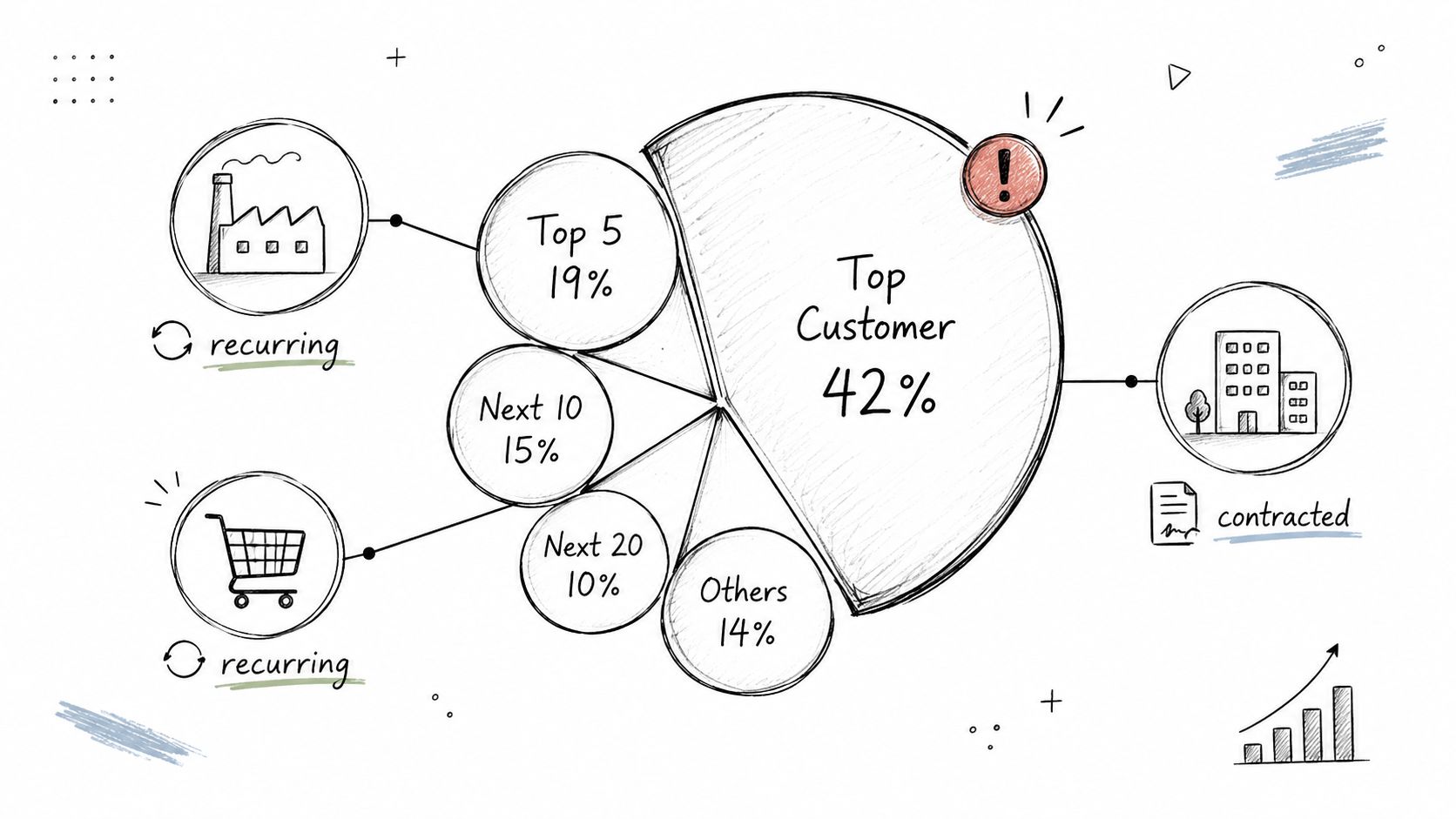
A seller walks into diligence expecting the financials to carry the story. Then the buyer asks a harder question. How much of this revenue will still be here after closing, at the same margin, without the same owner involvement? That is the primary purpose of commercial diligence.
This work goes beyond collecting customer lists and signed contracts. It tests whether revenue is durable, transferable, and priced well enough to support the valuation. A business with clean historical earnings can still disappoint a buyer if sales are concentrated, renewals are informal, pricing is inconsistent, or customer relationships sit with one founder or salesperson.
I would take slower growth with documented renewals, stable gross margin, and broad customer spread over faster growth tied to a few accounts every time. Buyers usually make the same trade-off because revenue quality affects both close certainty and post-close performance.
A useful review starts by organizing the commercial picture into a few questions management should be able to answer with data:
- Who drives the revenue base? Identify top customers, revenue by account, gross margin by account, and trend lines over multiple periods.
- What type of revenue is it? Separate recurring contracts, repeat but non-contracted work, project revenue, and one-time sales.
- How dependable is the forecast? Reconcile pipeline, bookings, backlog, and closed revenue against actual conversion history.
- How transferable are relationships? Determine whether customers buy from the company, a specific location, or a specific individual.
- Where does margin quality break down? Look for accounts that appear large but only stay because of discounts, custom service terms, or costly delivery requirements.
The red flags are usually operational, not theoretical. Unsigned customer agreements. Auto-renew terms no one monitors. Revenue booked from customers whose buying patterns have already softened. Margin concentration hiding inside customer concentration. Forecasts built from sales rep optimism instead of stage-based conversion evidence.
The industry context matters. In construction, backlog can look strong and still deserve a discount if too much volume depends on one general contractor or a narrow bid pipeline. In distribution, repeat ordering does not always mean loyalty if customers stay only because pricing is aggressive. In professional services, a client roster may appear stable while the core asset walks out the door each night with one rainmaker.
That is why I treat commercial diligence as a value-creation exercise, not just a defensive review. If management can show which accounts are recurring, which customers are profitable, which renewals are documented, and which relationships have been institutionalized across the team, the buyer gets a clearer case for durability. That can support valuation. It can also reduce the pressure for earnouts tied to post-close revenue retention.
Forecast discipline matters here more than pitch quality. A buyer will trust a clean revenue bridge and a forecast built from actual conversion patterns long before they trust a confident narrative from the sales team. If that process needs work, use a structured tool like this projected sales forecast template to tie pipeline assumptions back to historical results in a format a buyer can test.
4. Legal & Liability Due Diligence Quantifying Debts and Contingencies
Legal diligence answers a blunt question. What obligations come with this company, and which ones aren't visible in the financial statements? That includes debt, leases, guarantees, litigation, warranty exposure, indemnification obligations, change-of-control clauses, and contract terms that can break customer or vendor relationships after closing.
In this area, optimism is expensive. If the buyer finds one undisclosed issue, they'll assume there may be more. That's why legal diligence needs a full schedule of outstanding debt, accrued liabilities, pending disputes, and material contracts, not just the agreements management thinks are important.
Liabilities that change the deal economics
Start with obligations that can directly alter purchase price or close certainty:
- Debt and off-balance-sheet commitments. Include lines of credit, equipment notes, personal guarantees, and unusual vendor financing.
- Litigation and threatened claims. Buyers care about the facts, the status, and what reserves have or haven't been booked.
- Contract traps. Change-of-control provisions, termination rights, exclusivity commitments, and automatic renewals often matter more than legal teams expect.
Legal due diligence also requires a complete list of regulatory filings, licenses, permits, and correspondence with federal, state, or foreign regulatory bodies, including notices of violations or enforcement actions, so the buyer can assess whether the company is compliant with its operating requirements (Bloomberg Law on legal due diligence records).
A real example from the market: a distribution business can look simple until counsel discovers that a handful of supplier agreements limit assignment or allow termination upon a change in control. A construction company may have bonding or licensing issues buried in state correspondence. A professional services firm may have client contracts with consent rights that make revenue less transferable than management assumed.
The purchase agreement doesn't solve a disclosure problem you should have fixed earlier. It just prices the problem after leverage has shifted.
What works is a disciplined contract abstraction process. Pull the major commercial terms, expiration dates, assignment language, indemnities, and unusual obligations into a summary sheet. Then reconcile that sheet against the balance sheet and legal expense history.
5. Operational Due Diligence Analyzing Working Capital and Cash Flow
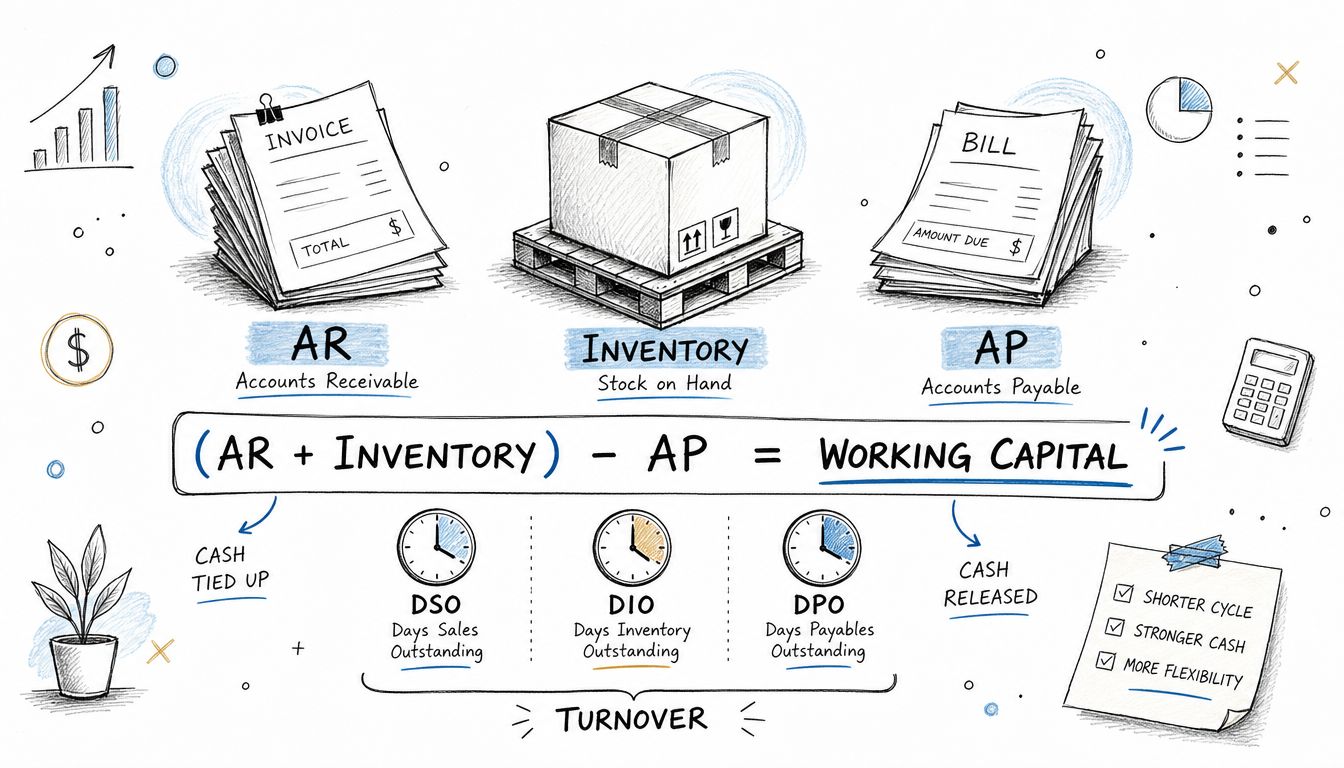
Many owners focus on headline valuation and overlook working capital until the closing statement arrives. That's a mistake. You can win the price negotiation and still lose value if the net working capital target is set badly or if your cash conversion profile isn't understood.
Operational diligence gets into the mechanics of how cash moves through the business. Buyers review receivables aging, inventory turns, payables practices, deferred revenue, job schedules, and seasonality to understand how much capital the business needs to operate. If those trends are unstable, they may argue for a lower target, a post-close adjustment, or a different view of earnings quality.
Working capital is where many sellers get surprised
Benchmark data shows that deals failing to validate working capital trends on a trailing 12-month basis or customer contract renewal rates face a higher risk of post-transaction valuation adjustments (Peony on diligence documents and adjustment risk was already noted earlier). That's why a monthly working capital bridge matters more than a year-end snapshot.
In real companies, the issues are usually operational:
- Receivables. Old invoices may be collectible, but buyers will haircut anything that isn't well supported.
- Inventory. Distributors need clear slow-moving and obsolete reserves. Construction firms need job cost detail that ties to WIP and billing status.
- Payables. Stretching vendors before a sale may boost cash temporarily, but buyers usually catch it.
A distribution company with rising sales can still consume cash because inventory lead times lengthened. A construction firm can look profitable while underbilling jobs and funding the gap. A professional services firm can have decent margins but poor collections because billing discipline lags project delivery.
That's why I push owners to build a detailed monthly operating cash view before diligence. AmbitionCFO's article on cash flow management for small business is a useful starting point if your team needs a clearer grip on the levers.
If you can't explain why working capital moved month to month, the buyer will assume the worst case and negotiate from there.
6. HR Due Diligence Assessing People, Payroll, and Key Person Risk
People risk can kill value even when the financials hold up. Buyers know that in founder-led businesses, relationships, process knowledge, and leadership credibility often sit with a small group. If that group isn't contractually secure or culturally aligned with the next chapter, the buyer starts modeling attrition.
Leading M&A frameworks treat people, culture, and incentives as one of eight distinct due diligence pillars because soft risks can derail integration even after the numbers check out (Altrata on the eight-pillar due diligence structure). That's why HR diligence goes well beyond payroll totals.
What buyers want to know about your team
Human resources diligence should include employment agreements, compensation plans, turnover rates, and any pending labor disputes or union matters so the buyer can identify retention risk, cultural misalignment, and employment-related liabilities (Siegel Brill on HR due diligence requirements). Owners often underestimate how much buyers care about this package.
The buyer is trying to assess a few specific issues:
- Who is essential. Which leaders own customer relationships, estimating knowledge, pricing authority, or operational know-how?
- What are they owed. Change-in-control payments, phantom equity, accrued PTO, bonus plans, and deferred comp need to be clear.
- Will they stay. A management team that can't articulate its future role makes the business look more founder-dependent.
A practical example: in a professional services firm, one senior partner may generate an outsized share of revenue and hold most client trust personally. In a construction business, the estimator or project executive may be the primary keeper of margin. In distribution, the operations leader may own the supplier relationships that keep fill rates stable. None of that always shows up in the org chart.
If the buyer senses concentration in one or two people, they may shift value into earnouts, employment agreements, or retention pools. That isn't always bad, but it changes how much cash the owner sees at close.
AmbitionCFO's perspective on fractional CFO ROI is useful here because part of the CFO's job in a sale is to reduce owner dependence by institutionalizing reporting, planning, and management cadence before buyers test it.
7. IT & Cybersecurity Due Diligence Gauging Tech Health and Security
Technology diligence used to be a specialist concern in software deals. It isn't anymore. A contractor with weak access controls, a distributor running on brittle ERP customizations, or a services firm with poor client data handling can all create post-close cost and liability that buyers have to price.
The practical review usually covers systems architecture, core applications, user access, backup practices, disaster recovery, vendor dependencies, privacy controls, and incident history. Buyers also want to know whether your systems can integrate without months of manual workarounds.
The systems test behind the financial model
Technology due diligence now commonly requires architecture diagrams, IT security assessments, and vendor dependency maps to judge integration feasibility and cost reduction opportunities in major markets. That matters because buyers aren't just asking whether the systems run. They're asking what those systems will cost to stabilize, secure, and combine after closing.
The trouble spots are familiar:
- Single points of failure. One outsourced IT person, one undocumented integration, or one employee with admin access to everything.
- Shadow systems. Revenue reports built outside the ERP, payroll data tracked in spreadsheets, or contract records scattered across shared drives.
- Ownership gaps. Unclear software licensing, missing documentation, or customer data stored in tools with weak controls.
A distribution company might rely on an ERP that no one has upgraded because “it still works,” but the buyer sees unsupported software, reporting fragility, and cybersecurity exposure. A professional services firm may hold sensitive client data in cloud apps without a formal access review. A construction company may have estimating, project management, and accounting data split across systems that don't reconcile cleanly.
What works here is transparency. Show the architecture. List your key vendors. Document backups, MFA use, incident response procedures, and who owns security decisions. If the environment has issues, describe the remediation path instead of pretending they don't exist.
Buyers can tolerate a tech stack that needs work. They don't tolerate a company that can't explain how its own data flows.
8. Environmental & Regulatory Due Diligence Checking Compliance
This workstream matters most when the business touches regulated activity, physical sites, specialized licensing, fleet operations, hazardous materials, or public contracts. Construction and distribution owners usually feel this first, but professional services firms aren't exempt if they operate in licensed fields or handle regulated client work.
The buyer wants evidence that the company's permissions to operate are current and that no buried compliance issue will show up after closing. That means permits, licenses, inspection history, notices, correspondence, and internal compliance processes all matter.
Compliance records tell buyers how you manage risk
The strongest diligence packages show more than a permit binder. They show control. For example, a construction company should be able to explain permit status, subcontractor compliance practices, safety oversight, and any environmental exposure tied to historical sites or materials. A distributor should have clear records on product handling, transportation requirements, warehouse compliance, and any industry-specific registrations. A professional services firm should show current licenses, supervision protocols, and complaint handling.
This area also connects to reputational risk. In current M&A practice, ESG and reputational risk sit alongside the more traditional diligence pillars because buyers don't want to inherit environmental exposure, sanctions issues, or governance practices that weaken the business after close. You don't need a glossy sustainability report. You do need records that show the company follows the rules that apply to it.
A common seller mistake is treating notices, minor violations, or unresolved remediation items as “old news.” Buyers don't see it that way. They use those files to evaluate whether leadership responds quickly, escalates issues correctly, and funds compliance adequately.
The good news is that this is often fixable before the market sees the business. If a license file is incomplete, rebuild it. If permit renewals are decentralized, centralize them. If environmental reviews were done but not organized, put them in one place and summarize any open items plainly.
9. Insurance & Risk Management Evaluating Coverage and Claims
Insurance review sounds routine until it isn't. Buyers use it to understand what risks have been transferred, what risks are still sitting in the business, and whether claims history tells a different story than management does. Coverage schedules, exclusions, deductibles, self-insured elements, and claims patterns all matter.
This becomes especially important when a company has field operations, vehicles, products, professional liability exposure, cyber exposure, or a history of employee claims. Buyers aren't just checking whether policies exist. They're asking whether the program matches the business you say you run.
Insurance review is really a risk transfer review
A practical insurance file should include policy summaries, full policies for key lines, claims runs, broker correspondence on renewals, and any major reservation-of-rights or denial letters. If your risk profile changed in recent years, explain why the program changed too.
Third-party due diligence often costs buyers between $50,000 and $300,000 in external fees for mid-market transactions because they need legal, financial, operational, and technical specialists working in parallel, and that spend reflects how seriously buyers take hidden risk before close (CTA Acquisitions on diligence costs and timelines). Insurance and claims analysis is part of that broader risk screen.
Look closely at these areas:
- Coverage adequacy. General liability, workers' comp, auto, umbrella, cyber, E&O, D&O, and property should fit the actual operation.
- Claims pattern. Frequent small claims often reveal weak controls even when reserves look manageable.
- Contract alignment. Customer and vendor agreements may require limits or endorsements your current program doesn't meet.
A construction company may discover that subcontractor certificate tracking has been inconsistent. A distributor may have cargo or inventory exposure that outgrew the old policy structure. A professional services firm may have cyber coverage that excludes how client data is handled.
AmbitionCFO's article on financial risk management strategies offers a useful lens here. Good risk management isn't buying more insurance by default. It's matching coverage, process, and contract obligations so the business is protected where it counts.
9-Area M&A Due Diligence Comparison
| Due Diligence Type | Implementation Complexity | Resources Required | Expected Outcomes | Ideal Use Cases | Key Advantages |
|---|---|---|---|---|---|
| Financial Due Diligence: Normalizing Statements for True Value | Medium–High, detailed accounting adjustments | Forensic accountants, 3–5 years financials, access to accounting systems | Normalized EBITDA, defensible valuation, reduced earnings risk | Valuation-focused M&A, deals with owner discretionary items | Reveals true earning power; can increase negotiable valuation |
| Tax Due Diligence: Uncovering and Mitigating Hidden Liabilities | High, tax law complexity and jurisdictional issues | Tax CPAs, tax attorneys, federal/state filings, IRS transcripts | Identified tax exposures, optimized deal structure, after-tax models | Multi-state operations, prior audits, complex tax positions | Prevents large post-closing tax surprises; improves R&W options |
| Commercial Due Diligence: Assessing Customer Health and Revenue Quality | Medium, data and market analysis | Commercial analysts, CRM/contract data, sales metrics | Customer concentration risk, churn/renewal insight, pricing power assessment | Revenue‑concentrated firms, subscription or contract businesses | Quantifies revenue stability and supports contract or retention actions |
| Legal & Liability Due Diligence: Quantifying Debts and Contingencies | High, legal review and contract scrutiny | Corporate lawyers, full contract and litigation docket access | Comprehensive debt schedule, contingent liabilities quantified | Companies with significant contracts, loans, or litigation exposure | Prevents undisclosed obligations and enables price adjustments |
| Operational Due Diligence: Analyzing Working Capital and Cash Flow | Medium, transactional data analysis | Ops and finance teams, AR/AP/inventory reports, CCC metrics | Working capital target, cash needs, CCC optimization | Inventory-heavy or cash‑intensive businesses | Frees cash, reduces post-close adjustments, improves liquidity |
| HR Due Diligence: Assessing People, Payroll, and Key Person Risk | Medium, personnel and compliance focus | HR specialists, payroll records, benefit and contract docs | Key‑person risk profile, payroll liabilities, retention plans | Service firms, owner/key-employee dependent companies | Protects continuity and informs retention/earnout structuring |
| IT & Cybersecurity Due Diligence: Gauging Tech Health and Security | High, technical and security assessment | IT/cyber experts, asset inventory, incident logs, license reviews | Tech risk inventory, upgrade/CapEx estimates, security posture | Data-sensitive firms, SaaS, businesses with custom systems | Avoids breach/license liabilities; quantifies remediation costs |
| Environmental & Regulatory Due Diligence: Checking Compliance | High, specialized environmental and regulatory work | Environmental consultants, Phase I/II ESAs, permit records | Contamination/regulatory risk, remediation cost estimates | Manufacturing, distribution, construction, real estate | Prevents catastrophic environmental liabilities; informs escrows |
| Insurance & Risk Management: Evaluating Coverage and Claims | Low–Medium, policy and claims review | Insurance brokers/analysts, loss runs, policy documents | Coverage gap identification, premium impact, R&W needs | High-claims industries (construction), transactions needing R&W | Identifies coverage shortfalls and supports insurer discussions |
Your Next Move Turn Diligence into a Strategic Advantage
The right question isn't whether you can survive due diligence. It's whether you can use it to strengthen your position while the deal is still negotiable.
That's the shift owners need to make. A mergers and acquisitions due diligence checklist isn't just a document request response. It's a framework for proving that your revenue is durable, your earnings are real, your liabilities are understood, and your business can transfer to a new owner without value leaking out. When that proof is organized and credible, buyers move faster and negotiate with more confidence. When it's messy, they slow the process, widen the ask, and protect themselves with price cuts, escrows, holdbacks, or deal terms that push risk back onto the seller.
The most important tactical step is to organize diligence by functional area instead of by inbox request. Financial, tax, commercial, legal, operational, HR, IT, regulatory, and insurance workstreams each answer a different buyer concern. If you lump everything into a single folder tree without an owner for each stream, issues hide until the buyer's team finds them. That's when sellers lose control of the narrative.
A better approach is to prepare a diligence book for each area with three layers. First, the raw documents. Second, a management summary that explains what the buyer is seeing. Third, a red-flag log that identifies issues, status, and planned remediation. That format gives the buyer what they need while also showing that management understands the business beyond the documents themselves.
This matters even more in founder-led businesses because buyers are always assessing transferability. Can this company perform without the owner in every decision? Are financial reports timely and defensible? Does the team understand working capital? Are customer relationships institutionalized? Are key contracts assignable? Are payroll, compliance, and insurance disciplined enough to support the valuation? Every diligence request is really one version of those questions.
A fractional CFO can make that process materially better. Not because the CFO replaces legal counsel, tax advisors, or quality-of-earnings specialists, but because the CFO acts as the central operator across all of them. Someone has to reconcile the data room to the financial model, explain working capital trends, defend normalization adjustments, pressure-test forecasts, coordinate the management response, and stop small inconsistencies from becoming big trust problems. In a mid-market sale, that role often determines whether the business looks buttoned-up or improvisational.
I've found that the best diligence outcomes come from candor, speed, and evidence. If an issue exists, disclose it clearly, quantify it, and explain the fix. If a number is unusual, bridge it. If a contract has a consent requirement, map the path. If the business is stronger than the buyer realizes, prove it with clean support. Buyers don't expect a flawless company. They expect a company that understands itself.
If you're within a few years of a sale, don't wait for an LOI to force this work. Start building the data room. Clean up the reporting package. Reconcile tax and legal files. Identify customer and key-person concentration. Tighten cash flow forecasting. Put the company in a position where diligence confirms value instead of threatening it.
If you're preparing for a transaction and want senior-level help organizing the process, AmbitionCFO works with founder-led businesses to tighten reporting, clarify cash flow, defend valuation, and get management ready for buyer scrutiny. For owners in construction, distribution, and professional services, that often means turning a chaotic diligence sprint into a controlled, strategic process with fewer surprises and stronger negotiating power.