
You close the month, open the P&L, and see that profit missed the target. Revenue is off. Gross margin is thinner than expected. Cash feels tighter than it should. The numbers tell you something went wrong, but they don't tell you what to do next.
That's why founders need budget vs actual variance analysis. Not as an accounting ritual. As a management tool. It turns a disappointing month into a set of decisions about pricing, sales execution, labor use, purchasing, hiring, and cash protection.
If you run a founder-led business in construction, distribution, or professional services, this matters even more. Your results can swing because of job mix, client mix, labor efficiency, input costs, or timing. Looking only at top-line differences won't help. You need a way to connect financial results to operational reality, then turn that insight into action fast.
Table of Contents
- Your P&L Is Off But Do You Know Why
- Decomposing Variances to Find the Real Story
- A Step-by-Step Framework for Variance Investigation
- Building a Variance Report Your Leadership Team Will Use
- From Analysis to Action Corrective Playbooks for Your Business
- How Variance Analysis Drives Valuation and Exit Planning
- Take Control of Your Financial Story Today
Your P&L Is Off But Do You Know Why
Most founders don't have a reporting problem. They have an interpretation problem.
You can get a clean set of financials every month and still have no real answer to the question that matters most: why did we miss the plan? A P&L can show that revenue came in light or payroll came in high. It rarely tells you whether sales discounted too aggressively, a project burned extra labor hours, or the business shifted toward lower-margin work.
That's the job of budget vs actual variance analysis. It compares what you planned with what occurred, then forces the business to explain the gap in operational terms.
Favorable doesn't always mean good
A favorable variance means the result helped profit relative to plan. A common example is spending less than budgeted. An unfavorable variance means the result hurt profit relative to plan, such as lower revenue or higher direct labor cost.
But don't stop there. Founders get into trouble when they label a variance and move on.
A favorable cost variance might mean your team controlled spending well. It might also mean you delayed maintenance, underinvested in sales, or failed to hire a role the business needs. An unfavorable expense variance might mean sloppiness. It might also mean you spent ahead of revenue because demand arrived sooner than expected.
Practical rule: Never discuss a variance without discussing the decision it should trigger.
The real question is what changed in the business
Good variance analysis asks operational questions, not accounting questions.
- Revenue off plan: Did you lose volume, cut price, or shift toward lower-value work?
- Gross margin down: Did material costs rise, did labor efficiency slip, or did the work mix change?
- Overhead up: Was it intentional growth investment, poor discipline, or timing?
- Cash tighter than expected: Did collections slow, inventory build, or project billing lag?
That's why I tell founders to stop treating the monthly budget as a scoreboard and start treating it like a hypothesis. You made assumptions when you built the budget. Month-end tells you which assumptions held up and which ones broke.
If your budgeting process itself is weak, fix that first. A sloppy baseline creates noisy variance analysis. Start with a tighter planning process using a practical guide to create a business budget that your team can actually manage against.
A founder's lens on variance analysis
Founders of larger small and midsize businesses need a different lens than a controller doing month-end close. You're not trying to produce a perfect academic explanation for every line. You're trying to make better decisions on pricing, hiring, purchasing, job selection, and capital use.
Here's the standard I'd use:
| Question | Weak approach | Strong approach |
|---|---|---|
| Why profit missed | “Expenses were high” | “Labor hours ran over on specific jobs and pricing didn't absorb it” |
| What to review | Every account | The biggest drivers of profit and cash |
| Who owns follow-up | Finance only | Sales, operations, purchasing, and leadership |
| What happens next | File the report | Adjust forecast, assign action, monitor results |
That's the shift. Variance analysis isn't the postmortem. It's the management conversation that should happen right after close.
Decomposing Variances to Find the Real Story
A top-line variance is nearly useless by itself.
If revenue missed budget, you don't yet know whether you have a sales problem, a pricing problem, or a mix problem. Those are not the same thing, and they should never get the same response.
Why the top line is a trap
A technically strong approach breaks the variance into price, volume, and mix so you can tie the financial result to operational drivers, rather than staring at an accounting delta. That's the standard recommended in this variance analysis guide on price, volume, and mix decomposition.
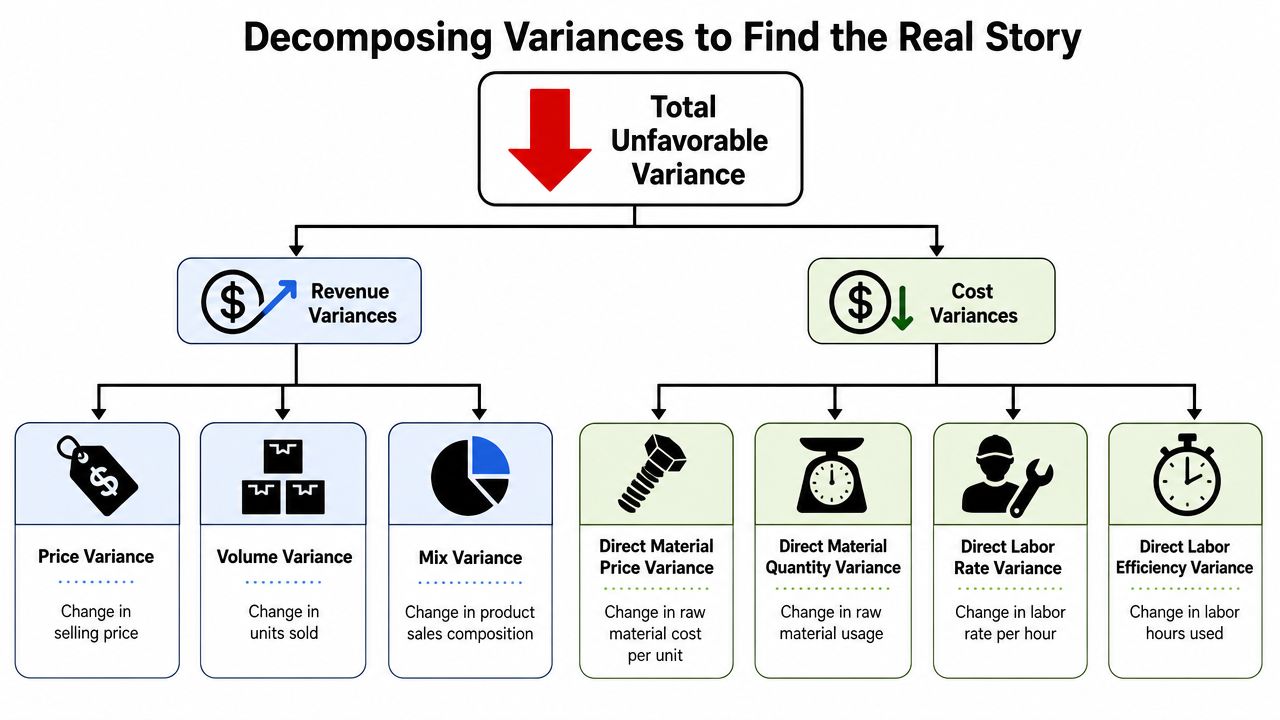
If you skip this step, leadership teams make bad calls. They pressure sales when the actual issue is discounting discipline. They attack pricing when the issue is lower lead volume. They celebrate stable revenue when the company sold more low-margin work, masking damage to future profit.
The same logic applies to costs. Higher direct costs can come from higher supplier pricing, inefficient material usage, higher labor rates, or extra labor hours. Each one points to a different owner and a different fix.
A practical operating example
Take a distribution business.
The month closes and revenue is under budget. A weak review says, “sales missed.” That statement is too vague to be useful. A strong review asks three questions:
- Price variance: Did the team sell at lower prices than planned because they discounted to close deals?
- Volume variance: Did the business ship fewer units than expected because demand softened or sales execution lagged?
- Mix variance: Did customers buy more lower-margin items and fewer premium products?
Now take a construction company.
The month closes and job gross profit is below plan. Again, one number can hide very different stories:
- Material price issue: Vendors raised prices or bids were based on old assumptions.
- Material quantity issue: Waste, rework, or poor estimating drove extra usage.
- Labor rate issue: The business used higher-cost crews or more overtime than expected.
- Labor efficiency issue: The team used more hours than the estimate allowed.
A single unfavorable variance can come from multiple causes at once. Until you split it apart, you're guessing.
That's why founders should insist that every material variance gets translated into business language. Not “COGS unfavorable.” Say, “We won the work, but discounts and crew inefficiency eroded margin,” or “We sold plenty, but mix shifted toward lower-margin product lines.”
What good decomposition looks like in practice
Use this sequence:
| Variance type | What to ask | Likely owner |
|---|---|---|
| Price | Did we charge what we planned? | Sales leader |
| Volume | Did demand or production match plan? | Sales or operations |
| Mix | Did customers buy the right type of work or product? | Sales and leadership |
| Material cost | Did supplier pricing change or did usage drift? | Purchasing or operations |
| Labor cost | Did rates change or did hours overrun? | Operations |
Finance's value to the business lies in delivering actionable insights. You're not producing commentary for the board deck. You're identifying the exact lever someone needs to pull.
If you want this analysis to matter beyond accounting, connect it to the operating metrics leadership already watches. That might be backlog quality, labor hours, close rates, utilization, or product mix. A good starting point is to align the variance review with the financial metrics every business owner should track, so the conversation stays tied to decision-making.
A Step-by-Step Framework for Variance Investigation
Most companies don't fail at variance analysis because the math is hard. They fail because the process is loose. Nobody agrees on what matters, who owns the explanation, or what happens after the review.
Use a disciplined workflow.
Start with the right comparison
For management reporting, treat budget vs actual as a layered control system. Use budget vs actual as the strategic check, then compare actuals against the latest forecast to isolate execution versus expectation changes. Finance process guidance also recommends setting materiality thresholds and focusing on the top three to five variances by absolute value instead of drowning in every line item. That guidance appears in this FP&A discussion of budget, actual, and forecast variance review.
That's the practical benchmark. Not perfection. Focus.
Budget tells you whether the business is tracking against the original plan. Forecast tells you whether the team is executing against the current view of reality. You need both because founder-led businesses change fast. Hiring plans shift. Demand moves. Input costs change. Capital spending gets pulled forward or delayed.
The workflow that keeps teams honest
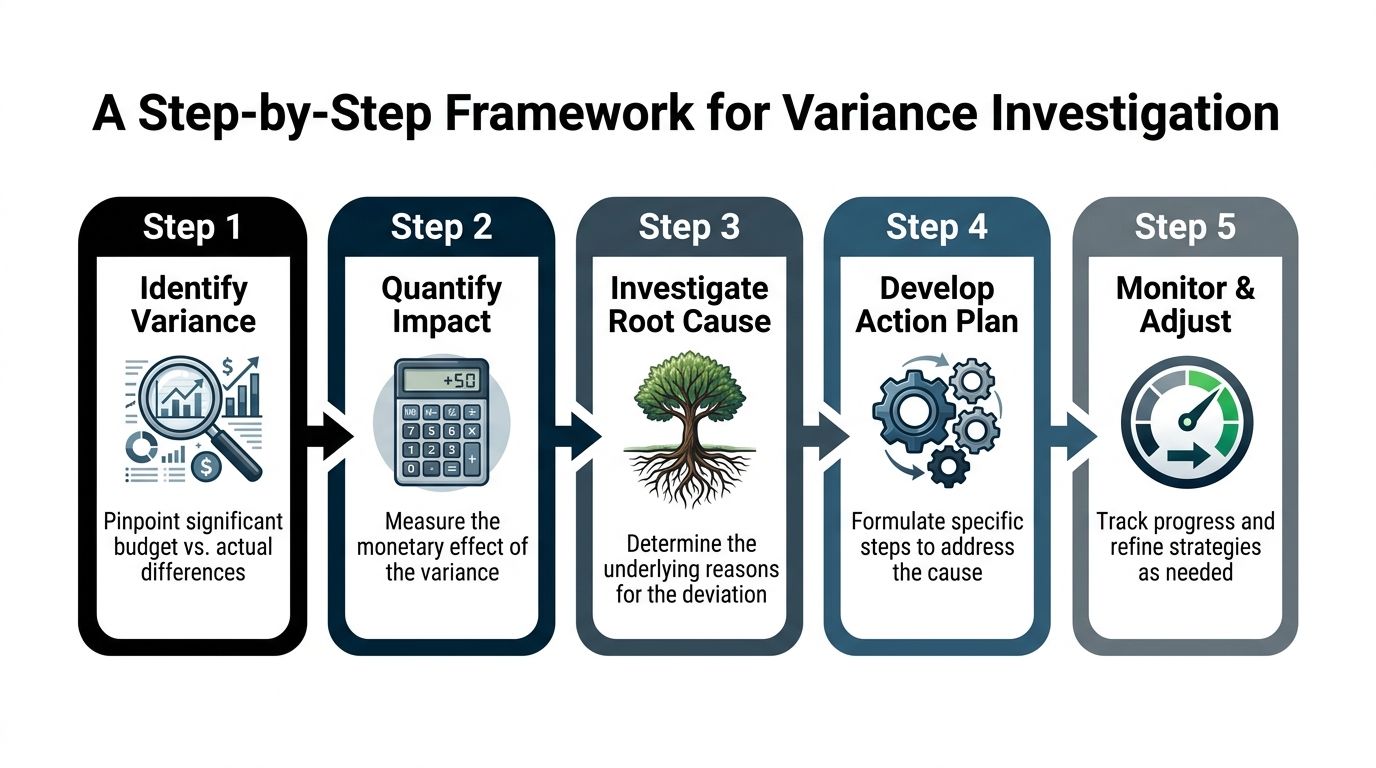
Use this five-step process every reporting cycle.
Calculate the high-level variance
Start with the major lines that affect profit and cash. Revenue. Gross profit. Direct labor. Materials. Overhead. Collections and working capital drivers if they're material. Don't begin at the account-detail level.Set a materiality threshold
Decide what deserves management attention before the meeting starts. If everything is urgent, nothing is. The review should center on the biggest economic drivers, not random noise.Decompose the largest variances
For the top three to five items by absolute value, split them into driver categories. Revenue gets broken into price, volume, and mix. Costs get split into rate versus efficiency, or price versus usage, depending on the line.
A short explainer can help your team grasp the cadence of this work before the meeting turns into a debate about anecdotes.
Investigate the root cause using operating data
Don't accept “timing” as the default answer. Check the inputs that drive the number. Labor hours. Quote win rate. Support volume. Client churn. Direct material usage. Project change orders. Collections lag. Use facts from operations to validate the financial story.Document action, owner, and reforecast impact
Every material variance needs three things attached to it: the root cause, the corrective action, and the owner. If the variance reflects a broken assumption rather than a one-off issue, update the forecast. That's how finance becomes useful.
Founder test: If a variance review ends without a named owner and a changed decision, it was just reporting.
One more point matters. Review cadence. If you only do this quarterly, you'll keep discovering problems after they've already burned cash. Businesses growing quickly often feel the hidden cost of late decisions first in margin compression and working capital strain. That's why disciplined review belongs alongside financial forecasting for managing rapid business growth.
Building a Variance Report Your Leadership Team Will Use
Most variance reports fail because they're built for accountants, not operators.
A leadership team doesn't need a spreadsheet dump. It needs a report that answers four questions fast: what changed, why it changed, who owns the response, and what that means for cash and the forecast.
What belongs on the page
Recent FP&A guidance pushes leaders to move beyond static monthly review and connect variances to operating metrics and cash, with regular monitoring so recurring or increasing issues get flagged early. It also reframes the discussion around assumptions: not just “why were we off budget?” but “which assumptions broke, and what should we reforecast now?” That approach is outlined in this guide to continuous budget versus actual review.

That's why the best variance report is short, sharp, and tied to action. Think one page for leadership. Backup schedules can live behind it.
Include these elements:
- Core financial view: Budget, actual, dollar variance, and percentage variance.
- Operational explanation: A plain-English reason tied to business drivers.
- Corrective action: The next step management agreed to take.
- Owner: One person accountable. Not a department.
- Forecast implication: Whether the issue changes the next period's outlook.
- Cash implication: Whether the variance affects collections, margin, inventory, payroll, or spend timing.
A simple template you can use
Here's a practical format.
| P&L Line Item | Budget ($) | Actual ($) | Variance ($) | Variance (%) | Root Cause Analysis | Corrective Action | Owner |
|---|---|---|---|---|---|---|---|
| Revenue | |||||||
| Gross Profit | |||||||
| Direct Labor | |||||||
| Materials | |||||||
| Marketing | |||||||
| G&A |
Call it your Action-Oriented Variance Report Template. It works because it forces the business to move beyond description.
Good commentary is short. “Revenue missed because close rates softened in one channel” is useful. “Sales underperformed due to various factors” is lazy.
You should also present a simple visual. A waterfall chart works well because it shows how multiple favorable and unfavorable variances bridge from planned profit to actual profit. Leadership teams grasp that format quickly.
A few reporting rules make a big difference:
- Keep narrative plain: Write for operators, not auditors.
- Limit the page: If the report sprawls, people stop reading.
- Track recurring items: Repeat variances deserve more attention than one-time noise.
- Use the same format every cycle: Consistency exposes patterns.
If you do this well, the monthly review gets shorter and better. The team spends less time debating the numbers and more time deciding what to do about them.
From Analysis to Action Corrective Playbooks for Your Business
Once you know the driver, the fix usually becomes obvious. The problem is that most companies never get specific enough to act.
The cure for that is a playbook mindset. If this type of variance appears, take this type of action. Don't reinvent the response every month.
Revenue misses need different responses
A revenue shortfall isn't one issue. It's several possible issues hiding inside one number.
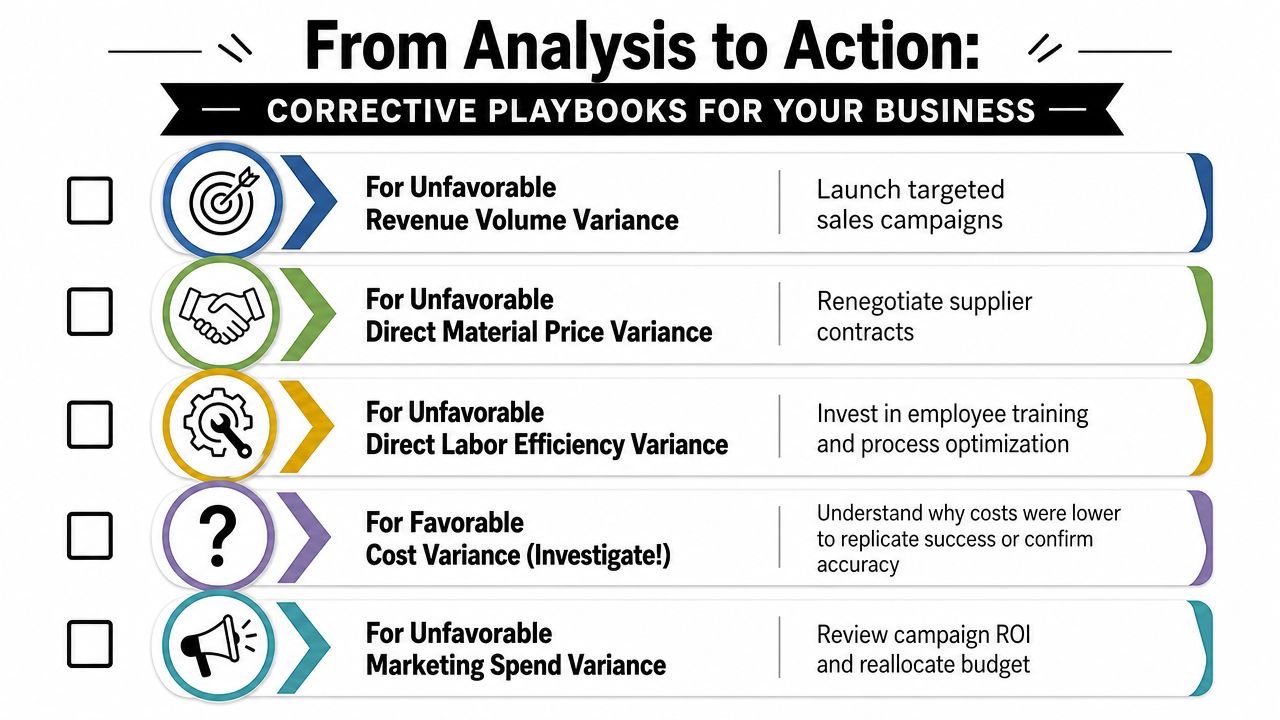
If the problem is volume, act in the sales engine. Review pipeline quality, close rates, lead sources, sales capacity, and account coverage. If the team has plenty of activity but weak conversion, fix qualification and sales management. If activity itself is thin, address demand generation or account penetration.
If the problem is price, look at discounting behavior and value communication. Your team may be giving away margin because they don't know how to defend price, or because leadership set targets that force bad selling behavior.
If the problem is mix, stop celebrating any revenue as good revenue. A business that fills capacity with lower-margin work can look busy while getting poorer.
When a founder says, “At least revenue held up,” I want to know whether margin and cash held up too.
Cost overruns need owner-level action
Now take common cost issues.
- Unfavorable material price variance: Purchasing should review supplier changes, bid assumptions, contract terms, and alternate vendors.
- Unfavorable material usage variance: Operations should inspect waste, rework, estimating accuracy, and job-site process discipline.
- Unfavorable labor rate variance: Leadership should check staffing mix, overtime, subcontractor reliance, and scheduling.
- Unfavorable labor efficiency variance: Project or operations leaders should investigate productivity, scope creep, supervision, and training.
- Unfavorable marketing spend variance: Review campaign quality, expected payback, and whether spend moved ahead of plan intentionally.
Favorable cost variances deserve scrutiny too. Lower spend can mean discipline. It can also mean a necessary initiative stalled, a team is understaffed, or accruals are wrong.
The best companies build these responses into operating rhythm. They don't wait for a dramatic miss. They identify a recurring issue, assign an owner, and build a standard response. That's how you turn a growing business into a more consistent and well-oiled machine without adding chaos.
How Variance Analysis Drives Valuation and Exit Planning
Founders often treat variance analysis like a monthly housekeeping task. That's too small a view.
If you plan to sell, recapitalize, transition leadership, or bring in a partner in the next several years, your reporting discipline becomes part of your value story. Buyers don't just look at your trailing results. They look at how predictable the business is and how well management understands the drivers behind performance.
Buyers pay for predictability
A buyer gets nervous when financial performance feels erratic and management can't explain the swings. If revenue missed, they want to know why. If margin compressed, they want to know whether it was mix, pricing, labor efficiency, supplier cost, or poor controls. If cash tightened, they want to know whether that's structural or temporary.
A business that consistently reviews variances, identifies root causes, and adjusts course sends a stronger signal. It shows management discipline. It shows the company isn't flying blind. It shows that when assumptions break, leaders notice and respond.
That matters because buyers are purchasing future cash flow, not just historical revenue. The more predictable your engine looks, the easier it is for them to believe the next years will be stable and well managed.
Good reporting strengthens your story
Variance analysis also improves the quality of your internal narrative.
You stop saying, “Margins were just weird last year.” Instead, you can say, “Margins compressed when mix shifted and labor efficiency slipped, then we corrected job selection, crew planning, and pricing discipline.” That's a much stronger story.
It also forces a cleaner leadership culture. Sales owns pricing discipline. Operations owns labor efficiency. Purchasing owns supplier strategy. Finance connects the dots. That's exactly what a serious buyer hopes to find: a company that runs on management process, not founder instinct alone.
If exit planning is on your horizon, this discipline belongs in your preparation work alongside organizational structure, cash flow visibility, and management accountability. It's part of building a practical roadmap to a less stressful business exit.
Take Control of Your Financial Story Today
Your financial statements should help you lead forward. Too many founders use them like a rearview mirror.
That changes when you build an effective budget vs actual variance analysis process. You stop reacting to surprise results. You start identifying broken assumptions, assigning ownership, protecting cash, and making smarter decisions faster. Profit improves because the team addresses the underlying issue. Forecasts improve because the business learns from what happened. Company value improves because results become more predictable and more explainable.
This is not about producing prettier reports. It's about running a better company.
If your team closes the books each month but still can't answer why performance changed, your process is incomplete. Fix that. Focus on the biggest variances. Tie them to operational drivers. Document the cause. Assign an owner. Update the forecast when assumptions break. Repeat until the business gets sharper.
That's what experienced financial leadership should do. It should turn numbers into decisions.
If you want help building a budget vs actual variance analysis process that drives decisions, cash flow, and exit value, talk to AmbitionCFO. The firm works with founder-led businesses that need senior-level financial leadership without hiring a full-time CFO, especially in construction, distribution, and professional services.