
Revenue is up. Headcount is up. Customer demand looks healthy. Yet you still hesitate before hiring, buying equipment, opening a second location, or taking on a large contract because you don't trust the financial picture enough to move fast.
That's the reality in a lot of founder-led businesses between $10M and $100M. You're not short on effort. You're short on visibility. The P&L arrives after the fact. Cash gets tight at the wrong time. Margin looks fine at the company level, but you can't clearly see which jobs, customers, or service lines are carrying the business and which ones are draining it.
That's why the question isn't “Can I afford a fractional CFO?” It's “What is it costing me to keep running a multi-million dollar business without forward-looking financial control?” If you're still making capital, pricing, and hiring decisions with incomplete reporting, you're driving from the rearview mirror. A better reporting rhythm fixes part of that problem, and strong financial reporting habits are the baseline. But reporting alone doesn't create ROI. Action does.
Most founders think about fractional CFO ROI too narrowly. They treat it like a salary comparison. That's a mistake. The return comes from three places: financial ROI, strategic ROI, and emotional ROI. The hard-dollar return matters. So does faster decision-making. So does the founder finally having someone who can turn financial noise into a clear recommendation.
If you want a clean way to judge this investment, use data, not hope. That's what this guide gives you.
Table of Contents
- Introduction Are You Flying Blind in a Multi-Million Dollar Business
- Understanding the Three Types of Fractional CFO ROI
- The AmbitionCFO Framework for Calculating Financial Return
- Where the ROI Comes From Three High-Impact Initiatives
- Fractional CFO ROI in Your Industry Numeric Examples
- Your 90-Day Plan to Measure Real-World Impact
- Conclusion Stop Guessing and Start Knowing Your Numbers
Introduction Are You Flying Blind in a Multi-Million Dollar Business
A founder in a multi-million dollar business usually knows when something feels off before the numbers prove it. The bank balance looks thinner than expected. A big month in revenue still doesn't create breathing room. The team is busy, but profit doesn't follow the effort.
That gap is where fractional CFO ROI starts. Not with a spreadsheet. With a business that has outgrown gut feel.
In founder-led construction, distribution, and professional services companies, the problem usually isn't a lack of accounting. It's a lack of decision-grade finance. You have historical reports. You may even have a controller or outside CPA. But you still don't have clear answers to questions like:
- Cash timing: When will cash get tight, and why?
- Margin truth: Which jobs, customers, or service lines are profitable?
- Capacity decisions: Can you hire, expand, or take on more backlog without stressing cash?
- Risk visibility: Where are the silent leaks in pricing, overhead, or working capital?
Practical rule: If you're making seven-figure decisions with last month's numbers and no forward view, the business already needs CFO-level thinking.
That's why a narrow cost comparison misses the point. A fractional CFO is not just a cheaper version of a full-time CFO. Return comes in three forms: financial return, strategic return, and emotional return. Hard-dollar gains matter. So does having a reliable model before you sign a lease, buy equipment, change pricing, or prepare for a transition.
The founders who get the best fractional CFO ROI are usually not looking for inspiration. They want clarity. They want someone to translate messy operations into clean financial choices. They want fewer surprises and faster decisions.
That's the standard you should use.
Understanding the Three Types of Fractional CFO ROI
A founder signs off on a new estimator, adds a truck, takes on more backlog, and feels busier than ever. Six months later, revenue is up, cash is tight, and nobody can explain whether the growth helped the business. That is the wrong way to judge CFO return.
You should measure fractional CFO ROI in three buckets: financial, strategic, and emotional. Keep them separate. If you mix them together, you get vague value instead of decision-grade value.
Financial ROI is the hard-dollar test
Start with the part that belongs in a spreadsheet.
ROI % = (Total Financial Gain – Annual CFO Cost) / Annual CFO Cost
Use that formula for one job only: proving whether the engagement pays for itself in dollars. In founder-led construction, distribution, and professional services companies, the gains usually come from fixing margin leakage and cash drag, not from flashy finance work.
Your Total Financial Gain can include:
- Higher EBITDA: Better pricing, cleaner job costing, tighter labor planning, improved customer or project mix
- Lower operating expense: Reduced waste, cleaner overhead control, fewer unnecessary hires or software costs
- Lower borrowing cost: Better cash forecasting, less use of expensive short-term debt, stronger banking conversations
- Working capital released: Faster collections, better payables discipline, cleaner inventory, WIP, or backlog billing
- Fewer avoidable errors: Less write-off risk, fewer reporting mistakes, fewer surprises tied to bad data
Your Annual CFO Cost is simple. Use the full annual fee for the engagement.
If you are still deciding whether the business has reached this level of complexity, this guide on when to hire a fractional CFO will help you make that call.
Strategic ROI is better decisions before the mistake gets expensive
Many founders often undercount value.
Strategic ROI means you can answer questions that were previously handled by instinct, pressure, or incomplete numbers. In non-tech businesses, that usually shows up in decisions about backlog, crew capacity, equipment purchases, customer terms, inventory buys, branch expansion, or owner compensation.
A good fractional CFO helps you answer questions like:
- Should we take this large contract at the quoted margin?
- Can cash support this hire before receivables catch up?
- Is this service line profitable after labor burden and overhead?
- Are we funding growth with profit, or with delayed vendor payments?
- Should we buy the equipment, finance it, or wait?
That value is real even when it does not appear as a neat line item in the first month. Avoiding one underpriced project or one bad working-capital decision can matter more than trimming a few overhead expenses.
Emotional ROI matters because founder capacity is finite
Emotional ROI sounds soft. It is not.
If the owner is spending every Friday chasing cash, second-guessing payroll timing, and trying to decode reports that arrive too late to use, the business is paying for that confusion already. The cost shows up in slower decisions, distracted leadership, and reactive management.
Here is the practical breakdown:
| ROI type | What it means | How to judge it |
|---|---|---|
| Financial ROI | The engagement produces more measurable gain than it costs | EBITDA improvement, expense reduction, borrowing cost reduction, working capital release |
| Strategic ROI | You can make high-stakes decisions with evidence instead of guesswork | Better calls on pricing, hiring, capex, customer terms, expansion, succession |
| Emotional ROI | The owner and leadership team carry less financial uncertainty | Fewer cash surprises, less firefighting, more focus, stronger accountability |
In a $3 million to $20 million business, emotional ROI usually comes from one thing. The founder stops being the only person trying to connect operations, cash, and profit.
Use all three categories. Just do not score them the same way. Financial ROI should be calculated. Strategic ROI should be tied to decisions made or mistakes avoided. Emotional ROI should be judged by how much leadership time and attention you get back.
The AmbitionCFO Framework for Calculating Financial Return
A founder in a $7 million construction firm looks at the P&L and sees a decent month. Two weeks later, payroll is tight, a supplier is calling, and the line of credit is creeping up again. That founder does not have a profit problem first. They have a financial control problem. That is the lens to use when you calculate fractional CFO ROI.
The right comparison is not fractional CFO versus full-time CFO salary. The right comparison is CFO cost versus the dollars recovered from better decisions. In founder-led businesses like construction, distribution, and professional services, the money usually sits in four places: margin leaks, slow cash conversion, avoidable borrowing, and reporting that arrives too late to use.
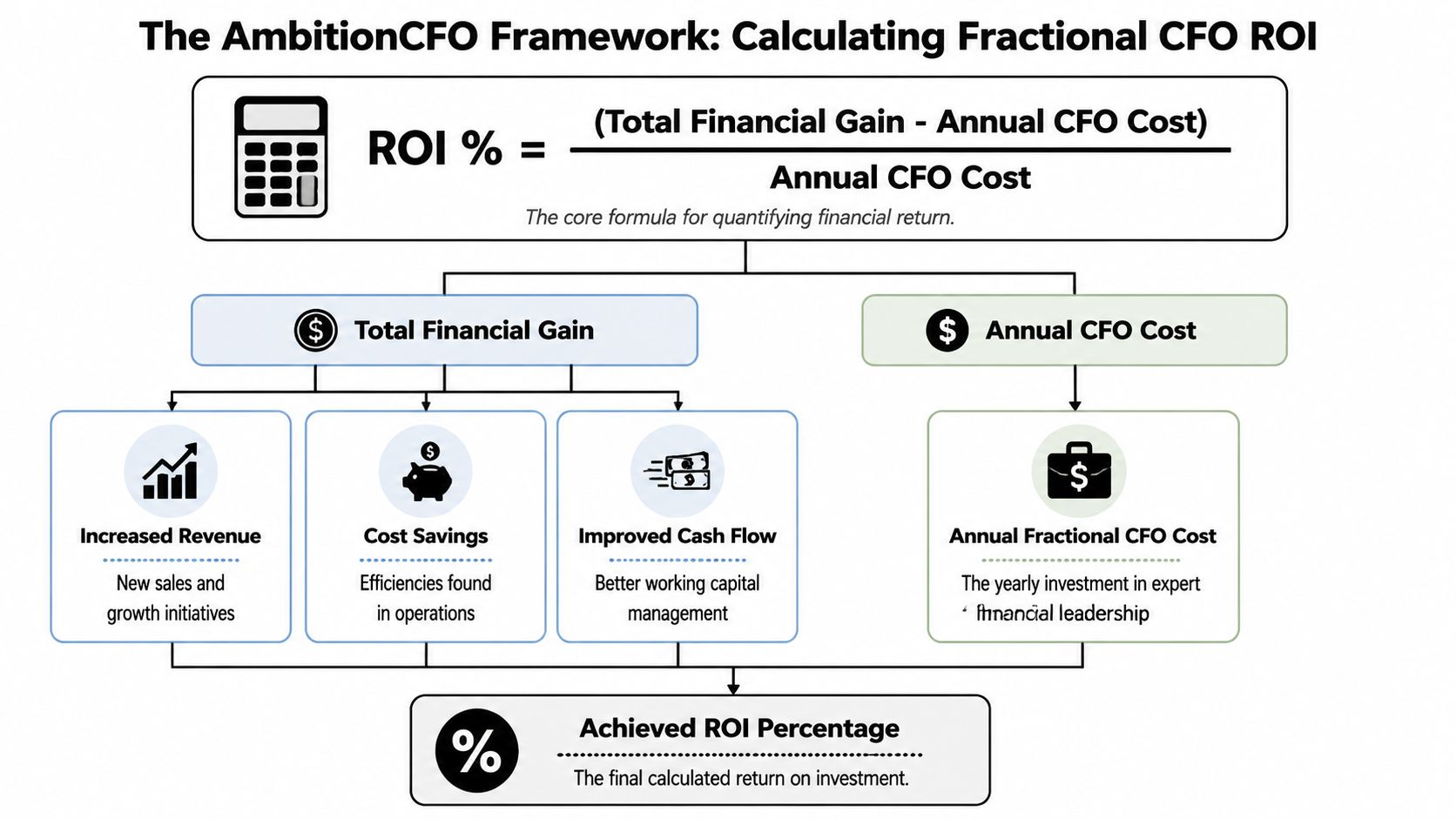
Use a simple ROI equation
Use this equation:
ROI % = (Total Financial Gain – Annual CFO Cost) / Annual CFO Cost
Keep the worksheet simple. Five lines is enough:
- EBITDA improvement
- Operating expense reduction
- Borrowing cost reduction
- Working capital released
- Errors, write-offs, or leakage avoided
Then subtract the annual CFO fee.
Here is the rule. Only count gains you can tie to a change in pricing, collections, purchasing, labor efficiency, project performance, reporting cadence, or financing. If you cannot point to the driver, do not count it.
In non-tech companies, I also recommend one adjustment founders often miss. Do not treat released working capital as theoretical value. Put a real number on it. If better collections and inventory discipline free up $300,000, that either reduces interest expense, reduces owner stress, or funds growth without outside capital. All three have real value.
If your reporting is messy, fix that before you try to prove ROI. A disciplined budget vs actual variance analysis process shows whether gains came from pricing, volume, labor, overhead, or timing. Without that baseline, every improvement turns into an argument.
Score the return by financial mechanism, not by job description
The fastest gains usually come from three financial mechanisms.
First, cash timing. A 13-week cash forecast, tighter collections, better billing discipline, and planned vendor timing reduce expensive surprises. In distribution and construction, this often matters more than trimming overhead because working capital can choke a profitable company.
Second, margin truth. Company-wide gross margin hides the problem. You need profitability by job, customer, crew, service line, route, or project manager. That is how you find underbidding, weak change-order recovery, waste, and unprofitable work that looks busy but does not create cash.
Third, decision speed. Founders lose money when reports show up after the month is gone. A useful dashboard ties financial outcomes to operating drivers such as WIP movement, labor efficiency, backlog quality, inventory turns, utilization, and customer payment behavior. That is what turns accounting into management.
| Financial mechanism | What the CFO changes | How value shows up |
|---|---|---|
| Cash timing | Forecasts receipts and disbursements, tightens billing and collections, plans payables | Lower borrowing, fewer cash crunches, more control over growth |
| Margin truth | Measures profit below the company total by job, customer, service line, or project | Higher EBITDA through better pricing, scope control, and operating fixes |
| Decision speed | Builds reports leaders can use weekly, not after the fact | Faster course correction, fewer misses, less leakage |
A practical example makes the math clearer. Say a professional services firm pays $60,000 a year for a fractional CFO engagement. During the year, DSO drops enough to reduce line-of-credit usage, one low-margin service line gets repriced, and write-offs fall because billing discipline improves. If those changes produce $180,000 in combined financial gain, the ROI is 200 percent. That is the standard. Measurable gain tied to specific operating changes.
That is the AmbitionCFO framework. Start with a short list of financial gains. Tie each one to an operating change. Use real numbers. If the engagement does not improve cash, margin, or decision quality in a way you can measure, it is overhead.
Where the ROI Comes From Three High-Impact Initiatives
Monday morning. Payroll clears on Wednesday, two large receivables are late, one project is eating labor hours faster than expected, and you still do not know which customer segment makes money. That is where fractional CFO ROI shows up in a founder-led business. Not in abstract strategy. In cash you can keep, margin you can defend, and decisions you can make before the month is gone.
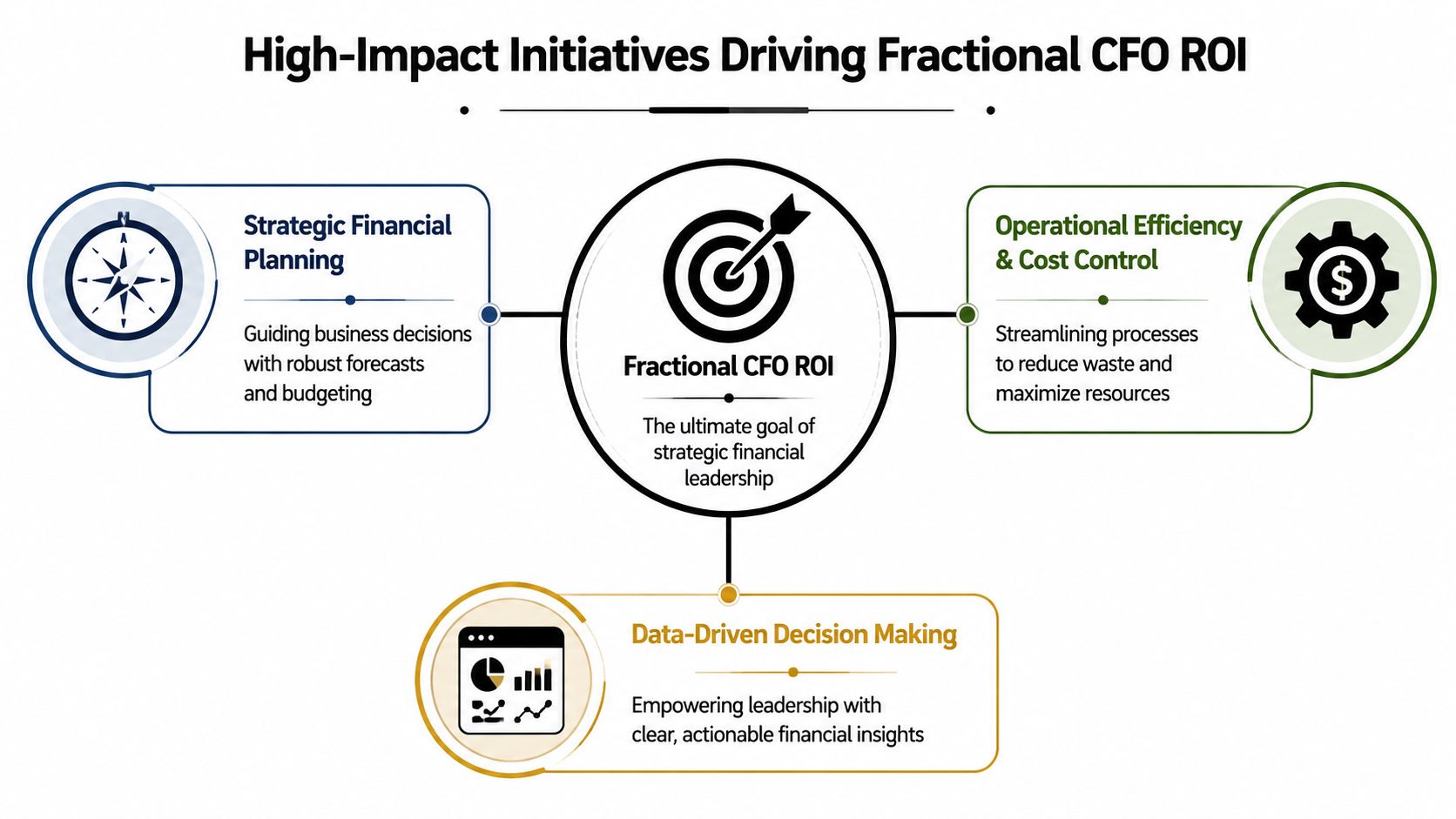
For companies in construction, distribution, and professional services, the highest-return work usually comes from three initiatives: cash flow control, margin visibility, and operating dashboards tied to core drivers of the business. Those are the areas that change outcomes fast because they address job costing, billing timing, collections, inventory, utilization, and overhead discipline.
Cash flow optimization
Cash problems usually start long before the bank balance looks dangerous.
In construction, the issue is often billing lag, underbilled jobs, retention, and mismatched vendor terms. In distribution, it is inventory sitting too long while receivables stretch. In professional services, it is labor delivered now and cash collected 30 to 60 days later. A founder sees revenue and assumes the business is healthy. The cash account tells a different story.
A 13-week cash forecast fixes that because it forces weekly accountability. You stop asking, "How did we do last month?" and start asking, "What will hit cash over the next 90 days, and what are we doing about it this week?"
A simple example shows the value. If a company cuts average collections by 12 days on $4 million in annual revenue, that frees up roughly $131,000 in cash. If that reduction lowers line-of-credit usage at 10 percent interest, the borrowing cost alone drops by about $13,000 a year. The bigger gain is control. The owner stops delaying hiring, equipment purchases, or vendor decisions because the cash picture is finally clear.
If cash timing is the main issue, start with a disciplined cash flow improvement process built around weekly forecasting, collections follow-up, and payment planning.
Margin and profitability analysis
A blended company-wide margin is not enough. It hides the underlying problem.
Founders in non-tech businesses need margin by the unit that drives operations. That means by job in construction, by customer and SKU category in distribution, and by client, service line, and team in professional services. If you cannot see margin at that level, you are pricing with guesswork.
The payoff is usually immediate. You find the jobs that looked busy but produced little profit. You find customers that consume service time without enough gross margin. You find crews, project managers, or service lines with a recurring pattern of leakage. Then you act. Reprice. Tighten scope. Cut waste. Fire bad-fit work if needed.
A 2-point margin improvement on a $5 million business adds $100,000. That is real ROI. It does not require explosive growth. It requires better financial visibility and the discipline to make harder operating decisions.
KPI dashboards and operating visibility
Monthly financials alone are too slow for an owner running multiple jobs, crews, trucks, warehouses, or client teams.
You need a dashboard that links financial results to operational drivers each week. For construction, that may include backlog quality, WIP accuracy, labor efficiency, change-order cycle time, and collections aging. For distribution, it may be inventory turns, gross margin by customer, fill rate, and aged receivables. For professional services, it is utilization, realization, pipeline quality, write-downs, and project margin.
Good dashboards change behavior. The leadership team spends less time arguing about the numbers and more time fixing the issue behind them. One bad job gets attention before it wipes out the month. One customer with shrinking margin gets reviewed before the relationship becomes unprofitable. One hiring decision gets delayed because utilization does not support it yet.
That is where a firm like AmbitionCFO adds value in a factual, practical way. The work usually includes 13-week cash flow modeling, margin analysis by job or client, budgeting and forecasting, KPI dashboards, and exit planning. Those are not extra reports. They are management tools that help a founder protect cash, improve profit, and run the business with fewer surprises.
Fractional CFO ROI in Your Industry Numeric Examples
A $6 million contractor can show a profit on the income statement and still miss payroll in six weeks. A $12 million distributor can grow sales 15% and lose cash because inventory and receivables are consuming cash like new hires. A $4 million professional services firm can stay busy all quarter and still underperform because half the work is underpriced or written off.
That is why generic ROI advice fails founder-led businesses in construction, distribution, and professional services. Return comes from better job costing, tighter working capital, and faster operating decisions. If you want to judge fractional CFO ROI properly, use numbers that match how your business makes money.

Construction
Construction ROI usually shows up in three places. Bid quality. WIP accuracy. Cash timing.
Here is a simple example.
A $8 million contractor runs at a 10% gross margin. One bad estimating habit and weak job-cost reporting let two jobs come in 3 points below target before anyone acts. On $1.5 million of combined revenue, that is $45,000 in lost gross profit.
Now add billing discipline. If the same company shortens average billing and collection timing enough to free up $150,000 in cash, it reduces the need to draw on a line of credit, delay vendors, or inject owner cash. Even before you talk about growth, the return is tangible. Better visibility protects margin and reduces cash pressure.
If a fractional CFO costs $4,000 to $8,000 per month, finding and fixing one margin leak like that can cover a large share of the annual fee.
Distribution
Distribution businesses rarely have a sales problem. They have a mix problem.
A $15 million distributor may carry 25% gross margins on paper, but that number means very little if the bottom 20 customers absorb rush orders, split shipments, pricing exceptions, and slow payment. If a CFO review identifies $2 million of revenue that should be repriced by 2 points, that is $40,000 in added gross profit. If the same review cuts stale inventory by $200,000, that is $200,000 of cash back on the balance sheet.
That is real ROI. Not theory. Cash and margin improve at the same time.
The point is simple. In distribution, the return often comes less from cost cutting and more from customer profitability analysis, purchasing discipline, and inventory decisions that stop draining working capital.
Professional services
Professional services firms usually underprice complexity and overestimate utilization.
Take a $5 million firm with 20 billable employees. If each employee has a $200,000 annual revenue target, a 3% improvement in realization adds roughly $150,000 in revenue without adding headcount. If tighter scope control and better project review preserve even one-third of that as operating profit, the CFO engagement has likely paid for itself.
Use a scorecard like this to find the gain:
| Operational issue | Numeric impact to check | Why it matters |
|---|---|---|
| Utilization | 2 to 3 point improvement in billable time | Adds capacity before you hire |
| Realization | 1 to 3 point reduction in write-downs or write-offs | Protects revenue you already earned |
| Client profitability | Margin by client or service line | Shows where pricing, staffing, or scope needs to change |
Founders often focus on top-line billings because that is the number they see first. The better question is how much of that billing turns into clean gross margin and cash.
How to read these examples correctly
Do not evaluate a fractional CFO on polished reports. Evaluate the work on dollars recovered, cash freed up, and bad decisions avoided.
For non-tech companies, the cleanest ROI test is usually one of these:
- Gross margin points recovered on jobs, customers, or service lines
- Cash released from receivables, inventory, or billing delays
- Interest expense avoided through better working capital control
- Overhead or hiring decisions postponed because the numbers did not support them
- Profit preserved by catching a bad contract, bad bid, or bad client earlier
That is the standard. If the engagement improves financial clarity but never changes decisions, the ROI is weak. If it changes pricing, collections, bidding, staffing, and cash planning in measurable ways, the ROI is strong.
Your 90-Day Plan to Measure Real-World Impact
You are 30 days into a fractional CFO engagement. Payroll is coming up, two large customers are paying late, and you are about to approve another hire because the team feels stretched. If you still cannot answer what cash will look like in six weeks, which jobs or clients are dragging margin down, and whether that hire is justified, you do not have ROI yet.
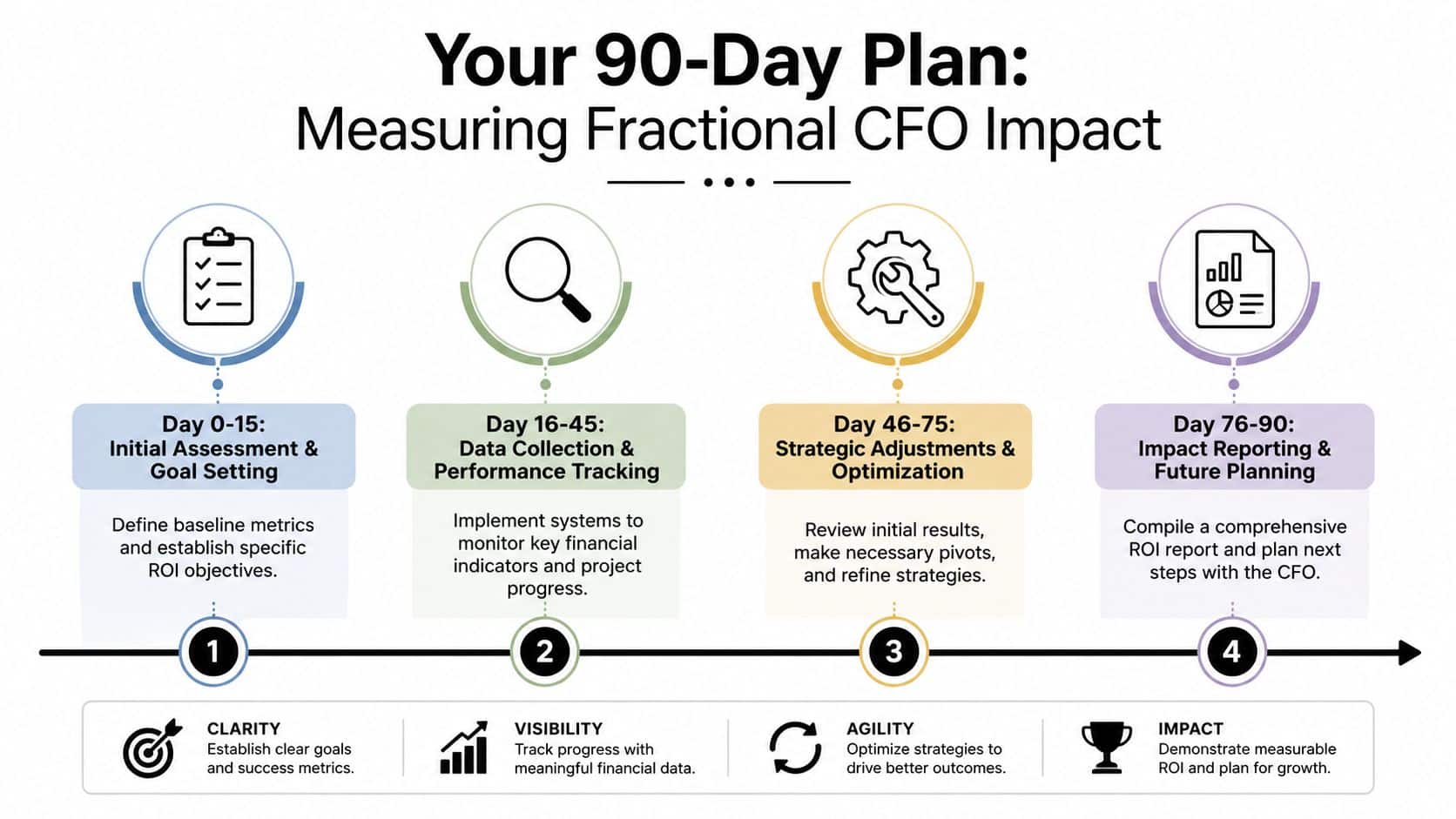
Do not wait six months to judge the work. In founder-led construction, distribution, and professional services businesses, the first 90 days should produce visible operating control. Case studies from fractional CFO firms often describe payback inside six months, but you should hold the engagement to a higher standard than marketing anecdotes. By day 90, you should see changed decisions, cleaner numbers, and a short list of financial gains you can tie to actions taken.
If you need a baseline revenue view for cash and capacity planning, use a projected sales forecast template before the engagement starts. That gives you a clean point of comparison.
Days 0 to 15
Set the baseline. Write it down.
Use one page, not a 40-tab workbook. Include the numbers that drive a non-tech business:
- Cash position: Current cash, weekly swings, debt payments, and any looming squeeze points
- Margin visibility: Gross margin by job type, customer group, service line, or location
- Working capital: Receivables aging, inventory levels, unbilled work, payables pressure
- Decision agenda: Hiring, equipment purchases, pricing changes, borrowing, owner distributions
- Known blind spots: Bad job costing, late closes, weak collections, unreliable forecasting
If the baseline is fuzzy, every later "win" turns into an argument.
Days 16 to 45
Now you should see evidence that the CFO is fixing the control system, not just commenting on it.
Three things should exist by this point. A rolling cash forecast your team can update weekly. Reporting that arrives faster and ties back to operations. A short list of financial leaks with owners assigned to fix them.
For a contractor, that might mean identifying two crews with lower-than-expected gross margin because labor hours were underbid. For a distributor, it might mean finding $300,000 of slow inventory that is choking cash. For a professional services firm, it might mean showing that one client segment has strong billings but weak realization and poor payment behavior.
Days 46 to 75
This is the action window. Diagnosis is over.
Ask questions that force specifics:
- What changed in collections, billing speed, or payment timing?
- Which jobs, customers, or service lines are below target margin right now?
- What pricing, purchasing, staffing, or scope decisions have changed because of the numbers?
- Which KPI set does leadership review every week, and who owns each number?
You are looking for operational moves with financial consequences. A $2 million distributor that trims DSO by 8 days frees up roughly $44,000 in cash. A $5 million services firm that improves gross margin from 32% to 34% adds $100,000 in gross profit on the same revenue. That is the level of clarity you want.
Days 76 to 90
By day 90, score the engagement on business impact, not effort.
| By day 90 | What you should have |
|---|---|
| Cash control | A 13-week cash forecast, weekly review rhythm, and fewer cash surprises |
| Margin insight | A usable view of profit by job, customer, or service line |
| Decision quality | Clear support for hiring, pricing, purchasing, and timing decisions |
| Measured gains | Dollars collected faster, margin points recovered, waste cut, or spending avoided |
One more rule. Tie every claimed improvement to a number and a decision.
If the fractional CFO helped you delay a bad hire, quantify the avoided cost. If better billing discipline cut receivables by 10 days, quantify the cash released. If revised job costing stopped you from repeating underpriced work, quantify the margin preserved. That is how founders in non-tech businesses should judge ROI. Not by presentation quality. By cash, margin, and better calls under pressure.
Conclusion Stop Guessing and Start Knowing Your Numbers
The point of hiring a fractional CFO isn't to add another expense. It's to stop making major business decisions with incomplete information. Real fractional CFO ROI comes from tighter cash control, better margin visibility, cleaner reporting, and faster decisions.
If you run a founder-led business in construction, distribution, or professional services, generic advice won't help much. You need financial leadership built around working capital, job or client profitability, and decision clarity.
If you're ready to move from guessing to knowing, let's schedule a call to build a preliminary ROI calculation for your specific business.
If your business has outgrown rearview-mirror reporting, AmbitionCFO can help you evaluate whether fractional CFO support would create measurable return in your situation. A good next step is a conversation focused on your cash flow, margin visibility, reporting gaps, and the financial decisions you need to make next.