
Your controller says the month was profitable. Your banker wants updated numbers. Payroll hits on Friday. Two customers are dragging their feet, a big vendor wants to be paid now, and you’re staring at a healthy P&L while wondering why your checking account feels tight again.
That’s a common problem in founder-led businesses once revenue gets into the $10M to $100M range. I see it in construction companies that are booking work faster than they can bill and collect. I see it in distributors carrying too much stock because “we never want to be out.” I see it in professional services firms with strong margins and weak collections discipline.
Mastering how to improve cash flow can transform your business’s financial health.
Profit is not cash. Profit is an accounting result. Cash is timing.
Understanding how to improve cash flow is vital for maintaining a healthy business operation.
If you’re growing, cash usually gets trapped in receivables, inventory, and operating decisions made without a forward view. That doesn’t mean your business is broken. It means you need better control over the cash engine behind the income statement. If you’ve been feeling the pressure that comes with fast growth, start with the hidden costs of rapid growth and financial forecasting. Then fix the system.
Learning how to improve cash flow is essential in this scenario.
| Metric | Formula | What it tells you |
|---|---|---|
| DSO | Accounts Receivable / Average Daily Sales | How long it takes customers to pay |
| DIO | Inventory / Average Daily COGS | How long cash sits in inventory |
| DPO | Accounts Payable / Average Daily COGS | How long you hold cash before paying vendors |
| CCC | DSO + DIO – DPO | Total operating days cash is tied up |
If you run a construction company, substitute unbilled receivables and contract assets into your review, because that's often where collections friction hides. If you run distribution, break inventory into fast, medium, and slow movers instead of looking at one inventory total.
This diagnosis changes the conversation. Instead of saying “cash feels tight,” you can say, “collections are slow,” or “inventory is bloated,” or “we're paying vendors faster than customers pay us.” That's a fixable problem.
Once you know where cash is stuck, act fast. Most businesses don't need a miracle. They need a short list of decisions executed hard for one quarter.
Start with the levers inside your operating cycle. That's where the fastest gains usually show up.
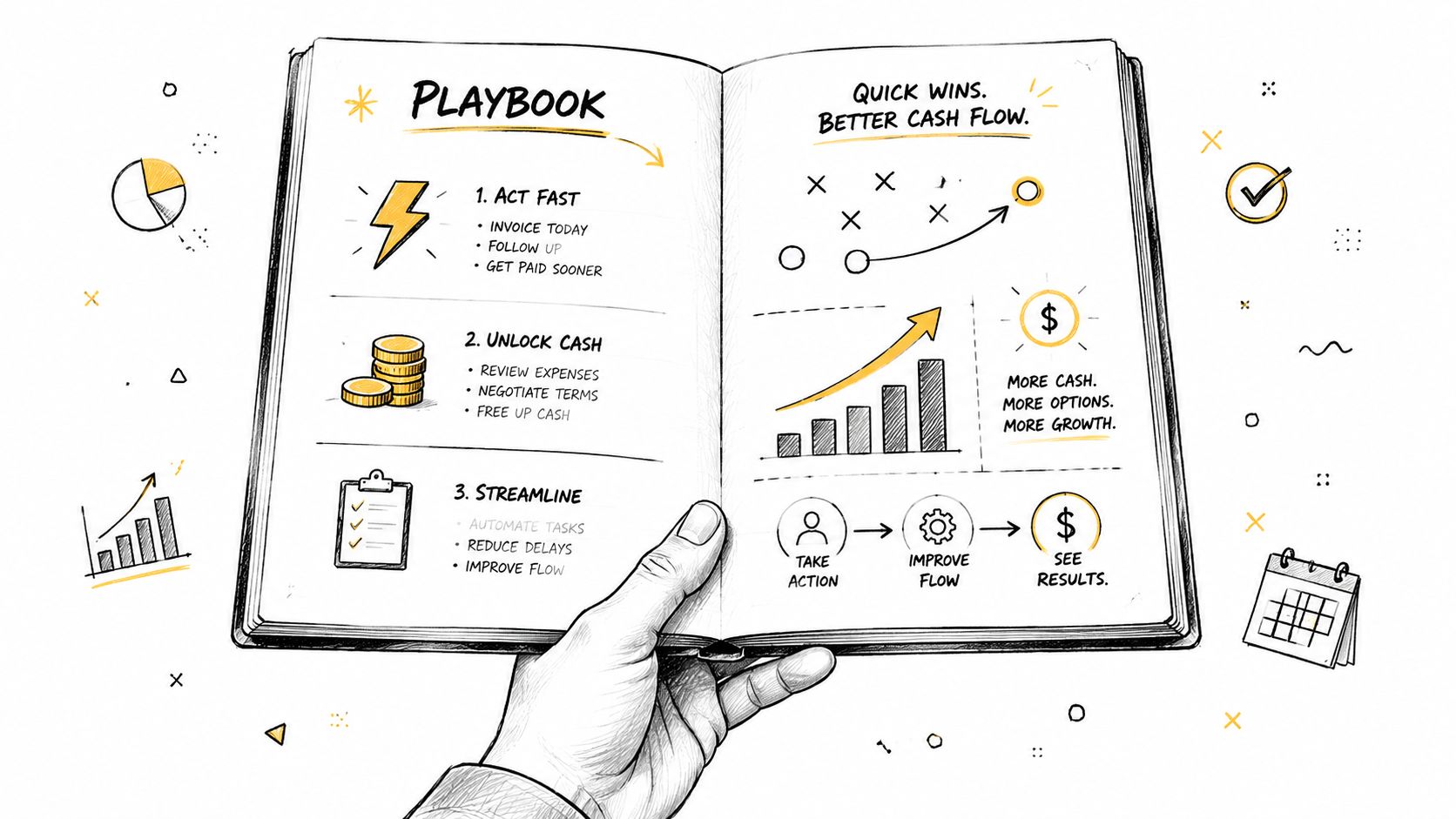
AR is often the quickest place to improve cash flow because it's usually a process problem, not a sales problem.
Invoice immediately after delivery: If your team waits until month-end to bill, you're extending terms without admitting it. In construction, bill approved milestones as soon as the contract allows. In professional services, send invoices the day the work period closes.
Clean up invoice errors before they leave: Customers don't pay disputed invoices. They set them aside. Require a pre-send check for PO number, billing contact, line-item match, and supporting documentation.
Segment your collection calls: Don't give every overdue account the same script. A long-term customer with one late invoice needs a different conversation than a repeat slow payer. Your AR lead should know which is which before picking up the phone.
Use a direct collection script: Try this.
“I'm calling about invoice 1847. I want to confirm it's approved for payment and ask what date we should expect funds.”
That's better than “just checking in,” which invites delay.
Change terms for problem accounts: If a customer pays late consistently, stop pretending they're a net terms customer. Move them to deposits, progress billing, or tighter credit limits.
Offer early-pay discounts selectively: Use them on large, clean invoices where accelerating cash matters more than protecting every basis point of margin. Don't train your whole customer base to expect discounts.
A distribution company I worked with had a familiar pattern. Sales looked fine, but overdue receivables kept stacking up behind invoice disputes, proof-of-delivery issues, and weak follow-up. The company assigned a specific owner to top accounts, pushed invoices out faster, and escalated past-due balances in a disciplined cadence. That created a meaningful cash release without adding new sales.
A lot of owners mismanage payables in one of two ways. They either pay too early because they hate being behind, or they pay too late because cash got tight and no one planned ahead. Both are expensive.
Use AP as a controlled lever.
Here's the operating principle. Vendors care less about perfect speed than predictable behavior. If you say you'll pay on a date, pay on that date.
After you get the basics under control, review budget vs actual variance analysis monthly. It shows where spending drift is pushing cash out faster than expected.
Here's a useful walkthrough on the topic:
Inventory can suffocate a growing business because it looks productive while it's sitting still.
In distribution, I'd rather see a disciplined stock policy than a warehouse full of “just in case” purchases. In construction, the equivalent is buying materials too early or overcommitting to stock that sits on jobs waiting for schedule changes.
Use this checklist:
Identify slow movers clearly: Break inventory into A, B, and C categories based on movement and margin. C items need active decisions, not passive hope.
Liquidate dead stock: Sell it, bundle it, return it where possible, or stop reordering it. The goal is cash recovery and simplification.
Tighten purchasing rules: Require a reorder logic tied to actual demand, not gut feel or the loudest salesperson.
Review price discipline: Many owners underprice by habit, especially after years of trying to win volume. Small, thoughtful price moves often improve cash immediately because they raise gross profit without increasing overhead.
Protect margin on custom work: In construction, unapproved change orders and sloppy job-cost follow-up create a cash problem disguised as a project management problem.
Slow inventory is cash with a barcode on it.
A mid-market distribution business can free cash surprisingly quickly when it attacks AR, stale inventory, and vendor timing at the same time. That's one reason a structured operating cadence matters more than one-off heroics.
If you're still running cash by gut feel, you're driving at night without headlights. A 13-week cash flow forecast fixes that.
This is the operating model I want every $10M+ business to run. It's long enough to show pressure coming, short enough to stay grounded in real information, and practical enough for weekly use. If you're learning how to improve cash flow, this is the tool that turns reaction into control.
Your forecast needs two buckets. Cash in and cash out.
Cash in usually includes customer collections, deposits, milestone payments, retainage releases, and any other non-operating receipts that are expected within the period.
Cash out includes payroll, payroll taxes, rent, supplier payments, debt service, insurance, subcontractors, software, equipment payments, and owner distributions if those occur regularly.
Here's a simple structure.
Sample 13-Week Cash Flow Forecast Structure
| Cash Flow Item | Week 1 | Week 2 | Week 3 | Week 4 | Week 5 | Week 6 | Week 7 | Week 8 | Week 9 | Week 10 | Week 11 | Week 12 | Week 13 |
|---|---|---|---|---|---|---|---|---|---|---|---|---|---|
| Beginning Cash | |||||||||||||
| Collections from AR | |||||||||||||
| New Customer Deposits | |||||||||||||
| Other Cash Inflows | |||||||||||||
| Total Cash In | |||||||||||||
| Payroll | |||||||||||||
| Supplier Payments | |||||||||||||
| Rent and Occupancy | |||||||||||||
| Debt Payments | |||||||||||||
| Taxes | |||||||||||||
| Capex | |||||||||||||
| Owner Distributions | |||||||||||||
| Other Cash Outflows | |||||||||||||
| Total Cash Out | |||||||||||||
| Net Cash Movement | |||||||||||||
| Ending Cash |
The model is only useful if it reflects reality. Don't let finance build it in isolation.
Use these inputs:
Accuracy matters less than discipline. A forecast that gets updated every week beats a “perfect” model nobody trusts.
Roll the forecast every week. When Week 1 closes, shift the file forward and add a new Week 13. That rhythm forces constant visibility.
Use it to answer real questions:
If you need a starting point, this guide on how to create a financial forecast is a practical companion to a weekly cash model.
Some teams build this in Excel. Others use Google Sheets, Fathom, or a BI tool connected to their accounting system. The software matters less than ownership. Someone has to maintain it, and leadership has to use it.
Most cash problems aren't caused by one bad month. They're caused by a leadership team that treats cash as finance's job.
That approach fails. Sales affects collections. Operations affects inventory. Purchasing affects vendor timing. Project management affects billing accuracy. If no one outside finance owns cash drivers, your forecast becomes a scoreboard with no players.
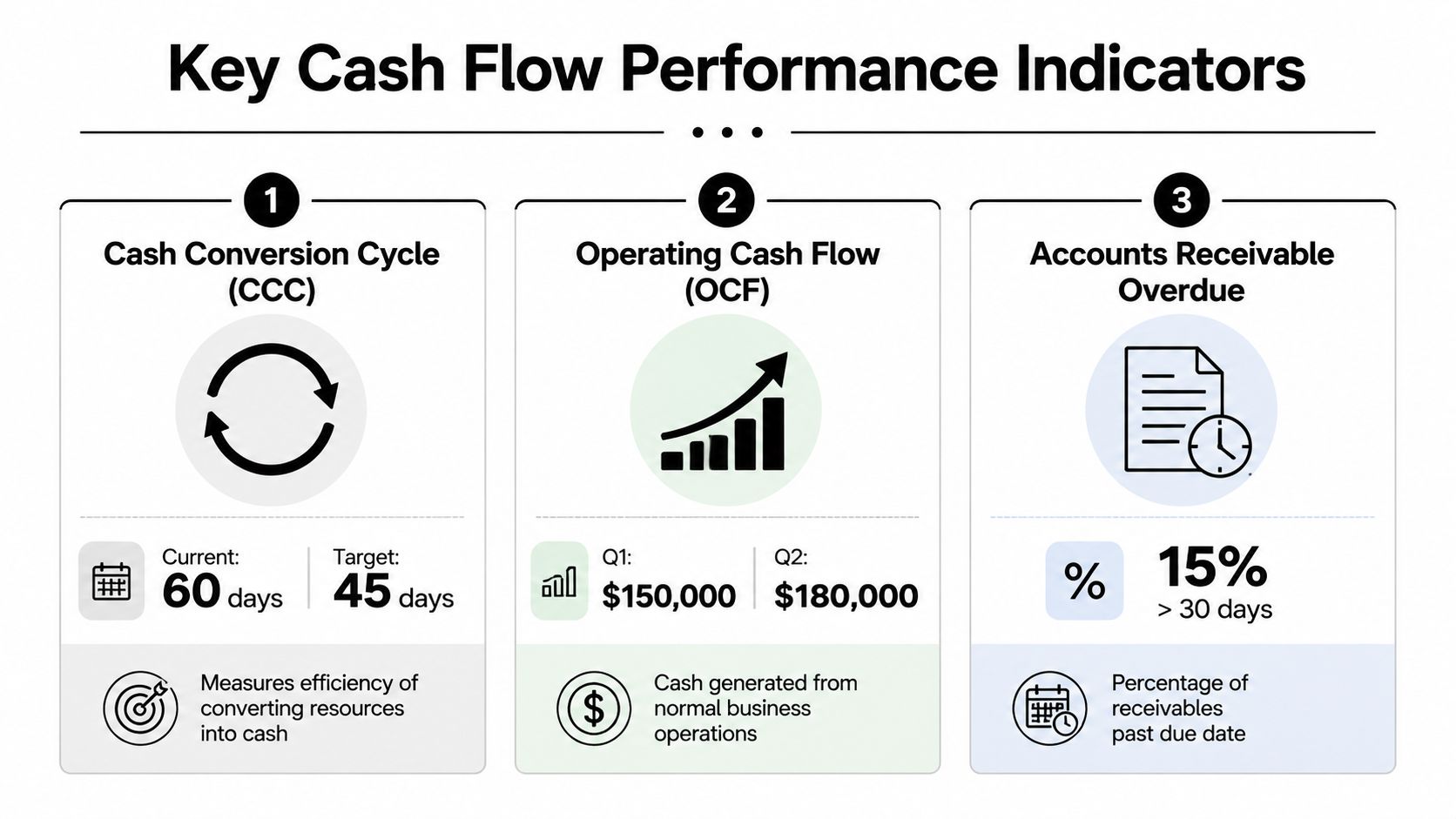
A CFO.com incentive study summary found that companies tying leadership incentives to cash flow metrics, not just revenue or EBITDA, improve their Cash Conversion Cycle by an average of 15-20% within the first year. That should change how you compensate and review your managers.
Don't give everyone “cash flow” as a vague goal. Give each leader one operational metric they can influence directly.
| Role | KPI to own | What that looks like in practice |
|---|---|---|
| Sales leader | DSO or overdue AR trend | Clean terms, fast billing handoff, escalation on slow accounts |
| Operations leader | DIO or work-in-process discipline | Tighter inventory levels, fewer idle materials, faster project closeout |
| Finance leader | DPO and weekly cash forecast accuracy | Planned payment timing, visibility into shortfalls, weekly reporting |
| Project manager or account lead | Billing readiness | Change orders approved, documentation complete, invoice delays removed |
Construction businesses usually need tighter ownership around billing packages, change-order approval, and unbilled work. Distribution businesses usually need tighter ownership around purchasing discipline, replenishment logic, and stale inventory review.
One practical option for putting this structure in place is a fractional CFO model. Firms such as AmbitionCFO work with leadership teams to build KPI dashboards, assign ownership, and run the reporting cadence around cash.
Most finance meetings are too long, too backward-looking, and too fuzzy. A weekly cash meeting should be short, specific, and operational.
Use this agenda:
If your sales leader can't explain overdue receivables on their largest accounts, you don't have a cash process. You have a finance cleanup function.
Culture is built. Not through slogans. Through repetition, accountability, and decisions made with cash impact in view.
A business with reliable cash flow plays offense differently. It doesn't just survive surprises. It gets options.
When your cash position is predictable, you can choose when to invest, when to wait, and when to negotiate hard. You stop using financing as a stress response and start using it as a strategic tool.
A line of credit is useful when it bridges timing gaps. It's dangerous when it covers chronic operating weakness.
If you've tightened receivables, improved inventory discipline, and built a live forecast, then financing becomes more powerful. You can support seasonal buildup, buy equipment at the right time, or carry a short-term working capital gap with a plan to unwind it. Lenders also respond differently when they see clean reporting, stable cash management, and a business that understands its operating cycle.
That's a major difference between a company asking for help and a company presenting a plan.
Owners planning an exit often focus on EBITDA and ignore the quality of the cash engine. Buyers don't.
A buyer wants confidence that reported earnings convert into cash, that working capital is controlled, and that the business won't require constant owner intervention to stay liquid. A company with disciplined collections, rational inventory, documented forecasting, and clear controls is easier to diligence and easier to value.
Buyers don't just assess profit. They assess whether the business turns profit into cash without drama.
That matters in construction, where project billing and working capital can swing hard. It matters in distribution, where stock and vendor terms shape liquidity. It matters in professional services, where unbilled work and partner draws can distort reality.
Healthy cash flow gives you strategic freedom now and a stronger story later. That's not a side benefit. It's part of the asset you're building.
There's a point where basic accounting support isn't enough. You feel it when the questions get bigger than bookkeeping and more urgent than annual tax planning.
If you're making decisions about equipment, headcount, inventory commitments, or a new location based mostly on instinct, you need sharper financial leadership. If your controller can close the books but can't build a real cash model, you need sharper financial leadership. If you're losing time every week worrying about cash instead of running the company, you need sharper financial leadership.

A good fractional CFO doesn't replace your bookkeeper or CPA. They sit above those functions and turn financial information into operating decisions. They build the 13-week cash flow model. They pressure-test assumptions. They help your team own the right KPIs. They put structure around pricing, margins, working capital, and capital planning.
That's especially useful for founder-led businesses in construction, distribution, and professional services. Those industries have real timing complexity. Revenue recognition alone won't keep you safe. You need someone who can connect contract terms, billing cadence, collections behavior, purchasing decisions, and forecast accuracy into one operating picture.
Here are the clearest signs it's time:
If that sounds familiar, read when to hire a fractional CFO and decide whether you need part-time senior finance leadership before the next major decision forces the issue.
If you want help building a 13-week cash flow forecast, tightening your cash conversion cycle, and giving your leadership team clearer financial accountability, talk with AmbitionCFO. They work with founder-led businesses in the $10M to $100M range that need CFO-level cash flow management without a full-time hire.