
You're probably asking a simple question that doesn't have a simple answer: when should I hire a fractional CFO instead of leaning on my bookkeeper, CPA, or my own instincts?
If you're running a founder-led business and revenue is up, the pressure usually shows up before the answer does. Payroll is bigger. Jobs overlap. Inventory ties up cash. One delayed payment throws off three other decisions. You can still get financial statements, but they arrive too late and answer the wrong question. They tell you what happened. They don't tell you what to do next.
That's the pivot point.
A fractional CFO isn't a part-time controller and isn't a glorified accountant. It's senior financial leadership brought in to help you make better operating decisions, protect cash, improve margins, and prepare for major events like expansion, acquisitions, or an eventual exit. If you've outgrown historical reporting and need forward-looking guidance, you're in the zone where this decision matters.
Table of Contents
Your Business Is Growing Is Your Financial Strategy?
Growth exposes weak finance fast.
You land more work, add headcount, commit to equipment, or open a new line of business. Then you realize your reporting cadence hasn't kept up. You're making decisions on stale P&Ls, a bank balance, and whatever your gut tells you. That works for a while. Then it doesn't.
The most common mistake I see is founders waiting for a crisis before asking when to hire a fractional CFO. That's backwards. You hire before the financial complexity starts costing you margin, cash, or options.
The revenue range where this usually makes sense
There is a practical range where the model fits best. The optimal window to hire a fractional CFO is typically when a business generates annual revenue between $10 million and $30 million. Within this range, fractional CFO services can represent a 50% to 80% cost reduction compared to hiring a full-time CFO who would cost $21,000 to $42,000+ per month, according to this breakdown of fractional CFO timing and cost.
That doesn't mean a larger company can't benefit. It means the economic fit is strongest in that band, especially when complexity is rising faster than the finance function.
Practical rule: If your business is too complicated for bookkeeping but not ready for a full-time CFO seat, fractional is usually the right move.
If cash is already tight and decisions feel reactive, start with better visibility. A good first step is tightening your operating rhythm around cash flow management for small business. Then decide whether you need strategic finance leadership layered on top of it.
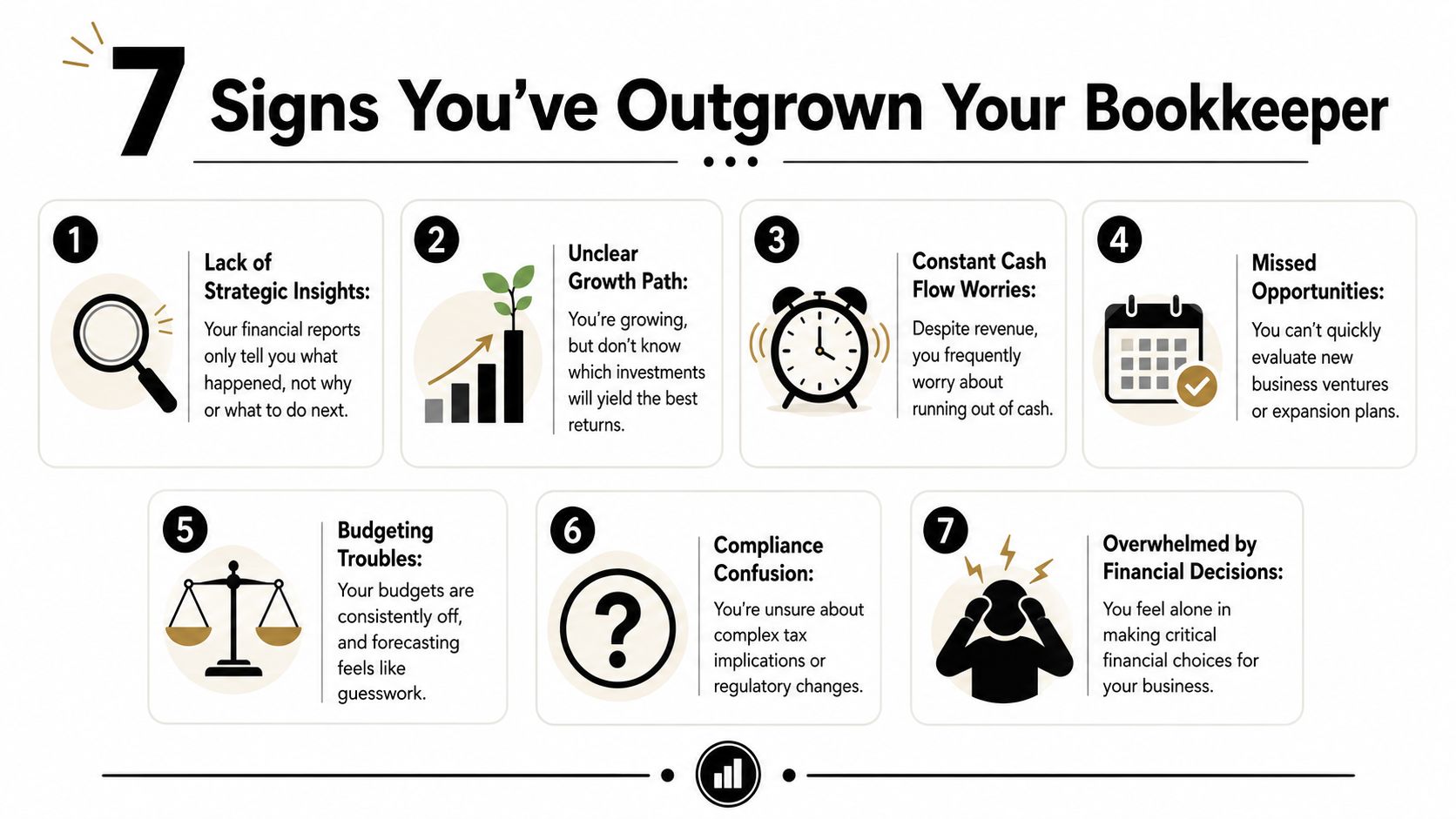
7 Signs You Have Outgrown Your Bookkeeper
The issue usually isn't that your bookkeeper is doing a bad job. It's that they're doing the job they were hired to do.
Bookkeepers record, reconcile, close, and keep the historical record clean. That matters. But once your business starts carrying more operational complexity, historical accuracy alone stops being enough.
The real divide is historical reporting versus strategic finance
You've outgrown your bookkeeper when you need forecasts, not just statements. You need someone who can model hiring decisions, map cash gaps before they hit, and tell you which jobs, customers, or product lines are carrying the business.
That's the bookkeeper-to-fractional pivot. It happens when the business needs FP&A, or financial planning and analysis. In plain English, that means turning financial data into decisions.
One of the clearest warning signs is what I'd call cash flow opacity. When a company experiences 20%+ annual revenue growth, 68% of SMBs in this phase make major capital expenditure decisions without a validated cash conversion cycle model, leading to liquidity crises. Hire when variance between budgeted and actual cash flow exceeds 15%, based on this analysis of rapid-growth finance failure points.
The seven signs
You can't produce a rolling 13-week cash flow forecast.
If you don't know what cash will look like over the next quarter, you're operating blind. That's not a reporting problem. That's a leadership gap.Your budget misses reality on a regular basis.
When actual cash and planned cash are too far apart, your assumptions are broken. That shows up in rushed borrowing, delayed purchases, and reactive hiring.Margins are harder to explain as revenue grows.
More sales should not automatically mean less clarity. If you can't see margin by job, client, crew, project, or SKU, scale can hide underperformance instead of fixing it.
Your financials should answer operational questions. If they don't, the problem isn't your accounting software. It's the level of finance leadership.
You make equipment, hiring, or expansion decisions without a model.
Founders do this all the time because no one has built the scenario analysis. “Can we afford it?” gets answered with optimism instead of math.Your reports arrive after the decision window closes.
If it takes too long to get usable reporting, leadership starts ignoring the numbers. Then the bank balance becomes the dashboard.You can't produce decision-ready financials quickly.
Lenders, buyers, and serious partners won't wait while you sort through spreadsheets and inconsistencies.You feel alone on financial decisions.
This one matters more than most owners admit. If every major decision lands on your desk without a strategic finance partner to challenge assumptions, you're carrying unnecessary risk.
A lot of these issues trace back to weak reporting discipline. If your numbers aren't timely, structured, and decision-ready, tighten that process first with financial reporting best practices. Then decide whether the business needs a strategist, not just a scorekeeper.
From Pain Points to Profit What a Fractional CFO Actually Does
A strong fractional CFO fixes decision quality first. Better cash is usually the result, not the starting point.
They don't just “watch the numbers.” They build the tools and cadence that let you run the business with fewer surprises and better tradeoffs.

What changes first
First, they build a 13-week cash flow model. That gives you a short-horizon operating view of cash in and cash out. You stop guessing whether growth is affordable. You start seeing exactly when cash tightens and which lever to pull first.
Second, they install variance analysis. That means comparing budget to actual and then explaining the gap in a way leadership can use. If labor drifted, collections slowed, or job costs ran ahead of plan, you know where and why.
Third, they force margin visibility. In practical terms, that means breaking profitability down by the unit that matters in your business. Job. Client. Product line. Route. Crew. Contract. That's how you find which work deserves more attention and which work should be repriced, redesigned, or dropped.
For a deeper view of how that discipline works, this guide on budget vs actual variance analysis is a useful place to start.
Operator's view: A fractional CFO should make your next decision easier than your last one. If reporting still creates more questions than answers, the finance function isn't doing enough.
Exit planning is where strong CFO work pays off
Most founders think about when to hire a fractional CFO in terms of growth. That's only half the story. Exit planning is the other half, and too many owners start far too late.
For exit planning, the optimal time to hire a fractional CFO is 3–5 years prior to a planned transition. Data from the Exit Planning Institute indicates that companies engaging a fractional CFO at the 5-year mark achieve transaction multiples 1.2x higher than those who wait, as the CFO can implement a quality of earnings audit that mitigates buyer discounts of 15-25%, according to this guide to hiring a fractional CFO for transition readiness.
A quality of earnings audit is a disciplined cleanup of what buyers care about. It separates recurring earnings from one-off noise, adjusts owner-specific expenses, and gives the market a cleaner EBITDA story. If you want a premium outcome later, that work can't wait until the last year.
Fractional CFOs in Action Industry Scenarios
Theory is useful. Operations are where this decision gets obvious.
Different industries break in different places. Construction loses control at the job level. Distribution loses control in inventory and SKU margin. Professional services lose control in utilization, pricing, and backlog quality.

Construction
A contractor may be busy and still underperforming. Revenue looks strong. Cash feels tight. Owners assume collections are the issue when the problem is often buried in job costing, change orders, labor absorption, or underpriced work.
A fractional CFO steps in and reorganizes reporting around job-level truth. Which projects are producing margin? Which crews are drifting? Which backlog is worth pursuing? Once those answers are visible, bidding, staffing, and equipment timing improve.
Distribution
Distribution businesses often mistake movement for profitability. Product is moving, trucks are rolling, and revenue is there. But without margin analysis by SKU, customer, or channel, leadership can't tell where profit is leaking.
That's where a CFO mindset changes decisions. Reorder timing, inventory mix, customer terms, and working capital discipline become visible as business levers instead of accounting afterthoughts.
A good CFO doesn't just report margin. They show you where operations are creating it, and where operations are giving it away.
If acquisitions or ownership transition are part of the plan, the financial discipline built now also makes the company more transaction-ready later. That's especially relevant when owners are considering the role of fractional CFOs in business mergers and acquisitions.
Professional services
Professional services firms, agencies, and consultancies usually hit the wall when revenue gets lumpy. Retainers shift. Project work lands unevenly. Hiring decisions get made ahead of visibility. Then profit swings harder than leadership expected.
For businesses like construction and professional services with lumpy revenue between $3M–$20M, a fractional CFO is critical. They provide forward-looking strategy, including utilization rate analysis and project-level profitability forecasting, which are rarely addressed by traditional CPA services. Engagements typically range from $5,000 to $15,000 monthly, based on this comparison of fractional and interim CFO needs.
In that environment, a fractional CFO tracks utilization, backlog, pricing discipline, and client-level economics. That gives the owner a much better answer to hard questions like: Should we hire now? Which clients deserve senior talent? Which work should be declined?
The Smart Investment Fractional CFO Costs and Models
Founders always ask the right question next. What's this going to cost me?
The better question is what poor financial visibility is already costing you. Delayed pricing changes, weak cash planning, bad hiring timing, and margin blind spots don't show up as one clean line item. They show up as drag across the business.
What you're actually buying
You're not buying “hours.” You're buying senior judgment, better models, stronger reporting cadence, and sharper decisions. The fractional model works because most founder-led companies do not need a full-time executive in the seat every day. They need the right expertise focused on the right issues.
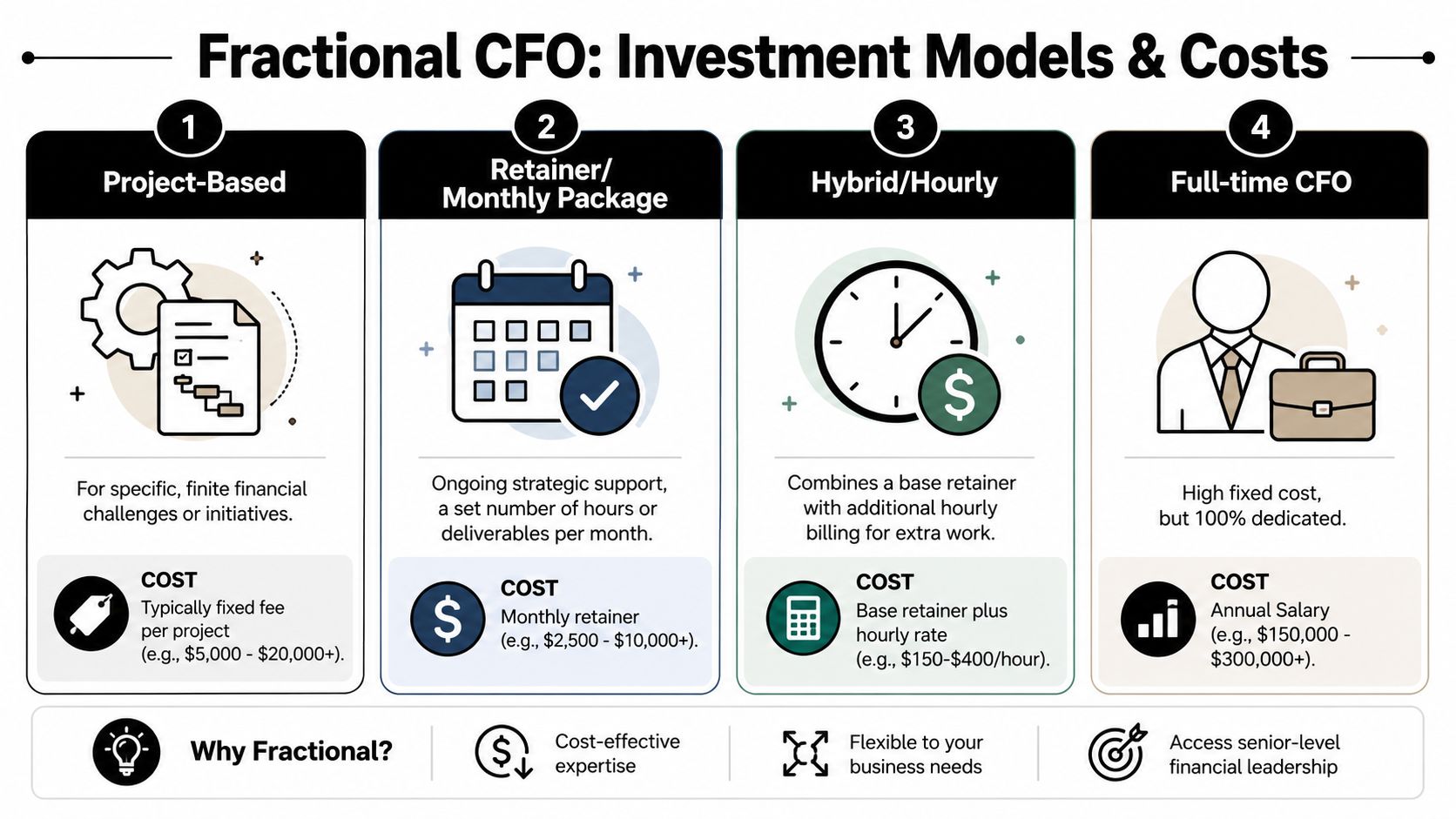
Fractional CFO services typically cost 70–80% less than a full-time CFO. A full-time position carries a base salary of $200,000+ plus benefits, while fractional engagements range from $3,000 to $15,000 per month, translating to an annual savings of $150,000–$250,000 for senior-level strategic expertise.
That's why this model fits so well for businesses that need CFO-level thinking but can't justify a permanent $200K+ seat.
Which engagement model fits
Here's the clean way to think about the common structures:
| Model | Best fit | What it usually covers |
|---|---|---|
| Project-based | One specific issue | Cash flow model build, KPI dashboard design, pricing review, reporting cleanup |
| Monthly retainer | Ongoing leadership | Forecasting, monthly reviews, margin analysis, decision support, leadership meetings |
| Hybrid | A stable baseline plus occasional bursts | Regular oversight with added support during budgeting, acquisitions, or transition planning |
| Full-time CFO | Constant complexity across the business | Daily executive ownership of finance, larger team management, deeper capital market needs |
A project-based engagement makes sense when you have a clear bottleneck. A monthly retainer fits when the business needs an operating rhythm, not a one-time fix. Hybrid works well when complexity spikes seasonally or around major decisions.
Cost test: If one bad pricing decision, one mistimed hire, or one poorly modeled equipment purchase can cost more than the monthly CFO fee, the engagement is easy to justify.
The wrong comparison is “fractional CFO versus doing nothing.” The right comparison is “fractional CFO versus the cost of running a more complex business without strategic finance leadership.”
Your Go No-Go Decision Checklist and Next Steps
At this point, you don't need more theory. You need a decision.
If you answer yes to enough of the questions below, stop debating when to hire a fractional CFO and start interviewing candidates.
Use this checklist honestly
A practical threshold is simple: if you answer yes to three or more, you likely need strategic finance help now.
| Question | Yes / No |
|---|---|
| Do you lack a rolling 13-week cash flow forecast? | |
| Can't your team produce investor-ready or lender-ready financials quickly? | |
| Is your business in the revenue band where fractional CFO support tends to fit well? | |
| Are you scaling without reliable forecasts to guide hiring, capital spending, or project decisions? | |
| Are you preparing for a major transaction such as an acquisition, transition, or rapid expansion? | |
| Do you struggle to see profitability by job, client, product, or business line? | |
| Has financial planning outgrown what your bookkeeper or CPA can realistically provide? |
That checklist works because it focuses on operational pain, not vanity milestones.
How to vet the right fractional CFO
Don't hire the first person who says they can “help with strategy.” Press for specifics.
Use this screen:
Ask about forecasting discipline. Can they build and maintain a 13-week cash flow model that leadership will use?
Ask how they analyze margin. If they can't talk clearly about job, client, product, or contract profitability, keep looking.
Test communication. A strong CFO translates complex finance into operating decisions that non-financial leaders can act on.
Look for credentials that match your goals. If exit is part of your plan, CPA and CEPA credentials are especially relevant.
Require industry fluency. Construction, distribution, and professional services each have different margin drivers and reporting needs.
Clarify scope early. You want financial strategy, forecasting, budgeting, KPI visibility, and decision support. If you mainly need reconciliations and bookkeeping, don't overhire.
If your current planning process is weak, start by tightening your operating discipline around how to create a business budget. Then bring in a CFO who can turn that budget into a living tool instead of a static file.
The best time to hire is before your next big decision, not after the consequences show up.
If your business has outgrown historical reporting and you need clear financial leadership around cash flow, profitability, forecasting, or exit planning, talk with AmbitionCFO. John Myklusch, CPA, CEPA, and the AmbitionCFO team work with founder-led businesses to build 13-week cash flow visibility, margin discipline, KPI dashboards, and transition-ready financials without the burden of a full-time CFO hire.